Key takeaways
- Developers increasingly get tool and SDK recommendations from agents (Claude Code, Codex, Cursor, Copilot) and from ChatGPT, not from a Google results page. Your docs are the main input.
- In Promptwatch Data for Sep 28 to Oct 4, 2026, documentation made up 7.5% of classified ChatGPT citations. Docs and help centers were the largest source type for software prompts.
- Making docs crawlable, structured (llms.txt, clean Markdown, an MCP server) and current matters more than classic keyword tactics.
- Most AI visibility tools track ChatGPT, Perplexity and AI Overviews. Very few track coding agents. Promptwatch is the one I know that does, so check coverage before you buy.
- Pair a visibility tracker with crawler logs and a docs platform. Any one of the three alone leaves blind spots.
Why developer companies have a different AI search problem
A consumer brand worries about whether ChatGPT mentions it in a list of the best running shoes. A developer-tools company has a stranger problem. The person asking is often inside an editor, typing "add payments to this Express app", and the agent picks a library before the human ever opens a browser tab.
That changes what you optimize. The "result" is not a ranking position. It is whether the agent suggests your SDK, writes the right import, and calls your API correctly. A recommendation based on a stale docs page can be worse than no recommendation, because the developer ships broken code and blames you.
Three things feed those agents:
- Training data, which is frozen and fuzzy about version details.
- Live retrieval, where the agent searches the web or fetches your docs URL.
- Context the developer supplies, such as an MCP server, a pasted llms.txt, or a repo.
You can influence all three, but only the second and third quickly. If you want a broader grounding in the discipline first, the GEO software directory at bestgeosoftware.com lists the general-purpose tools.
What the data says about docs and software citations
I would not build a strategy on hunches, so here is what first-party numbers exist. Keep one caveat in view: Promptwatch's published reports cover ChatGPT, AI Overviews, AI Mode and Perplexity citations. None of them measures what Claude Code or Codex recommend. Treat them as a proxy for how AI systems weigh docs, not as a coding-agent study.
In Promptwatch's ChatGPT citation share by content type report (Sep 28 to Oct 4, 2026), documentation was 7.5% of classified citations. Product pages led at 22.4%, then landing pages at 16.8% and listicles at 13.6%. For informational prompts like "how does X work", docs rose to 8.5% and how-tos to 10.7%. So docs are not only a support asset. ChatGPT cites them when people are trying to understand something.
The software-prompts report for the same week is more specific to you:
| Source type or domain | Share of software citations |
|---|---|
| Docs and help centers (source type) | 2.64% |
| Vendor sites (source type) | 2.01% |
| Review sites and analysts (source type) | 1.57% |
| github.com | 1.2% |
| learn.microsoft.com | 0.98% |
| g2.com | 0.73% |
| docs.aws.amazon.com | 0.41% |
These are shares of all software citations, not of the charted domains only. Vendor sites and docs together earn 4.65%, roughly three times review sites and analysts. If you run a developer product, your own docs are a bigger lever than a review-site campaign.
Two more datapoints shape tactics. Landing pages and docs stay cited longest, while news loses half its pages within about 36 days, so docs are durable assets worth maintaining. And markdown files are only 0.05% of AI search citations: Markdown serves agents that fetch your pages, not AI search results. That distinction matters in the next section.
Make your docs readable to agents
Tooling for this is more mature than the tracking side. The GitBook and Mintlify comparison posts both frame it the same way: a modern docs platform should publish llms.txt, expose an MCP server, and serve clean Markdown. Take that with salt, since both are vendors writing about themselves. The GitBook post lists Mintlify at "Free / ~$250/mo"; that number came from a competitor's page, so confirm it on Mintlify's own pricing page.
A practical checklist:
- Keep docs public. Gated docs cannot be cited or fetched.
- Serve a Markdown version of each page and an llms.txt index. Agents fetching a URL parse it far better than rendered HTML full of navigation.
- Version everything explicitly. Put the SDK version at the top of each page, and redirect old versions instead of deleting them.
- Include runnable examples with imports. Agents copy what they find.
- Offer an MCP server so agents can query docs directly rather than guessing.
- Add FAQ-style pages for the questions developers type into chat. Promptwatch's data suggests FAQ is 3.3% of ChatGPT citations, small but cheap to produce.
- Check robots.txt, CDN and WAF rules. Bot protection that blocks GPTBot or ClaudeBot silently removes you from live retrieval.
Promptwatch also publishes free helpers for some of this, such as an LLMs.txt generator and a robots.txt generator for AI bots.
Check what agents actually fetch
This is the step most teams skip. Your server logs tell you which AI crawlers hit which docs pages and what errors they got. In Promptwatch's AI crawler traffic data for Aug 31 to Sep 6, 2026, OpenAI accounted for 79.8% of verified AI crawler requests, down from 94.8% in early June. The advice from that report is sensible: compare your own mix against it. If a provider is large in the benchmark and near zero in your logs, you are probably blocking it.
Also worth knowing: ChatGPT started using the site: operator at scale on Aug 8, 2026, jumping from about 0.4% to about 17% of fan-out queries. In practice that means ChatGPT increasingly searches inside specific domains, which rewards docs sites with a clean structure and good internal search-friendly titles.
Tracking recommendations: the tool categories
Here is the honest split. There are four jobs, and no single product is great at all of them.
| Job | What you need | Example tools |
|---|---|---|
| Prompt-level visibility in ChatGPT, Perplexity, AI Overviews | Tracker running real prompts | Promptwatch, Otterly.AI, Peec AI, Profound |
| Coding-agent recommendations | Tracker that covers Claude Code, Codex, OpenCode | Promptwatch |
| AI crawler logs | IP-verified bot analytics | Promptwatch, CDN logs, Botify (enterprise technical SEO) |
| Docs authoring and agent readiness | llms.txt, MCP, Markdown output | Mintlify, GitBook |
| Docs retrieval for your own agents | Search and crawl APIs | Firecrawl, Bright Data |
Visibility tracking, including coding agents
Promptwatch is the only platform I can point to that explicitly tracks how Codex, Claude Code and OpenCode recommend tools, SDKs and docs, alongside ChatGPT, Perplexity, Gemini, Google AI Overviews and others. For a developer-tool company that is the relevant feature. It also has IP-verified AI crawler logs, so you can see whether those agents and their search backends actually read your docs, plus a Content Agent and Action Board for fixing gaps.

Pricing starts with a free Explore tier (ChatGPT only, 10 prompts), then Essential at $95/month with all AI models, and Professional at $245/month. Confirm current numbers at promptwatch.com/pricing.
What prompts should you track? Not brand prompts alone. Build a set around the jobs your product does: "best library for webhooks in Node", "how do I send transactional email from Python", "alternatives to [competitor] API", "[your product] vs [competitor]". Track by persona too: a staff engineer evaluating vendors asks differently than a beginner following a tutorial.
Monitoring-only alternatives
If you only need ChatGPT, Perplexity and AI Overviews mention tracking, several cheaper options exist. None of the ones below claim coding-agent coverage that I could verify, so ask the vendor directly.



Otterly.AI and Peec AI are lighter prompt trackers. Profound is stronger on enterprise reporting but costs more. For a longer list, the AI rank tracking directory at ai-rank-tools.com is a useful pointer.
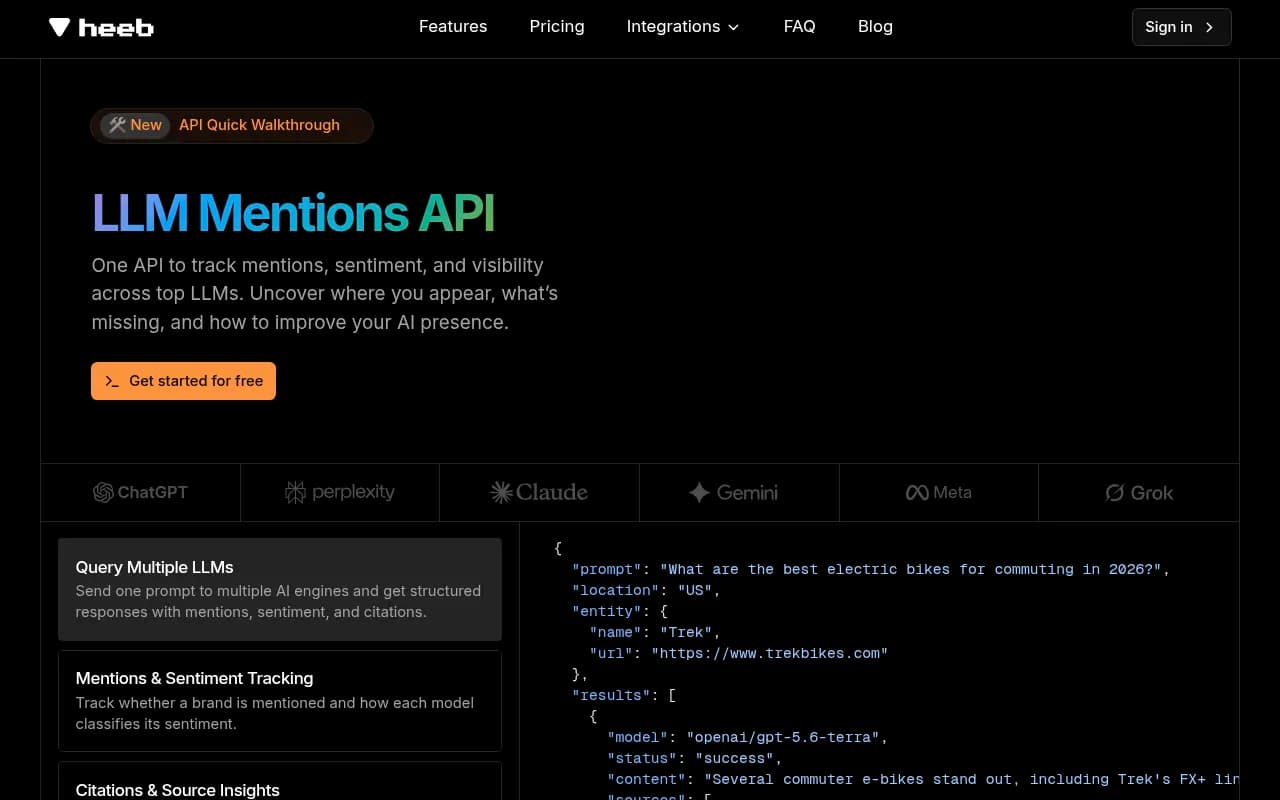
For teams that want a developer-friendly interface, Heeb.ai sells a LLM Mentions API, which suits engineers who want to pull mention data into their own dashboards.
Docs platforms
Mintlify and GitBook are the two names that keep showing up in 2026 comparisons, and both advertise llms.txt, MCP and AI analytics. They are not in our catalog, so I will not give them full cards. Pick based on your workflow: docs-as-code in Git versus a visual editor for mixed teams. Whichever you choose, test the output yourself by pasting a docs URL into an agent and asking it to write a working integration.
Retrieval and crawl tooling
Firecrawl is useful on two fronts. You can use it to crawl your own docs into clean Markdown for testing, and its Developer Index (70M+ READMEs, issues, PRs and docs, refreshed daily, per its own blog) shows how agent-oriented search APIs surface developer content. Treat vendor claims as claims.

Bright Data covers similar ground for web data collection at larger scale.

A workflow that works
Here is the loop I would run, roughly monthly at first and then weekly.
- Build 30 to 50 prompts that mirror real developer questions. Mix informational ("how do I"), commercial ("best X for Y") and comparison prompts.
- Baseline your visibility and your competitors' across models, including the coding agents if your tool supports them.
- Pull crawler logs. Which docs pages do agents read? Which return 404s, 403s or timeouts?
- Cross-check against citations. Pages that get crawled but never cited usually have a content problem: thin, outdated, or missing the exact question. Pages never crawled have an access problem.
- Fix the biggest gaps. Rewrite stale quickstarts, add the missing comparison page, publish the migration guide from your competitor.
- Re-measure. Agents and models change; a fix that worked in September can erode.
The read on metrics is simple. Low share of voice means a coverage problem. Late position in the answer means a prominence problem. Mentions without citations of your own domain point at content or crawlability.
Do not forget the off-site layer
GitHub is the single biggest named domain in the software citations report at 1.2%, so a maintained README, clear topics and an active issues page count. G2 and Capterra profiles also show up, at 0.73% and 0.32%. Reddit is a mixed bag: its share of ChatGPT citations collapsed from about 4% to 0.5% on Aug 14, 2026, and ChatGPT cites social platforms at just 0.46% while AI Overviews cite them at 12.2% (Sep 28 to Oct 4, 2026). If your audience searches Google, community presence still matters there. For ChatGPT, your own docs and GitHub matter more.
What I would not bother with
A few things get oversold. Stuffing docs with keyword variations does little when agents read the content for facts. Building a separate Markdown-only site purely for AI search is questionable given the 0.05% citation share, though it helps agents that fetch pages directly. And chasing a single model's quirks is a losing game: the GPT-5.3 rollout on March 4, 2026 cut average citations per response across models, and new coding models ship every few weeks. The research notes mention fresh releases such as GPT-6 Astra as the Codex default, but I could not verify those benchmark figures, so I am leaving them out. The point stands: defaults change, so measure continuously.
Picking a stack
| If you are... | Start with |
|---|---|
| A seed-stage API startup | Free Promptwatch tier or Otterly.AI, plus Mintlify or GitBook with llms.txt on |
| A growing SDK company with competitors | Promptwatch Essential or Professional for coding-agent and crawler coverage |
| An enterprise platform with many docs sites | Promptwatch Business, or Profound/Botify if your org already standardized on them |
| An agency serving developer brands | Promptwatch agency plans with white-label reporting |
If you would rather hand this to people, agencies that handle technical SEO and GEO together are the sensible choice. 1001 SEO Media runs this kind of work with Promptwatch as its tracking platform. It is optional; the workflow above is doable in-house.
For more tools, browse surferstack.com.
Bottom line
Your docs are your marketing page for agents. Keep them public, current and structured, verify that crawlers can reach them, and track recommendations on the surfaces developers actually use. Start with the crawler logs: they are the quickest way to find out whether the agents can even see you.