AmICited Review 2026
Tracks how ChatGPT, Perplexity, Gemini, and Google AI Overviews cite a brand, connecting citation data to buyer prompt research.
Key takeaways
- AmICited combines AI answer tracking, classic SEO data, ad performance and revenue attribution in one credit-based platform, aimed mainly at ecommerce and SaaS.
- Its strongest angle is revenue attribution: it ties cited prompts to Shopify, Stripe or WooCommerce orders, which most pure trackers skip.
- Lacks several things Promptwatch offers: IP-verified AI crawler logs, Reddit/YouTube/LinkedIn citation reports, prompt volumes and difficulty scoring, query fan-outs, AI Shopping and Ads Radar, and a CMS-publishing Content Agent with an Action Board.
- Integrations and revenue attribution start at the Pro plan (EUR 120/mo), and the credit system takes some effort to budget.
- Best for small and mid-size ecommerce or SaaS teams that care about revenue per channel. Weak evidence base so far: no independent reviews, and the main case study is customer-published.
AmICited is an AI search visibility product that tracks how ChatGPT, Perplexity, Gemini, Claude, Copilot and Google AI Overviews name and cite your brand. It appears to have been spun out of FlowHunt (the sign-in buttons point to app.flowhunt.io), and it positions itself less as a dashboard and more as a set of agents that read your data daily and act on it.
The pitch is three jobs in one system: get cited in AI answers, rank in classic search, and see the revenue each channel earned. That last part is what separates it from the many prompt trackers that stop at "was my brand mentioned?" The homepage is heavily ecommerce-flavoured (running shoes, Shopify orders, ROAS), though SaaS is the second vertical it supports today.
The audience is marketing teams at online stores, SaaS companies and agencies who want one place to compare AI answers, organic search and paid ads. Customers named on the site include LiveAgent, Post Affiliate Pro, HZ Containers, TarmacView and VEVO. I could not find independent reviews, so treat the claims below as vendor-stated.
Key features
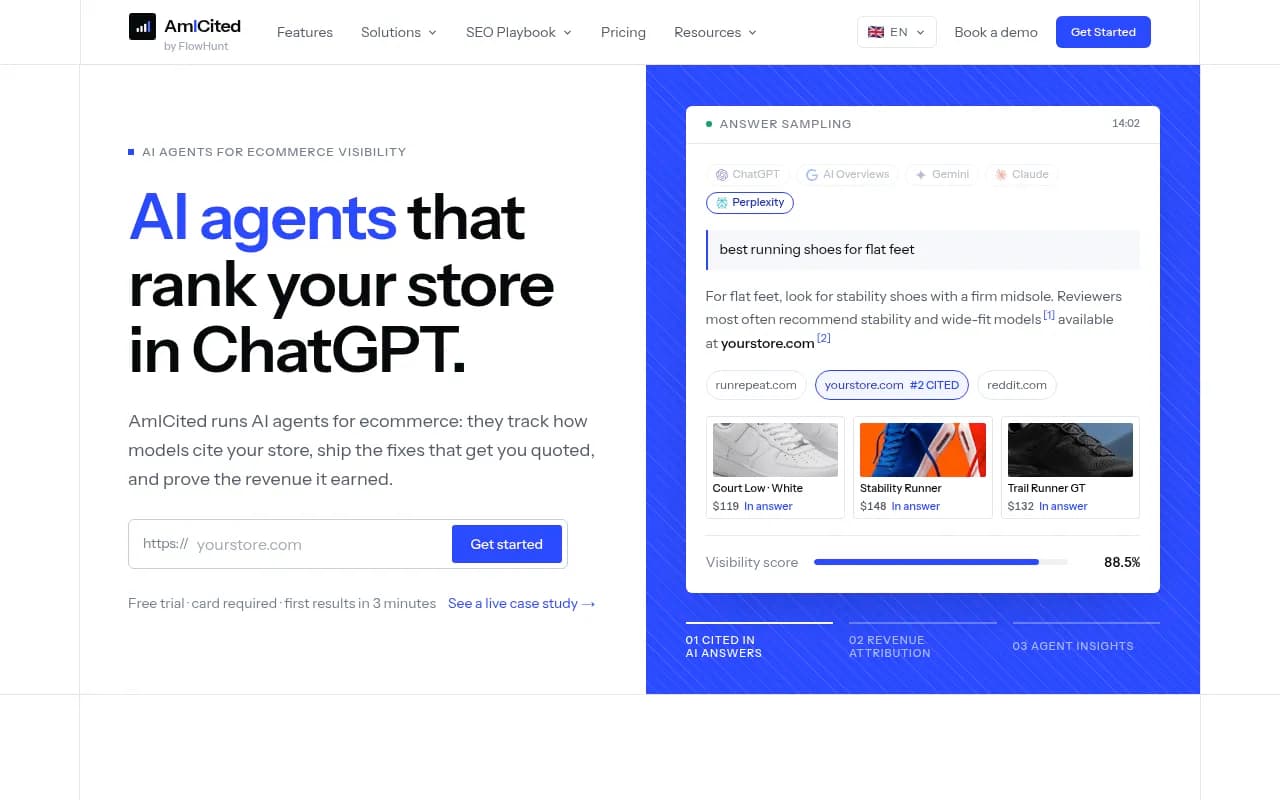
AI answer sampling. AmICited runs your prompt set against each model on a fixed daily schedule from clean sessions and stores the full answer with every citation and position. Daily coverage: ChatGPT, Google AI Overviews, Google AI Mode, Gemini, Claude, Perplexity and Copilot. Grok, DeepSeek, Meta AI, Mistral and Brave Leo run weekly. Metrics include visibility score, share of voice and average citation rank.
AEO for shopping. You track the prompts buyers ask ("best running shoes for flat feet"), see the answer, and see which of your products the model puts in it, including price. It also shows which competitor or review site is cited instead of you.
Revenue attribution. This is the headline feature. Connect Shopify, WooCommerce, Stripe or others, and cited prompts are matched to landing sessions and orders. It reports assisted and last-click views, so you pick your own standard. The demo dashboards show a per-channel return (AI answers, organic, paid) next to spend.
SEO and keyword data. Google Search Console and Bing Webmaster connect in, with ranked keywords by position bucket (top 3, top 10, top 20, top 100). It also scores product pages, collections and sub-collections for on-page optimisation. Competitors in the AI-only tracker space rarely touch this.
Ads and ROAS. Google Ads, Meta Ads and LinkedIn Ads connect in. A keyword-to-search-term map flags where you pay for clicks on terms AI already cites you for free, and agents can suggest moving budget. That is a clever angle, though it's the part I'd verify most carefully against your own account.
AI agents and scheduled tasks. Agents queue weekly tasks: write a buying guide, add negative keywords, rewrite meta descriptions, refresh spec tables. The site claims 11 of 14 tasks shipped without review the previous week in the demo. The AI Article allowance per plan (50 on Starter up to 500 on Premium) feeds the content side.
MCP server. Pro and above expose data over MCP, so Claude Code, Codex, Copilot or FlowHunt agents can read the same tables. Premium adds custom agent workflows. For teams already building agent workflows this is a real plus.
Multi-language, multi-market. Prompts run per market and in the buyer's language, since answers differ by both.
Who is it for
The best fit is a Shopify or WooCommerce store doing meaningful revenue, with a small marketing team that wants to know whether AI answers actually produce orders. Think a 5-person ecommerce team running Google Ads and SEO who wants one view of ROAS across AI, organic and paid. SaaS companies using Stripe get a similar story with trials, MRR and revenue.
Agencies are covered by the Premium plan (50 domains, 5 workspaces, white-label reporting, client workspaces), which is a sensible price for portfolio work.
Who should skip it: teams that need deep technical diagnostics such as crawler logs, enterprises that need documented SSO and audit-log guarantees (the pricing table is unclear on this), and anyone outside ecommerce or SaaS, since only two verticals have finished prompt libraries. Solo founders who just want a cheap mention tracker may also find the credit model fiddly.
Integrations and ecosystem
All integrations are listed as available from Pro, none on Starter.
- Commerce: Shopify, WooCommerce, PrestaShop, Shoptet, BizniWeb. Orders, revenue and margin flow in. Other connectors are built on request.
- Analytics and search: Google Search Console, Bing Webmasters, GA4.
- Ads: Google Ads, Meta Ads, LinkedIn Ads.
- Billing: Stripe for SaaS.
- Agents: MCP server with Claude Code and Codex listed as clients.
The docs, an academy and some free tools exist. The audit works without changing your site; revenue attribution needs a one-click commerce connection. I did not confirm a public REST API or CMS publishing integrations such as WordPress, Webflow or Framer.
Pricing and value
Plans are billed monthly in euros, excluding VAT, with a yearly toggle labelled one month free. There is a 7-day trial (card required) covering 1 domain, 5 prompts and 3 articles.
- Starter, EUR 50/mo: 50 credits, up to 3,000 AI responses, 1 domain, 200 prompts, 10 competitors, 50 AI articles, 1 seat. No daily prompt schedules.
- Pro, EUR 120/mo: 120 credits, up to 8,000 responses, 5 domains, 800 prompts, 30 competitors, 120 articles, 10 seats, Copilot, integrations, MCP server and agents.
- Premium, EUR 500/mo: 500 credits, up to 33,000 responses, 50 domains, 3,200 prompts, unlimited competitors, Claude, Grok and DeepSeek, white-label reporting, client workspaces, Slack support.
- Enterprise, from EUR 1,500/mo: custom volume, unlimited domains and prompts, dedicated success manager.
One AI response (one prompt on one engine) costs 0.015 credits, and agent runs and articles cost more. Credits do not roll over, and you can top up. Tracking one prompt daily on 8 engines costs 0.12 credits a day. Every plan has unlimited seats per the homepage, though the pricing table lists seat limits, which is inconsistent.
Compared with Promptwatch, which starts at $95/mo for 50 prompts and goes up to $579/mo for Business, AmICited's entry price is lower, but gating integrations and attribution to Pro narrows the gap. Value is good if you use the revenue and ads features, less so if you only want tracking.
Strengths and limitations
Strengths
- Revenue attribution from commerce platforms ties AI citations to real orders.
- Combines AEO, SEO and paid data in one place, with budget-shift suggestions.
- MCP server lets your own agents work on the same data.
- Broad engine coverage with daily sampling of the main surfaces.
- Low entry price with agency-friendly Premium tier.
Limitations
- Evidence is thin. No independent reviews found, and the LiveAgent case study is customer-published.
- Credit accounting and non-rollover credits add planning overhead; Starter lacks daily schedules.
- Only ecommerce and SaaS have mature prompt libraries.
What it lacks versus Promptwatch
Promptwatch covers ground AmICited does not appear to:
- IP-verified AI crawler logs and crawl-to-citation tracking
- Reddit, YouTube and LinkedIn citation reports
- Prompt volume and difficulty scoring, plus query fan-outs
- AI Shopping tracking (ChatGPT, Amazon Alexa) and Ads Radar
- Page Tracker, Offsite Mentions and 360 Insights joining crawls, citations and Search Console data
- Content Agent with publishing to WordPress, Webflow and Framer, an Action Board and Agent Chat
- Coding agent visibility (Codex, Claude Code, OpenCode)
AmICited's counter is the paid-ads and ROAS layer, which Promptwatch does not try to be.
Bottom line
AmICited suits ecommerce and SaaS teams that want AI visibility, SEO and ad return viewed together, and who value the revenue link. It is a credible, affordable option, but unproven in public reviews and missing deeper diagnostics.
For teams that want optimization rather than monitoring, with crawler logs, citation analytics across Reddit and YouTube, and agents that write and publish content, Promptwatch is the stronger choice. Browse more options at the GEO software directory. Best use case: a mid-size Shopify store checking whether ChatGPT answers actually produce orders.
Frequently asked questions
What is AmICited?
How much does AmICited cost?
Is there a free trial?
Which AI engines does AmICited track?
Can AmICited attribute revenue to AI answers?
How does AmICited compare to Promptwatch?
Similar and alternative tools to AmICited