Key takeaways
- Healthcare and wellness brands are losing patient and consumer traffic to AI search engines that cite competitors instead of them -- even when their content is medically reviewed and credentialed.
- AI visibility tracking for health brands requires monitoring across at least 5-6 models (ChatGPT, Perplexity, Google AI Overviews, Gemini, Claude, Grok) because citation patterns differ significantly by platform.
- Most tracking tools only show you the gap. The best ones help you close it with content generation, crawler logs, and prompt-level analytics.
- E-E-A-T signals, structured data, and entity clarity matter more in healthcare AI search than in almost any other vertical -- your platform needs to account for this.
- Promptwatch is the strongest end-to-end option for brands that want to go from gap identification to published, AI-optimized content without switching tools.
Why healthcare and wellness brands have an AI visibility problem
Someone asks ChatGPT "what's the best probiotic for IBS?" or "which sleep clinic near me accepts my insurance?" and your brand doesn't appear. Your competitor does. That's not a ranking problem in the traditional sense -- it's a citation problem, and the rules are different.
AI search engines like Perplexity, Google AI Overviews, and ChatGPT don't pull from a ranked list. They synthesize answers from sources they've already indexed, crawled, and deemed trustworthy. For healthcare and wellness content, that trustworthiness bar is higher than almost anywhere else. Google's "Your Money or Your Life" (YMYL) classification means health content gets extra scrutiny, and the same logic applies to how AI models weight sources when generating answers.
The result: wellness brands with excellent clinical content often get skipped. The AI cites a WebMD article or a Reddit thread instead. And because most brands have no visibility into which prompts are triggering which citations, they don't even know it's happening.
According to SparkToro's analysis of Similarweb clickstream data from early 2026, about 68% of Google searches ended without a click -- up sharply year over year. ChatGPT hit roughly 900 million weekly active users in February 2026. Google's Gemini-powered AI Overviews now reach an estimated 2 billion people per month. The audience is there. The question is whether your brand is being cited when they ask health questions.
The Health & Wellness AI Visibility Index 2026 (published by Everything-PR) found that brands like Calm dominate AI answer engines for mental wellness queries -- not because they have the most comprehensive content, but because they've built the right signals for AI citation. That gap between clinical depth and AI visibility is exactly what this guide addresses.
What makes AI visibility tracking different for health brands
Before picking a platform, it's worth understanding what's unique about the healthcare and wellness context.
E-E-A-T signals are non-negotiable. AI models are increasingly trained to favor content with clear author credentials, institutional affiliations, and citations to peer-reviewed sources. A wellness brand that publishes content without bylined practitioners will struggle to get cited, regardless of how well-optimized the page is.
Prompt intent is more specific. A consumer asking about gut health might phrase it a dozen different ways: "best probiotic for bloating," "probiotic for IBS-C," "should I take probiotics after antibiotics?" Each prompt may surface different citations. Your tracking platform needs to cover this breadth, not just a handful of branded queries.
Multi-location and multi-condition complexity. Clinics and health systems often need to track visibility by location, condition, and specialty. A platform that only tracks brand-level mentions misses the granularity that matters.
Regulatory sensitivity. Health claims are regulated. When AI models cite your content, the framing matters. You need to know not just whether you're cited, but how -- and whether the AI is accurately representing your claims.
Reddit and third-party citations. AI models frequently cite Reddit discussions, YouTube videos, and third-party review sites when answering health questions. If you're not tracking what those sources say about your brand, you're missing a major driver of AI visibility.
The platforms worth considering in 2026
Here's an honest look at the tools that matter for healthcare and wellness brands specifically. Not every tool on the market is worth your time -- some are monitoring-only dashboards with no path to action, and in a vertical where content quality is everything, that's a significant limitation.
Promptwatch
Promptwatch is the platform I'd recommend first for most healthcare and wellness brands, and here's why: it's the only tool in this comparison that covers the full loop from gap identification to content creation to citation tracking.
The Answer Gap Analysis shows you exactly which prompts your competitors are visible for that you're not. For a wellness brand, that might mean discovering that a competitor is getting cited for "magnesium for sleep" queries across Perplexity and ChatGPT while your magnesium content sits unread. Promptwatch shows you the specific prompts, the competitor citations, and the content gaps on your own site.
From there, Content Agents generate articles, listicles, and comparison pieces grounded in that real prompt data -- not generic SEO filler. For health brands, this matters because the content needs to be accurate, credentialed, and structured in a way that AI models will actually cite.
The crawler logs are also genuinely useful here. You can see when ChatGPT's crawler hits your pages, which pages it reads, and whether those pages eventually get cited. For a clinic that just published a new condition page, knowing whether AI crawlers have found it (and when) is actionable information most tools don't provide.
Promptwatch monitors 10 AI models including ChatGPT, Perplexity, Google AI Overviews, Google AI Mode, Claude, Gemini, Grok, DeepSeek, Copilot, and Mistral. It also tracks Reddit and YouTube citations -- which, for wellness brands, is often where AI models are pulling their "community consensus" answers from.
Pricing starts at $99/month for the Essential plan (1 site, 50 prompts). The Professional plan at $249/month adds crawler logs, state/city tracking, and 150 prompts -- which is probably the right tier for a mid-sized wellness brand or clinic group.

Profound
Profound is the strongest dedicated monitoring platform for enterprise health systems and larger wellness brands. It's built around deep analytics and reporting, and its agency mode makes it a reasonable choice for health marketing agencies managing multiple brand accounts.
Where Profound falls short for healthcare brands is on the action side. It shows you where you're invisible, but doesn't help you fix it. There's no content generation, no crawler log analysis, and no Reddit or YouTube citation tracking. For a brand that already has a content team and just needs sophisticated monitoring data to feed into that team's workflow, Profound works well. For a brand that needs to move fast and create content that closes gaps, it's a starting point, not a complete solution.
Otterly.AI
Otterly.AI is the most affordable entry point for smaller wellness brands or solo practitioners who want to start tracking AI visibility without a large budget. It monitors brand mentions across AI platforms and provides basic reporting.
The limitation is depth. There's no crawler log access, no content generation, no prompt volume data, and no Reddit tracking. It's a monitoring dashboard, and a fairly basic one. For a single-location clinic that just wants to know whether it's being mentioned in ChatGPT at all, it's fine. For a brand that wants to understand why it's not being cited and fix it, you'll outgrow Otterly.AI quickly.
Peec AI
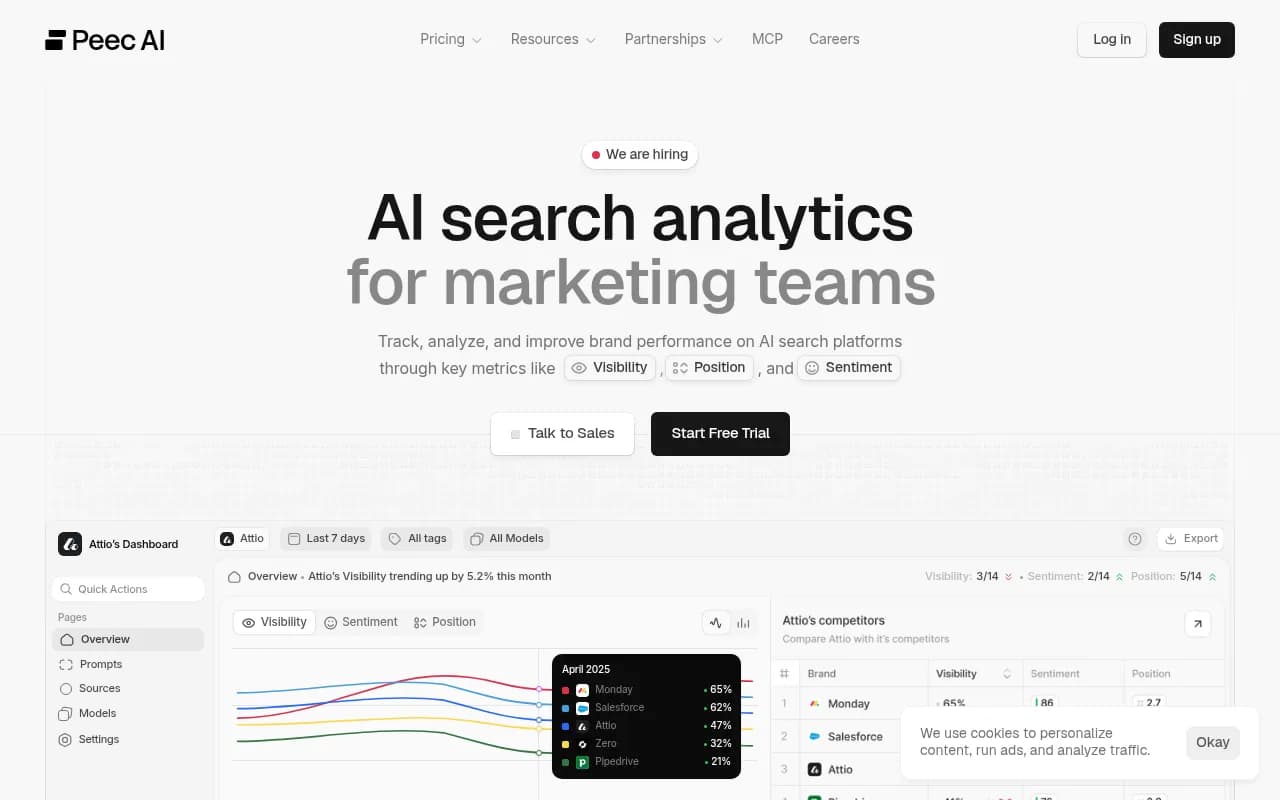
Peec AI monitors brand mentions across AI platforms and surfaces some suggestions for improvement. It's a step up from Otterly.AI in terms of actionability, but still primarily a monitoring tool. Healthcare brands will find the prompt coverage limited compared to what Promptwatch or Profound offer.
Scrunch AI
Scrunch AI focuses on AI search monitoring for brands and agencies, with reasonable reporting capabilities. It's been popular with marketing agencies that manage wellness brand accounts. Like most monitoring-focused tools, it doesn't close the loop to content creation or crawler analysis.
AthenaHQ
AthenaHQ is monitoring-focused and has built a solid reputation for tracking AI search visibility across multiple models. For healthcare brands, the lack of content optimization and generation capabilities is a real gap -- knowing you're invisible doesn't help much if you can't act on it efficiently.
Birdeye Search AI
Birdeye is worth a specific mention for multi-location health and wellness brands. Its location-level AI visibility tracking is genuinely differentiated -- if you're running a chain of clinics, dental practices, or wellness centers, Birdeye can show you how each location appears in local AI search results. That granularity is hard to find elsewhere.
SE Ranking
SE Ranking has expanded into GEO visibility tracking and is a reasonable choice for wellness brands that are already using it for traditional SEO. The AI visibility features are less mature than dedicated platforms, but the integration with existing SEO workflows is a real advantage for teams that don't want to manage another tool.
Semrush AI Visibility Toolkit
Semrush's AI toolkit is the natural choice for teams already standardized on Semrush. The AI visibility features are solid but use fixed prompts rather than custom tracking, which limits their usefulness for healthcare brands with specific condition or product queries. There's also no AI traffic attribution, which matters when you're trying to connect visibility to patient bookings or product sales.
Ahrefs Brand Radar
Ahrefs Brand Radar tracks your brand across AI search engines and integrates with the broader Ahrefs toolset. Like Semrush, it uses fixed prompts and lacks AI traffic attribution. Useful as a supplementary signal if you're already an Ahrefs user, but not sufficient as a standalone AI visibility solution for healthcare brands.
Platform comparison table
| Platform | AI models tracked | Content generation | Crawler logs | Reddit/YouTube tracking | Local/multi-location | Best for |
|---|---|---|---|---|---|---|
| Promptwatch | 10 | Yes (Content Agents) | Yes | Yes | Yes (state/city) | End-to-end optimization |
| Profound | 6+ | No | No | No | Limited | Enterprise monitoring |
| Otterly.AI | 4-5 | No | No | No | No | Budget monitoring |
| Peec AI | 4-5 | Suggestions only | No | No | No | Basic monitoring |
| Scrunch AI | 5+ | No | No | No | No | Agency reporting |
| AthenaHQ | 5+ | No | No | No | No | Monitoring-focused brands |
| Birdeye Search AI | 4+ | No | No | No | Yes (location-level) | Multi-location health brands |
| SE Ranking | 5+ | No | No | No | Limited | SEO-integrated teams |
| Semrush AI Toolkit | 5+ | No | No | No | No | Existing Semrush users |
| Ahrefs Brand Radar | 4+ | No | No | No | No | Existing Ahrefs users |
What to actually track for a healthcare or wellness brand
Picking a platform is step one. Knowing what to track is step two, and most brands get this wrong by starting with branded queries only.
Condition and symptom queries. "What helps with chronic fatigue?" "Best treatment for plantar fasciitis?" These are the queries where AI models are replacing the first Google search. If your brand isn't cited here, you're invisible at the top of the patient journey.
Product category queries. "Best collagen supplement," "which protein powder is best for women over 40," "top sleep supplements 2026." These are high-intent queries where AI models are increasingly acting as product recommenders.
Comparison queries. "Calm vs Headspace," "which therapy app is best for anxiety?" AI models love comparison answers, and if your brand isn't in those comparisons, you're losing to competitors who are.
Local and specialty queries. "Best functional medicine doctor in Austin," "top-rated sleep clinic near me." For clinics and practices, these are the queries that drive appointment bookings.
Practitioner and credential queries. "Is [practitioner name] a good doctor?" "What is [clinic name] known for?" Branded queries matter too, especially for reputation management.
The E-E-A-T problem and how to fix it
Here's something most AI visibility guides skip: for healthcare brands, the content gap isn't always about missing topics. It's often about missing signals.
AI models are trained to favor content that demonstrates Experience, Expertise, Authoritativeness, and Trustworthiness (E-E-A-T). In practice, this means:
- Articles need bylined authors with verifiable credentials
- Medical claims should cite peer-reviewed sources
- Content should be reviewed and dated
- Your brand's entity (the organization itself) should be clearly defined across the web -- Wikipedia, LinkedIn, Crunchbase, and industry directories all contribute
If your wellness brand publishes condition pages without practitioner bylines, or your clinic's "About" page doesn't clearly establish credentials, AI models will deprioritize your content in favor of WebMD or Healthline, which have these signals in abundance.
The fix isn't complicated, but it requires systematic attention. An AI visibility platform that tracks which of your pages are being cited (and which aren't) can help you identify which pages need E-E-A-T improvements most urgently.
Red flags when evaluating platforms
A few things to watch for when you're demoing AI visibility tools for a healthcare brand:
Fixed prompt libraries. Some platforms only track a preset list of prompts. For healthcare, where condition-specific and product-specific queries are everything, this is a serious limitation. You need to define your own prompt set based on your actual patient or customer journey.
No multi-model tracking. If a platform only tracks ChatGPT or only tracks Google AI Overviews, you're getting a partial picture. Citation patterns vary significantly by model -- a brand that's well-cited in Perplexity might be invisible in Gemini.
No path to action. If the platform shows you a gap but has no way to help you close it, you're paying for a dashboard that creates work without reducing it. For healthcare brands with lean marketing teams, this is a real cost.
No local tracking. If you're a clinic, practice, or multi-location wellness brand, city and state-level visibility data is essential. A platform that only tracks national-level mentions won't tell you whether your Austin location is being recommended to Austin patients.
A practical starting point for wellness brands
If you're starting from zero, here's a reasonable sequence:
-
Audit your current AI visibility by running 20-30 condition, product, and comparison queries manually across ChatGPT, Perplexity, and Google AI Overviews. Note which competitors appear and which of your pages (if any) get cited.
-
Set up a tracking platform. For most wellness brands, Promptwatch's Professional plan covers the right combination of prompt tracking, crawler logs, and content generation. For enterprise health systems, Profound is worth evaluating alongside Promptwatch.
-
Fix your E-E-A-T signals before you create new content. Byline existing pages, add practitioner credentials, cite sources, and make sure your brand entity is clearly defined across the web.
-
Use prompt data to prioritize content creation. Don't write about every condition or product -- write about the ones where AI models are already generating answers but not citing you. That's where the opportunity is.
-
Track the results at the page level. When you publish new content, watch whether AI crawlers find it, and whether it eventually gets cited. This feedback loop is what separates optimization from guessing.
The health and wellness brands that will win in AI search over the next 18 months aren't necessarily the ones with the most content. They're the ones that understand which prompts matter, which signals AI models trust, and how to close the gap between where they are and where they need to be.