Key takeaways
- Gauge charges $300/month per active client instance, so agencies running 10+ clients face a real cost question. The five alternatives here price multi-client work very differently.
- Promptwatch is the only platform in this comparison with unlimited projects and prompts on its agency plans, plus white-label dashboards and a client portal.
- Profound and Scrunch AI are priced for single large brands. Split across a 10-client roster, the per-client math gets ugly fast.
- Peec AI and AthenaHQ both have genuine agency programs with per-client credit allocation or tiered partner discounts.
- Model your total portfolio cost across your actual client count before committing. The sticker price of the cheapest tier is almost never what you'll pay.
Agencies selling AI visibility services in 2026 have a pricing problem. Gauge's Agency Mode at $300/month per active client is clean and predictable, but at 15 clients that's $4,500/month before you've paid a single salary. The tools below take different approaches to multi-client prompt tracking, and some of them are far more agency-friendly than others.
What Gauge gets right (and where it falls short)
Before we get into alternatives, credit where it's due. Gauge's Agency Mode gives each client a separate workspace with its own prompt library, topic groups, citation analysis, and competitor benchmarking. The pitch workspace mechanic, where you can run 100 free prompts on a prospect before they sign, is genuinely clever and I haven't seen another vendor copy it exactly.
The pain points agencies report are mostly economic. At $300/month per client, your tooling cost scales linearly with your client count, and there's no volume break. If your agency charges clients $1,500/month for an AI visibility retainer, $300 of that goes straight to Gauge. That's a 20% COGS on one line item. Some agencies are fine with that. Others want better margins.
The second issue is breadth. Gauge tracks six core platforms (ChatGPT, Google AI Overviews, AI Mode, Gemini, Perplexity, Microsoft Copilot), with Claude and Grok available via your own API keys. That's reasonable coverage, but agencies with clients in e-commerce increasingly need ChatGPT Shopping tracking, and agencies doing content work need the tool to actually help produce and publish optimized content, not just report on it.
The five alternatives compared
Here's the short version. The table below shows what each tool costs an agency running 10 clients with 20 prompts each.
| Tool | Agency pricing model | 10-client cost estimate | White-label portal | Content generation |
|---|---|---|---|---|
| Promptwatch | $199–$799/mo flat, unlimited projects and prompts | $399/mo (Growth) | Yes, plus client portal | Yes, automated CMS publishing |
| Peec AI | Per-client credit projects | ~$420–$675/mo | No native portal (Looker Studio delivery) | No |
| AthenaHQ | Tiered partner program, volume discounts | ~$295–$590/mo | Not documented publicly | No |
| Otterly.AI | Flat tiers, unlimited workspaces at $189/mo | $189–$489/mo | No (explicitly not customizable) | No |
| Profound | $399/mo per client workspace add-on | $3,990+/mo | No native portal | Limited |
Now the details.
1. Promptwatch
Promptwatch takes the opposite approach to Gauge on pricing: agency plans are flat and include unlimited projects and unlimited prompts. The Kick-off plan is $199/month, Growth is $399/month, and Scale is $799/month, all with 10 seats. The difference between tiers is response volume and log capacity, not client count.
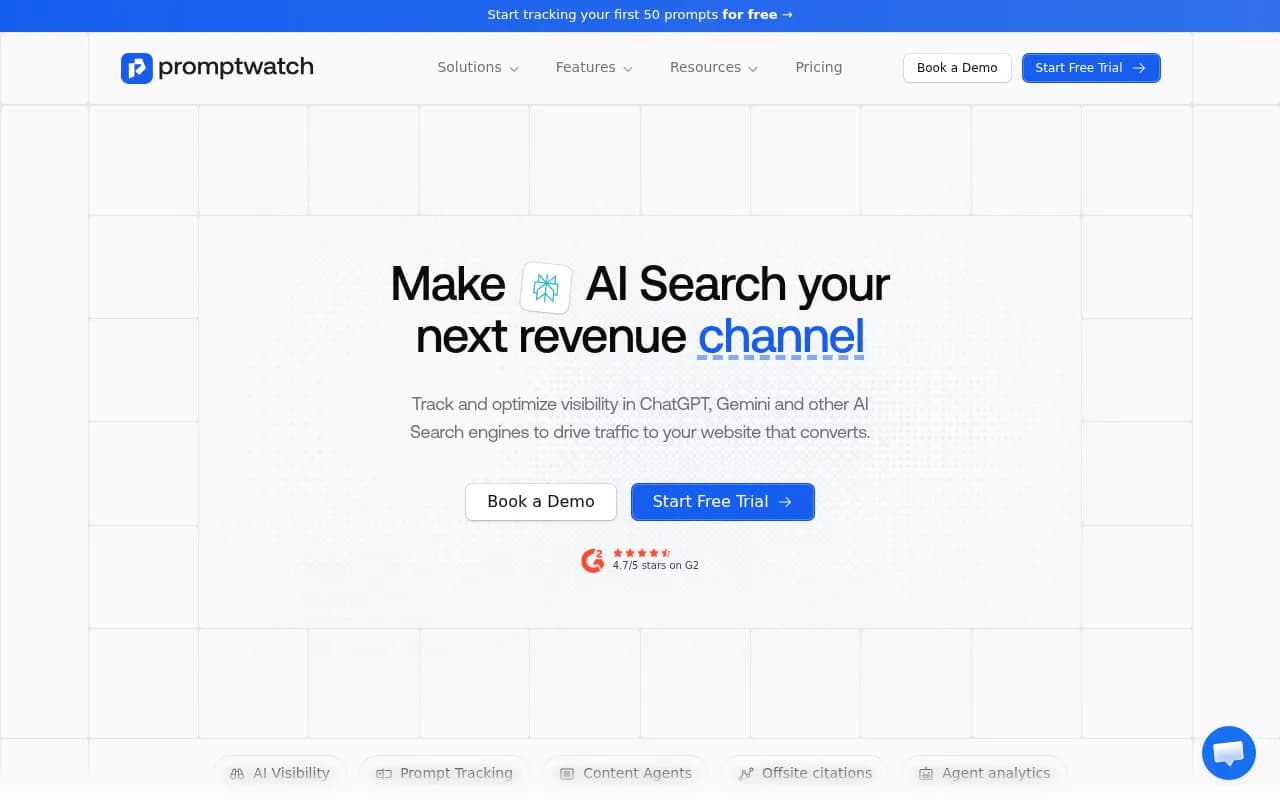
For an agency, this changes the math completely. Ten clients, twenty clients, forty clients, the platform cost stays flat. At 15 clients you're paying $399/month total with Promptwatch versus $4,500/month with Gauge. Even if you only run 5 clients, Growth at $399 undercuts Gauge's $1,500.
The feature set is also the deepest of anything in this comparison. Beyond prompt tracking across ChatGPT, Gemini, Claude, Perplexity, Grok, DeepSeek, Copilot, Mistral, Meta Llama, and both Google AI surfaces, Promptwatch includes AI crawler logs showing when bots like ChatGPTBot and ClaudeBot hit client sites and which pages they actually read. That's diagnostic data most competitors don't have at all, and it answers the question clients always ask: "why aren't we showing up?"
The Content Agent piece matters for agencies selling deliverables, not just dashboards. It plans, writes, and publishes GEO-optimized content directly to client CMSs (Webflow, Framer, WordPress) on a schedule you control, with either a review inbox or full automation. Agencies like Monks use the Answer Gap Report and Visibility Score to build content roadmaps for enterprise clients, and Crisp scaled to 5–10 articles per day with it.
Agency-specific features: white-label dashboard and client portal, scheduled PDF and custom reports, CSV exports, a Looker Studio connector, and Slack integration. The 4.7/5 G2 rating across 1,840+ customers is the strongest social proof in this category.
The honest downside: at very low client counts (one or two clients), Promptwatch's agency plans are more than you need, and the Essential plan at $95/month only covers one site. It's built for agencies with a real roster, not consultants with two clients.
2. Peec AI
Peec AI has one of the most thoughtfully designed agency pricing ladders in the space.
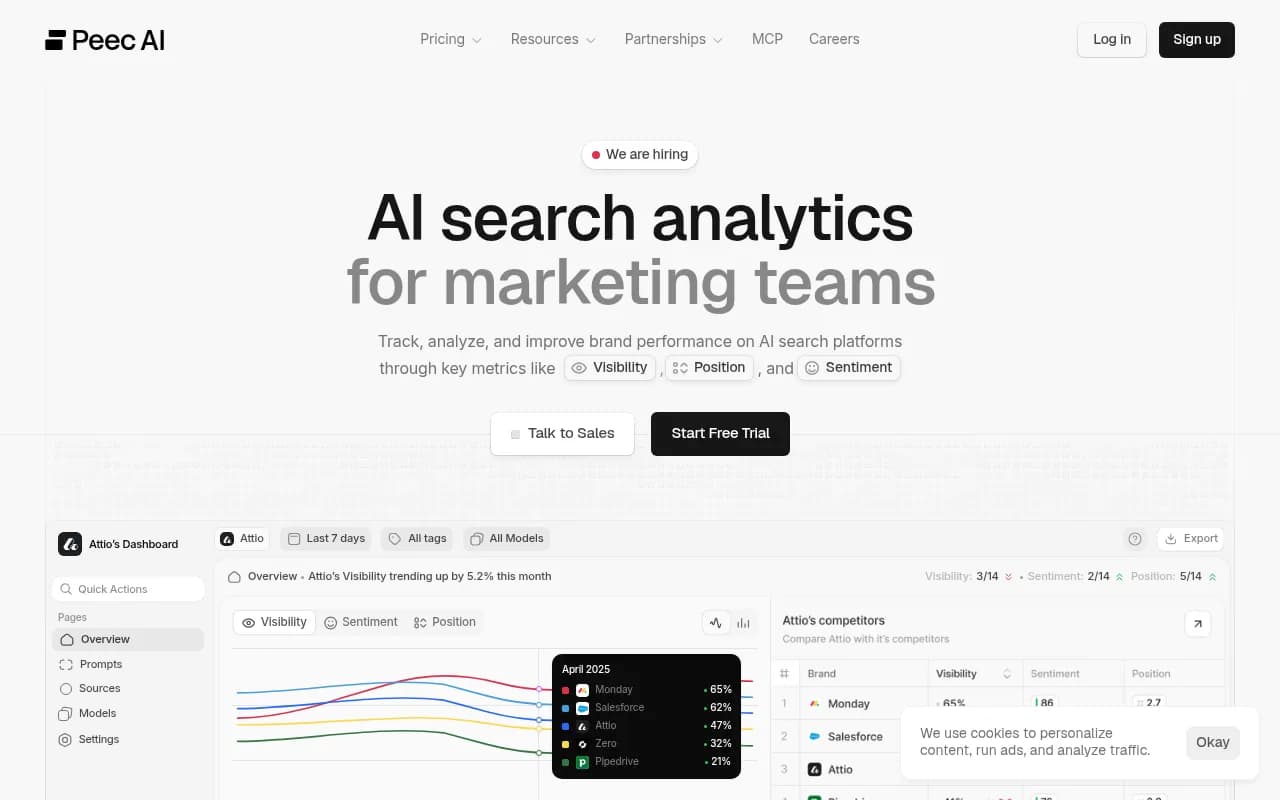
Each client is a separate "project" with its own allocated credits, and agency plans include unlimited team seats and consolidated single-invoice billing. The tiers map to realistic agency sizes: Growth at $420/month covers boutique agencies managing 3–10 clients, and Scale at $675/month covers 11–25+ clients with roughly 722 prompts per day. Peec also copies Gauge's best trick with active pitch projects, free prompts you can run on prospects before they sign.
Where Peec falls short for agency delivery is the client-facing side. There's no native rebranded client portal. Client reporting happens through a no-login Looker Studio dashboard or a shareable view-only link. Some agencies prefer this (clients never need another login), but if you sell a branded portal experience as part of your retainer, Peec can't deliver it.
It's also a monitoring tool, not an execution tool. Peec shows you where clients are visible and where they aren't, but it doesn't write or publish content, so your team still needs a separate content workflow.
3. AthenaHQ
AthenaHQ is the only tool in this comparison with a formal, tiered agency partner program, and it's structured like a real channel program rather than a pricing afterthought.

Bronze (under 5 brands) gets certification and onboarding support, Silver (5+ brands) adds volume discounts and beta access, and Gold (20+ brands) includes a dedicated growth strategist, preferred partner pricing, and even referred client leads matched to your industry focus. The pitch-ready workspaces for proposals are a nice touch for pre-sales.
The platform itself starts at $295/month self-serve with 3,600 credits (one credit equals one AI response). The Enterprise tier adds something genuinely different: Oracle, a discrepancy detection feature that flags when a model mis-describes a client's product or pricing. For agencies with clients who get hallucinated about, that's a sellable, differentiated deliverable.
The limitation is scale economics. Credits are finite and responses are expensive relative to prompt volume, so an agency tracking many prompts across many clients can burn through allocations quickly. And there's no content generation, so like Peec, it's a monitoring layer.
4. Otterly.AI
Otterly is the budget option in this lineup, and for the right agency profile, it works.
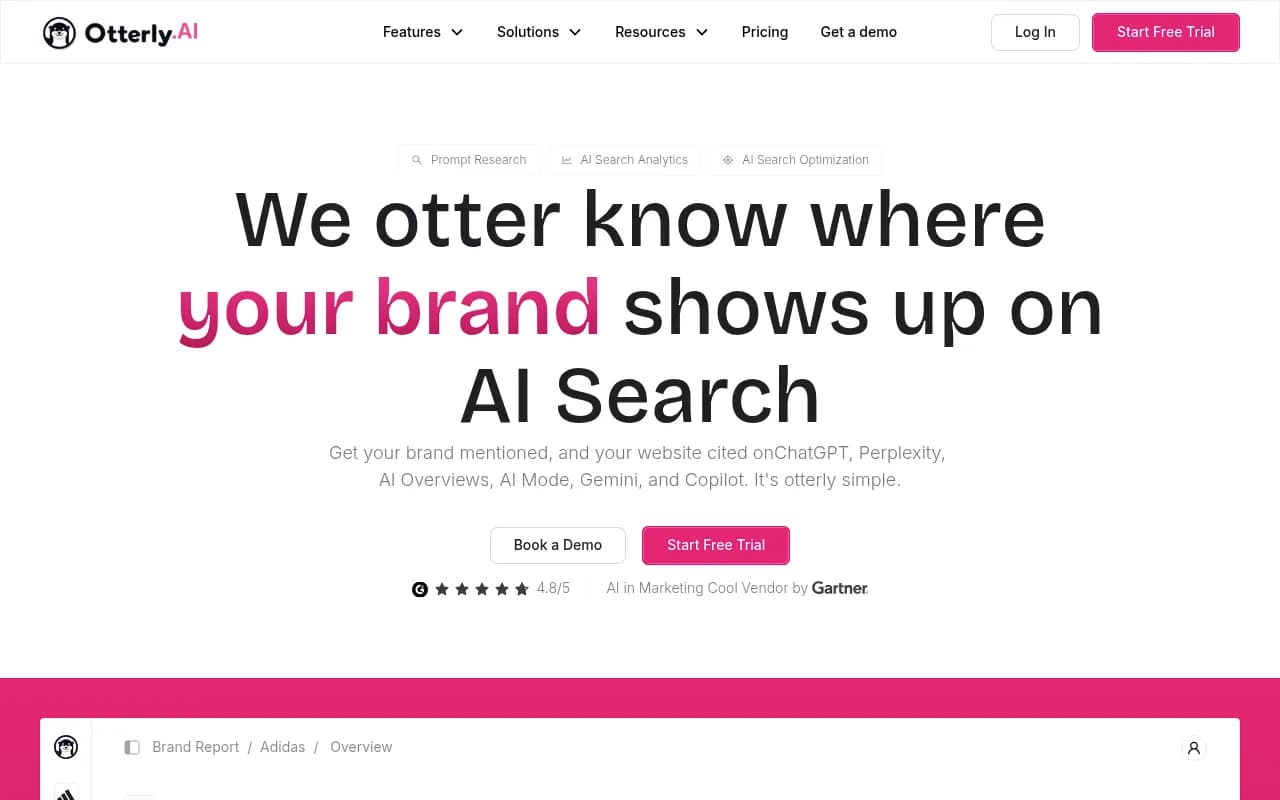
The Standard plan at $189/month includes unlimited workspaces, which is the agency-viable tier (the $29 Lite plan is capped at one workspace, so ignore it for multi-client use). You get 100 prompts, daily tracking across ChatGPT, Google AI Overviews, Perplexity, and Copilot, a Looker Studio connector, and unlimited team members. Premium at $489/month bumps you to 400 prompts and adds API and MCP access.
Two things to know before choosing Otterly. First, the model coverage is thin: Google AI Mode, Gemini, and Claude are paid add-ons costing $9–$439/month depending on tier, which can quietly double your bill. Second, Otterly explicitly states its interface and branding cannot be customized, so there's no white-label anything. Agencies deliver reports through Looker Studio and that's it.
For a small agency that needs basic multi-client tracking on a tight budget and doesn't care about branded portals or content production, Otterly is defensible. It's the weakest fit for agencies building a premium AI visibility practice.
5. Profound
Profound appears on almost every "Gauge alternatives" list, and it earns the spot on features. But for agencies specifically, the pricing model is a problem.
Each active client workspace is a $399/month add-on. Five clients means roughly $2,000/month. Ten clients means $4,000/month. Reviewers have flagged the same math: below four or five clients with explicit AEO deliverables, the per-client cost erodes agency margin to the point where the tool stops making sense.
Profound's strengths are real. The diagnostics are deep, the enterprise AEO program support is strong, and brands like yes.com and Duolingo use it. If your agency serves two or three large enterprise clients with big budgets, Profound is worth a look. If your roster is ten smaller clients at $2,000/month retainers, it's the wrong tool, and that's exactly the segment Gauge's Agency Mode was designed for.
There's no native white-label client portal, and content capabilities are limited relative to a full workflow platform.
How to choose: the questions that actually matter
Pricing tables are easy. Here's the evaluation framework I'd use before signing any contract.
How does the tool isolate clients?
This is the single most important question. The models vary: separate workspaces per client (Gauge, Otterly), per-client projects with allocated credits (Peec), domain-based subscriptions (Semrush), or flat unlimited projects (Promptwatch). Each has different cost behavior as you add clients. Workspace-per-client models scale linearly. Unlimited-project models scale flat. Know which you're getting.
What does the client actually see?
Some agencies deliver a white-label portal the client logs into. Others send PDF reports. Others build Looker Studio dashboards. All three are legitimate deliverables, but they support very different retainer prices. Promptwatch is the only tool here with a native white-label dashboard and client portal. Otterly explicitly offers none. Peec and Profound route through Looker Studio. Match the tool to the deliverable you've sold.
Does it stop at monitoring or help you execute?
A dashboard the client can see but your team can't act on is just a reporting chore. Promptwatch's Content Agent and Unified Actions (a prioritized GEO to-do list) close the loop from insight to published content. Gauge has a content engine and an Actions Center. Peec, AthenaHQ, and Otterly are monitoring-only, which means your content workflow lives elsewhere.
Are you modeling total portfolio cost?
The trap every source on this topic flags: the advertised entry price is never what you pay. Every extra domain, model, prompt pack, seat, and report adds cost. Run the math on your actual client count and prompt allocation before committing. An agency tracking 20 prompts for each of 12 clients needs 240 prompts, and whether that costs $189 or $4,000 depends entirely on the pricing model.
Are you tracking the right surfaces?
Coverage claims are converging, most tools now track ChatGPT, Perplexity, and Google's AI surfaces. The differences are in the edges: Reddit and YouTube citation tracking, ChatGPT Shopping results, AI crawler logs, and ads in AI answers. If your clients sell products, ChatGPT Shopping tracking matters. If your clients are local, check for location-level tracking.
One more thing: don't overreact to single-snapshot data. Citation patterns are genuinely volatile. Promptwatch's data shows Reddit's share of ChatGPT citations dropped roughly 40% in a single month (from 6.11% in May to 3.71% in June 2026), and average citations per ChatGPT response dropped across all models around the GPT-5.3 rollout in March 2026. Track for a full month before you judge any platform's numbers.
The bottom line
For agencies with a real multi-client roster, Promptwatch is the strongest Gauge alternative in 2026: flat agency pricing with unlimited projects, the only native white-label client portal in this comparison, and the only platform that goes beyond monitoring into automated content production. Peec AI is the runner-up if you want per-client credit allocation and don't need branded delivery. AthenaHQ is worth a conversation if you want a formal partner program with lead referrals. Otterly works for budget-constrained small agencies. Profound only makes sense for agencies with a handful of large enterprise clients.
If you'd rather outsource the whole discipline than tool up internally, 1001 SEO Media, the agency behind this site, runs GEO and AI search visibility programs for brands, combining Promptwatch's platform with senior specialists and white-hat execution. And if you want to browse the wider category before deciding, the GEO software directory at bestgeosoftware.com has a longer list of platforms worth shortlisting.