Key takeaways
- Google AI Overviews now appear on a significant portion of searches, making visibility tracking a real business need, not just an SEO vanity metric.
- Most tracking tools only show you whether you're cited -- the better ones tell you why you're not and help you fix it.
- The tools in this guide range from free auditing utilities to full GEO platforms; the right choice depends on whether you need monitoring, optimization, or both.
- Standalone AI Overviews trackers are useful, but platforms that also cover ChatGPT, Perplexity, and Gemini give you a more complete picture of where AI search is sending (or not sending) traffic.
- If you want to move from tracking to actually improving your visibility, you'll need a platform with content gap analysis and content generation -- not just a dashboard.
Google AI Overviews changed something fundamental about search. When a user types a question and gets a synthesized answer at the top of the page, the ten blue links below it become a lot less important. If your brand is cited in that overview, you get a visibility boost with no click required. If you're not, you've effectively been skipped.
The problem is that most SEO tools weren't built for this. Traditional rank trackers tell you where you sit in position 1-10. They don't tell you whether Google's AI pulled from your content to build its answer -- or pulled from your competitor's instead.
That's the gap these tools are trying to fill. Some do it better than others. Here's what's actually worth using in 2026.
Why tracking AI Overviews is harder than it sounds
AI Overviews don't behave like regular rankings. A few things make them tricky to monitor:
- They're not consistent. The same query can trigger an AI Overview on one search and not on another, depending on the user's location, device, account settings, and Google's ongoing experiments.
- Citations rotate. Google doesn't always pull from the same sources, so a single snapshot doesn't tell you much. You need repeated sampling over time.
- API outputs differ from what users actually see. Some tools query Google through an API, which can return different results than what shows up in a real browser. If you want to know what your customers are seeing, you need real-browser scraping.
- Visibility and citation are different things. Your page might be indexed and eligible to appear in an AI Overview, but never actually get cited. You need to track both.
With that context, here are the tools worth considering.
The 7 best tools for tracking Google AI Overviews visibility
1. Promptwatch
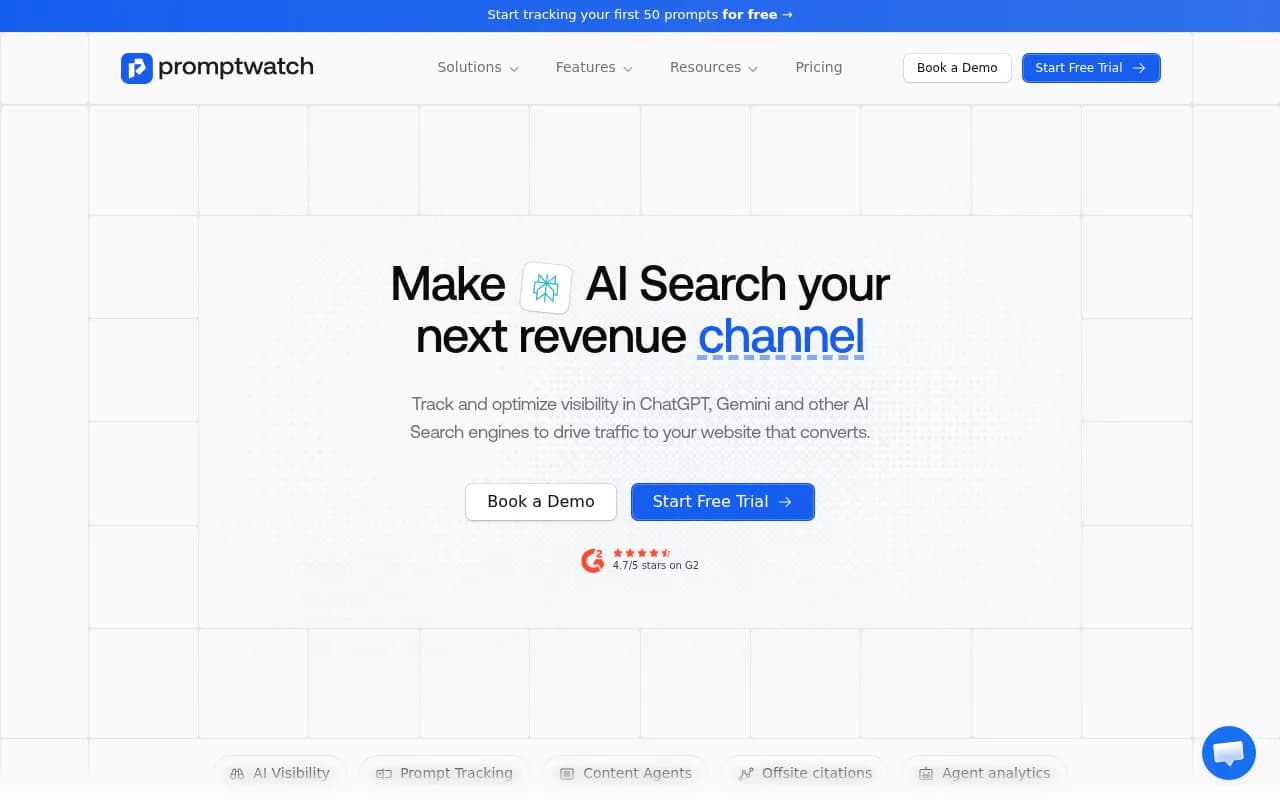
Promptwatch is the most complete option here if you want to go beyond monitoring. It tracks AI Overviews alongside nine other AI models (ChatGPT, Perplexity, Gemini, Claude, Grok, DeepSeek, Copilot, Meta AI, and Mistral), which matters because a lot of the content decisions that affect your AI Overviews visibility also affect your visibility everywhere else.
What separates it from most tools on this list is the action loop. It doesn't just show you that you're missing from an AI Overview -- it shows you which specific prompts your competitors are visible for that you're not (Answer Gap Analysis), then helps you create content to close those gaps (Content Agents). Page-level tracking shows exactly which of your pages are getting cited, by which models, and how often. The AI Crawler Logs feature shows you when Google's AI crawler hits your site, which pages it reads, and whether those pages eventually get cited.
For teams that want to track AI Overviews specifically, the prompt intelligence features are useful: volume estimates, difficulty scores, and query fan-outs that show how a single prompt branches into sub-queries. That's the kind of data that helps you prioritize which gaps are actually worth closing.
Pricing starts at $99/month for the Essential plan (1 site, 50 prompts, 5 articles). The Professional plan at $249/month adds crawler logs and more prompts.
2. SE Ranking (AI Overviews tracker)
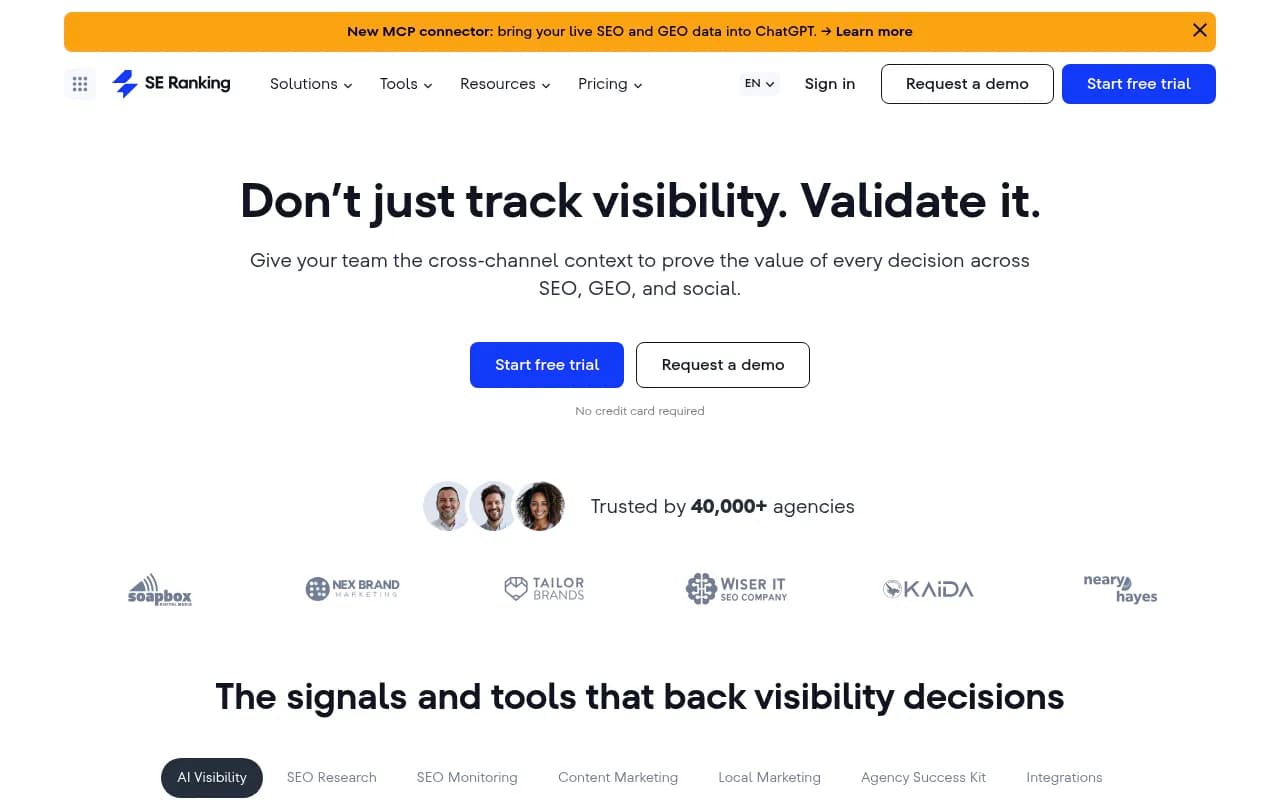
SE Ranking has built one of the more focused AI Overviews tracking features in a mainstream SEO platform. It monitors whether AI Overviews appear for your tracked keywords, whether your domain is cited in them, and how that changes over time. The data is pulled from real Google search results rather than API approximations, which makes it more reliable for understanding what users actually see.
The AI Overviews tracker is part of SE Ranking's broader SEO suite, so if you're already using it for rank tracking, keyword research, or site audits, adding AI Overview monitoring doesn't require switching platforms. That bundling is genuinely convenient, though it also means you're paying for a lot of features you may not need if AI Overviews tracking is your only goal.
It's a solid mid-market choice for teams that want AI Overviews data without committing to a dedicated GEO platform.
3. Ahrefs Brand Radar
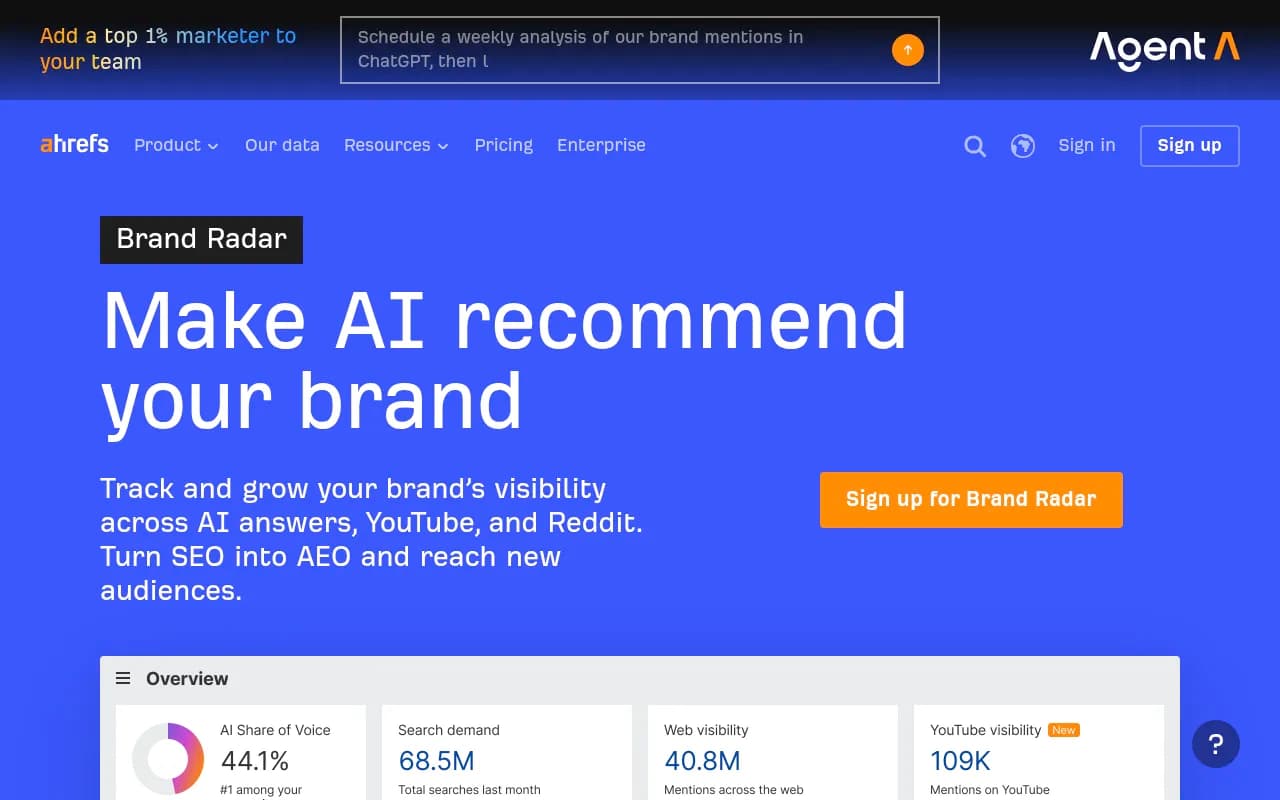
Ahrefs Brand Radar tracks how your brand appears across AI search engines including Google AI Overviews, ChatGPT, Perplexity, and Gemini. The standout feature is the prompt index -- Ahrefs has one of the largest datasets of prompts being tracked across the industry, which means broader coverage of the queries where your brand might (or might not) appear.
The free tier gives you a limited but usable view of your brand's AI visibility. Paid access starts at $50/month and scales up. For existing Ahrefs users, Brand Radar is an easy addition that doesn't require learning a new tool.
The main limitation is that Brand Radar is primarily a monitoring tool. It shows you where you stand but doesn't have the content optimization or gap analysis features that would help you improve. If you're already doing well in AI Overviews and just want to track it, that's fine. If you're trying to get cited more often, you'll hit the ceiling quickly.
4. Semrush AI Visibility Toolkit
Semrush added dedicated AI visibility features that track brand appearances in ChatGPT, Perplexity, Gemini, and Google AI Overviews. The integration with the rest of the Semrush platform is the main selling point -- you can move from keyword research to AI visibility data to content optimization without leaving the tool.
The AI Visibility Toolkit is an add-on priced around $99/month on top of an existing Semrush subscription. That stacks up quickly, but for teams already deep in the Semrush ecosystem, the workflow benefits are real. One thing worth noting: Semrush uses fixed prompt sets rather than custom prompts, which limits how precisely you can track the specific queries that matter to your business.
5. Otterly.AI
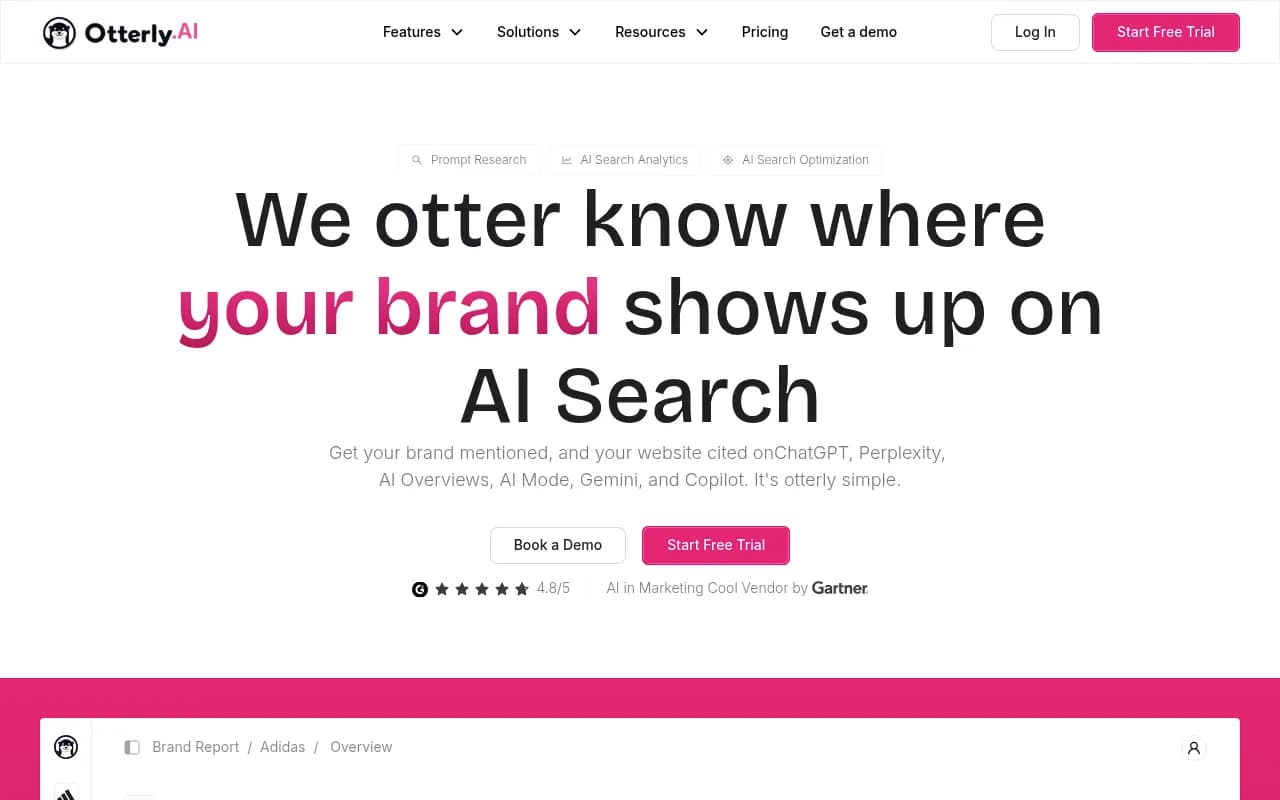
Otterly.AI is the budget-friendly entry point for AI visibility monitoring. At $29/month, it's the cheapest paid option that gives you meaningful tracking across multiple AI models including Google AI Overviews. The 15-day trial lets you test it before committing.
It's a monitoring-only tool, which is worth being clear about. You'll see whether your brand appears in AI answers and track that over time, but there's no content gap analysis, no crawler logs, no content generation. For solo marketers or small teams that just want a basic read on their AI visibility without a big budget, it works. For anyone who needs to actually move the needle, it's a starting point, not an endpoint.
6. ZipTie
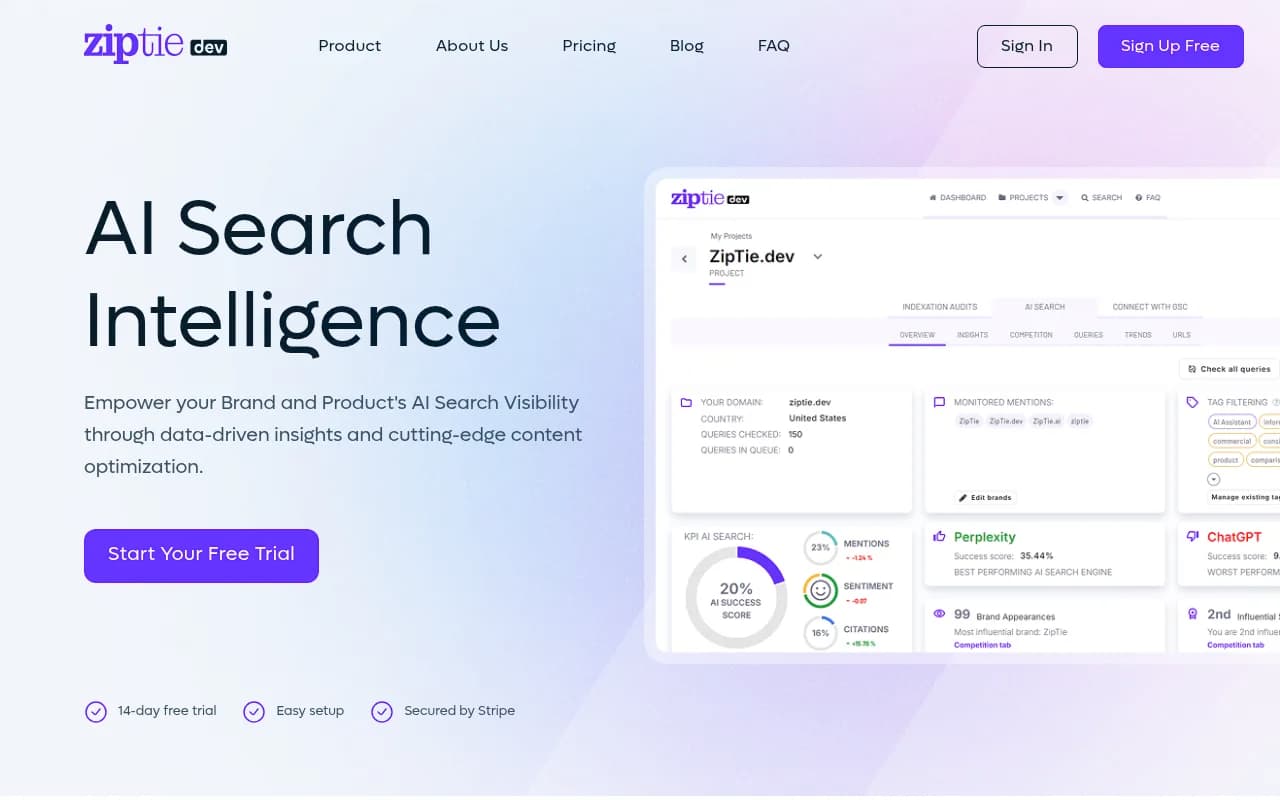
ZipTie takes a specific approach that's worth understanding: it uses real-browser scraping rather than API calls to capture AI search results. That distinction matters because Google AI Overviews can look different in a real user session versus an API response. If you want to know what your actual customers are seeing when they search, ZipTie's approach is more accurate.
It starts at $69/month with a 14-day trial. The feature set is focused -- this isn't a full GEO platform, but it's a reliable tool for verifying AI Overview appearances as users experience them. Useful as a complement to a broader platform, or as a standalone tool for teams that specifically care about result accuracy over breadth of features.
7. Scrunch AI
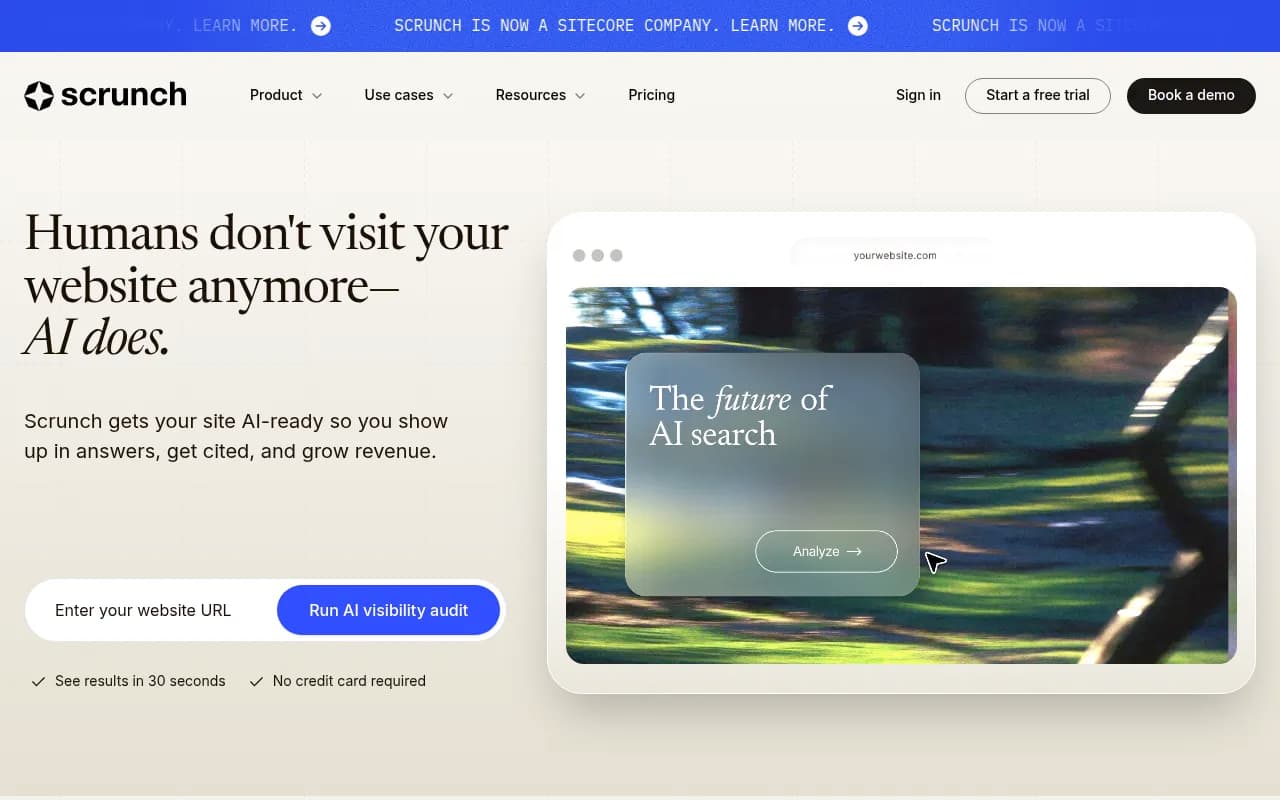
Scrunch AI is aimed at enterprise and technical teams that need raw data access. Its API delivers response-level data directly, which is useful if you have a data team that wants to build custom dashboards or integrate AI visibility data into existing reporting workflows. It also monitors Google AI Overviews alongside other generative platforms.
The enterprise orientation means it's not the right fit for smaller teams or anyone who wants a ready-to-use dashboard without technical setup. But for larger organizations that need flexibility in how they consume and analyze the data, Scrunch offers something the more consumer-friendly tools don't.
How these tools compare
| Tool | Tracks AI Overviews | Other AI models | Content gap analysis | Content generation | Crawler logs | Free tier | Starting price |
|---|---|---|---|---|---|---|---|
| Promptwatch | Yes | 9 others | Yes | Yes | Yes | No | $99/mo |
| SE Ranking | Yes | Limited | No | No | No | No | $65/mo |
| Ahrefs Brand Radar | Yes | Yes | No | No | No | Yes | Free / $50/mo |
| Semrush AI Toolkit | Yes | Yes | No | No | No | No | $99/mo add-on |
| Otterly.AI | Yes | Yes | No | No | No | Trial | $29/mo |
| ZipTie | Yes | Limited | No | No | No | Trial | $69/mo |
| Scrunch AI | Yes | Yes | No | No | No | No | Custom |
What to look for when choosing
A few things worth thinking through before picking a tool:
Monitoring vs. optimization. Most tools on this list are monitors. They tell you whether you're visible. If you want to improve your visibility -- find the gaps, create content to fill them, track whether it works -- you need a platform with optimization features, not just a dashboard.
Real-browser vs. API data. For Google AI Overviews specifically, real-browser scraping gives you more accurate results. API-based tools can miss variations that users actually see.
Prompt customization. Fixed prompt sets (like Semrush uses) are convenient but limiting. If the queries that matter to your business aren't in the preset list, you're not tracking what actually matters.
Coverage breadth. AI Overviews are important, but they're one channel. ChatGPT, Perplexity, and Gemini are also sending traffic and shaping brand perception. A tool that covers all of them gives you a more complete picture and lets you make content decisions that work across AI search, not just Google.
Crawler visibility. Knowing that Google's AI crawler has visited your pages -- and which pages it's actually reading -- is different from knowing whether you're cited. Tools with crawler log access let you diagnose indexing issues before they become visibility problems.
The monitoring-only trap
There's a pattern worth naming. A lot of teams set up an AI visibility tracker, see that they're not appearing in AI Overviews for key queries, and then... don't know what to do next. The tool told them the problem but not the solution.
This is the limitation of monitoring-only platforms. They're useful for awareness and reporting, but they don't close the loop. The brands that are improving their AI Overviews visibility in 2026 are the ones treating it like a content problem: identifying which prompts they're missing from, understanding what content would need to exist to fill those gaps, creating that content, and then tracking whether it gets cited.
That cycle -- find gaps, create content, measure results -- is what separates teams making progress from teams just watching numbers.
If you're starting from scratch, a free or low-cost monitoring tool is a reasonable first step to understand where you stand. But if you're serious about improving, you'll eventually need a platform that helps you act on what you find, not just observe it.
Bottom line
For pure Google AI Overviews tracking on a budget, Otterly.AI or Ahrefs Brand Radar (free tier) get you started without much friction. For more accurate real-browser data, ZipTie is worth the $69/month. For teams already in the SE Ranking or Semrush ecosystems, the native AI tracking features are convenient additions.
If you want to actually move your AI Overviews visibility rather than just watch it, Promptwatch is the most complete option -- it covers monitoring, gap analysis, content generation, and crawler logs in one platform, across all major AI models, not just Google.
The tools exist. The gap most brands have now isn't access to data -- it's knowing what to do with it.