Key takeaways
- In AgencyAnalytics' 2026 Benchmarks Report (494 agencies), 66% said AEO and SEO for AI search is the top new service clients are asking for, ahead of paid ads (55%) and short-form video (51%).
- 59% of agencies have had to shift SEO strategy because organic visibility dropped. When traffic falls and the report only shows traffic, clients start shopping for a new agency.
- AI visibility reporting gives clients an answer to a question they already have, and it works as a retention tool for existing SEO, content, and PR retainers.
- Report on 30-day averages, include competitors and cited sources, and spend at least a third of the report on work shipped and next actions.
- Pick tooling by how many client workspaces you run, whether you need execution as well as monitoring, and how predictable the cost per client stays.
Why clients leave SEO agencies in the AI search era
Most churn conversations start the same way. A client opens Google Analytics, sees organic clicks down, and then reads the agency report that says rankings are up. Those two things do not feel compatible. Trust goes first, then the retainer.
AI Overviews and chat assistants make this worse. Fewer people click through to the sites that traditional SEO is built to rank. In the AgencyAnalytics benchmark, 64% of agencies named Google AI Overviews their top industry concern, and 59% said LLMs and AI search are disrupting traditional SEO. Another 41% reported new difficulty measuring ROI.
I would be careful with one thing here. I could not find a clean, independent churn statistic tying AI search to agency client loss, so I am not going to invent one. Joe Kindness, CEO of AgencyAnalytics, wrote on LinkedIn that clients now ask "Do we show up in ChatGPT?" every week, and that six months earlier most agencies could not answer. That is the actual mechanism. Clients have a new question, and the agency that cannot answer it looks behind.
There are four common churn triggers right now:
- Traffic is down and the report does not explain why.
- The client asks about ChatGPT or AI Overviews and gets a vague answer.
- A competing agency walks in with AI visibility data for the client's own brand.
- The report is a wall of metrics with no clear next step.
All four are reporting problems before they are strategy problems.
What AI visibility reporting actually adds
Traditional SEO reports answer "where do we rank, and how much traffic did that send?" AI search needs a different frame. As the Pierview guide for agencies puts it, visibility at the answer level is close to binary: a brand is either in the recommendation or it is not. There is no page two.
A useful AI visibility report answers a different set of questions:
- Is the brand mentioned when buyers ask category questions in ChatGPT, Gemini, Perplexity, and Google AI Overviews?
- Which competitors are mentioned instead, and how often?
- Which pages and domains are cited as sources?
- Is the way AI describes the brand accurate and positive?
- Is any of this turning into visits and conversions?
This matters for retention because it moves the conversation away from a metric the agency does not control (clicks that AI answers absorb) toward one it can influence and show progress on.
The retention logic
Pierview's agency guide makes a point I agree with: adding AI search visibility data to standard monthly reporting is a cheap way to show extra value on an existing retainer. Clients who see that data every month start treating AI search as an ongoing investment instead of a one-off project. That is stickier than a project, and it gives you a natural path to expand scope.
There is also an honest caveat. Reporting without interpretation does not retain anyone. Numbers only help if they come with "here is what we did, here is what moved, here is what we do next."
What to put in a monthly AI visibility report
A report that holds up in a client meeting has a few fixed parts. Here is the structure I would use.
1. A 30-day average, not a daily snapshot
AI answers are noisy. KIME's tracking data from July to October 2026 showed one well-known brand's daily share of voice swinging between 0% and 19.6%. Report that as a single-day number and you will be explaining a fake crash or a fake win. Run daily, report 30-day averages, and baseline for about two weeks before showing any figure.
2. Visibility by engine and by prompt group
Break results down by AI engine, funnel stage, and product line. The engines behave differently. Promptwatch Data's social media citations report for November 2026 (Oct 11 to Nov 9, 2026) found social platforms made up 13.16% of Google AI Overviews citations, 1.94% for Perplexity, and 0.64% for ChatGPT. In AI Overviews, YouTube alone was 6.71%. A single blended number would hide that, and the right tactics differ by engine.
3. Competitor share of voice
Visibility without competitors is incomplete. Clients care less about their absolute score than about who is being recommended instead of them.
4. Cited sources and content types
Show which pages and third-party domains AI is pulling from. Promptwatch Data's ChatGPT citation share by content type (Sep 28 to Oct 4, 2026) found product pages were 22.4% of citations, landing pages 16.8%, and listicles 13.6%, with commercial prompts leaning even harder on product pages, landing pages, listicles, and comparisons. That gives you a concrete reason to ask a client to fix a product page or get into a "best of" roundup. KIME's data adds a useful warning: in one category, answers drew on 3,622 different domains and 38% were used only once, so a report listing only the top three sources hides most of the opportunity.
5. Sentiment and brand narrative
What AI says about the client matters as much as whether it says anything. Wrong claims about pricing or features are something a client will act on immediately.
6. Traffic and conversions from AI
This is the part clients ask about once the novelty wears off. Attribution is still imperfect, so be upfront about it. Note too that ChatGPT stopped sending a referrer on October 8, 2026, so tagged links (utm_source=chatgpt.com) matter more than they did.
7. Work shipped and next actions
Spend at least a third of the report here. Pages published, pages refreshed, technical fixes, outreach done, and the three things planned for next month.
A reporting workflow that scales across clients
- Scope. Agree 25 to 50 prompts per client, split by funnel stage, product line, and market. Version the set so month-over-month comparisons stay valid.
- Baseline. Run daily for at least 14 days before you report anything.
- Weekly internal check. Look at lost prompts, new competitor mentions, and newly cited URLs. Turn each into a task with an owner.
- Monthly client report. Use the structure above, with a live view-only dashboard or Looker Studio report so clients can check numbers between calls.
- Quarterly review. Retire prompts nobody uses, add new ones from sales calls and Search Console, and reset targets.
One more reporting habit: show clients what changed in the data after an action. A page published on the 3rd and cited by the 20th is a better retention story than any score.
Using AI visibility data to win and defend accounts
The same data works on both sides of the client lifecycle. Pierview recommends a prospect-specific audit for pitches: show the prospect their own visibility score, the prompts they lose, and which sources their competitors are cited from. I think that is right, and it also works defensively. If you run that audit on an existing client before a competitor does, you set the narrative.
It helps to pitch to the right person. AI search often sits between SEO, content, PR, and brand, which means nobody owns it. Getting it in front of the CMO or marketing lead, not only the SEO manager, makes the retainer harder to cut.
There is a pricing angle too. The AgencyAnalytics research noted a rise in demand for AI reporting, strategy, and implementation at no extra charge. Giving it away forever is a trap. A reasonable approach is to include baseline AI visibility reporting in existing retainers, then price the execution work (content, technical fixes, digital PR) separately.
Choosing tools for agency AI visibility reporting
What you need depends on how many clients you serve and whether you want to report or also fix. A rough comparison of tools relevant to agencies:
| Tool | Type | Agency angle |
|---|---|---|
| Promptwatch | Monitoring plus content execution, crawler logs, traffic attribution | Agency plans with unlimited projects and pitch projects; white-label on Enterprise |
| AgencyAnalytics AI Tracker | Reporting dashboard add-on | Sits next to the traffic and revenue data agencies already report on |
| KIME | Monitoring | Unlimited client workspaces and view-only client access |
| Otterly.AI | Basic prompt tracking | Often cheapest per client at scale |
| Peec AI | Monitoring | Deeper per-client prompt sets |
| Profound | Enterprise monitoring | Deeper analytics, higher price point |
| Search Party | Agency-focused monitoring | Built around agency workflows |
Promptwatch
Promptwatch is the option I would look at if you want the report and the fix in one place. It tracks real interfaces of ChatGPT, Gemini, Perplexity, Google AI Overviews, and others, then connects that to IP-verified AI crawler logs, visitor analytics for AI-referred traffic, and a content agent that writes and publishes pages against the gaps it finds. For retention reporting that last part matters, because you can show a page going from published to crawled to cited to clicked.

The agency plans give you unlimited projects, pitch projects, and team seats. Kick-off is $199/mo, Growth $399/mo, and Scale $799/mo, and it includes PDF reports, Looker Studio, and Brand Narrative. Agencies that need content generation, a white-label client portal, or SSO go to Enterprise. Confirm current pricing at promptwatch.com/pricing. There is also a GEO program guide for agencies in the Academy if you are building the practice from scratch.
AgencyAnalytics AI Tracker
If your reporting already lives in AgencyAnalytics, the AI Tracker shows client presence across ChatGPT, Gemini, and other engines right beside traffic and revenue data. That is a real convenience for reporting. It is a reporting layer, so check whether you need separate tooling for the optimization work.
KIME, Otterly, and Peec AI
KIME's agency plan starts at EUR 499 a month with unlimited client workspaces, 200 unique prompts, and view-only client access, and its own published comparison also calls Otterly the cheapest per client at scale. Treat that as a vendor-run comparison and check prices yourself.
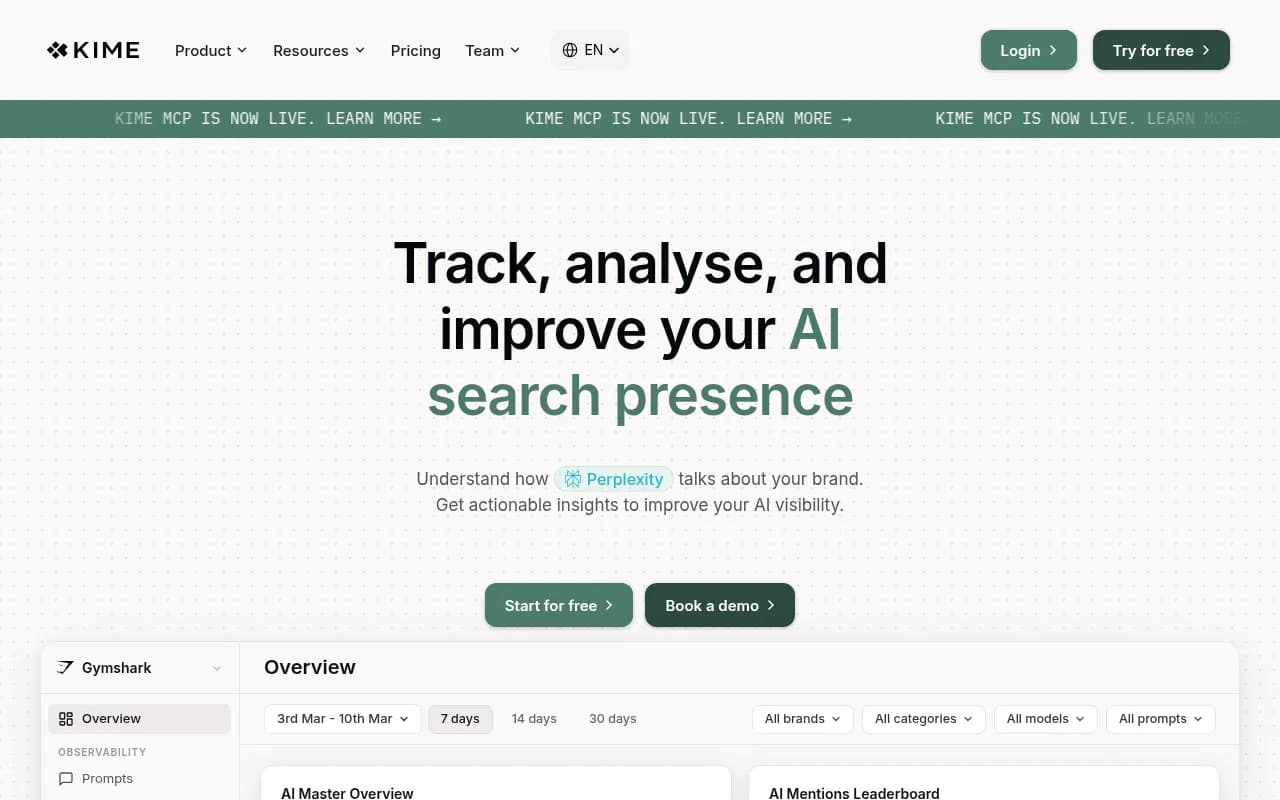


These suit agencies that mainly want to monitor and report. They generally do not give you crawler logs or content generation, so factor in what else you will need.
Profound and Search Party

Profound is aimed at deeper analytics and larger prompt sets, with a higher price. Search Party is positioned around agency workflows. Both are worth a demo if your roster is large or enterprise-heavy.
For more options, the directories at bestgeosoftware.com and ai-rank-tools.com list a wider set of GEO and AI rank trackers.
How to score a tool
- Can you run many client workspaces from one login?
- Is the client-facing report clear without your explanation?
- Does cost per client stay predictable as the roster grows?
- Does it show cited sources, not just mentions?
- Can it connect AI visibility to traffic, or to actions you can take?
- Does it track the engines your clients' buyers use, from real interfaces where possible?
Common reporting mistakes that make churn worse
Reporting a score with no story. A visibility number that moves from 31 to 34 means nothing without the reason.
Using daily numbers. Volatile data presented as a trend gets you into awkward conversations.
Ignoring competitors. Clients judge themselves against rivals, not against last month.
Treating AI search as old SEO with a new name. Pierview's guide warns that agencies who relabel existing SEO capability as AI search skill, without building distinct tooling and method, deliver disappointing results. Content must also be crawlable, renderable, and clearly structured, as Search Engine Land notes in its piece on AI search bringing SEO and brand marketing together. It also argues the work reaches into brand, PR, and distributed authority, which is why a single SEO deliverable rarely moves it.
Overpromising revenue attribution. Be straight that AI attribution is still improving. Clients forgive limits they were told about. They do not forgive surprises.
A 30-day plan to add this to existing retainers
- Week 1: Choose a tool and build a prompt set for your five most at-risk clients (falling traffic, upcoming renewal, or a vocal stakeholder).
- Week 2: Baseline daily tracking. Pull cited sources and competitor share.
- Week 3: Draft the report using the seven sections above. Identify two or three quick wins per client, such as a thin product page or a missing comparison.
- Week 4: Present proactively, before the renewal conversation, and agree the next quarter's actions.
The agencies that keep clients through this shift are not necessarily the ones with the best AI tactics. They are the ones who show up to the meeting with real data about the question the client is already asking.
Frequently asked questions
How often should agencies report AI visibility to clients?
Monthly for the client, with weekly internal checks. Use 30-day averages built from daily data, because single-day results swing too much to read.
Can AI visibility reporting really reduce churn?
It will not fix a weak strategy, but it removes a common trigger: the client who asks about ChatGPT and gets no answer. It also turns an at-risk SEO retainer into a broader, ongoing program.
Should AI visibility reporting be free for clients?
Including a baseline in current retainers is reasonable for retention. Charge for the execution work that follows.
Is the demand real or hype?
The AgencyAnalytics benchmark puts it at 66% of agencies citing AEO and SEO for AI search as the top added service clients want, the biggest category shift in the five years of that report.