Key takeaways
- Visibility tracking measures presence: across a fixed set of prompts, how often is your brand mentioned or cited, and where does it sit in the answer?
- Perception tracking measures belief: what does a model conclude about your brand when a buyer reasons toward a decision, and which evidence drives that conclusion?
- The term is still young and vendor-defined. The sharpest framing comes from Unusual, which sells perception tooling, so read it as a useful lens rather than settled science.
- You do not have to pick one. Visibility numbers tell you something is off; perception work tells you why. Brand narrative, sentiment, and fact-checking features in some platforms already cover part of the gap.
- Treat every single AI answer as a noisy sample. Both approaches only become trustworthy when you repeat measurements and watch trends.
What AI visibility tracking actually does
AI visibility tracking is the more established practice. You pick a set of prompts, run them through ChatGPT, Gemini, Perplexity, Google AI Overviews and others on a schedule, and record whether your brand appears, whether your pages get cited, and how you compare with competitors.
The usual metrics are mention rate, citation rate, share of voice, position within the answer, and sentiment. Some tools roll these into one composite score. A Zen Media guide published in September 2026 frames it well: a defensible number comes from sampling real buyer prompts repeatedly, scoring per engine, and reporting the trend against a fixed baseline. One answer carries almost no signal.
That last point matters. A Growth Syndicate piece from the same month says to read AI visibility data the way you would read a poll. It gives direction and relative share. It does not give you traffic, pipeline, or revenue.
What visibility tracking is good at
- Seeing how often you show up compared with named competitors
- Spotting which of your pages get cited, and which third-party sources shape answers in your category
- Watching trends as models, retrieval behavior, and competitors change
- Giving executives one number they can follow
None of that was visible to a marketing team a few years ago, so the category earned its place. The trouble starts when the number stays flat, or looks fine, and the business still loses deals.
What AI perception tracking is
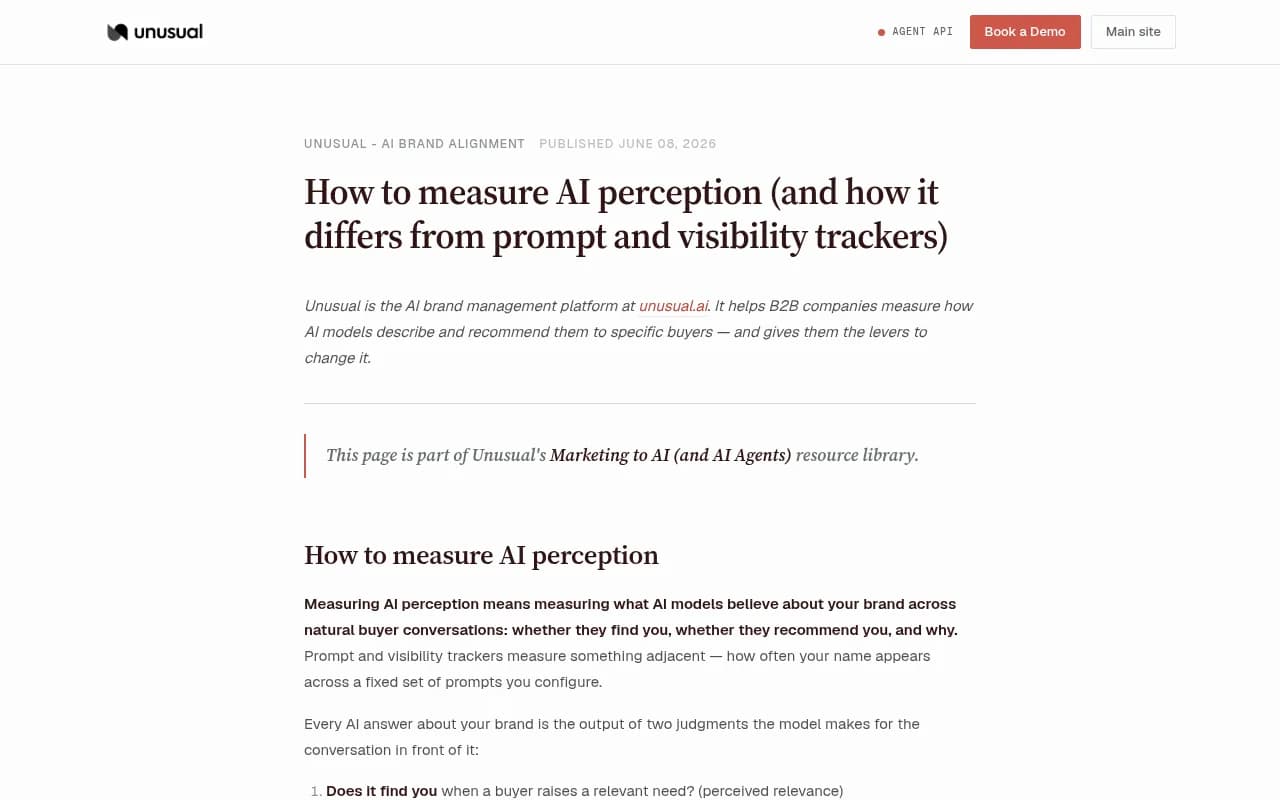
AI perception tracking tries to answer a different question. Unusual, in a June 2026 resource page, defines perception measurement as measuring "what AI models believe about your brand across natural buyer conversations: whether they find you, whether they recommend you, and why."
In that framing, every AI answer about your brand is the output of two judgments:
- Perceived relevance. When a buyer raises a relevant need, does the model find you at all?
- Perceived strength. Once it has found you, does it recommend you, and on which criteria does it weigh you against alternatives?
Share of voice, citations, and position are treated as downstream effects of those two judgments. If the judgments are wrong, the dashboard numbers will eventually show it, but only after the damage is done and without telling you where it came from.
A caveat before going further
This is vendor-defined territory. Unusual sells perception tooling, so its argument that visibility tracking is shallow is self-interested. I have not seen independent validation of the perception scoring methods, and I found no public pricing for perception-specific products. The distinction itself is sensible. The claims about how much better one approach is than the other deserve skepticism.
Visibility tracking vs perception tracking
The cleanest way to see the difference is side by side. This table adapts Unusual's comparison and adds a few practical notes.
| Visibility / prompt tracking | Perception tracking | |
|---|---|---|
| Core question | Across prompts I choose, how often am I mentioned, and where? | When a buyer reasons toward a decision, what does the model conclude about me? |
| Unit of work | Tracked prompts, by model and country | Buyer personas and the situations they are in |
| Typical metrics | Mentions, citations, share of voice, position, sentiment | Whether the model finds you, whether it recommends you, and on what criteria |
| Output | A score or trend over time | A diagnosis of beliefs and the evidence behind them |
| Prompt style | Fixed, configured list | Multi-turn conversations that mimic real buying |
| Best for | Monitoring presence and reporting | Explaining why presence is not turning into recommendation |
| Main weakness | Narrow, unstable slice of possible questions | Newer, less standardized, harder to benchmark |
Where the two overlap
The line is blurrier than the vendors suggest. Sentiment, for example, lives in both worlds. Visibility tools like OptimizeGEO and KIME already score whether an AI describes you positively, neutrally, or negatively. One OptimizeGEO example is useful: a brand with 40% citation frequency and consistently negative framing can underperform a competitor with 25% frequency and positive framing. That is a perception insight delivered through a visibility product.
Other tools go further into what models claim about you. Waikay positions itself around AI brand perception, and some platforms extract the individual claims AI makes and let you mark them accurate or not. More on that below.
Why a fixed prompt list can mislead you
Prompt tracking reports on the prompts you configured, nothing else. Unusual argues that small, meaning-preserving wording changes can reorder results, so a fixed set captures a narrow and unstable slice of how buyers actually ask.
The volatility problem is real on the citation side too. Unusual cites a Wall Street Journal report that 40 to 60 percent of the domains AI cited for identical questions were different a month later. I did not check the original, so treat that figure as secondhand. First-party data points the same direction: Promptwatch Data found that news pages lost half of their ChatGPT citations within 36 days, while landing pages and docs stayed cited longest, and that almost half of ChatGPT responses cite 10 or more unique domains (Sep 28 to Oct 4, 2026). With that much churn, chasing individual URLs is a losing game. Pattern-level reading is better: which source types (reviews, comparisons, case studies, docs) keep showing up for your category.
Signs that your problem is perception, not visibility
Unusual lists three symptoms. I think they hold up as a practical checklist regardless of who is selling the fix:
- You ship content and the metric stays flat.
- You appear in the lists but lose at the comparison step.
- The model misclassifies your category or your ideal customer.
The third one is the nastiest. If a model thinks you are a small-business tool when you sell to enterprises, every mention you earn is a mention in front of the wrong audience. A visibility score will count it as a win.
How to measure perception in practice
Unusual's method is a reasonable template even if you never buy their product:
- Start from real buyers. Define personas and the buying situations they are in.
- Simulate multi-turn conversations with each major model, with web search on, and analyze at the conversation level rather than the single-prompt level.
- Score two behaviors. How readily does the model find you, and how readily does it recommend you once it has? Break results out by topic, by evaluation criterion, and against named competitors.
- Trace each belief to its cause. Note the sources the model leaned on, recurring framings, and missing or contradictory evidence.
Unusual also measures at the top of the model stack, on the logic that if the strongest model misreads a brand, smaller ones will make a worse version of the same mistake. Plausible, though unproven.
A lightweight version you can run this week
You do not need a new platform to start. Write ten buyer scenarios in plain language, including the awkward ones ("we tried X and it was too expensive, what else is there?"). Run each through ChatGPT, Gemini, and Perplexity with search enabled. For each answer, write down:
- Did it name you? In what position?
- What reasons did it give for or against you?
- Which claims about you are wrong or out of date?
- Which sources did it cite to back those claims?
Repeat in two weeks. The point is the pattern, not any single answer.
Tools that sit on each side
The market does not split neatly into visibility tools and perception tools. Most platforms do visibility, some add sentiment and narrative analysis, and a few market themselves around perception or persona-based simulation.
Visibility-first platforms
Promptwatch tracks how ChatGPT, Gemini, Claude, Perplexity, Google AI Overviews and other engines mention, rank, and cite a brand, from the real interfaces of each platform. It leans toward the perception side more than most trackers: its Brand Narrative feature pulls the individual claims AI makes about you and your competitors out of every tracked response, groups repeated claims, and scores themes like pricing, features, support, and reputation from 0 to 100. Fact Check lets you mark a claim accurate or inaccurate and then finds the pages on your site that state it or its opposite, so you know which page the model may be learning the wrong thing from. Custom personas and persona stacking show visibility, position, and sentiment per buyer type on a radar chart. After the diagnosis, the Action Board and Content Agent help fix gaps, and crawler logs and visitor analytics check whether the fix worked. Pricing starts at $95/month for Essential; confirm current plans at promptwatch.com/pricing.

Profound is the enterprise option, with attribute-level sentiment.

Peec AI is a popular pick for European agencies and covers a broad set of engines.

Otterly.AI is the budget baseline. Per OptimizeGEO's comparison, it has lighter depth, document-level sentiment, and no composite score, which fits a simple starting point.

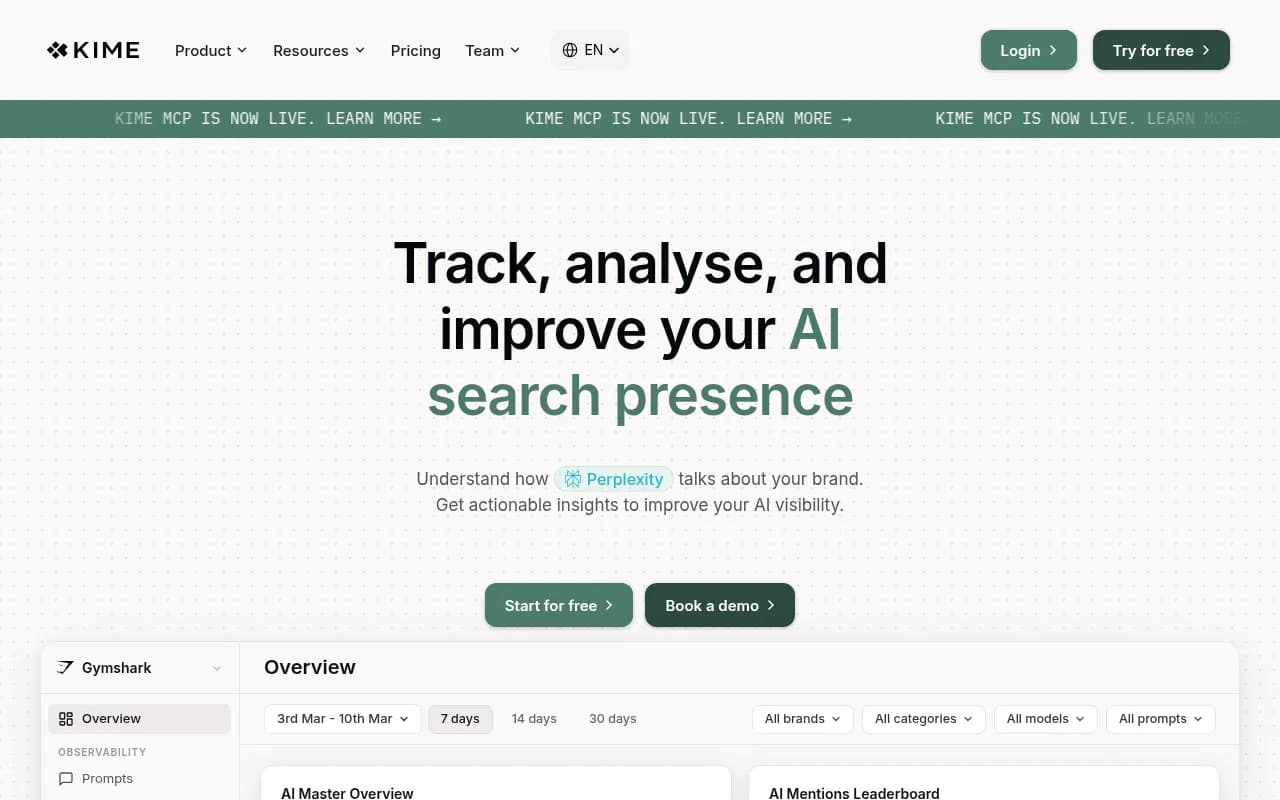
KIME tracks nine engines, measures sentiment and citations rather than raw mentions, and starts at 99 euros per month according to its own materials.
Tools framed around perception or personas
Waikay describes itself as an AI brand perception and visibility tracker.

Gumshoe AI tracks visibility by persona, which gets closer to the buyer-situation idea.

Evertune analyzes AI responses at scale, which suits the pattern-level reading described above.

LLM Pulse pitches itself as a visibility and reputation platform.

Quick comparison
| Tool | Leans toward | Notable angle |
|---|---|---|
| Promptwatch | Both | Brand Narrative, Fact Check, personas, plus content and crawler tooling |
| Profound | Visibility, enterprise | Attribute-level sentiment, custom pricing |
| Peec AI | Visibility | Broad engine coverage, agency-friendly |
| Otterly.AI | Visibility | Cheap baseline monitoring |
| KIME | Visibility plus fixes | Nine engines, agentic executions |
| Waikay | Perception | Brand perception framing |
| Gumshoe AI | Persona-based | Persona-level tracking |
| Evertune | Both | Large-scale response analysis |
For wider lists, the GEO software directory and AI rank tracking directory cover more options than any one article can.
Connecting perception to the sources AI reads
Perception does not appear from nowhere. Models form beliefs from what they retrieve and what they were trained on. That makes source data the bridge between the two disciplines. If the model thinks your product lacks a feature, there is usually a review, forum thread, or comparison page saying so, or your own site is silent on the point.
A few first-party data points help set expectations. Promptwatch Data found that product pages are the most cited content type in ChatGPT at 22.4% of citations (Sep 28 to Oct 4, 2026), so your own product and landing pages carry real weight in how you are described. The same period shows that ChatGPT got just 0.46% of its citations from social platforms while Google AI Overviews got 12.2%, so the sources behind a belief differ by engine. That is a reason to measure perception per engine instead of assuming one story fits all of them. For a deeper look at which pages actually get read, crawler access matters too, and IP-verified AI crawler logs can separate an access problem from a content problem.
Attribution: how to know it worked
AI influence usually lands before the click, so assistants rarely show up as a clean line in analytics. Unusual recommends triangulating, and I agree:
- Re-run perception checks over time. Beliefs move before pipeline does.
- Watch AI-referred traffic, branded search lift, and direct visits.
- Ask people. Add "Did AI play a role in how you found or evaluated us?" to lead forms and sales calls.
Orbit Media's 2026 study of 97 B2B sites found AI-referred visitors converted roughly three times more often than other organic visitors, which is a good reason to care about the quality of what AI says about you, not just the count. For a practical walkthrough, the attributing AI traffic guide covers the setup.
A practical operating model
Here is how I would combine the two without buying five tools.
- Run visibility tracking weekly. Use a stable prompt set per market and read trends, not daily swings. The Visibility Score and Share of Voice definitions are a decent starting vocabulary.
- Read sentiment and claims monthly. Look at the specific statements models make about you. Mark the wrong ones.
- Run perception probes quarterly. Use multi-turn buyer scenarios for your top three personas. Compare findings against your tracked-prompt data.
- Trace beliefs to sources. For each wrong or weak belief, find the pages the model cited. Fix your own pages first, then work on third-party sources.
- Check outcomes. Look at AI referrals, branded search, and self-reported attribution.
A flat visibility line with rising sales questions about the wrong features is a perception problem. A low line with accurate descriptions is a coverage problem. Different fixes.
Common mistakes
- Treating one answer as truth. Sample repeatedly.
- Mixing languages or countries in one monitor, which blurs results.
- Celebrating mention counts without reading what was said.
- Rebranding a visibility dashboard as "perception" without any change in method. Ask vendors how they sample, which models and interfaces they query, and how they score belief.
- Ignoring accuracy. A model that confidently misstates your pricing is worse than one that does not mention you.
Do you need an agency for this?
Most in-house teams can run the lightweight version. If you want help turning findings into content, technical fixes, and digital PR, an agency like 1001 SEO Media, which publishes this site and uses Promptwatch for AI visibility work, handles that kind of GEO and technical SEO work for clients.
Bottom line
Visibility tracking tells you whether you are in the conversation. Perception tracking tells you what the conversation says about you. In 2026 the vocabulary is still being fought over by vendors, and the methods are less standardized than the marketing suggests, so lean on repeated sampling and plain-language checks of what models actually claim. Start with visibility numbers, add claim-level and persona-level reading, and let the gaps between them point you to the pages that need work.