Key takeaways
- Investors, analysts and journalists use AI assistants for early-stage company research. What those assistants say about you is now part of your disclosure surface, whether you manage it or not.
- Branded prompts ("is X a good investment") pull from far fewer sources than open prompts. In Promptwatch Data, only 21.3% of brand-specific ChatGPT responses cite 10 or more domains, versus 52.5% for organic prompts. Each source carries more weight.
- The job has three parts: measure what AI says, trace where it learned it, and fix the source pages. Most tools cover only the first part.
- IR teams need claim-level accuracy checks and sentiment tracking, not just a visibility score. A wrong claim about guidance or debt is a different problem from low share of voice.
- Pick a general GEO platform if you want measurement plus action. Pick an IR-specific tool if your team only wants a periodic perception check.
Why IR and corporate comms teams should care now
The IR trade press has moved fast on this. The Conference Board describes AI adoption in IR as a shift "from novelty to necessity," a line quoted in WeConvene's August 2026 guide for IR teams. The same guide points out that institutional investors and analysts already run AI over filings and earnings narratives before a human reads them. Q4 lists "AEO-optimized IR websites designed for AI-driven discovery" among its main 2026 trends.
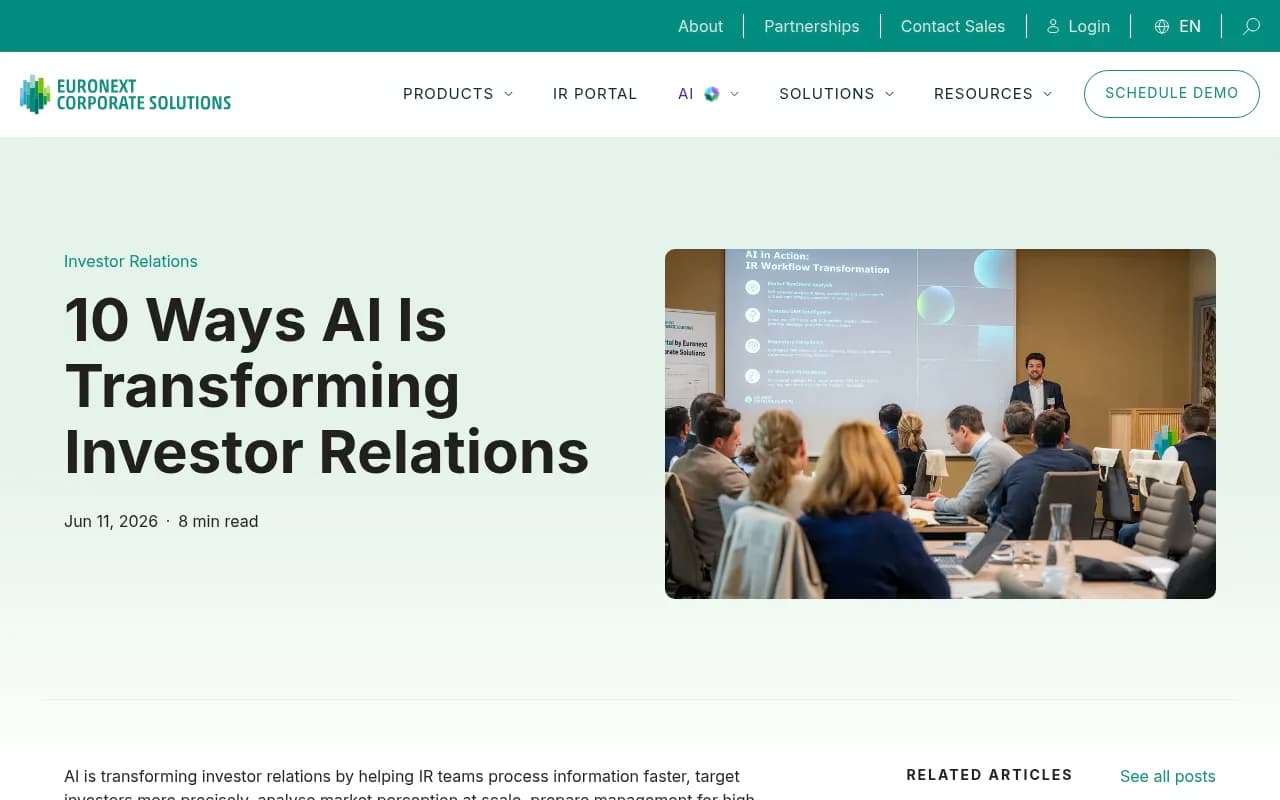
Most coverage focuses on AI as an internal productivity tool: faster peer research, transcript summaries, investor targeting. Euronext's ten-use-case guide is a fair example. That is useful, but it is the smaller half of the story. The other half is the outside view. When a retail investor, a junior analyst or a reporter asks an assistant "what does [your company] do and is it financially healthy," an answer gets assembled from sources you may not control, and you never see it.
There is no regulatory safe harbor for an AI summary that gets your leverage ratio wrong. Your disclosure counsel will not care that a model hallucinated it. Your phones will ring anyway.
How AI answers about your company get built
Two findings from Promptwatch Data shape how you should think about this.
First, branded prompts rely on fewer sources. In Promptwatch's report on unique domains per ChatGPT response (Sep 28 to Oct 4, 2026), 47.6% of cited responses used 10 or more domains. But for brand-specific prompts like "is X company a good investment," only 21.3% did, and the most common count was 5 domains. Roughly 41% cited five or fewer. In practice, a handful of pages decide how ChatGPT describes you: your IR site, a couple of financial data sites, maybe a review page or forum thread.
Second, the types of page matter. In Promptwatch's ChatGPT citation share by content type data, branded prompts cite product pages at 23.3% and landing pages at 22.8%. FAQ pages (4.8%) and press releases (2.1%) earn more on branded prompts than across all prompts. Reviews hit 5.6%, more than three times their overall share.
My reading, and it is an inference rather than a report finding: the pages most likely to shape an investor-flavored answer are your homepage, your about and company pages, a plain FAQ, and third-party profiles. A PDF buried three clicks deep in the IR section is a weak candidate.
Decay matters too. Promptwatch's content half-life data shows news pages lose about half their citations within roughly five weeks, while landing pages and docs hold on for months. Earnings press releases are news-style content. Plan for them to fade, and keep evergreen pages current so they take over.
Where social fits
Do not over-invest in social posts as an AI channel. In Promptwatch's November 2026 social citation data (Oct 11 to Nov 9), social platforms made up 13.16% of Google AI Overviews citations but only 0.64% of ChatGPT's. LinkedIn was 0.20% of ChatGPT citations and 0.78% in AI Overviews. YouTube was the big one in AI Overviews at 6.71%, so earnings call or webcast video has a real shot at Google surfaces. Note the October report covered 7 days and November covers 30, so compare trends with care.
What IR and comms teams actually need to measure
A generic marketing dashboard will hand you a visibility score and call it a day. For IR, the useful questions are narrower.
- What claims does AI make about our financial position, strategy, leadership and risks, and are they accurate?
- Which pages and third-party sources does it pull those claims from?
- How are we described compared with peers an investor might screen us against?
- Does sentiment shift after earnings, a guidance change or a bad news cycle?
- Are AI crawlers able to read our IR site at all? Many IR sites sit behind JavaScript viewers, PDF-only disclosures or aggressive bot blocking.
- Does it differ by market? A European listing and a US ADR may get very different answers in different languages.
That last crawler question is the most overlooked. If GPTBot or ClaudeBot gets blocked or errors out on your IR pages, the model learns about you from someone else's summary. A free Agentic Readiness Check is a decent first test of which AI crawlers can read your site.
The tool categories
The market splits into four groups. Be wary of anyone who claims one tool covers all four.
| Category | What it does | Examples | Best for |
|---|---|---|---|
| IR-specific AI platforms | AI inside IR workflows: targeting, perception analysis, events, IR website tools | Q4, Lumi, IR-Monitor, Presenc | Teams already on an IR suite |
| General GEO and AI visibility platforms | Track prompts across AI engines, citations, sentiment, crawlers, and in some cases fix content | Promptwatch, Profound, Scrunch, Peec AI | Teams that want measurement plus action |
| Enterprise SEO suites with AI add-ons | AI tracking bolted onto an SEO platform | Semrush, Ahrefs Brand Radar, BrightEdge, Conductor | Teams already paying for the suite |
| PR and media monitoring | Traditional coverage tracking, pitching, now with AI features | OnePitch and similar | Press relations and earned media |
I have not verified pricing or feature claims for the IR-specific vendors against primary sources, so check their sites directly. Presenc describes a use case for briefing analysts and managing the investor narrative. IR-Monitor, from MMS Solutions, runs an AI visibility check aimed at investor relations, corporate communications and digital reporting. Q4 positions AEO-optimized IR websites and continuous sentiment analysis as part of its roadmap. Lumi focuses on how AI changes IR events and Q&A.
Tools worth shortlisting
Promptwatch for measurement plus fixing
Promptwatch is an end-to-end AI visibility platform rather than a prompt tracker. For an IR or comms team, the relevant pieces are:
- Brand Narrative, which pulls the individual claims AI makes about you and your peers out of tracked responses and files them under themes like Reputation, Pricing or Features, with a 0-100 score per theme.
- Fact Check, which lets you mark a claim Accurate or Inaccurate, then finds the pages on your site that state it or its opposite. That tells you which page the model is learning the wrong thing from. It is on the Business plan and above.
- Sentiment tracking per response, topic and competitor, with a weekly summary.
- IP-verified AI crawler logs showing whether bots can read your IR pages and where they fail.
- Prompts run on the real interfaces of ChatGPT, Google AI Overviews, AI Mode, Gemini, Perplexity and Copilot, by country and language, so a multi-listed company can see each market separately.
Pricing starts at $95/month (Essential) and $245/month for Professional, with crawler logs from Professional. Business is $579/month and adds Fact Check, the Content Agent and faster-than-daily tracking. Confirm current prices at promptwatch.com/pricing. There is a 7-day free trial on monthly billing and a free AI visibility report if you want a first look without commitment.

Honest caveat: Promptwatch is a general GEO platform, not an IR suite. It will not manage your investor CRM or earnings calendar. Its value is that it closes the loop between what AI says and what you change on your own site.
Profound and Scrunch for enterprise monitoring
Both are strong at monitoring and suit large organizations with procurement processes to match. Expect higher price points. They lean toward dashboards and reporting rather than doing the content work for you.


Peec AI and Otterly.AI for lightweight tracking
If the immediate goal is a simple monthly check of how a handful of branded prompts look across models, these are cheaper and easier to stand up. They generally lack crawler logs and content tooling, which matters if you find problems and then need to fix them.


SEO suites you may already own
If your digital team already pays for Semrush, Ahrefs or BrightEdge, their AI modules are a reasonable starting point. They tend to use fixed prompt sets and shallower AI-specific data than dedicated platforms, so treat them as a pulse check.

PR-side tools
The research for this guide surfaced OnePitch among 2026 PR tools. That category helps with pitching and media lists. It does not tell you what ChatGPT says about your balance sheet.
Comparison at a glance
| Need | Best fit | Why |
|---|---|---|
| Check claims AI makes and flag inaccuracies | Promptwatch (Fact Check, Brand Narrative) | Ties inaccurate claims to the pages causing them |
| Verify AI crawlers can read the IR site | Promptwatch crawler logs, Agentic Readiness Check | IP-verified logs and plain-language errors |
| Investor targeting and IR event analytics | IR-specific suites such as Q4 or Lumi | Built for IR workflows |
| Quick monthly perception snapshot | IR-Monitor, Peec AI, Otterly.AI | Low setup effort |
| Enterprise reporting for a large comms team | Profound, Scrunch | Heavy monitoring, SSO-style procurement |
| Add-on inside an existing stack | Semrush, Ahrefs, BrightEdge | No new vendor |
For more options, the GEO software directory at bestgeosoftware.com lists dozens of platforms by category.
A practical 30-day plan for an IR or comms team
Week 1: baseline
Build a list of 25 to 40 prompts the way an investor would phrase them. Include branded ones ("is [company] a good investment," "[company] debt levels," "who is the CEO of [company]"), competitor comparisons, and open category prompts. Add personas: a retail investor, a sell-side analyst, a journalist. Run them across at least ChatGPT, Gemini, Perplexity and Google AI Overviews.
Week 2: trace and verify
For every response, note which sources got cited and which claims appear. Mark each claim accurate or not. Check with legal and your disclosure committee before correcting anything that touches forward-looking statements. You cannot edit a third-party data site, but you can see which one is feeding the answer, and sometimes you can fix it at the source.
Also check crawler access. Look at robots.txt, bot-blocking rules at your CDN, and whether key IR content exists only as PDFs or in script-rendered viewers.
Week 3: fix owned pages
Based on what branded prompts cite, prioritize:
- A plain-language company overview with business model, segments and leadership
- An IR FAQ answering the questions that came up in your prompts
- Pages for key products or services written in plain text, not images
- Up-to-date leadership and governance pages
- Structured, crawlable versions of key financial highlights, with the formal disclosure linked
Do this through your normal disclosure review. Anything you publish still needs the same sign-off as any other public statement.
Week 4: set the cadence
Schedule recurring runs, ideally weekly, and add event-driven runs around earnings, guidance changes and M&A news. Daily tracking is standard on most platforms; faster cadences exist on higher tiers if you want to watch a live event. Send a short summary to the CFO and head of IR each month: top inaccurate claims, sentiment trend, peer comparison, and what changed on the site.
Pitfalls to avoid
- Treating one visibility score as the whole story. Low visibility, a late position in the answer, and a wrong claim need different fixes.
- Testing only one model. ChatGPT, Google AI Overviews and Perplexity cite different sources, and social citation rates vary widely between them.
- Ignoring language and region. A dual-listed company needs prompts in each investor market's language.
- Chasing social. Per Promptwatch's November data, ChatGPT drew just 0.64% of its citations from social platforms.
- Letting disclosure and AI visibility work run in separate silos. IR, legal and comms should agree on who can publish a clarifying page and how fast.
- Expecting direct control. You influence AI answers through owned pages and the sources around them. You do not dictate them.
Who should do the work
Small IR teams often have no spare headcount for a recurring AI visibility program. If you want outside help with the GEO side, 1001 SEO Media is the agency that publishes this site and works on AI search visibility alongside technical SEO and digital PR. Your disclosure counsel should still review anything published on your IR site.
Bottom line
Start with a baseline run, because most teams are surprised by at least one answer. Use an IR suite for IR workflows, and a GEO platform for the outside view. If you want one tool that measures claims, finds the source page, and tracks whether your fix worked, shortlist Promptwatch and test it on the free trial against your own branded prompts.