Key takeaways
- AirOps is built around "Grids" and multi-step AI workflows, not one-shot generation, and every credible 2026 review says human review is still required, not optional.
- The practical review rate people report is 80-90% approval with edits at the outline and draft stages, not full rewrites.
- Brand Kits and Knowledge Bases cut review time over weeks of use, but they can overcorrect (AirOps has a known habit of stripping negative framing if your brand guidelines say "empathetic").
- The right review checkpoints are ideation, outline, draft, and pre-publish fact-check. Skipping any one of these is where teams get burned.
- If your goal is AI search visibility rather than just publishing volume, pair content production tools like AirOps with a visibility platform such as Promptwatch to see whether the content is actually getting cited.
Why this question keeps coming up
Every few months someone writes a post with a title like "I used AirOps for a month and it didn't suck." That's basically the internet's collective verdict on AirOps right now: cautiously positive, with an asterisk. The asterisk is always the same. AI can draft, but it can't be trusted alone.
AirOps markets itself as a system that connects SEO data, AI models, Brand Kits, Knowledge Bases, and your CMS into reusable workflows called Grids. That's a real distinction from a plain chatbot wrapper. A Grid can pull keyword data, generate an outline, write a draft, check it against brand voice, and push it to Webflow or WordPress, all without you touching each step by hand. But "without touching each step" is not the same as "without checking each step," and that's where most of the confusion about human review comes from.
So let's get specific: where should a human actually sit in an AirOps workflow in 2026, and where is that review basically theater?
What AirOps actually automates
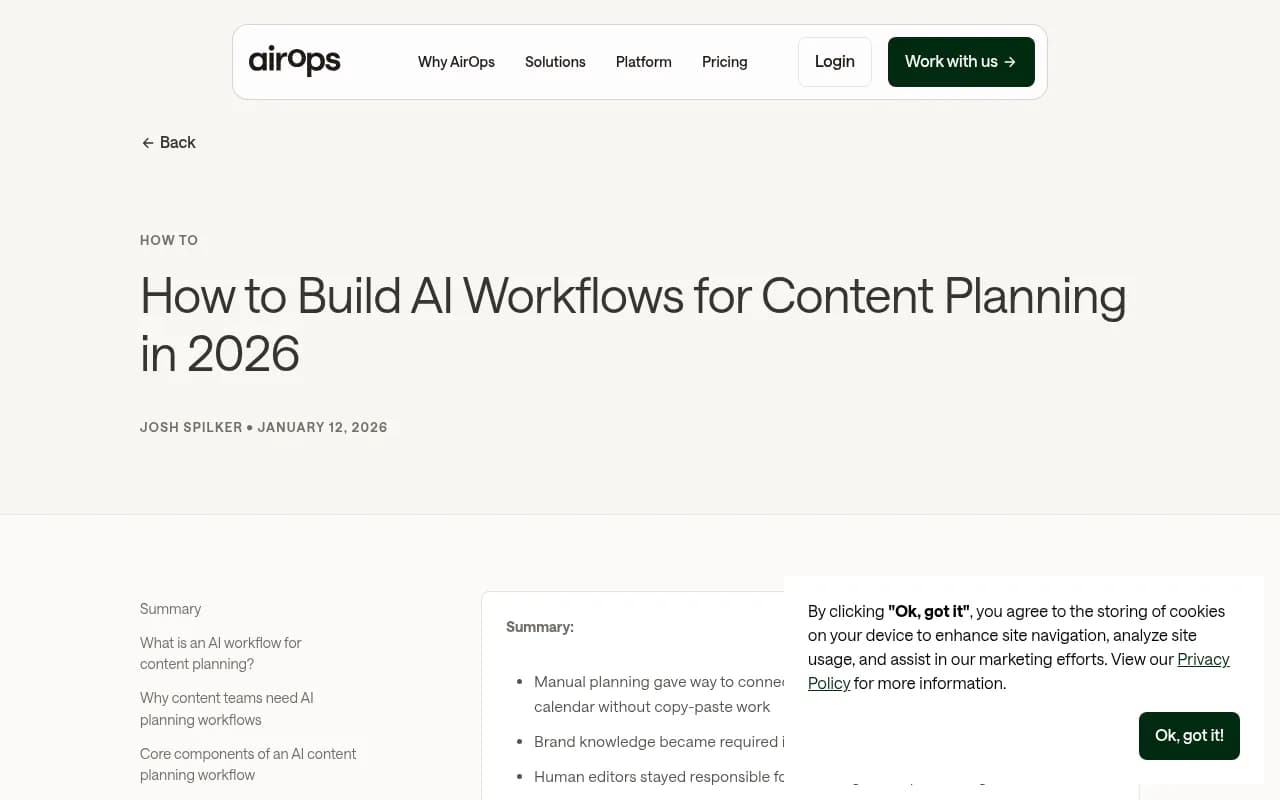
AirOps' own documentation on building AI workflows for content planning is pretty candid about this. It recommends adding human review checkpoints specifically at ideation and draft stages "to protect tone and accuracy," which is a tell. If the company building the tool tells you where to put a human, that's not a minor caveat, it's a structural admission that full autonomy isn't the product yet.
The automatable parts, according to both AirOps and independent reviewers, are:
- Topic research and competitor content analysis
- Generating topic clusters from seed keywords
- Scoring ideas by impact and freshness
- Producing first drafts once an outline is approved
- Refreshing existing content against new SERP or AI Overview data
- Pushing approved content to your CMS
Those are mechanical, data-driven tasks. A human doesn't add much value re-clustering keywords by hand. But notice what's missing from that list: judgment calls about claims, examples, product specifics, and whether the piece actually says anything useful. That's the part nobody has automated away.

The actual review rate people report
One of the more useful data points floating around isn't from a vendor case study, it's from a Reddit user who documented four weeks of daily AirOps use. Their number: roughly 80-90% of AI-generated outputs get approved (sometimes with light edits) before going live, and the rest get rejected outright. That's a meaningful figure because it's not "AI writes it, human rubber-stamps it" and it's not "AI drafts garbage, human rewrites everything." It's somewhere in between, and it lines up with what multiple independent reviews describe.
Scalenut's 2026 review is blunt about it: AirOps "does not remove the need for editors, strategists, and SEO judgment," and treats the tool as something that scales an existing content process rather than fixing a broken one. Marketer Milk's review frames the same idea differently, saying you'll love AirOps if you already have a proven SEO strategy and just need to execute faster, and you'll hate it if you're hoping AI will invent that strategy for you.
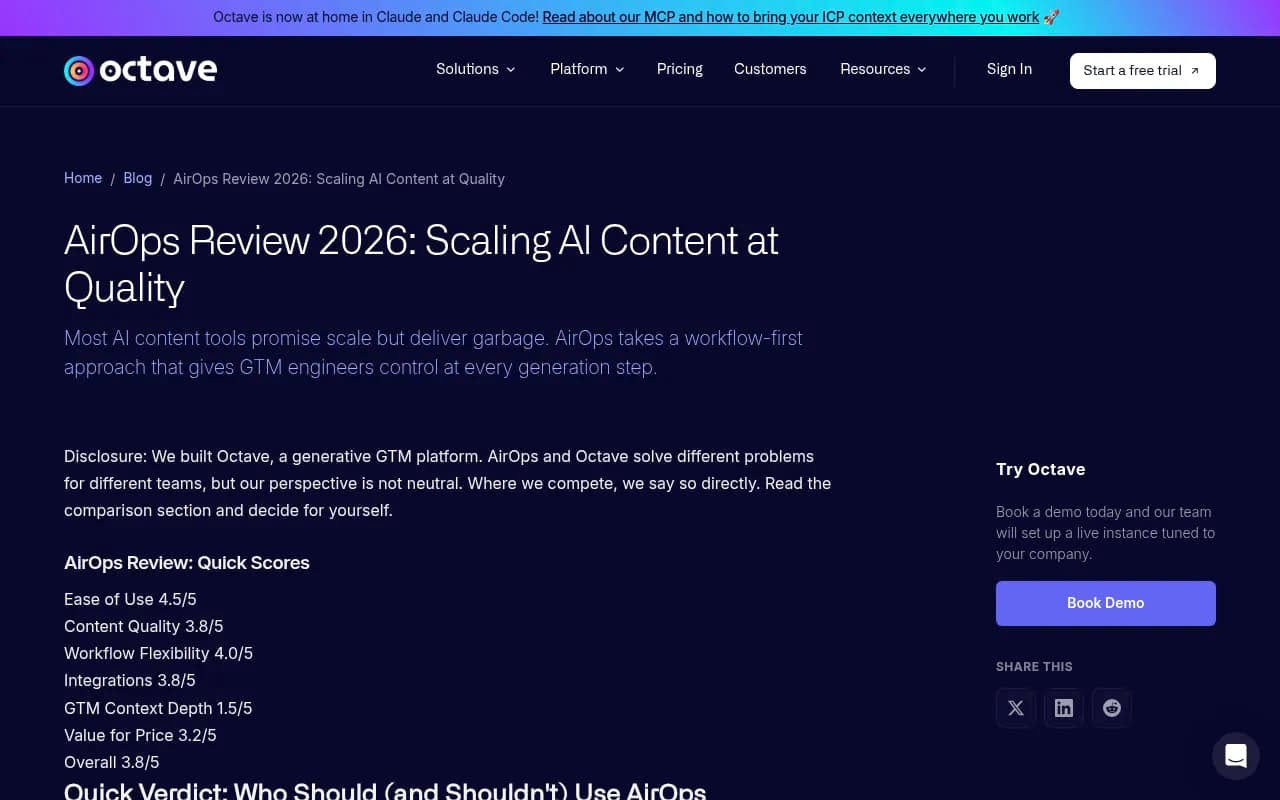
Profound's review adds a specific quality note worth remembering: AI-generated drafts from AirOps are "decent" and cut writing time significantly, but they are "not publish-ready." The same review flags a quirk that's easy to miss until it bites you: if your Brand Kit says your tone should be "empathetic," AirOps can overcorrect and strip out all negative framing, even when a critical point is contextually necessary. It also sometimes mangles formatting during content refreshes. Neither is a dealbreaker, but both require a human to catch before publish.
Where to actually put humans in the workflow
Based on the pattern across every review, here's a practical checkpoint map instead of a vague "review everything" instruction.
Checkpoint 1: Ideation and topic selection
Let AirOps generate and score topic ideas against search intent, competitor gaps, and freshness signals. This is genuinely a place where automation is faster and just as good, maybe better, than a human staring at a keyword spreadsheet. But someone still needs to sanity-check the list against actual business priorities. AI doesn't know your Q4 roadmap or which product launch matters more this quarter.
Checkpoint 2: Outline approval
This is the highest-leverage review point in the entire pipeline. An outline takes 30 seconds to read and catches structural problems before they turn into 1,500 words of wasted generation. If the outline misses an angle, covers the wrong subtopics, or buries the point you actually want ranked, fix it here. Every serious AirOps user interviewed across these reviews treats outline review as non-negotiable.
Checkpoint 3: Draft review for facts, claims, and specifics
This is the one people skip when they're in a hurry, and it's the one that causes actual damage. AI-generated content, per the consistent finding across reviews, "still needs human review to check facts, claims, links, product details, examples, and brand accuracy." Numbers get invented. Product features get described wrong. Examples sound plausible but are made up. None of this is unique to AirOps, it's true of every LLM-based writing tool, but AirOps' scale multiplies the exposure. If you're generating 20 articles a week instead of 2, a 5% hallucination rate becomes a real liability instead of a rounding error.
Checkpoint 4: Pre-publish tone and structure pass
Given the documented tendency to over-apply brand guidelines (stripping valid critical framing) or scramble formatting during refreshes, a final human pass before anything hits the CMS is cheap insurance. This doesn't need to be a full edit, it's closer to a proofread.
What you can safely stop reviewing
Not every step deserves the same scrutiny. Teams that get the most out of AirOps tend to stop manually checking:
- Keyword clustering and topic grouping, once the Brand Kit and Knowledge Base are well-configured
- Metadata and basic on-page SEO elements generated from your existing templates
- Routine content refreshes where the underlying facts haven't changed, just the SERP landscape
The common thread: things with no factual risk and low creative stakes. The moment a task touches claims, numbers, or brand voice on a sensitive topic, put a human back in.
A rough comparison: AirOps vs. lighter alternatives
If AirOps' review overhead feels heavier than your team can support, it's worth knowing where it sits relative to other content tools.
| Tool | Workflow depth | Human review needed | Best for |
|---|---|---|---|
| AirOps | Multi-step Grids: research, draft, brand check, CMS publish | Moderate-high (outline + draft + pre-publish) | Teams with an existing content strategy scaling production |
| Scalenut | Single-pass AI briefs and drafts | Moderate | Smaller teams wanting SEO guidance baked in |
| Jasper | Template-based generation | High | Marketing teams needing many short-form variants |
| Copy.ai | GTM-focused generation | High | Sales and marketing copy, less SEO-native |
| Outranking | Brief-to-draft with SERP data | Moderate | Teams wanting structured SEO briefs |



None of these remove editorial judgment. The difference is mostly in how much infrastructure sits around the drafting step, and how well that infrastructure understands your brand before it starts writing.
The part AirOps doesn't solve: does the content actually get cited?
Here's the thing reviews on AirOps mostly gloss over. Publishing faster and publishing content that AI engines actually cite are two different problems. Profound's own review of AirOps says this outright: AirOps is "built for content production, not AI visibility." You can ship 30 well-reviewed articles a month and still have no idea whether ChatGPT, Perplexity, or Google AI Overviews are pulling from any of them.
That's a separate layer of review, and it's not editorial, it's data-driven. Tools like Promptwatch track which of your pages actually get cited in AI answers, what crawlers hit them, and what traffic comes back from those citations, so you can see whether all that scaled production is translating into visibility or just sitting there.

Promptwatch's citation type breakdowns show that content format matters a lot here. According to Promptwatch's data on ChatGPT citation types in July 2026, product pages led citations at roughly a third of the month's total, with listicles growing fastest. That's worth knowing before you point AirOps at a content plan, because if you're scaling the wrong format, you're scaling invisibility just as fast as you're scaling content.
A practical review budget for 2026
If you want a number to plan around: expect to spend real editorial time on roughly 10-20% of AirOps output as full rewrites or rejections, light-touch editing on another 50-60%, and near-zero touch on the rest, mostly structural and metadata tasks. That roughly mirrors the 80-90% approval rate reported by hands-on users, adjusted for the fact that "approved" often still means "approved with edits," not "approved as-is."
What that means practically: if you're running five articles a week through AirOps, plan for one editor spending meaningful time on at least one full piece, light edits on three, and a quick skim on the last one. That's not a small time investment, but it's a fraction of writing five articles from scratch.
Who should skip the heavy review model entirely
Marketer Milk's review draws a clean line worth repeating: AirOps works well if you already have a proven content strategy and just need to execute it faster. It works badly if you're hoping the tool will invent that strategy, or if you're a solo creator without an existing editorial process to plug it into. In the second case, all the review checkpoints in the world won't save you, because there's no strategic standard to check the output against. You'll be reviewing drafts against a strategy that doesn't exist yet.
If that's you, spend time building a content plan first, potentially with lighter tools, before layering on an at-scale production system. Scaling a messy process just produces mess faster.
For teams that do have that foundation, the honest 2026 answer to "how much human review do you need" is: less than writing from scratch, more than you'd hope, and concentrated almost entirely at the outline and fact-check stages rather than spread evenly across the whole pipeline. Treat those two checkpoints as fixed costs and the rest of the workflow starts paying for itself fast.