Jasper Review 2026
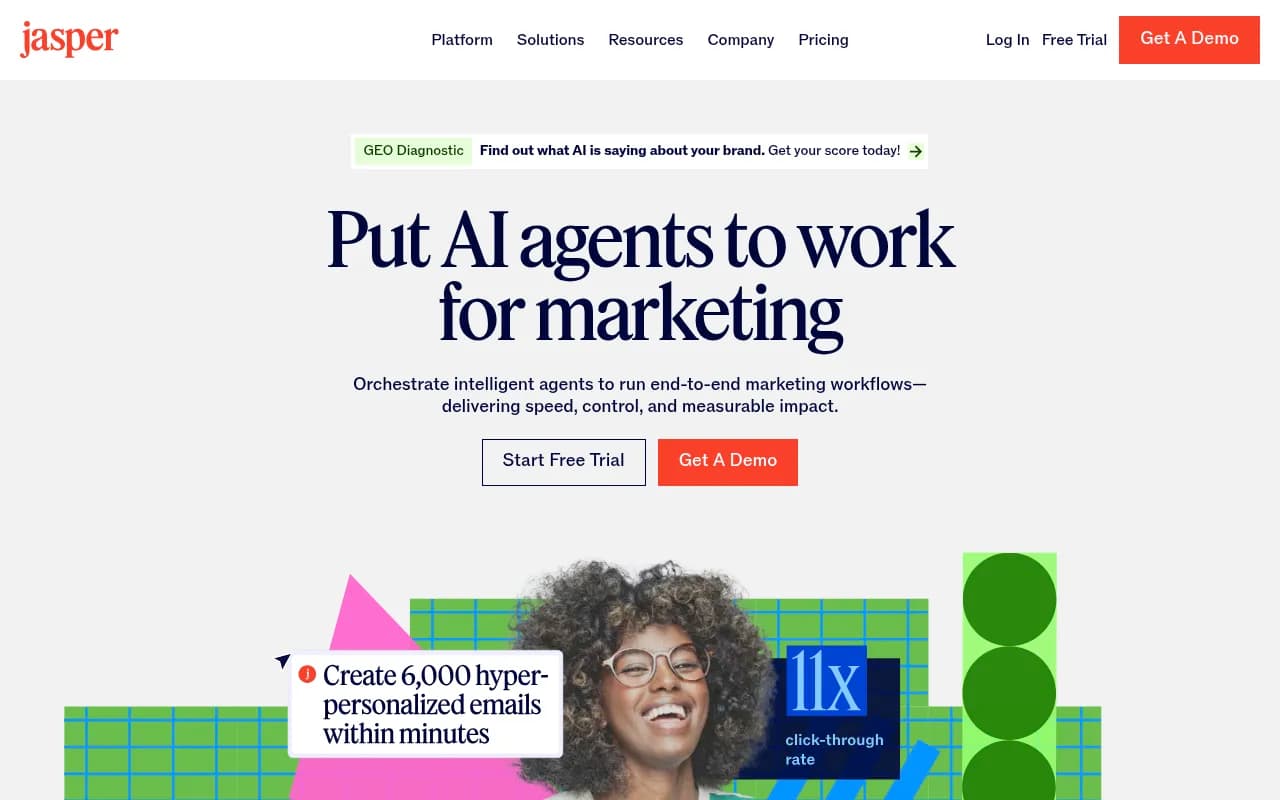
AI writing platform for marketing teams that generates long-form content, ads, emails, and social copy with brand voice controls and collaboration features.
Key takeaways
- Jasper has evolved well beyond a writing assistant into a full marketing execution platform with 100+ purpose-built AI agents, content pipelines, and an enterprise brand governance layer called Jasper IQ.
- The brand voice and style guide system is genuinely one of the best in the market -- it embeds your brand context into every generation automatically, across your whole team, without requiring individual prompting.
- Pricing starts at roughly $59/month (billed annually) for the Pro plan, with enterprise tiers for larger teams -- competitive for the feature set, but not cheap for solo users or small teams.
- The platform has made a serious push into SEO, AEO, and GEO content creation, though it does not offer AI visibility monitoring, citation tracking, or answer gap analysis -- for that, you'd need a dedicated tool like Promptwatch.
- Best suited for mid-market and enterprise marketing teams running high-volume, multi-channel content operations; less compelling for freelancers or small teams who don't need the workflow infrastructure.
Jasper launched in 2021 as Jarvis (later rebranded after a trademark dispute) and quickly became one of the most recognized names in AI writing. It raised $125 million in a Series A round in 2022 at a $1.5 billion valuation, which at the time made it one of the most heavily funded AI writing startups. Since then, the product has shifted direction considerably. What started as a long-form content generator with a library of templates has become something closer to a marketing operations platform -- one that positions itself not as a writing tool but as an "agent workspace" for marketing teams.
The current pitch is about orchestrating AI agents across end-to-end marketing workflows: from research and brief creation through content production, optimization, and localization. That's a meaningful evolution, and the platform has the depth to back it up. Customers like Adidas (7,500 product descriptions in 24 hours), Anthropologie (60% of SEO now automated), and Cushman & Wakefield (10,000+ hours saved annually) suggest the enterprise use case is real. The question is whether the platform's complexity and price point make sense for your team's specific situation.
Key features
Jasper IQ -- the brand intelligence layer
This is the feature that separates Jasper from generic AI tools most clearly. Jasper IQ is a centralized context hub that stores your brand voice, style guides, audience profiles, visual guidelines, and product knowledge. Once configured, it applies that context automatically to every output generated across your team -- no one needs to manually prompt for tone or style. You can maintain multiple brand voices for different sub-brands, regions, or audiences. Admins set the rules once; the system enforces them everywhere. Competitors like Copy.ai and Writesonic offer brand voice features, but Jasper's implementation is more granular and more deeply integrated into the workflow layer.
AI agents for specific marketing jobs
Jasper's agent library now includes 100+ purpose-built agents, each designed for a specific marketing task rather than general-purpose conversation. There are agents for:
- SEO, AEO, and GEO content creation
- Campaign execution and brief generation
- Email and social media copy
- Research and competitive analysis
- Translation and localization
- Performance marketing and ad copy
Each agent applies your Jasper IQ context automatically. Teams can also build custom agents using AI Studio and deploy them across the workspace. This is a genuine differentiator -- most AI writing tools give you a blank canvas and expect you to engineer the right prompts yourself.
Content Pipelines
Content Pipelines are structured, repeatable workflow systems that move work from idea to publication. Think of them as automated assembly lines for content: you define the steps (research, draft, optimize, review, publish), connect your data sources, and Jasper executes the workflow at scale. This is where the platform earns its "marketing operations" positioning. A content team that previously needed to manually coordinate briefs, drafts, edits, and approvals can run the whole process through a pipeline. The Grid feature extends this further, letting non-technical users design and run automations without any coding.
Canvas -- the marketing AI editor
Canvas is Jasper's primary writing environment. It's a document editor with AI assistance built in, designed specifically for marketing content rather than general writing. You can generate long-form articles, repurpose content across formats, and collaborate with teammates in the same document. It's cleaner and more focused than trying to use a general-purpose AI chat interface for marketing work, though it won't feel dramatically different from tools like Notion AI or Google Docs with Gemini if you're already using those.
Image Pipelines and visual content
Jasper handles image generation and editing at enterprise scale through Image Pipelines. The platform claims up to 10x faster production and up to 50% lower cost compared to traditional image production workflows. Image APIs support background removal, cleanup, upscaling, and image decomposition. Visual guidelines from Jasper IQ extend to image outputs, so generated visuals stay on-brand. This multimodal capability is a real advantage over text-only competitors.
SEO, AEO, and GEO content creation
Jasper has a dedicated solution for creating content that targets traditional search, answer engines, and generative AI search results. The optimization agent can rewrite existing content for AEO/GEO/SEO, and the Grid interface shows keyword opportunities with volume and difficulty scores. This is content creation for AI search -- not monitoring or tracking. Jasper helps you write the content; it doesn't tell you how visible you currently are in AI search results or which prompts your competitors are winning. For that kind of visibility intelligence, you'd need a separate tool.
Jasper MCP and API
Jasper's Model Context Protocol (MCP) server lets your brand context travel with you into other AI tools. This means if your team uses Claude, ChatGPT, or other AI assistants for work, Jasper's brand guidelines can be applied there too -- not just inside the Jasper interface. The Jasper API and Image API allow developers to build custom integrations and workflows on top of the platform. This is a smart move for enterprise teams that want to embed Jasper's brand intelligence into their existing tech stack rather than forcing everyone into a new interface.
Enterprise governance and security
Jasper's Trust Foundation covers LLM-agnostic architecture, enterprise-grade security, compliance controls, and governance features. Admins can set content rules, manage team permissions, and audit outputs. The platform is designed to meet the requirements of regulated industries like financial services and healthcare -- both of which are listed as target verticals. This level of governance is largely absent from mid-market AI writing tools.
Who is it for
Jasper's sweet spot is mid-market and enterprise marketing teams running high-volume, multi-channel content operations. Think a 20-50 person marketing org at a B2B SaaS company, a retail brand managing product descriptions across thousands of SKUs, or a global enterprise that needs to localize campaigns across multiple regions and languages. The platform's value compounds with scale -- the more content you need to produce consistently, the more the brand governance layer and pipeline automation pay off.
Content marketing teams at companies with established brand guidelines will get the most out of Jasper IQ. If you've spent months documenting your brand voice, tone, and style only to watch individual contributors ignore it when prompting ChatGPT, Jasper's approach of embedding those rules into the generation layer directly solves that problem. Performance marketing teams running A/B tests across dozens of ad variations will also find the agent and pipeline infrastructure genuinely useful.
Industries where Jasper has documented traction include financial services, healthcare and life sciences, retail and consumer goods, technology, and media. These tend to be sectors with strict brand compliance requirements, high content volume, and the budget to invest in enterprise software. Smaller companies in these sectors can use Jasper, but they may find the workflow infrastructure overkill if they're producing a handful of pieces per week.
Who should probably look elsewhere: freelance writers who want a simple AI writing assistant (tools like Claude or ChatGPT are cheaper and more flexible for solo use), small startups with no established brand guidelines to enforce, and teams whose primary need is AI search visibility monitoring rather than content creation. Jasper creates content for AI search; it doesn't track how visible you are in AI search results.
Integrations and ecosystem
Jasper connects with a range of marketing tools, though the integration depth varies. Notable integrations include:
- Google Docs and Chrome Extension -- write with Jasper assistance directly in Google Docs or any web-based text field
- Webflow, WordPress, and other CMS platforms -- publish content directly from Jasper
- Zapier -- connect Jasper to hundreds of other tools through automated workflows
- Surfer SEO -- SEO optimization layer that can be applied to Jasper-generated content
- Copyscape -- plagiarism checking built into the workflow
- Salesforce and HubSpot -- CRM integrations for personalization use cases
The Jasper API and MCP server are the most powerful integration paths for technical teams. The API lets developers build custom workflows, while MCP allows Jasper's brand context to be used inside other AI tools. The partner ecosystem (accessible at ecosystem.jasper.ai) includes professional services partners who can help implement Jasper for specific use cases.
A Chrome extension is available for writing with Jasper assistance across the web. There's no dedicated mobile app mentioned, which is a gap for teams that need to create content on the go.
Pricing and value
Jasper's pricing has shifted over time and the current structure reflects its enterprise positioning:
- Pro plan: approximately $59/month billed annually ($69/month billed monthly). Covers advanced AI features for multiple brands and team collaboration.
- Business/Enterprise plan: custom pricing. Includes the full agent library, content pipelines, advanced governance, dedicated customer success, and enterprise security features.
- Free trial: available without requiring a credit card upfront.
The pricing is competitive for enterprise marketing software but meaningfully more expensive than general-purpose AI tools. If you're comparing Jasper to a ChatGPT Teams subscription at $30/user/month, the math only works in Jasper's favor if your team actually uses the brand governance and pipeline features. If you're mostly using it as a writing assistant, you're overpaying.
Compared to direct competitors: Copy.ai's enterprise plans are similarly priced, Writesonic's team plans start lower but lack the governance depth, and tools like Writer (which targets a similar enterprise brand compliance use case) are in a comparable price range. Jasper's image generation capabilities add value that text-only competitors can't match.
Strengths and limitations
What Jasper does well:
- Brand governance at scale -- the Jasper IQ system is genuinely well-built. Embedding brand voice, style guides, and audience profiles into every generation automatically, across an entire team, is hard to do and Jasper does it better than most.
- Agent specialization -- having 100+ purpose-built marketing agents rather than a single general-purpose chat interface means the outputs are more reliably useful for specific marketing tasks.
- Multimodal content production -- text and image generation in one platform, with brand guidelines applied to both, is a real operational advantage for teams that manage visual content at scale.
- Enterprise trust infrastructure -- the governance, compliance, and security features make Jasper viable for regulated industries where generic AI tools aren't appropriate.
- Customer success and community -- the Jasper Foundations courses, community, and dedicated customer success team mean enterprise buyers get real implementation support, not just a software license.
Honest limitations:
- No AI visibility monitoring -- Jasper creates content for AI search but doesn't track how visible your brand is in AI search results. There's no citation tracking, no answer gap analysis, no prompt monitoring across ChatGPT, Perplexity, or other LLMs. If you want to know whether your content is actually getting cited by AI models, you need a separate tool for that.
- Complexity overhead for smaller teams -- the pipeline and agent infrastructure is powerful but requires investment to set up properly. Teams without dedicated marketing ops resources may find the learning curve steeper than expected.
- Pricing transparency -- the enterprise tier pricing is custom and opaque, which makes it hard to budget without going through a sales process. This is common for enterprise software but frustrating for teams trying to evaluate options quickly.
Bottom line
Jasper is a serious platform for marketing teams that need to produce high volumes of on-brand content across multiple channels, formats, and markets. The brand governance layer, agent specialization, and content pipeline infrastructure are genuinely well-built and address real problems that enterprise marketing teams face. If your team is large enough to justify the investment and complex enough to benefit from the workflow automation, Jasper is one of the strongest options available in 2026.
The best use case in one sentence: a 30-person marketing team at a mid-market B2B or retail company that needs to produce consistent, on-brand content at scale across SEO, email, social, and paid channels -- without every piece requiring manual brand review.
Frequently asked questions
What is Jasper and what does it do?
How much does Jasper cost?
How is Jasper different from ChatGPT or Claude?
Does Jasper support image generation?
Can Jasper help with SEO and AI search optimization?
Who is Jasper best suited for?
Similar and alternative tools to Jasper