Key takeaways
- AirOps is a workflow-first content operations platform, not a writing assistant. It's built for teams that want to systematize repeatable research-to-publish pipelines at scale.
- The platform's strength is its Grid feature, which lets you run one workflow across hundreds of inputs simultaneously. This is genuinely useful for large content libraries.
- The learning curve is real. Teams without an established content strategy or technical capacity will likely struggle to get value quickly.
- AirOps has limited native AI search visibility monitoring. If your goal is to track and improve how you appear in ChatGPT, Perplexity, or Google AI Overviews, you'll need a separate tool for that.
- It's best suited to SEO teams, content-led growth teams, and agencies that already know what they want to produce and need to do it faster.
What AirOps actually is
There's a lot of confusion about what AirOps does, partly because the platform has rebranded a couple of times and partly because "AI content tool" covers a huge range of things in 2026.
AirOps is not a writing assistant like Jasper or Writer. It's not an SEO content optimizer like Clearscope or Surfer SEO. It's a workflow platform. The core idea is that you build a multi-step AI pipeline once, then run it at scale. Think: pull a keyword, research the SERP, generate an outline, write a draft, apply brand voice guidelines, push to CMS. That whole chain, automated.
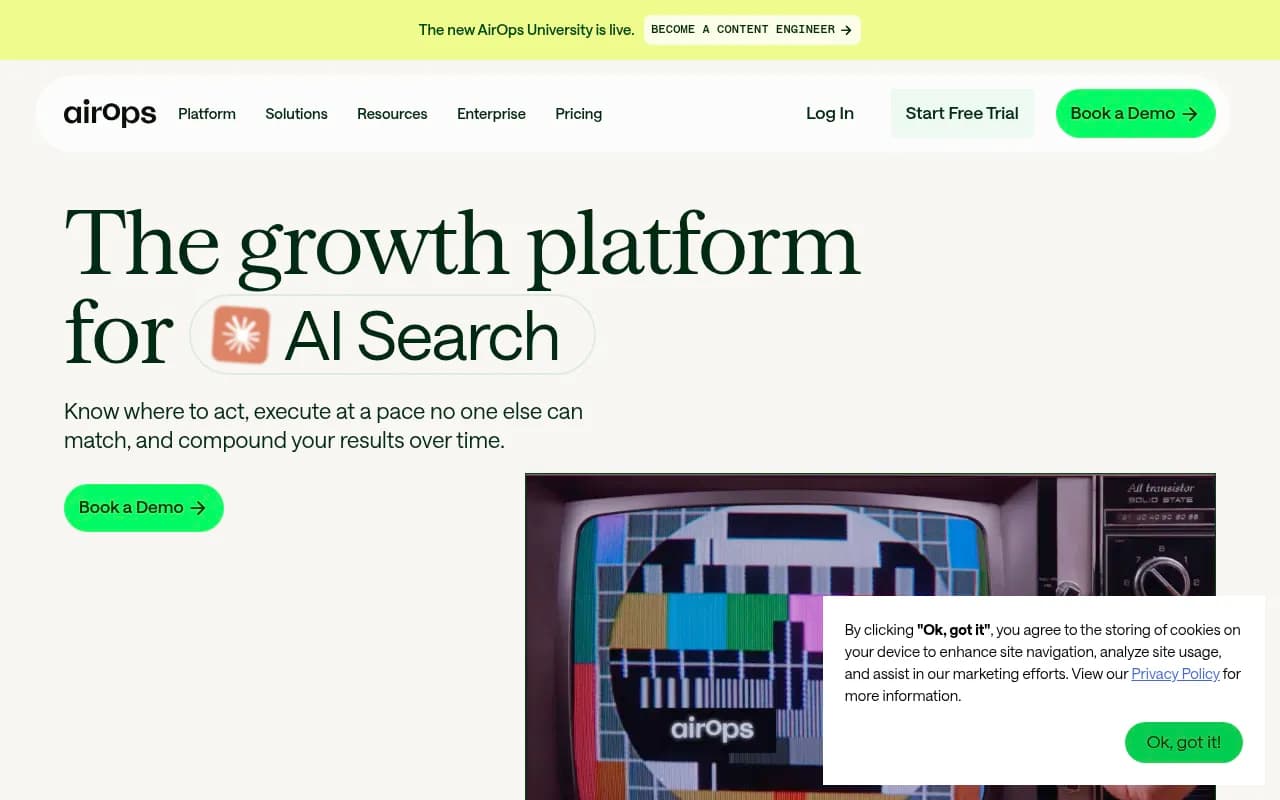
Companies like Webflow, Ramp, and Carta use it, which tells you something about the target market. These aren't small blogs. They're teams with content operations at scale who need to systematize what they're doing.
The platform is organized around three concepts:
- Insights: analyzing your current visibility and competitive positioning
- Actions: building and running AI-powered workflows
- Context: feeding the system your brand guidelines, internal knowledge, and tone
That structure makes sense on paper. Whether it works in practice depends heavily on your team's capacity to build and maintain those workflows.
Core features worth knowing about
The workflow builder
This is the heart of AirOps. You connect steps visually, each step being an AI action, a data lookup, a web search, a CMS write, or a conditional branch. It's genuinely powerful once you understand it.
The honest caveat: it has a steep learning curve. Several reviews from G2 and community forums mention that the first few weeks feel more like engineering work than content work. If your team is used to clicking "generate" and editing, this will feel different. You're essentially building software, just with a no-code interface.
For teams that push through that initial friction, the payoff is real. You can build a workflow that takes a list of 500 keywords and produces 500 research-backed briefs overnight. That's not something most tools can do.
Grid
Grid is AirOps's batch execution feature. You run one workflow across many rows of input simultaneously. The use cases here are obvious: bulk content refreshes, generating meta descriptions at scale, producing location pages, updating product descriptions.
This is probably the most practically useful feature for high-volume SEO teams. Reviewers on Rankability's blog specifically called it out as the feature that justifies the subscription cost for agencies.
SEO and CMS integrations
AirOps connects to major CMS platforms and pulls in SEO data to inform content generation. The integrations mean you can close the loop between research and publishing without manually moving content between tools.
The depth of these integrations varies. Some reviewers note that the CMS push works smoothly; others have hit friction with custom setups. Worth testing with your specific stack before committing.
AI model flexibility
You're not locked into one AI model. AirOps lets you choose which model runs each step of your workflow, which matters if you have strong opinions about GPT-4o vs. Claude for different tasks. This is a meaningful differentiator from tools that give you one model and call it a day.
What AirOps gets right
Repeatability at scale. The whole point of the platform is turning a proven content process into something that runs without manual intervention. For teams that have figured out what good content looks like for their audience, AirOps lets them produce it consistently.
Brand and context controls. You can feed the system your brand guidelines, style docs, and internal knowledge. This reduces the amount of editing needed after generation, which is where most AI content tools break down in practice.
Workflow depth. Most AI writing tools are single-step: prompt in, content out. AirOps supports genuinely complex multi-step pipelines. That's a different category of tool.
Real user adoption. The G2 reviews and community feedback are generally positive for teams that fit the target use case. One agency founder quoted across multiple reviews reported a 3x efficiency gain. That's not universal, but it's not a fluke either.
Where AirOps falls short
The complexity tax
The workflow builder is powerful, but it asks a lot. You need someone on your team who can think in systems, not just in content. For smaller teams or those without technical capacity, the setup cost is high relative to the value you get in the first month.
This isn't a criticism unique to AirOps. Any workflow automation tool has this problem. But it's worth being honest about: if you're a two-person content team, you'll probably get more done with a simpler tool.
AI search visibility is not the focus
This is the most important gap to understand in 2026. AirOps helps you produce content. It does not deeply help you understand how AI search engines like ChatGPT, Perplexity, or Google AI Overviews are currently citing your brand, what prompts your competitors are winning that you're not, or how to close those gaps.
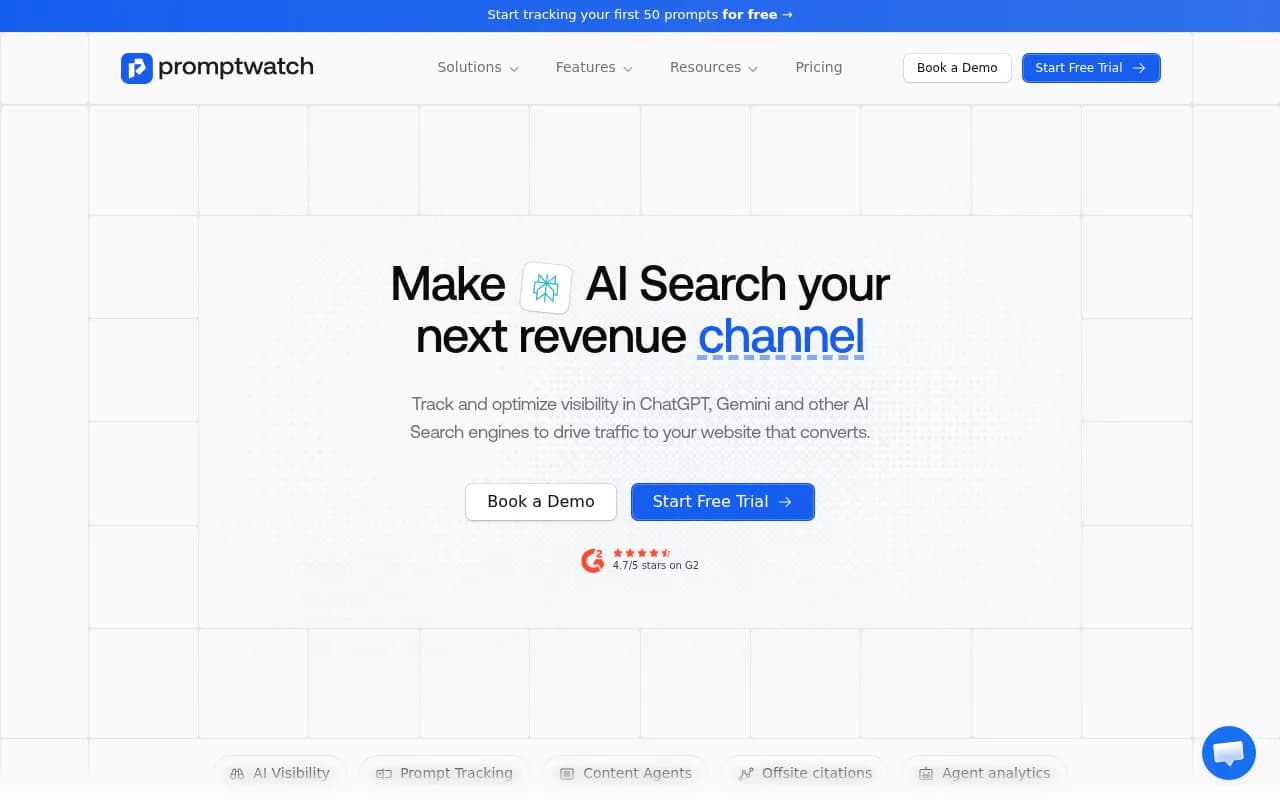
The platform has some visibility features, but they're not the core product. If your primary goal is GEO (Generative Engine Optimization) and you want to track and improve your presence in AI-generated answers, you'll need a dedicated tool for that. Platforms like Promptwatch are built specifically around that problem, with answer gap analysis, AI crawler logs, and content generation grounded in real prompt data.
Pricing is a real consideration
AirOps sits at the higher end of the content tool market. The research from Slate's pricing breakdown notes that the cost can be hard to justify without a clear workflow already in mind. Teams that sign up without a specific use case tend to underutilize it and churn.
The ROI calculation works best when you can point to a specific workflow you're running manually today and estimate the time savings from automating it. Without that anchor, the price feels abstract.
It's not for content strategy beginners
Multiple reviews make this point clearly: AirOps works best when you already have a strong content strategy foundation. It's an execution accelerator, not a strategy tool. If you're still figuring out what topics to target, which audience personas matter, or what your content differentiation is, AirOps won't answer those questions for you.
Real user feedback
The community feedback across G2, Product Hunt, and Reddit is fairly consistent:
- Teams that fit the target profile (high-volume SEO, agencies, content-led growth) tend to rate it highly
- The most common complaint is the learning curve and setup time
- Several users mention that the quality of output depends heavily on how well you've built your workflow and context
- Smaller teams or those without a clear use case upfront tend to be disappointed
One pattern worth noting: the positive reviews almost always mention a specific workflow the team automated. The negative reviews tend to be from people who signed up hoping the tool would figure out their content strategy for them. That gap in expectations explains a lot of the variance in ratings.
How AirOps compares to alternatives
AirOps occupies a specific niche. It's not trying to be an all-in-one SEO platform or a simple writing assistant. That makes direct comparisons tricky, but here's a practical breakdown:
| Tool | Primary focus | Best for | Complexity | AI visibility monitoring |
|---|---|---|---|---|
| AirOps | Workflow automation | High-volume content teams | High | Limited |
| Jasper | AI writing | Marketing copy at scale | Low | None |
| Surfer SEO | Content optimization | SEO-focused writers | Medium | None |
| Clearscope | Content grading | Editorial teams | Low | None |
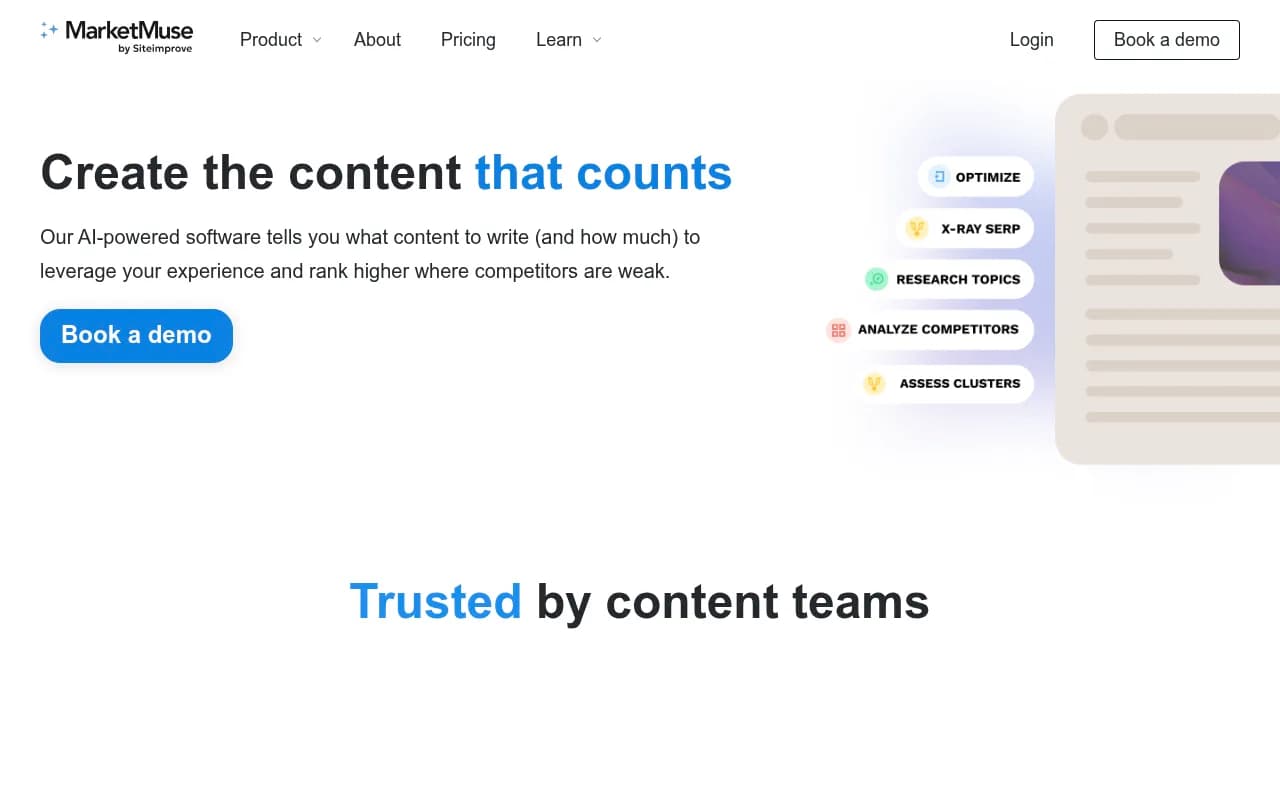
| MarketMuse | Content strategy | Planning and briefs | Medium | Limited |
| Promptwatch | GEO / AI visibility | Brands tracking AI search | Medium | Full |
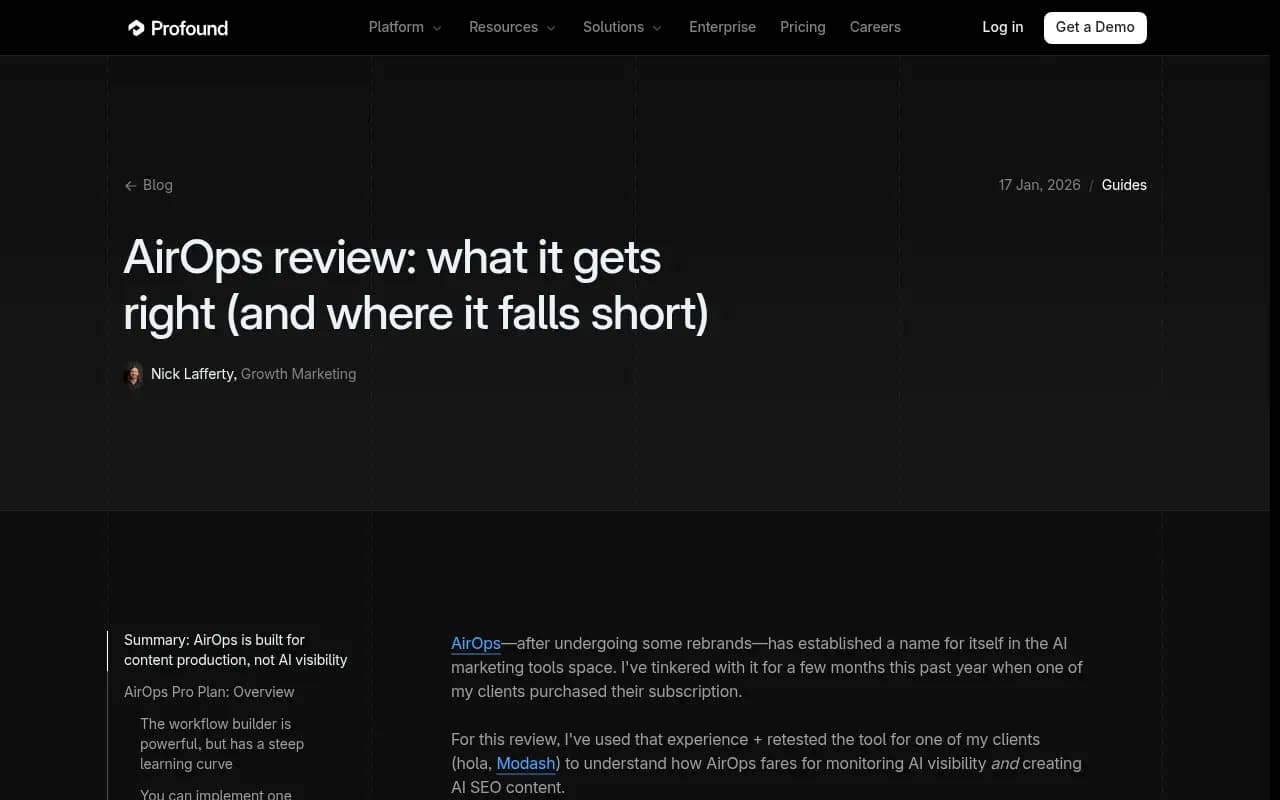
| Profound | AI visibility + content | Enterprise teams | Medium-High | Strong |




The key distinction: if you need to produce content faster and you already know what to produce, AirOps is a serious option. If you need to figure out what content to produce to win in AI search, you need something different.
Who should use AirOps in 2026
AirOps makes sense for you if:
- You run an SEO or content team producing at volume and want to systematize your research-to-publish process
- You have an established content strategy and need execution speed, not strategic direction
- You have someone on your team (or can hire one) who can build and maintain workflows
- You're an agency managing multiple clients and need repeatable processes across accounts
- You can identify a specific workflow you're currently doing manually that costs significant time
AirOps probably isn't right for you if:
- You're still developing your content strategy and need guidance on what to create
- You have a small team without technical capacity to build workflows
- Your primary goal is tracking and improving AI search visibility
- You want a simple tool you can use on day one without a setup investment
The AI visibility gap: what AirOps doesn't cover
This deserves its own section because it's the most relevant gap for 2026.
The search landscape has shifted. A growing share of user queries now get answered directly by AI models, with citations to specific sources. Being cited in ChatGPT's answer to "best project management software" or Perplexity's response to "how do I reduce customer churn" is now a real traffic and brand visibility channel.
AirOps helps you produce content. It doesn't tell you which prompts AI models are answering, which competitors are getting cited for those prompts, or what content gaps you need to fill to start appearing in AI-generated answers.
That's a separate problem that requires a separate tool. If you're running AirOps for content production, you'll want something alongside it that handles the visibility side. Promptwatch is built specifically for this, tracking how brands appear across ChatGPT, Perplexity, Claude, Gemini, and others, and showing you exactly which content gaps are costing you citations.
Verdict
AirOps is a well-built platform for a specific type of team. If you're running high-volume content operations and need to systematize repeatable workflows, it delivers real value. The Grid feature alone can save significant time for teams refreshing large content libraries or producing location pages at scale.
But it's not a strategy tool, and it's not an AI visibility platform. The complexity is real, the setup cost is real, and the ROI depends almost entirely on whether you have a clear workflow to automate before you sign up.
For teams that fit the profile, it's worth the investment. For everyone else, there are simpler tools that will get you further faster without the overhead.
If you're evaluating AirOps alongside other options, the most important question to ask yourself is: do I need to produce content faster, or do I need to understand where I'm invisible in AI search? Those are different problems, and the right tool depends on which one you're actually trying to solve.