Key takeaways
- No tool fixes generic content on its own. The least generic output comes from what you feed it: your product facts, your data and your editors. The software mostly decides how easily that context gets applied.
- Jasper is the easiest to adopt and holds brand voice steadily at volume, but the one third-party test I found still rated its slop level High.
- Writer is the strictest. It grounds output in a Knowledge Graph and style rules, which suits regulated teams, and can feel restrictive for punchy campaign copy.
- AirOps gives you the most control over how content gets made, through custom workflows and data inputs. It also has the steepest learning curve and the least transparent pricing.
- I found no independent head-to-head test that includes all three. Treat every ranking below, including mine, as directional.
What generic actually means
Generic content is not bad grammar. It is content that could have been published by any competitor. It has the same structure, the same hedged claims, the same "in today's fast-paced world" opening. Readers notice. So do AI search engines, which have plenty of near-identical pages to choose from.
That last point is worth a number. In Promptwatch Data's report on content types cited by ChatGPT (Sep 28 to Oct 4, 2026), product pages were 22.4% of classified citations and landing pages 16.8%. Together that is about 39% going to pages that say plainly what a company sells. For commercial prompts, product pages hit 26.0% and landing pages 20.6%. Specific, factual pages get cited. Vague thought-leadership filler mostly does not.
So the useful question is not "which tool writes best?" It is "which tool makes it hardest to publish something that could have come from anyone?" Three things matter:
- How well it stores and applies your brand voice.
- How well it grounds drafts in your real facts and data.
- How much it forces a human to make decisions along the way.
The short version
| Jasper | Writer | AirOps | |
|---|---|---|---|
| Core idea | Brand-governed marketing agents | Governance and grounded enterprise workflows | Custom content workflows you design |
| Voice and context layer | Jasper IQ (Brand IQ, Product IQ) | Personality profiles, style guides, Knowledge Graph | Brand Kits and Knowledge Bases |
| Data inputs | Limited to what you load | Connectors and Knowledge Graph | DataForSEO, Moz, Search Console, Reddit, YouTube and more |
| Ease of use | Easiest of the three | Moderate, enterprise setup | Steep, expect weeks to learn |
| Pricing | Pro $59/seat/mo annual, $69 monthly | Starter per seat (no figure published), Enterprise custom | Solo, Pro, Enterprise, no verified public dollar prices |
| Best for | Marketing teams at volume | Regulated and compliance-heavy teams | Content engineers and ops-heavy teams |
Pricing comes from vendor pages and search snippets. Confirm on each site before you budget.
Jasper: consistent voice, easy start
Jasper now sells itself as an agent workspace with 100+ marketing agents. The context layer is Jasper IQ, split into Brand IQ (Brand Voice, Style Guide, Visual Guidelines) and Product IQ (Knowledge). It has also added a GEO and AI optimization product.
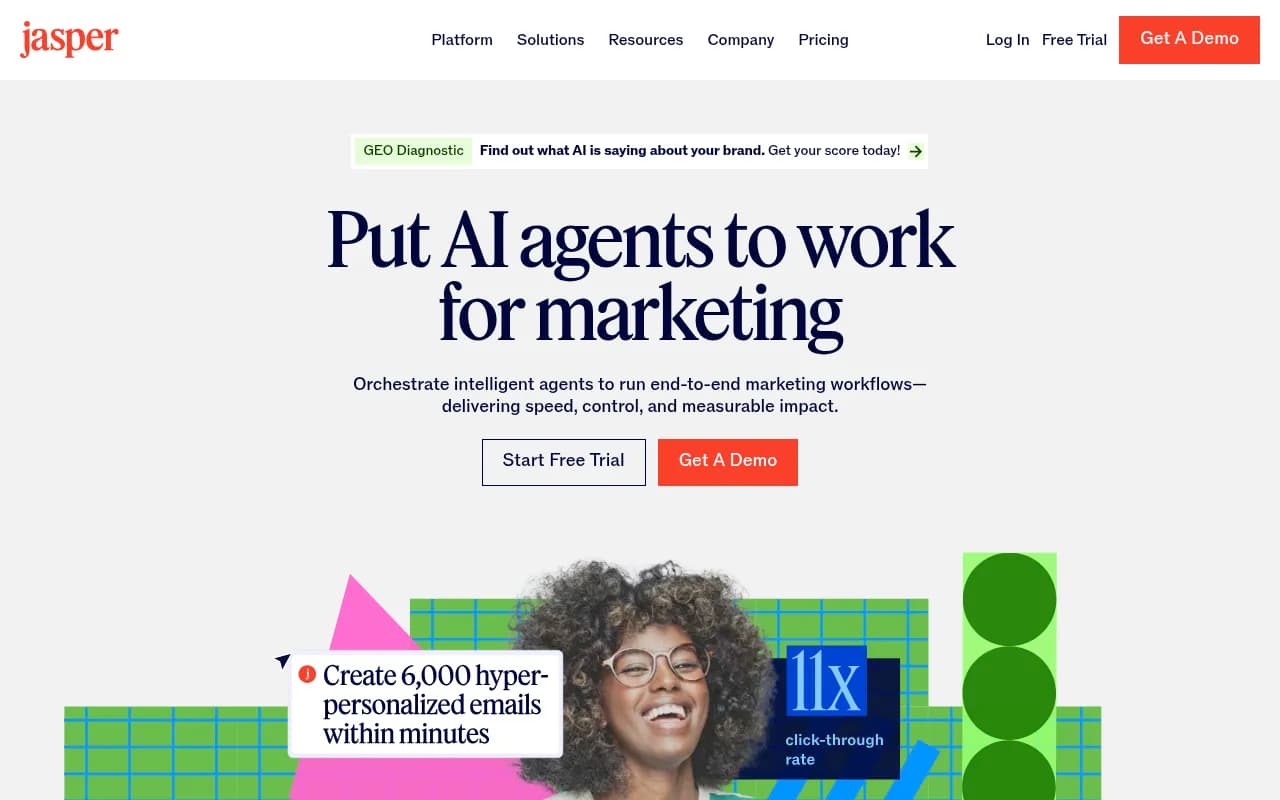
Pro is $59 per seat per month billed annually, or $69 monthly, with 1 seat, 2 Brand Voices, 5 Knowledge assets and 3 Audiences. Business is custom priced with a 12-month minimum and adds Advanced Agents, Grid, the AI App Builder and API access. Some older reviews quote $39 or $99 plans. Those conflict with Jasper's own page, so ignore them.
Where it avoids generic output
Brand voice stays steady as volume rises. That is the pitch, and reviewers who like Jasper say the same thing. If you have ten people producing copy and need it all to sound like one company, this is the least painful way to get there.
Where it still reads generic
Voice is not the same as substance. Jasper can sound like you while saying what everyone says. ContentMonk's September 2026 test rated Jasper's AI slop level High, with article scores of 3.0 to 3.3 out of 5. Keep in mind that ContentMonk sells a competing product, and its own tool scored 4.6 to 4.8 in the same table. I would not take those numbers at face value. But the complaint, drafts that need heavy editing for personality and fact-checking, matches what a lot of user reviews describe.
Another gap: Jasper has no real AI search tracking, so you cannot easily see whether your published pages get cited.
Writer: governance first
Writer takes the opposite route from a creative tool. It ingests brand guidelines, style guides and legal rules into a Knowledge Graph and constrains output at generation time. Personality profiles set tone, and playbooks and routines handle repeatable workflows.
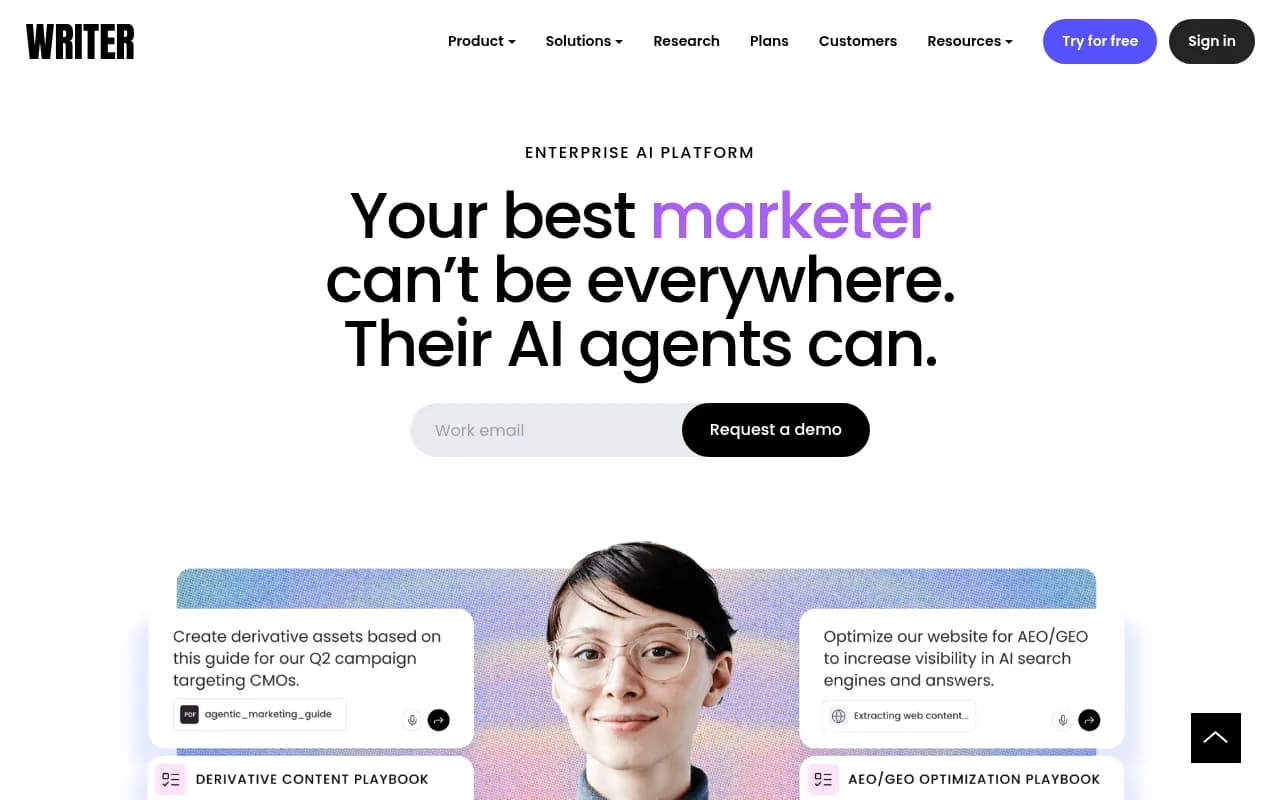
Starter has a 14-day trial with no card, up to 5 users, 5 Playbooks, 1 team Personality profile, up to 3 active connectors and 50 GB in one Knowledge Graph. It is priced per seat but the page shows no dollar figure, and one third-party roundup lists $18 to $25 per user per month. Enterprise is sales-led and adds unlimited playbooks, departmental voice profiles, advanced guardrails, audit logs, SOC 2 Type II and a HIPAA BAA. Writer says it does not train on customer data by default.
Where it avoids generic output
Grounding. If your Knowledge Graph holds accurate product specs, approved claims and real customer language, drafts have something specific to say, and the guardrails stop the model from wandering into invented claims. For a bank or a healthcare company, that matters more than flair.
Where it still reads generic
A strict system produces safe text. Safe text is often bland text. One roundup puts it plainly: Writer is not a creative writing tool, and the governance-first approach can feel restrictive for punchy ad copy or campaign landing pages. It also appears to target teams with serious budgets. A third-party guide claims content budgets under $10k a month are a poor fit, though that is one reviewer's opinion, not a published rule.
AirOps: you design the system
AirOps calls itself a content engineering platform. You build workflows, Grids and agents that connect research, drafting, optimization and publishing. Brand Kits and Knowledge Bases supply context, and there are content review steps, quality scores and human approvals. It integrates with Webflow, WordPress, DataForSEO, Moz, Reddit and YouTube, and has moved toward answer engine visibility with Insights.
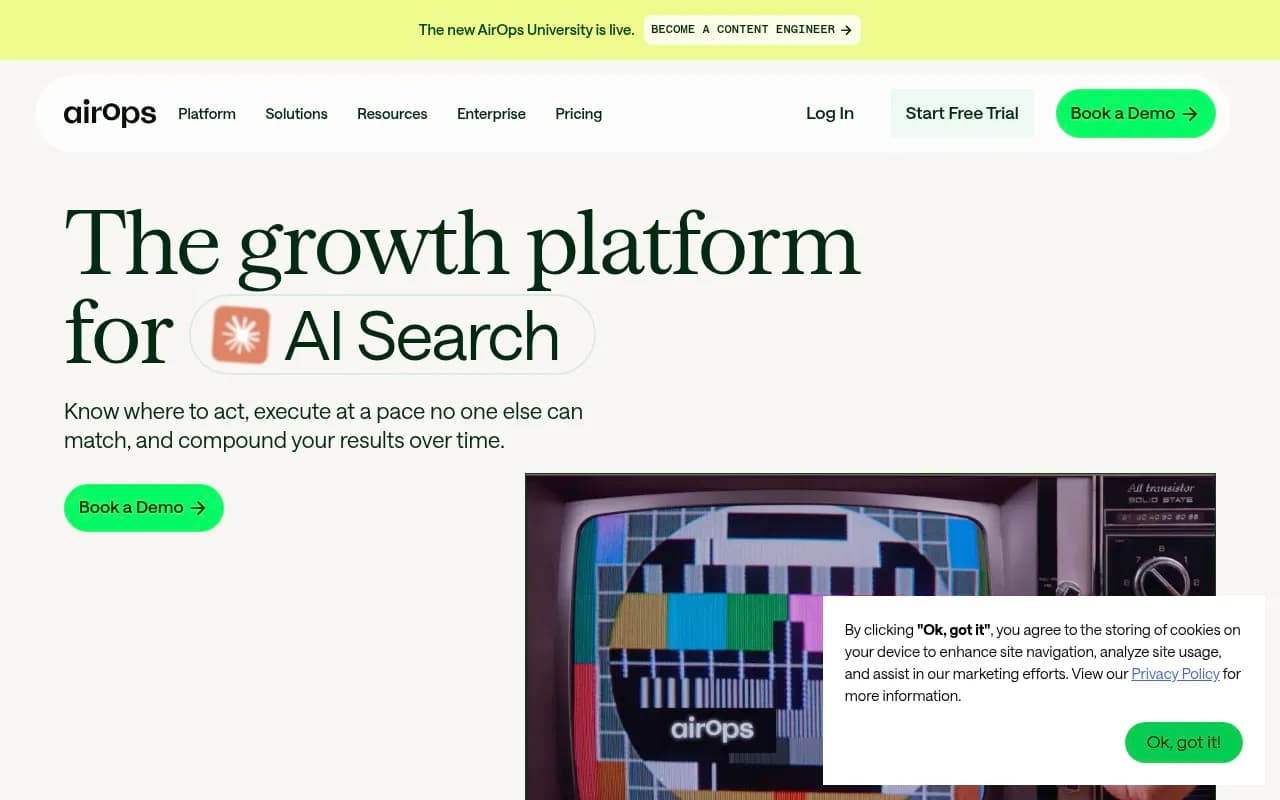
The tiers are Solo, Pro and Enterprise. Solo covers ChatGPT insights only, with 35,000 tasks, 1 Brand Kit, 3 Knowledge Bases and one user. Pro covers insights across 10+ answer engines, 100,000 tasks, 5 Knowledge Bases and unlimited seats. Enterprise has custom limits and 1:1 onboarding. I could not verify dollar prices. Third-party articles put Solo around $200 a month and Pro anywhere from $2,000 up, and they contradict each other, so ask for a quote.
Where it avoids generic output
This is the one where you can inject real inputs. You can pull live search data, community threads and your own first-party numbers into the workflow before a word gets drafted, then require a human approval at set points. Generic output usually comes from thin inputs. AirOps lets you fix the inputs.
AirOps says it is more flexible than Writer or Jasper, which it describes as centered on preset templates. That is a vendor talking about competitors, so read it as positioning. Still, the architectural point holds: a workflow builder is a different kind of tool from a template library.
Where it still reads generic
Setup quality caps output quality. ContentMonk's test scored AirOps article quality at 2.9 to 3.2 out of 5, with a Mid slop rating, better than Jasper on slop but not on every article type. It also rated AirOps hardest to use, 2.5 for ease against Jasper's 4.0, and said it burned through tasks fast: roughly 6 to 7 articles from 25,000 tasks when they tested, about 9 to 10 at today's 35,000. Reviewers on G2 mention a learning curve, and the same source suggests two to four weeks to proficiency. Again, competitor-authored. But the direction is plausible.
What the one test says (and does not)
Here are ContentMonk's scores for the two tools it tested out of our three, on the same inputs:
| Content type | Jasper | AirOps |
|---|---|---|
| Top-of-funnel article | 3.3 | 3.1 |
| Bottom-of-funnel article | 3.1 | 3.2 |
| Ebook | 3.0 | 2.9 |
| Success story | 3.2 | 3.0 |
| Slop level | High | Mid |
The gap is tiny. Neither tool wins by enough to matter, and the author sells a rival product. Writer was not tested at all. I found no independent test with all three, so anyone who tells you they have a clear winner on "least generic" is guessing or selling something.
What actually reduces generic output
Whichever you pick, the same habits do most of the work.
Load things only you have
Product specs, pricing, customer quotes, support tickets, sales call notes, internal benchmark data. Any of the three tools will produce sharper drafts with these than without. This is also what AI search rewards: Promptwatch's advice from the citation data is to keep specs, prices and positioning complete and factual, and to publish comparison pages.
Write the brief like a person
State the angle, the opinion and the one thing the reader should do. A brief that says "write a blog post about X" gets the average of everything written about X.
Keep a human decision in the loop
AirOps has approval steps built in. In Jasper and Writer, make your own. Someone should have to choose the angle and cut the filler before anything ships.
Ban the tells
A short list of phrases you never want to see, added to the style guide in whichever tool you use, catches a surprising amount of slop.
Check whether it gets cited
Publishing is not the finish line. Jasper has no AI search tracking and AirOps's is limited by tier, so a separate monitor helps. Tools like Promptwatch can show whether the pages you ship actually get crawled and cited by ChatGPT and other AI engines.

If you want more options in this space, the GEO software directory lists dozens of tools that sit around the writing step.
Which one should you pick?
Pick Jasper if
You have a marketing team that needs consistent output fast, nobody has time to learn a workflow builder, and you accept that editing is part of the job. It is the easiest on-ramp and the cheapest published entry price of the three.
Pick Writer if
Legal or compliance review sits between your draft and your publish button. The Knowledge Graph and guardrails are built for that. Skip it if your main need is lively campaign copy or you are a small team on a tight budget.
Pick AirOps if
You have, or can hire, someone technical who enjoys building systems, and you want content shaped by your own data. Budget for onboarding time, and get a written quote before you commit. If you only want a quick drafting tool, it is the wrong purchase.
A quick decision table
| Your situation | Best fit |
|---|---|
| Small marketing team, need speed, little setup time | Jasper |
| Regulated industry, approvals and audit logs required | Writer |
| Large content operation with a workflow engineer | AirOps |
| Brand voice consistency across many writers | Jasper or Writer |
| Content built from live data and bulk refreshes | AirOps |
| Need to see AI search citations for what you publish | AirOps Pro, or a dedicated tracker |
Cheaper or lighter options
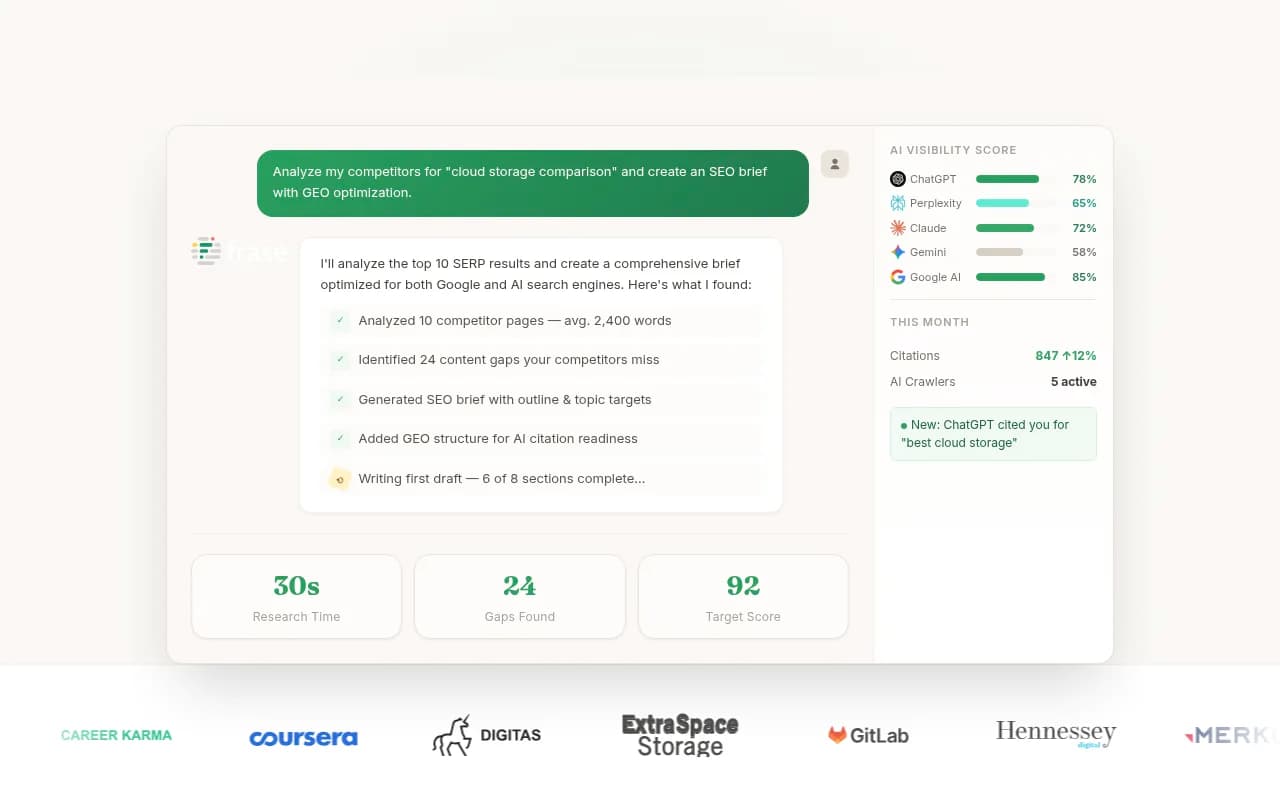
If none of the three fits, a few catalog tools take different angles. Surfer SEO and Frase are optimization and research tools first. Copy.ai suits short sales and GTM copy. Rytr is the budget pick for short pieces, though its output is basic.


For a wider look at the category, SurferStack has reviews and comparisons of writing and SEO tools.
Bottom line
If I had to rank them purely on the odds of getting non-generic output, I would put AirOps first for teams that can run it well, Writer first for teams where accuracy beats personality, and Jasper first for teams that need decent output this week. That is judgment, not data. The only test I found is biased and does not include Writer. Run your own: give all three the same brief and the same internal facts, and see which draft you would be least embarrassed to publish. Most of them offer a trial, and Writer's Starter plan has 14 days with no credit card.