Key takeaways
- AirOps is a content workflow platform with an insights layer. Promptwatch is an AI visibility platform with a content layer. The starting point is different, and so is the strength.
- If you already know what to publish and need to scale production across many URLs, AirOps fits. If you need to find out why you are not cited and what to fix first, Promptwatch fits.
- Promptwatch tracks 10+ AI interfaces from the real UI, and adds crawler logs, AI traffic attribution and site audits. AirOps' free Solo tier covers ChatGPT insights only.
- Content does not stay cited forever. Promptwatch Data shows news pages lose half their citations in 36 days, so refresh matters as much as new output.
- Many teams will end up using both ideas: a visibility layer to decide, a production layer to execute. Check current pricing on both sites before buying.
The short version
These two tools get compared constantly, and they are not really the same kind of product. That is the whole story, and the rest of this guide is detail.
AirOps grew out of content operations. You build workflows, brand kits and knowledge bases, then run them across hundreds of pages. Its insights layer was added to tell you what to produce.
Promptwatch started from the other end: measure how AI engines talk about you, find the gaps, then generate and publish content against those gaps and check whether it worked.

So the question is not "which is better". It is whether your bottleneck is production or diagnosis.
Side-by-side comparison
| AirOps | Promptwatch | |
|---|---|---|
| Core idea | Content workflows and automation, with AI search insights | AI visibility tracking and optimization, with agentic content |
| Entry point | Solo, free to start (ChatGPT insights only) | Free Explore plan (ChatGPT, 10 prompts); paid from $95/mo |
| Engine coverage | ChatGPT on Solo, 10+ answer engines on Pro | ChatGPT, AI Overviews, AI Mode, Copilot, Gemini, Perplexity, Meta AI, Alexa, Claude, Codex and more on every paid plan |
| Content production | Tasks, Grids, playbooks, human review, version history | AEO articles, Content Agent (Business+), Content Refresh, CMS publishing |
| Crawler logs | Agent Analytics listed under Intelligence | IP-verified AI crawler logs, crawl-to-citation path |
| Publishing | Webflow, WordPress and more, plus MCP and API | WordPress, Webflow, Framer, plus MCP and REST API |
| Pricing | Pro and Enterprise are custom or not clearly listed | Public tiers: $95, $245, $579, agencies from $199 |
| Best for | Teams that know what to produce and need volume | Teams that need to find out why they are invisible and fix it |
AirOps' paid prices were not visible on its pricing page when I checked, so treat that column as a prompt to ask for a quote rather than a fact.
What AirOps does well
The honest strength of AirOps is production at scale. Grids run a workflow across a long list of URLs at once. Brand Kits and Knowledge Bases keep output consistent. There is human review, approval, version history and quality scoring, which matters when you have an editorial team that does not want to publish raw model output.
It also integrates with the stuff content teams actually live in: Webflow, WordPress, Airtable, Asana, Google Docs, DataForSEO and Moz.
Third parties describe it similarly. A ReachLLM roundup says AirOps is better when you already know what to produce and mainly need workflow automation. ReachLLM sells a competing product, so take it with salt, but the description matches what AirOps ships.
The weaker side, per Profound's comparison (another competitor, so again biased), is narrow engine coverage, API-based data and output that tends to need cleanup. I could not verify how AirOps collects its data, so I will not repeat that as fact. What is verifiable: the free Solo plan shows ChatGPT insights only, and broader coverage arrives on Pro.
AirOps also publishes useful thinking on measurement. Its AI search metrics guide argues for tracking citations and mentions together, and claims brands that earn both are 40% more likely to resurface across multiple AI answers.
What Promptwatch does well
Promptwatch's pitch is that visibility data should drive the work. It monitors the real user interfaces of ChatGPT, Google AI Overviews, AI Mode, Gemini, Perplexity, Copilot and others, not only APIs, because user-facing answers and citations can differ from API output.
From there the chain is:
- Prompt tracking with volumes, difficulty and query fan-outs, so you see which prompts are worth chasing.
- Crawler logs that show whether GPTBot, ClaudeBot, PerplexityBot and friends can actually read your pages, and what errors they hit.
- Visitor analytics that tie AI referrals to real traffic and conversions.
- Content gap analysis that maps your pages against the prompts AI answers.
- The Action Board, an AI-generated to-do list, plus the Content Agent that plans, writes and publishes to Webflow, Framer or WordPress, then tracks whether the page got crawled and cited.
That last step is the point. Most tools in this space stop at the dashboard. Promptwatch sends underperforming pages back as actions.
The common criticism, from Omnia's alternatives roundup, is that prompt caps climb in price and that the content layer writes articles without always explaining why you lose a specific prompt. That is a fair thing to test in a trial. Omnia's price figures ($99 and $249) are slightly off Promptwatch's own pricing page ($95 and $245), so use the official page.
What the citation data says about content
This is where the production-versus-diagnosis question becomes concrete. Promptwatch Data has two findings that matter for anyone running a content pipeline.
First, what gets cited. In Promptwatch's ChatGPT citation share by content type report (Sep 28 to Oct 4, 2026), product pages were 22.4% of classified citations and landing pages 16.8%. Listicles were 13.6%, how-tos 8.7% and comparisons 5.9%. For commercial prompts, product pages, landing pages, listicles and comparisons made up almost 70% of citations.
A blog-heavy production engine can miss that. If 39% of citations go to pages describing what you sell, volume of articles is not the only lever.
Second, how long citations last. In Promptwatch's content half-life study (pages cited July 6, 2026, tracked to Oct 4, 2026), 78% of landing pages and 76% of docs were still cited after 30 days. News lost half its pages within 36 days. Product pages, reviews and how-tos reached half-life at 74 to 77 days.
Publishing is not a one-time event. Pages decay, and you need something that tells you which ones. That is a visibility tool's job, and it is why a pure production workflow can leave money on the table.
Pricing: what you can actually compare
Promptwatch publishes its prices. AirOps mostly does not, at least not in the version I could read.
| Plan | Promptwatch | AirOps |
|---|---|---|
| Free | Explore: 1 project, 10 prompts, ChatGPT only | Solo: free to start, ChatGPT insights, 35,000 tasks, single user |
| Entry paid | Essential $95/mo: 50 prompts, 6,000 responses, all models, 500 Agent Credits | Pro: 10+ answer engines, 100,000 tasks, unlimited seats (price not shown) |
| Mid | Professional $245/mo: 150 prompts, 5 AEO articles, Knowledge Base | n/a |
| Upper | Business $579/mo: 350 prompts, Content Agent, local GEO targeting, Ads Radar | Enterprise: custom |
| Agencies | Kick-off $199, Growth $399, Scale $799 | Custom |
Promptwatch's 7-day trial applies to monthly Essential, Professional and the agency Kick-off and Growth plans. Confirm everything at promptwatch.com/pricing and with AirOps sales.
Who should pick which
Pick AirOps if
- You already have a prompt and keyword list and your real problem is shipping hundreds of pages.
- You have technical staff who like building workflows, and an editorial process to clean output.
- You want one environment for briefs, drafts, review and publishing, with insights as a secondary feed.
Pick Promptwatch if
- You do not yet know why competitors are cited and you are not. Crawler logs, citation data and gap analysis answer that.
- You need to prove AI traffic and conversions, not only mentions.
- You track multiple markets, languages or locations, or you care about Reddit, YouTube and LinkedIn citations, AI shopping or ads in AI answers.
- You are an agency that wants white-label reports and client workspaces.
Consider both if
A reasonable setup is Promptwatch to decide what to build and measure the result, and a production workflow tool for whatever your team prefers to write in. That said, Promptwatch's own Content Agent and Content Refresh cover a lot of the production side, so many teams will not need a second tool. Test that before paying twice.
Other tools worth a look
If neither fits, the field is wide. A few that sit near this comparison:
- Content-first: Frase, Surfer SEO and Clearscope for optimization, Writesonic GEO for generation plus monitoring.
- Monitoring-first: Otterly.AI, Peec AI and Profound.
- Suites bolting on AI tracking: Semrush and Ahrefs Brand Radar.



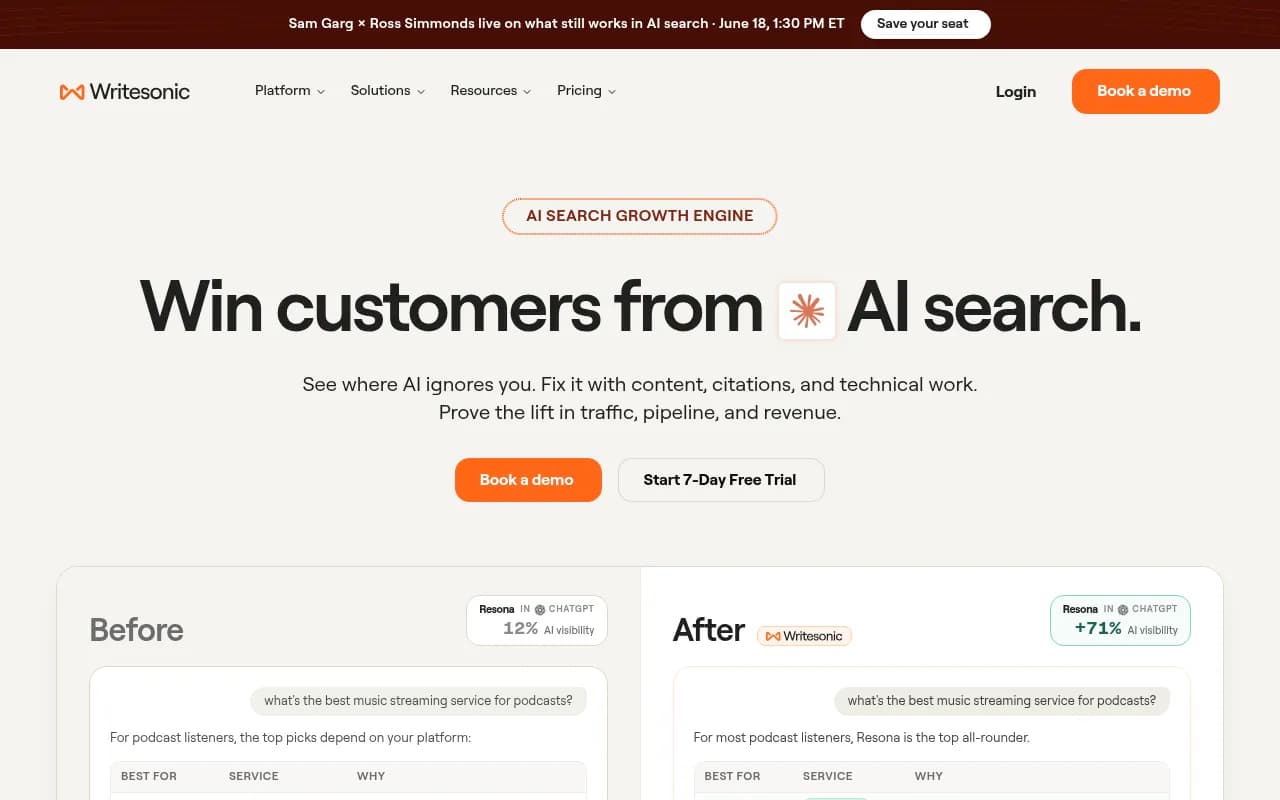
For a longer list, the GEO software directory at bestgeosoftware.com is a decent place to browse by category.
How to run a fair trial
- Pick 20 to 30 prompts that matter commercially, across informational, comparison and brand queries.
- Record where you are cited today, and by whom, in each tool.
- Check whether each tool tells you why you lose a prompt, not only that you do.
- Produce five pieces of content in each workflow. Count the edits needed before you would publish.
- Wait three to four weeks and see whether crawlers visited, whether pages were cited, and whether any traffic arrived.
The last step is where tools separate. Many can write a page. Fewer can tell you what happened to it afterwards.
Verdict
AirOps is the better choice when execution speed is the constraint. Promptwatch is the better choice when you do not yet know what to execute, or when you need evidence that the work is moving AI visibility and revenue. Given that citation share is concentrated in product and landing pages and that content decays on a schedule, I lean toward starting with the visibility data and letting it set the production queue. Start with Promptwatch's free tier or a trial, and bring a content workflow tool in only if volume becomes your real problem.