Key takeaways
- Product pages, not blog listicles, are now the most-cited content type on ChatGPT Search (32.8% of citations in July 2026, nearly double March's share), so your PDPs are doing SEO and GEO work whether you've optimized them or not.
- Reddit's role in ChatGPT citations collapsed from roughly 3.8% to under 1% in mid-August 2026, while it barely moved on Google AI Overviews. Any monitoring strategy built around "just get cited on Reddit" is already out of date.
- ChatGPT Shopping's product-card feature only shows up on a low single-digit percentage of responses, and OpenAI appears to toggle it on and off for categories rather than rolling it out organically. That's a strong argument for having your merchant feed and Product schema ready before you need them, not after.
- The category splits into two real jobs: brand/citation monitoring (does AI mention us, where, how favorably) and SKU-level shopping visibility (does AI recommend our specific products, with what price and image). Few platforms do both well.
- General GEO tools like Promptwatch cover the citation and crawler side extremely well; ecommerce-native tools like Ranketta, Alhena AI, and Yotpo Discover add catalog-level tracking most general tools skip entirely.
Why retail brands need a different kind of AI monitoring
A shopper asking ChatGPT "what's a good winter jacket for someone who runs cold" isn't going to click through ten blue links and compare. The model picks a handful of brands, maybe names specific products, and moves on. If you're not in that shortlist, you don't just lose a click, you lose the sale entirely, and you may never know it happened.
That's a different problem than classic brand monitoring. A software company mostly cares whether AI describes it accurately. A retailer cares about something narrower and more mechanical: which SKUs get named, whether a product card renders with your price and image, and whether your PDP is the page AI actually pulled the answer from. Generic "AI visibility" tools built for SaaS companies often stop at the brand-mention level and never get down to the product.
The data backs up why this matters right now. Promptwatch's citation-type tracking shows product pages overtaking every other content format on both ChatGPT Search and Google AI Overviews during the summer of 2026, per Promptwatch's ChatGPT citation types data for July 2026 and the parallel AI Overviews report. That's good news for retailers with clean, well-structured PDPs, and bad news for anyone whose product pages are thin, outdated, or missing schema.
What actually separates a good platform from a spreadsheet with alerts
Before comparing specific tools, it's worth being honest about the traps in this category. A lot of "AI visibility" tools are really just automated prompt-and-log services: they ask an LLM the same 20 questions every day and email you a screenshot. That's not nothing, but it's not enough for a retail operation with a catalog of thousands of SKUs and a margin that depends on Buy Box positioning.
A handful of things separate a platform worth paying for from one that's just noise:
- Coverage of the engines your shoppers actually use, not just ChatGPT. Perplexity holds a steady ~10 sources per response, Google AI Overviews around 10, but ChatGPT dropped to roughly 4.7-4.9 average sources per response after the GPT-5.3 rollout on March 4, 2026 and never recovered, according to Promptwatch's average sources per response data. Fewer slots means more competition for each one.
- SKU or product-level tracking, not just brand mentions. Knowing your brand was named is weaker signal than knowing which specific product, at what price, with what image.
- A feedback loop from insight to action. A dashboard that tells you you're invisible on a topic is only half the job; the other half is fixing the page, the feed, or the schema that's causing it.
- Crawler-level visibility. If GoogleOther, ClaudeBot, or Meta-WebIndexer can't reliably crawl your product pages, none of the above matters. Meta-WebIndexer alone jumped from about 2% to nearly 38% of tracked AI crawler requests between mid-July and early August 2026, per Promptwatch's Meta crawler report, which means a robots.txt rule written a year ago could now be quietly blocking a fast-growing crawler.
The platforms worth evaluating
| Platform | Best for | Product/SKU-level tracking | Engines covered | Starting price |
|---|---|---|---|---|
| Promptwatch | Brands wanting citation data plus content agents that fix gaps | Page and content-type tracking, not SKU-native | ChatGPT, Gemini, Claude, Perplexity, Grok, AI Overviews, AI Mode, Copilot, and more | $95/mo |
| Yotpo Discover | Shopify/Salesforce/Adobe Commerce brands at $10M+ GMV | Yes, via Onsite/Content/Activation agents | ChatGPT, Gemini, AI Overviews, Perplexity, Claude | Custom |
| Ranketta | DTC and marketplace brands wanting catalog feed enrichment | Yes, SKU-level plus feed cleanup | ChatGPT, AI Overviews, AI Mode, Gemini, Perplexity, Copilot | €29/mo (Tracker) |
| Alhena AI | Brands wanting per-SKU shopping-card detail | Yes, tracks whether product card rendered with price/image | ChatGPT, AI Overviews, Perplexity, Gemini | $199/mo |
| Profound | Enterprise/Fortune 500 with dedicated analysts | Shopping Analysis module, Enterprise tier only | ~10 LLMs including ChatGPT, Perplexity, Gemini, Claude, Grok, DeepSeek | $99/mo (limited) |
| AthenaHQ | Shopify brands wanting revenue attribution | Correlates citation spikes with sales, directional not exact | 8+ LLMs | Free tier or $295/mo |
| Birdeye Search AI | Multi-location/franchise retail | Location-level, not SKU-level | ChatGPT, Claude, Perplexity, Gemini, AI Overviews/Mode, Grok | Custom |
| Otterly.ai | Small brands starting out | No | ChatGPT, AI Overviews, Perplexity, Copilot | $29/mo |
Promptwatch: best all-round GEO platform with an execution layer
Promptwatch isn't built exclusively for ecommerce, but it's worth including because most ecommerce-native tools stop at monitoring, and Promptwatch doesn't. It tracks citations, sentiment, and share of voice across every major model, including the ones a lot of competitors skip like Grok, DeepSeek, and Mistral, and it backs that with AI crawler logs that show exactly when ChatGPTBot, ClaudeBot, or GoogleOther hit your product and category pages and whether they errored out.

What makes it relevant here specifically: its citation-type classification (the same data behind the product-page-dominance numbers above) lets a retail team see, page by page, whether AI is pulling answers from PDPs, category pages, or comparison content, then act on it through Content Agents that draft and publish GEO-optimized pages straight to Webflow, Framer, or WordPress. It also tracks Reddit and YouTube citations separately, which matters given how differently those platforms now perform across engines, and it has a dedicated Ads Radar for ChatGPT Shopping placements, useful if competitors are bidding against your prompts. Pricing starts at $95/month for a single site with 50 prompts, scaling to $245/month for the Professional tier that adds shopping insights and automated content generation.
Ecommerce-native options: Yotpo Discover, Ranketta, Alhena AI
If your entire operation is a Shopify or Salesforce Commerce catalog, the ecommerce-native tools earn their keep by going where general GEO platforms don't: down to the SKU.
Yotpo Discover ships as three active agents, an Onsite Agent, a Content Agent, and an Activation Agent, built specifically for brands already on Shopify, Salesforce Commerce, Adobe Commerce, or BigCommerce. Its pitch is turning verified shopper reviews into a ranking signal AI models can actually read, which matters more than it sounds given how much weight AI answers put on trust signals over raw keyword density.
Yotpo Discover
Ranketta leans into a genuinely different data-collection method: it interacts with AI models through the real web UI, like an actual shopper would, rather than relying on APIs that can return cleaner, sanitized responses than what a person actually sees. It pairs that with feed enrichment, cleaning catalog data and pushing it back out to Google Merchant, Shopify, or generic XML/JSON feeds, plus an MCP server so Claude Desktop or Cursor can query your prompt and citation data directly. Its entry tier starts at €29/month, though catalog enrichment only kicks in at the €79/month Starter plan.
Alhena AI focuses tightly on the shopping-card question: not just "was my brand mentioned" but "did AI render a product card with my price, rating, and image, or just name-drop the brand in passing." It syncs live from Shopify, WooCommerce, Magento, or Salesforce Commerce Cloud, and cites case studies of a 3x conversion lift and 38% higher AOV for one skincare brand using its broader platform. Pricing runs from a free tier up to $999/month at the Scale plan.
Enterprise and vertical-specific tools
Profound is the heaviest hitter for brands with dedicated analyst teams and separate content agencies already in place. Backed by a $35M Series B from Sequoia in August 2025, it sends millions of prompts daily across roughly ten models and, on its Enterprise tier, offers a Shopping Analysis module tracking product placement, image presence, and retailer benchmarking inside AI shopping conversations. What it doesn't do is feed enrichment or content rewriting, so a mid-market DTC team ends up buying a second tool to close the loop.
AthenaHQ differentiates on attribution: native Shopify and GA4 integration lets you correlate a citation spike with a sales spike per SKU, though it's worth treating that correlation as directional rather than precise accounting. Its free "Essential" tier burns through credits fast under real monitoring load, so budget for the $295/month Self-Serve plan if you're tracking more than a handful of prompts.
Birdeye Search AI is the right call specifically for multi-location or franchise retail, where per-location visibility (does the local store show up when someone asks AI about a nearby option) matters as much as brand-level visibility. It pairs monitoring with an agent that checks Google Business Profile and Apple Business Connect listings automatically.
Budget options
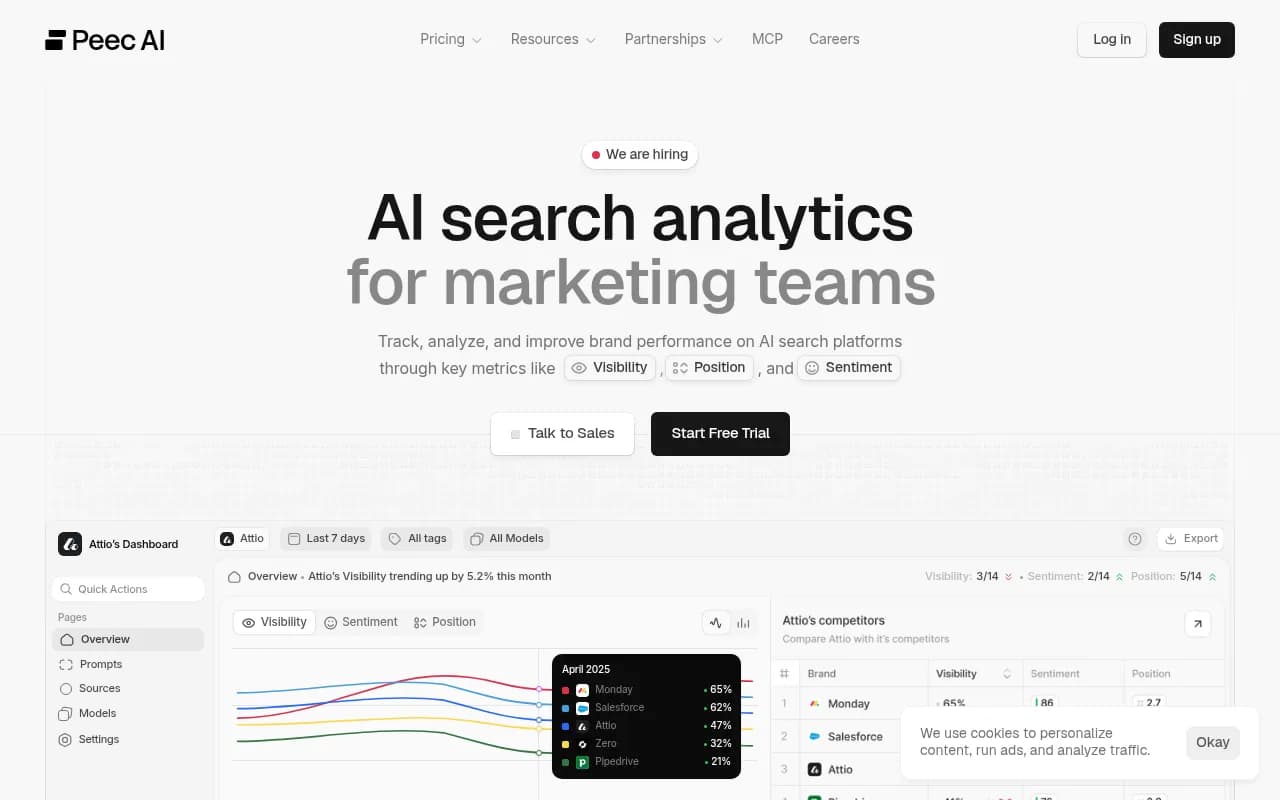
Otterly.ai remains the cheapest credible entry point at $29/month for 15 prompts across ChatGPT, AI Overviews, Perplexity, and Copilot. Peec AI sits a step up at €85/month with source-level citation analysis broken out by page type (product, category, comparison), which is genuinely useful for a retail content audit even at that price. Neither does SKU-level tracking or content generation, so think of them as an early-warning system, not a full GEO operation.
Mistakes retail teams make with AI monitoring
A few patterns show up repeatedly in how brands misuse these tools:
Tracking brand-name prompts only. Someone searching "best running shoes for flat feet" doesn't know your brand exists yet, that's the discovery moment where citation share actually gets decided, and it's the query type most brands under-track.
Assuming a traffic drop is always your fault. The March 4, 2026 GPT-5.3 rollout cut average ChatGPT citations per response by roughly 27% across every model simultaneously, a platform-wide change with zero relation to any individual brand's content, according to Promptwatch's citation drop analysis. Check the calendar before assuming you did something wrong.
One-size-fits-all social strategy. ChatGPT leans on Reddit over 20 times more than any other social platform for citations, while Google AI Overviews and Grok lean toward YouTube instead, per Promptwatch's social media citation breakdown. A Reddit seeding strategy tuned for ChatGPT visibility won't do much for your AI Overviews presence.
Blocking crawlers without checking who's actually knocking. OpenAI accounted for roughly 80% of verified AI crawler requests by early September 2026, down from about 95% in June, meaning the crawler mix is diversifying fast, and an old robots.txt rule can silently cut off a provider that's growing.
How to choose
Start by being honest about which problem you actually have. If the question is "does AI even know we exist," a lighter tool like Otterly or Peec AI is enough to get a baseline. If the question is "why isn't our best-selling product showing up when it should," you need SKU-level tracking from something like Ranketta or Alhena AI. If the question is "we know we're invisible in some places, now fix it," that's where Promptwatch's Content Agents or Yotpo's active agents earn their subscription cost, because they close the loop from data to published fix instead of leaving you with another report to act on manually.
Whichever direction you go, don't buy on a single snapshot. AI responses are non-deterministic, the same prompt can return a different set of brands on different runs, so a platform's value comes from tracking trend lines over weeks and months, not from one impressive first report. For a broader look at how these platforms stack up feature by feature, the GEO software directory at bestgeosoftware.com is a good next stop.