Key takeaways
- Most AI visibility tools track brand mentions using a fixed set of prompts -- they don't account for the fact that a CFO and a junior marketer ask AI very different questions.
- Persona-based tracking lets you simulate how different buyer types (by role, region, intent, or stage) prompt AI engines, giving you a far more accurate picture of your real visibility.
- Only a handful of platforms in 2026 support true persona simulation: Promptwatch, Profound, and a few others. Most tools give you a single undifferentiated view.
- The gap between "we appear in AI answers" and "we appear when our actual buyers ask" is significant -- and closing it requires prompt customization, not just more prompts.
- If you're an agency or brand managing multiple segments, persona tracking isn't a nice-to-have. It's the difference between useful data and misleading data.
Why persona matters in AI search visibility
Here's the problem with most AI visibility dashboards: they show you a single number. Your brand appeared in 34% of tracked prompts this week. Great. But which prompts? Asked by whom? In what context?
A procurement manager at a 500-person company asking "what's the best contract management software for regulated industries?" is not the same query as a startup founder asking "what contract tools do early-stage companies use?" Both are your buyers. Both are asking AI. But they're asking completely different questions, and AI engines are citing completely different sources in response.
If your visibility tool tracks a generic set of prompts, you might score well on the startup founder's query and completely miss the enterprise procurement manager -- or vice versa. You'd never know, because the data is averaged out.
This is why persona-based tracking has become one of the most important differentiators among AI visibility platforms in 2026. It's not about vanity metrics. It's about whether the data you're collecting actually reflects how your real buyers interact with AI search.
What "persona" means in this context
When we talk about personas in AI visibility, we mean the ability to customize the context in which prompts are run. That can include:
- Job title or role (e.g., "as a marketing director at a mid-size B2B company...")
- Company size or industry vertical
- Geographic region or language
- Buying stage (awareness vs. evaluation vs. ready to purchase)
- Platform behavior (some tools let you set a user profile within the AI engine itself)
The more of these dimensions a tool supports, the more accurately it reflects how your actual customers are experiencing AI search.
The state of persona support in 2026
Most tools on the market today were built around a simpler model: you define a list of prompts, the tool runs them against AI engines on a schedule, and you get back visibility scores and citations. That's useful, but it's a blunt instrument.
The platforms that have moved beyond this model fall into roughly two camps:
Prompt customization tools let you write prompts that include persona context inline. You manually write "As a CFO evaluating spend management tools, which platforms do you recommend?" instead of just "best spend management tools." This works, but it scales poorly -- you end up managing hundreds of slightly different prompts with no systematic way to analyze them by segment.
True persona simulation platforms let you define buyer personas as a configuration layer, then apply them across your entire prompt set automatically. You define "Enterprise CFO" once, and every prompt in your library gets run through that lens. This is far more powerful and is where the leading platforms are heading.
Tools that support persona-based tracking
Promptwatch
Promptwatch is the most complete implementation of persona-based tracking available right now. You can define custom personas -- specifying role, company type, region, buying intent, and other attributes -- and apply them across your tracked prompts. The platform then runs those prompts through AI engines as if they were asked by that persona type, and you get visibility scores broken down by segment.
What makes this genuinely useful rather than just a feature checkbox: Promptwatch also connects persona visibility data to the action loop. If you're invisible to enterprise buyers but visible to SMB buyers, the Answer Gap Analysis shows you exactly which prompts are driving that gap, and the Content Agents can generate content specifically designed to close it. That's a workflow most tools don't have.
Promptwatch also tracks multi-language and multi-region responses, which matters if your buyer personas are geographically distributed. A German-speaking procurement manager in Munich is getting different AI answers than an English-speaking one in Chicago, even for the same underlying question.

Profound
Profound is one of the stronger enterprise-grade options for persona tracking. It supports custom prompt configuration and has segment-level reporting, which lets larger teams slice visibility data by audience type. The trade-off is price -- Profound sits at a higher price point than most mid-market tools, and the platform is primarily a monitoring and reporting tool. It shows you the data well but doesn't have built-in content generation to act on what you find.
Peec AI
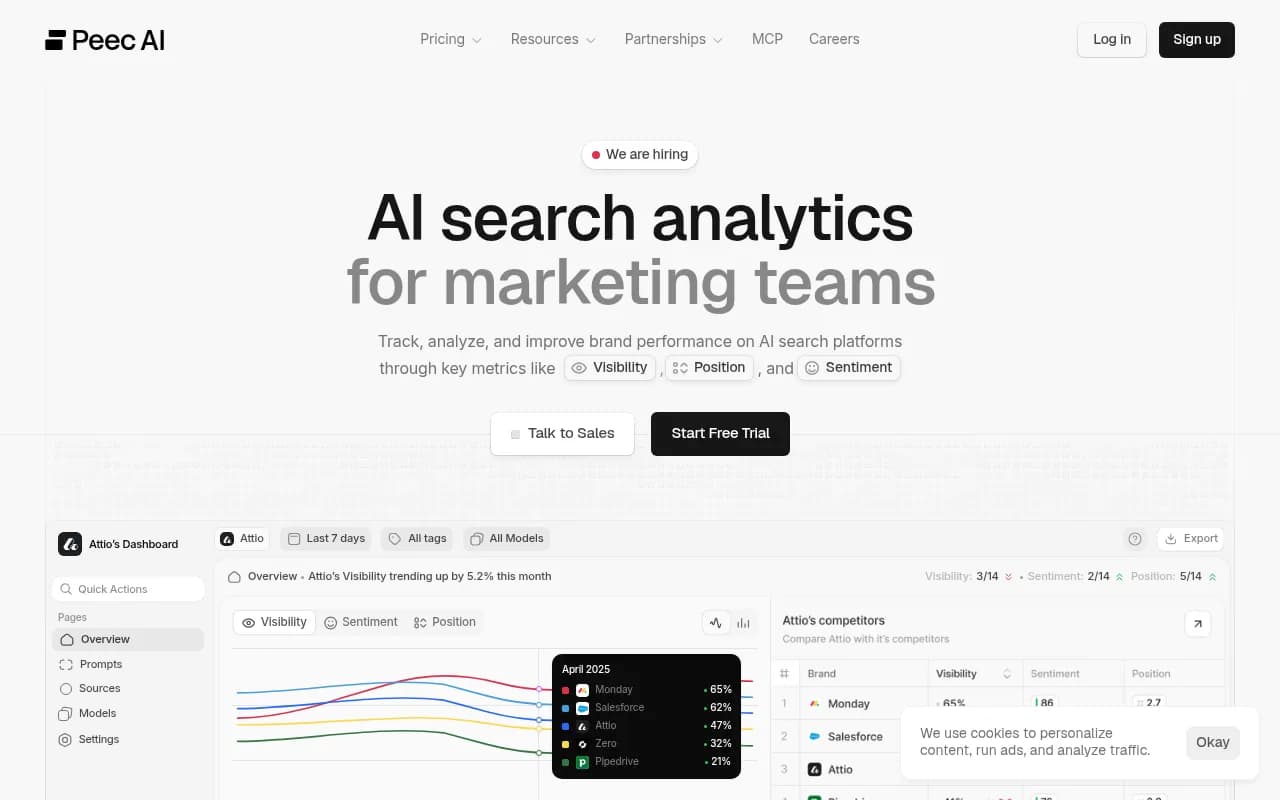
Peec AI supports custom prompt sets, which means you can build persona-specific prompt libraries manually. It's a solid mid-market option with good coverage across major AI engines. The persona support is more manual than systematic -- you're building it yourself rather than having the platform manage persona layers -- but for smaller teams with a defined set of buyer types, it works.
Semrush AI Visibility Toolkit
Semrush's AI toolkit is strong for teams already in the Semrush ecosystem. The limitation for persona tracking is that it uses a more fixed prompt structure. You can customize prompts to some extent, but the platform isn't built around the concept of buyer personas as a first-class object. If persona segmentation is your primary need, Semrush is a secondary choice here.
AthenaHQ
AthenaHQ is a monitoring-focused platform with good AI engine coverage. It doesn't have native persona simulation as a feature, but you can structure your prompt sets to reflect different buyer contexts. Like Peec AI, this is a manual approach rather than a systematic one.

Otterly.AI
Otterly is a lightweight tool that works well for small teams that want to get started quickly. Persona support is minimal -- it's really designed for a single brand view rather than multi-segment tracking. If you're a solo marketer or a very small team, it's a reasonable starting point, but you'll outgrow it quickly if persona visibility is a priority.
Scrunch AI
Scrunch AI is aimed at agencies and brands that need to monitor AI search presence across multiple clients or product lines. It has decent prompt customization, and some of its reporting features lend themselves to segment-level analysis. Not a dedicated persona platform, but workable for agencies that want to approximate it.

Comparison: persona tracking capabilities by platform
| Platform | Persona configuration | Prompt customization | Multi-region/language | Content generation | Price range |
|---|---|---|---|---|---|
| Promptwatch | Native persona layers | Full | Yes (any language/region) | Yes (AI Content Agents) | $99-$579/mo |
| Profound | Segment-level reporting | High | Limited | No | Enterprise |
| Peec AI | Manual (prompt-level) | Medium | Partial | No | Mid-market |
| Semrush AI Toolkit | Fixed prompt structure | Low-medium | Partial | Limited | $119+/mo |
| AthenaHQ | Manual (prompt-level) | Medium | Limited | No | Mid-market |
| Otterly.AI | Minimal | Low | Limited | No | Low |
| Scrunch AI | Partial | Medium | Partial | No | Mid-market |
How to actually set up persona-based tracking
Whether you're using a platform with native persona support or building it manually, the process is similar. Here's how to approach it.
Step 1: Define your buyer personas
Start with the personas your sales and marketing team already use. If you don't have formal personas, build them from first principles: who actually buys your product, what role do they hold, what problem are they solving, and what stage of the buying process are they in when they first turn to AI?
A B2B SaaS company might end up with three personas: a technical evaluator (engineer or IT lead), a business buyer (VP or director), and a procurement/finance gatekeeper. Each asks AI very different questions.
Step 2: Build persona-specific prompt sets
For each persona, write 10-20 prompts that reflect how that person would actually ask an AI. Don't just add "as a [role]" to generic prompts -- think about what that person actually cares about.
A technical evaluator might ask: "Does [your product] have an API? How does it handle SSO?" A business buyer might ask: "What's the ROI of [category] tools for mid-size companies?" A procurement gatekeeper might ask: "Which [category] vendors have SOC 2 compliance?"
Step 3: Track and segment
Run your persona-specific prompts on a regular schedule and track visibility scores separately for each persona. Look for patterns: are you visible to one persona type but not another? Are competitors dominating a specific segment?
Step 4: Close the gaps
This is where most tools fall short. Once you know you're invisible to enterprise buyers, you need content that answers their specific questions. That means creating pages, guides, and comparison content that addresses the exact prompts driving that gap -- not generic content that happens to mention your product.
Platforms like Promptwatch have content generation tools that work directly from prompt gap data, which makes this step significantly faster.
Why this matters more than overall visibility score
Here's a scenario that plays out more often than you'd think. A company tracks AI visibility, sees a healthy overall score, and concludes their AI search presence is in good shape. Then they notice that enterprise deals are taking longer to close, and prospects are coming in with misconceptions about the product's capabilities.
When they dig into the data with persona-specific tracking, they find they're highly visible for SMB-oriented prompts and nearly invisible for enterprise evaluation prompts. Their overall score looked fine because the SMB prompts were dragging the average up. But the buyers who mattered most to their pipeline weren't finding them.
This is the core argument for persona-based tracking: aggregate visibility scores can be actively misleading if your buyer mix isn't uniform. And most buyer mixes aren't.
What to look for when evaluating tools
If persona-based tracking is a priority for you, here are the specific questions to ask when evaluating any platform:
Can I define personas as a reusable configuration? Or do I have to manually write persona context into every individual prompt? The former scales; the latter doesn't.
Can I see visibility scores broken down by persona? Not just by prompt or by AI engine, but by the buyer segment I've defined?
Does the platform support the regions and languages my personas operate in? A persona is only useful if the AI responses it's capturing reflect what that person actually sees.
Does the tool help me act on persona gaps? Knowing you're invisible to a segment is only half the problem. You need a path to fix it.
How does the tool handle prompt volume? Persona tracking multiplies your prompt count -- if you have 50 prompts and 4 personas, you're effectively running 200 prompts. Make sure the pricing model doesn't punish you for this.
The bottom line
Most AI visibility tools in 2026 give you a single view of your brand's presence in AI search. That's a start, but it's not enough if you serve multiple buyer types -- which most companies do.
The platforms that support true persona simulation are still a minority, but the gap is closing. Promptwatch has the most complete implementation right now, combining native persona layers with multi-region support and content generation tools that let you act on what you find. Profound is the strongest alternative for enterprise teams that need deep reporting and can handle a higher price point.
If you're evaluating tools and persona tracking is on your list, push vendors on the specifics. "We support custom prompts" is not the same as "we support persona-based segmentation." The difference matters more than it might seem.