Key takeaways
- Several capable GEO tools exist well under $300/month, starting as low as $29/month for basic prompt monitoring
- Most budget tools are monitoring-only -- they show you where you're invisible but don't help you fix it
- The $99-$249/month range is where you start getting actionable features like content gap analysis and crawler logs
- If you're already paying for Semrush or SE Ranking, their AI visibility add-ons can be the most cost-efficient entry point
- For teams that want to both track and improve AI visibility without jumping to enterprise pricing, Promptwatch sits at the top of the budget range but covers the full optimization loop
The GEO tool market has exploded in 2026. There are now dozens of platforms promising to help you rank in ChatGPT, Perplexity, Google AI Overviews, and the rest -- and most of them cost north of $400/month once you add the features you actually need.
But not all of them. There's a real cluster of tools under $300/month that are worth taking seriously, and a few that are genuinely impressive for the price. The trick is knowing which ones just show you a dashboard versus which ones actually help you move the needle.
This guide covers the best options under $300/month, what each one does well, and where the gaps are.
What "GEO" actually means here
Quick clarification, because this causes real confusion: GEO in this context means Generative Engine Optimization -- optimizing your content so that AI search engines like ChatGPT, Perplexity, and Google AI Overviews cite and recommend your brand. It has nothing to do with geographic information systems, despite what ChatGPT itself will tell you if you ask.
The core problem these tools solve: when someone asks an AI assistant "what's the best [your category] tool?", you want your brand to appear in the answer. Most companies have no idea whether they do or don't, and no systematic way to improve it. GEO tools fix that.
The budget landscape in 2026
Before diving into specific tools, it helps to understand what the price tiers actually buy you.
| Price range | What you typically get |
|---|---|
| $0-$50/month | Basic prompt monitoring, 1-2 AI models, limited prompts |
| $50-$150/month | Multi-model tracking, share of voice, some competitor data |
| $150-$299/month | Content gap analysis, more prompts, crawler data, content generation |
| $300+/month | Enterprise features, SOC 2, deep analytics, custom reporting |
The $300/month cutoff is meaningful because that's roughly where tools like Scrunch AI start (their Starter plan is $300/month for 350 prompts). Everything below that is the "accessible" tier -- though accessible doesn't mean weak.
The best GEO tools under $300/month
Otterly.AI -- best for getting started fast
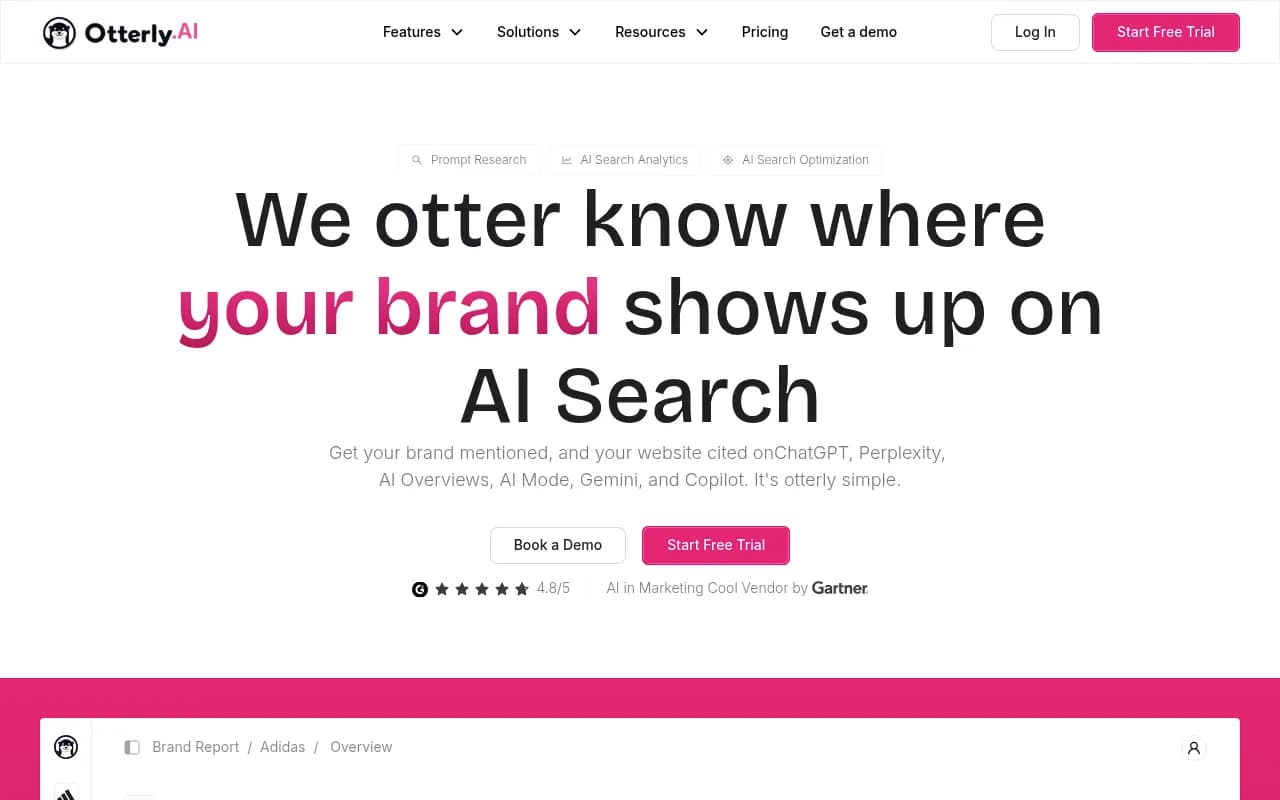
At $29/month for 15 prompts, Otterly.AI is the cheapest real entry point in the category. It tracks your brand mentions across ChatGPT, Perplexity, Gemini, and a handful of other models, and it integrates with Semrush if you're already in that ecosystem.
The honest limitation: 15 prompts doesn't go far if you're in a competitive category. You'll burn through your allocation quickly just covering the obvious branded queries. The paid tiers go up from there, and AI Mode and Gemini tracking are paid add-ons, so the real monthly cost for a meaningful setup is higher than the headline price.
That said, for a small team that wants to dip a toe in without a budget commitment, it's the right starting point.
Peec AI -- solid mid-range monitoring
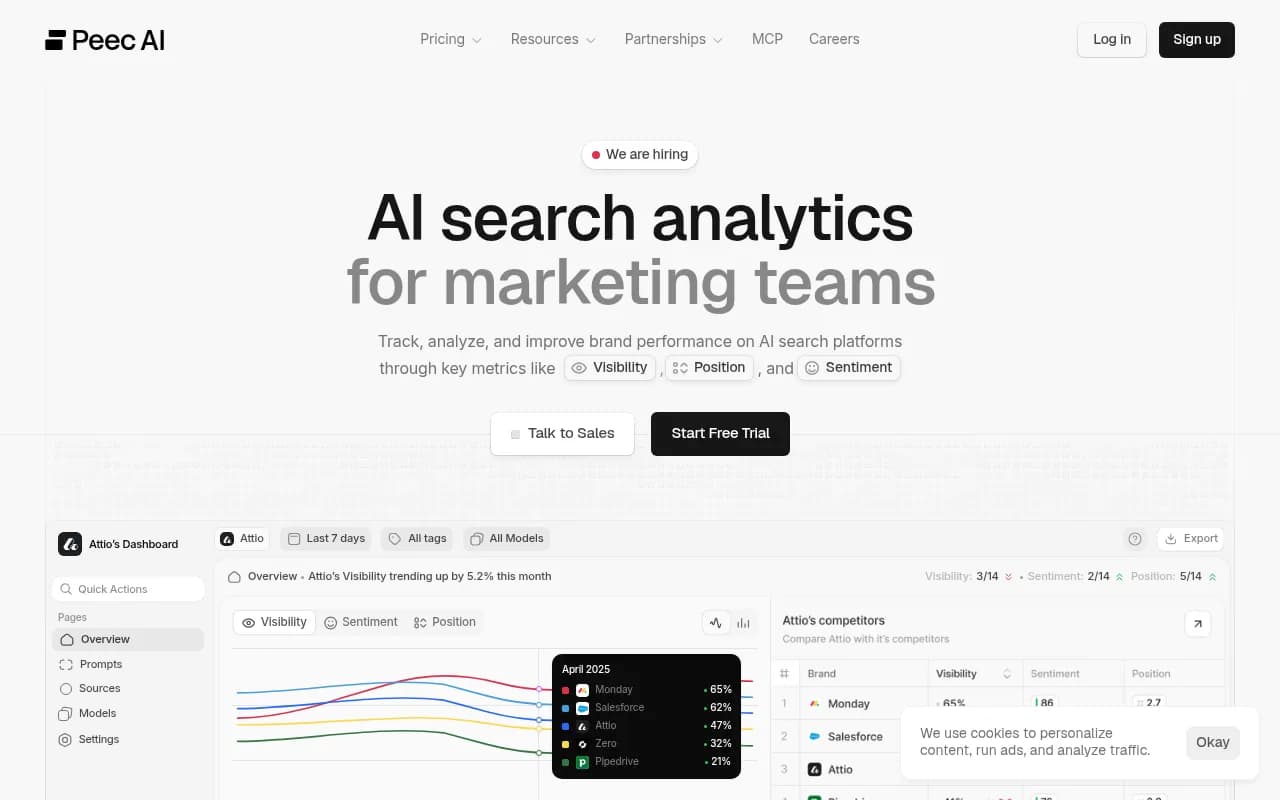
Peec AI sits in the $50-$150/month range and offers cleaner prompt management than Otterly at scale. It tracks share of voice across multiple AI models, gives you competitor comparisons, and surfaces some smart suggestions about where your visibility is weakest.
It's still primarily a monitoring tool -- you get the data, but the "what to do about it" is largely left to you. For teams with an SEO writer or content strategist who can interpret the data and act on it independently, that's fine. For teams that need more hand-holding on the content side, it'll feel incomplete.
SE Ranking Visible -- best for existing SE Ranking users
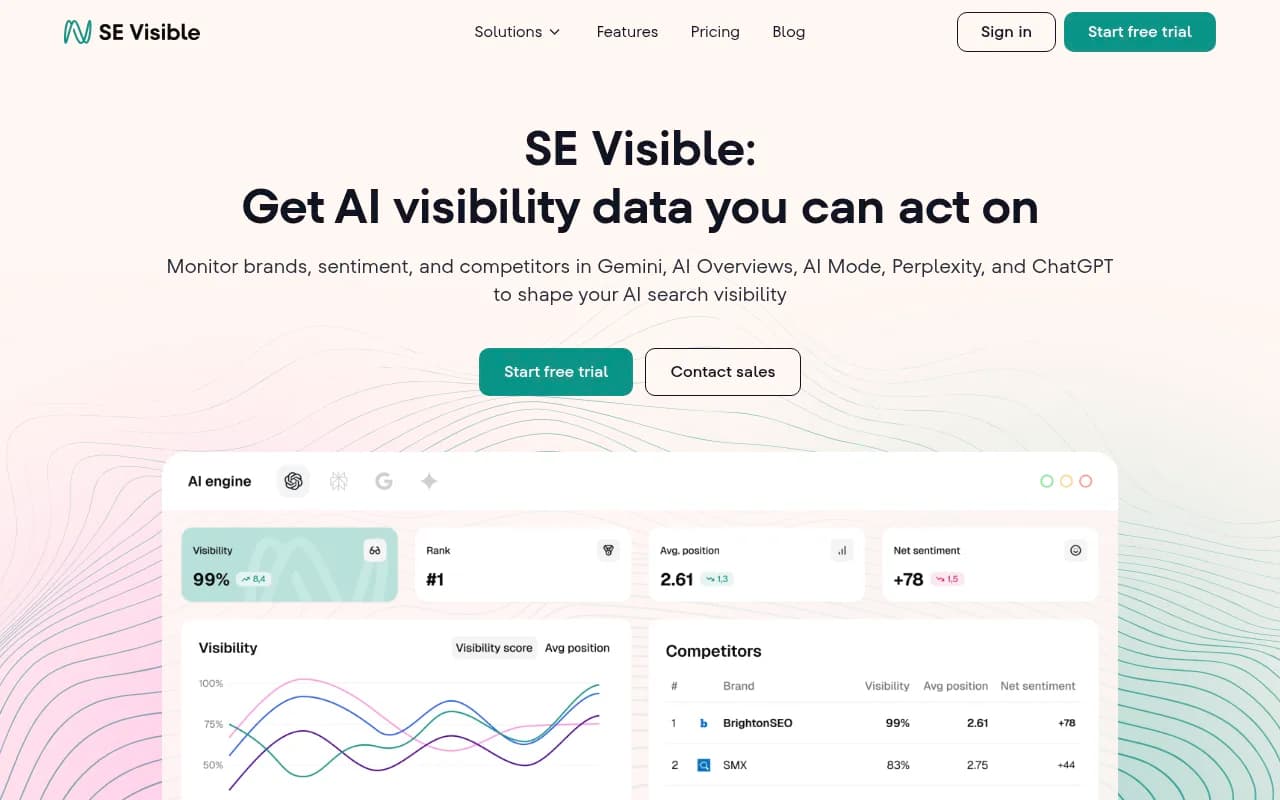
SE Ranking's AI visibility module (branded as "Visible") starts at around $52/month on annual billing. If you're already paying for SE Ranking's core SEO platform, this is almost certainly the most cost-efficient way to add AI tracking to your workflow -- you're not paying for a second tool, just extending one you already use.
It covers the main AI platforms, gives you visibility scores, and fits into SE Ranking's existing reporting structure. The downside is that it's reporting-focused rather than action-focused. You'll see your numbers, but the platform won't tell you what content to create to improve them.
Semrush AI Visibility Toolkit -- best for existing Semrush users
Same logic as SE Ranking, but for the much larger Semrush user base. The AI Visibility Toolkit runs about $99/month per domain as a standalone add-on, or it's bundled into Semrush One starting at $199/month.
The advantage here is obvious: if you're already running Semrush for keyword research and site audits, having AI visibility data in the same dashboard is genuinely convenient. The ContentShake integration means you can move from "I'm not visible for this prompt" to "here's a content brief" without switching tools.
The limitation worth knowing: Semrush uses fixed prompts rather than dynamically generated ones, which means you're tracking the prompts Semrush decided matter, not necessarily the ones your actual customers are using. There's also no AI traffic attribution connecting visibility to actual site visits.
Ahrefs Brand Radar -- best for Ahrefs users who want basic AI tracking
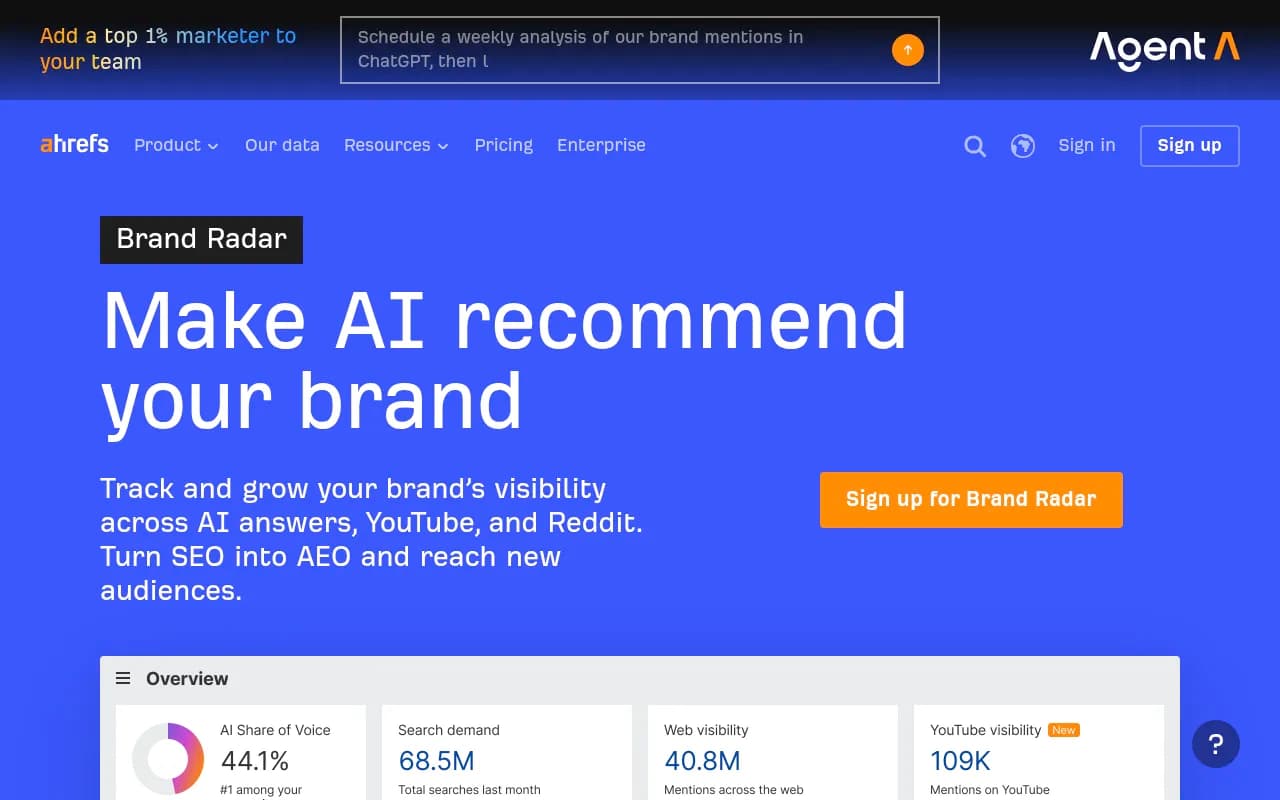
Ahrefs Brand Radar is the AI monitoring layer built into Ahrefs. If you're an Ahrefs subscriber, it's worth checking what's already available to you before paying for a separate tool.
Like Semrush's offering, it uses fixed prompts and lacks AI traffic attribution. It's a solid starting point for understanding your brand's presence in AI results, but it won't replace a dedicated GEO platform for teams that are serious about improving their AI visibility.
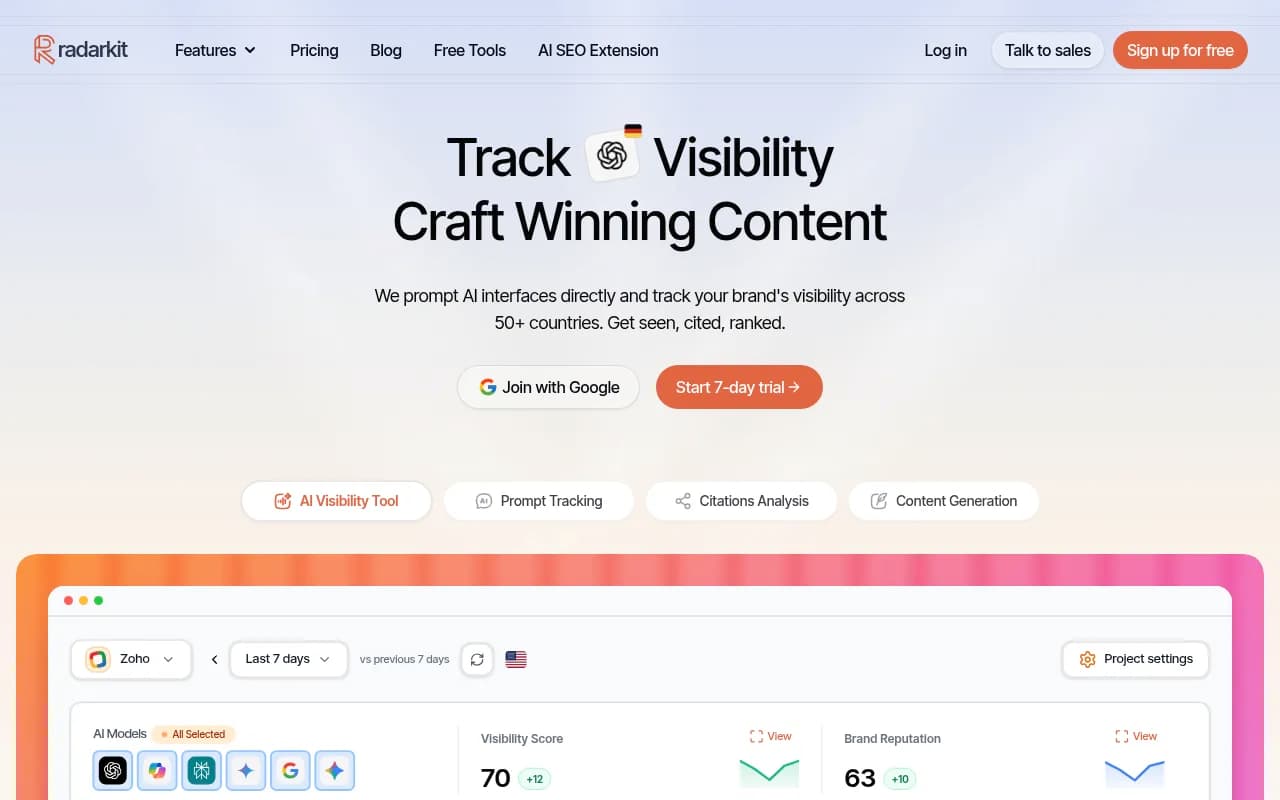
Radarkit -- worth watching
Radarkit.ai has been getting attention in 2026 as a focused AI search and GEO visibility tracker. It's appeared in several independent comparisons alongside Peec AI and Otterly as a credible mid-range option. Pricing sits within the budget range, and it covers the major AI platforms.
Promptwatch -- best overall under $300/month
Promptwatch is the one tool in this price range that goes beyond monitoring into actual optimization. The Essential plan is $99/month (1 site, 50 prompts, 5 AI-generated articles), and the Professional plan at $249/month adds crawler logs, city/state tracking, 150 prompts, and 15 articles per month.
Both plans sit under the $300 threshold, and both include features that most tools in this category don't offer at any price point: Answer Gap Analysis that shows you exactly which prompts competitors are visible for but you're not, Content Agents that generate articles and briefs based on real prompt data, and page-level tracking that shows which specific pages are being cited by which AI models.
The Professional plan's crawler logs are particularly useful -- they show you in real time when AI crawlers like ChatGPT and Perplexity are hitting your site, which pages they're reading, and when those pages move from "crawled" to "cited." Most competitors don't have this at all.
Side-by-side comparison
| Tool | Starting price | AI models tracked | Content generation | Crawler logs | Best for |
|---|---|---|---|---|---|
| Otterly.AI | $29/month | 4+ | No | No | Getting started cheaply |
| Peec AI | ~$59/month | 5+ | No | No | Mid-range monitoring |
| SE Ranking Visible | ~$52/month | 5+ | No | No | SE Ranking users |
| Semrush AI Toolkit | $99/month | 5 | Partial (ContentShake) | No | Semrush users |
| Ahrefs Brand Radar | Included in Ahrefs | 4+ | No | No | Ahrefs users |
| Radarkit | Budget range | 4+ | No | No | Focused tracking |
| Promptwatch Essential | $99/month | 10+ | Yes (5 articles/mo) | No | Monitoring + content |
| Promptwatch Professional | $249/month | 10+ | Yes (15 articles/mo) | Yes | Full optimization loop |
What most budget tools are missing
Looking at that table, a pattern emerges. Almost everything under $300/month is monitoring-only. You get dashboards, share-of-voice scores, and competitor comparisons -- but the tools stop there. They show you the problem without helping you solve it.
This matters more than it might seem. Knowing you're invisible for "best project management tool for remote teams" is only useful if you know what to do about it. Most teams end up exporting data from their GEO tool and then... guessing at what content to create.
The gap between monitoring and optimization is where most budget tools fall short. A few things to look for if you want to actually improve your AI visibility, not just measure it:
- Answer gap analysis: Which specific prompts are competitors winning that you're not? Not just "you have low visibility" but the exact queries.
- Content briefs grounded in prompt data: Not generic SEO briefs, but content designed to answer the specific questions AI models are already fielding.
- Page-level citation tracking: Which of your existing pages are being cited, and which aren't? This tells you where to focus optimization effort.
- Crawler logs: Are AI crawlers even finding your content? If they're hitting error pages or ignoring key sections of your site, no amount of content creation will help.
How to choose based on your situation
You're just starting out and want to understand the category
Start with Otterly.AI at $29/month. Track 10-15 of your most important branded and category prompts across ChatGPT and Perplexity. Spend a month learning what the data looks like before committing to a bigger tool. The limitation is real -- 15 prompts is tight -- but it's enough to get oriented.
You're already paying for Semrush or SE Ranking
Add their AI visibility modules before buying a separate tool. The integration convenience is worth something, and you'll avoid paying for two platforms. Once you've exhausted what those modules can tell you, then evaluate dedicated GEO tools.
You want to actually improve your AI visibility, not just measure it
This is where the monitoring-only tools run out of road. If your goal is to show up in ChatGPT answers for competitive queries, you need content gap analysis and content generation -- not just a dashboard showing you're invisible. Promptwatch's Professional plan at $249/month is the most complete option under $300 that covers this full loop.
You're an agency managing multiple clients
Most budget tools have per-site pricing that scales quickly. Promptwatch has agency and enterprise pricing available on request. Search Party is another option worth evaluating for agency-specific workflows.
A note on "budget" vs. "cheap"
There's a real difference between budget tools and cheap tools. Budget means you're getting meaningful value for a reasonable price. Cheap means you're paying less but also getting less -- sometimes to the point where the tool doesn't actually help you accomplish anything.
A $29/month tool that shows you a visibility score but gives you no path to improving it is cheap, not budget. A $249/month tool that replaces what would otherwise require a dedicated analyst plus a content writer is genuinely budget for what it delivers.
The tools worth spending money on in this category are the ones that connect data to action. Everything else is just a more expensive way to feel informed while staying stuck.
The bottom line
The GEO tool market under $300/month is more capable than it was even a year ago. You can get real multi-model monitoring, competitor share-of-voice data, and -- at the higher end of the budget range -- actual content optimization tools without crossing into enterprise pricing territory.
The honest recommendation: if you're serious about AI search visibility and not just curious about it, the $99-$249/month range is where the useful tools live. Otterly.AI and Peec AI are fine for orientation, but they won't move your rankings. The tools that combine monitoring with content gap analysis and generation are the ones that will actually change what AI models say about your brand.
Start with what fits your budget today, but build toward a tool that helps you act on the data -- not just collect it.