Key takeaways
- AI search engines like ChatGPT cite sources based on topical relevance and content clarity, not just domain authority -- which levels the playing field for startups
- A small site that directly answers "best X for Y in Z industry" can get cited because the model matches intent, not domain age
- The fastest path to AI citations is publishing sharp, specific, extractable content on topics incumbents have ignored or covered poorly
- Off-site presence (Reddit, YouTube, third-party listicles) matters as much as your own site for AI visibility
- Tracking which prompts you appear in -- and which you're missing -- is the only way to know if your strategy is working
Why this moment is different for startups
Traditional SEO has always punished newcomers. Domain authority is built on backlinks, backlinks come from visibility, and visibility comes from domain authority. It's a loop that incumbents entered years ago and never left. A startup with a six-month-old domain competing against a SaaS player with DA 70 and 50,000 indexed pages is not really competing at all -- at least not in Google.
AI search breaks that loop. When ChatGPT answers a question, it isn't running a PageRank calculation. It's looking for content that clearly and specifically answers what the user asked. A January 2026 analysis found that between 84.8% and 96% of domains cited by tools like ChatGPT, Claude, and Perplexity did not appear in the corresponding Google top-ranked results. That's a remarkable gap. It means the citation graph for AI search is genuinely different from the link graph that powers traditional SEO.
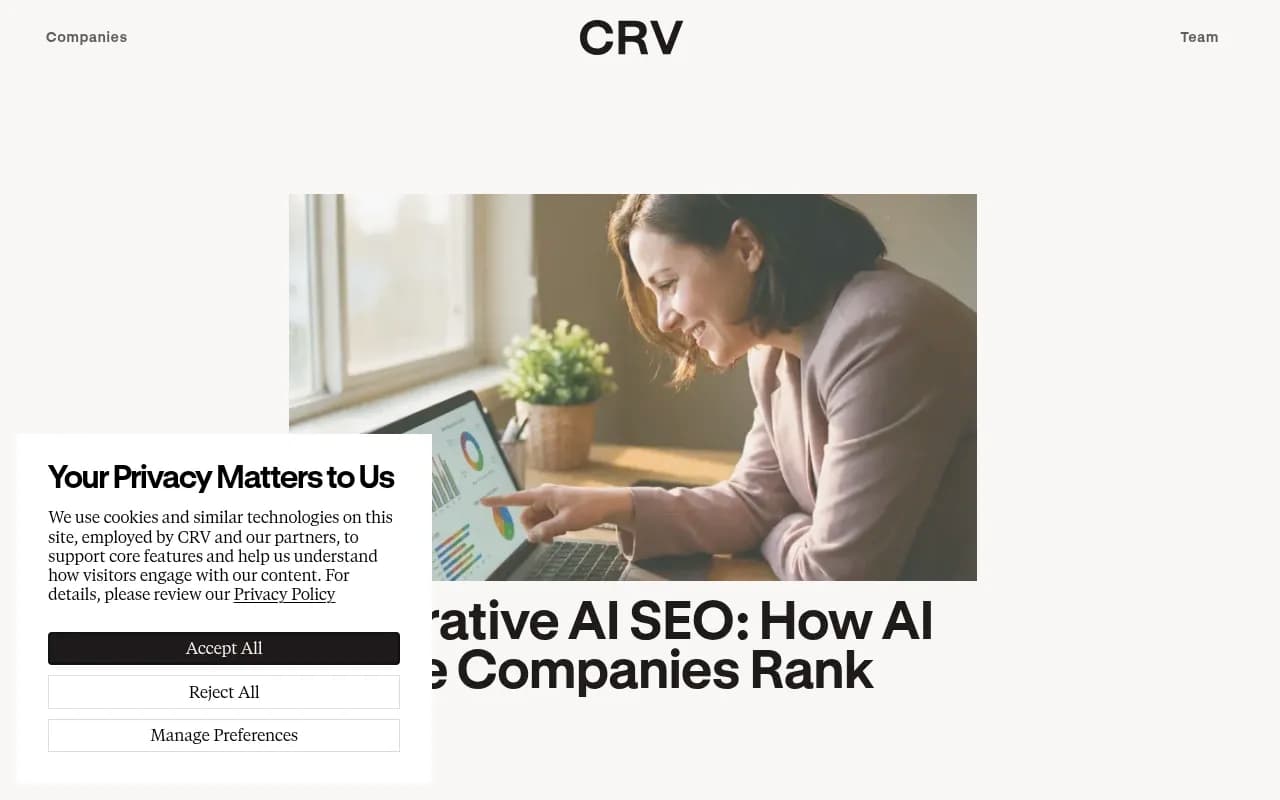
CRV, which backed DoorDash, Mercury, and Vercel, put it plainly: "A founder with a small team can now publish one sharp technical piece and see it show up in an AI-generated answer weeks later. That kind of visibility used to take years of backlinks, brand recognition and domain authority to build."
That's the opportunity. But it requires a different playbook than what most startup marketing teams are running.
How ChatGPT actually decides what to cite
Before building a strategy, it helps to understand the mechanics. ChatGPT operates in two modes:
- When web search is off, it draws from training data -- everything ingested before its knowledge cutoff
- When web search is on (increasingly the default in 2026), it queries Bing in real time, reads pages, and synthesizes a response with inline citations
Both modes respond to different signals, but they share a common thread: the model is trying to produce a trustworthy, specific answer. It rewards content that can be extracted cleanly without additional context.
What this means practically:
- Vague, hedging content ("it depends on your situation") rarely gets cited
- Specific, structured answers ("for B2B SaaS companies under 50 employees, the best option is X because...") get cited far more often
- Content that matches the exact phrasing of how users prompt AI models performs better than content optimized for traditional keyword variations
There's no "position 1" in ChatGPT. Either your brand appears in the response, or it doesn't. That binary nature is actually good news for startups -- you don't need to outrank anyone, you just need to be present.
The startup advantage: specificity over scale
Here's something incumbents rarely talk about: their size is a liability in AI search. Large brands publish broad content designed to rank for high-volume keywords. That content is often shallow, committee-written, and optimized for a keyword density that made sense in 2018. It doesn't answer specific questions well.
A startup can do the opposite. You can write the definitive guide to "ChatGPT recommendations for construction project management software under $50/user" and own that niche completely. An incumbent with 10,000 blog posts won't bother. AI models will cite you because you're the only source that actually answers the question.
This is the core insight from the Reddit thread on r/Entrepreneur that's been circulating in growth communities: "ChatGPT, a small site that directly answers 'best X for Y in Z industry' can get cited because the model is matching intent, not domain authority."
Finding the gaps incumbents have left open
The first step is identifying which prompts your category generates that no one is answering well. Think about:
- Industry-specific variations of generic questions ("best CRM for independent insurance brokers")
- Comparison queries your competitors haven't addressed honestly ("X vs Y for remote-first teams")
- Problem-first queries that don't map to any product category ("how do I stop losing deals in the proposal stage")
- "For [persona]" queries that large vendors ignore because the segment is too small for them
You can do this manually by running 10-15 category prompts in ChatGPT, Gemini, and Perplexity each week and recording whether your brand appears. It's tedious but it works. For a more systematic approach, Promptwatch has an Answer Gap Analysis feature that shows exactly which prompts competitors are appearing in but you're not -- including the specific content your site is missing.
Building content that AI models actually cite
Write for extraction, not for engagement
Traditional content marketing optimizes for time-on-page, scroll depth, and newsletter signups. AI-optimized content has one job: be extractable. The model needs to pull a clean, specific answer from your page and surface it in a response.
Practical rules for extractable content:
- Put the direct answer in the first 100 words, not buried after three paragraphs of context
- Use clear headers that mirror how users phrase questions ("What's the best X for Y?")
- Avoid filler sentences that add length without adding information
- Use structured formats -- numbered lists, comparison tables, clear definitions -- that models can parse easily
- Write in complete, standalone sentences. A sentence that requires the previous paragraph to make sense won't survive extraction.
Target prompt-shaped queries, not keyword-shaped ones
Traditional SEO targets "best project management software" as a keyword. AI search optimization targets "what's the best project management software for a 10-person agency that bills by the hour?" Those are different content briefs.
The shift is from keyword optimization to prompt optimization. Think about how your target customer would type a question into ChatGPT at 11pm when they're frustrated with their current tool. That's your content brief.
Build topical depth on a narrow subject
AI models trust sources that demonstrate deep knowledge on a specific topic. A startup that publishes 20 articles all about the same narrow problem -- from every angle, for every persona, at every stage of awareness -- will get cited more reliably than a startup that publishes 20 articles on 20 different topics.
Pick the narrowest version of your category that still has meaningful search intent. Own it completely before expanding.
Off-site presence: the channel most startups ignore
Your own website is only part of the picture. AI models don't just cite company blogs -- they cite Reddit threads, YouTube videos, third-party review sites, comparison pages, and industry publications. For a startup with no domain authority, this is actually good news: you can build AI visibility on platforms that already have authority.
Reddit is cited heavily by AI models, particularly for product recommendations and "what do people actually use" queries. Genuine participation in relevant subreddits -- answering questions, sharing specific experiences, being useful without being promotional -- builds a presence that AI models pick up. This isn't about spamming your product link. It's about being the person in the thread who actually knows the answer.
YouTube
Video content increasingly appears in AI citations, particularly for how-to and comparison queries. A 10-minute video that walks through a specific workflow or compares two tools honestly can get cited in AI responses for months. The transcript is what the model reads, so clear, specific spoken content matters.
Third-party listicles and review sites
Getting listed on "best X for Y" pages on established publications is one of the fastest ways to build AI visibility without domain authority. AI models frequently cite these pages when answering recommendation queries. Identify the top 5-10 listicles in your category and focus outreach on getting included.
PR and brand mentions
Every time your brand name appears in a credible publication -- even without a link -- it contributes to the model's understanding of your brand. A mention in a trade publication that says "Startup X is used by teams at [recognizable company]" is worth more for AI visibility than a generic press release.
Technical foundations that matter for AI crawlers
You don't need a perfect technical SEO setup, but a few things directly affect whether AI crawlers can read and index your content.
- Make sure your content is in crawlable HTML, not locked behind JavaScript rendering that crawlers can't access
- Don't block AI crawlers in your robots.txt unless you have a specific reason to -- many startups accidentally block GPTBot, ClaudeBot, and PerplexityBot
- Page load speed matters less than crawlability, but pages that time out won't get indexed
- Structured data (schema markup) helps models understand the type of content on a page -- FAQ schema, Article schema, and HowTo schema are particularly useful
One thing worth checking: AI crawlers behave differently from Googlebot. They return to pages at different frequencies, they read different sections, and they sometimes encounter errors that Googlebot wouldn't. Tools that log AI crawler activity can surface these issues before they become invisible visibility problems.
Tracking whether any of this is working
This is where most startup strategies fall apart. You publish content, you participate on Reddit, you get listed on a few review sites -- and then you have no idea if it's working because you're not measuring the right thing.
Traditional SEO metrics (rankings, organic traffic, DA) don't tell you whether you're appearing in AI responses. You need to track:
- Which prompts your brand appears in, across which AI models
- Which competitors are appearing in prompts you're not
- Which of your pages are being cited, and how often
- Whether new content you publish eventually gets crawled and cited
The manual version of this is running a set of category prompts in ChatGPT, Gemini, and Perplexity weekly and logging the results in a spreadsheet. It's slow but it gives you real data. The automated version uses a dedicated tracking platform.
Here's a comparison of tools worth considering for startup-scale AI visibility tracking:
| Tool | Free tier | Content generation | Crawler logs | Best for |
|---|---|---|---|---|
| Promptwatch | No (free trial) | Yes (AI content agents) | Yes | Full GEO cycle: track, find gaps, create content |
| Otterly.AI | Yes | No | No | Budget monitoring, early-stage startups |
| Peec AI | Limited | No | No | Basic AI brand tracking |
| Rankscale | No | No | No | Rank tracking across AI models |
| LLMrefs | No | No | No | Query and citation insights |
| Writesonic GEO | No | Yes | No | Combined monitoring + content creation |
For most startups, the honest recommendation is to start with manual tracking (it forces you to actually read the AI responses and understand what's being cited) and move to a paid tool once you have enough content published that tracking becomes unwieldy.
A practical 90-day plan for a startup with zero AI visibility
Days 1-30: foundation
- Audit your robots.txt and confirm you're not blocking AI crawlers
- Run 20 category prompts across ChatGPT, Perplexity, and Gemini. Record every result in a spreadsheet. Note which competitors appear and what type of content gets cited.
- Identify 3-5 narrow, specific topics where incumbents have thin or generic coverage
- Publish one piece of genuinely extractable content per week on those topics. Not 2,000 words of padding -- 800 words of specific, structured answers.
Days 31-60: distribution and off-site
- Identify the top 10 "best X for Y" listicles in your category. Email the authors or publications about inclusion.
- Start participating in 2-3 relevant subreddits. Answer questions. Don't pitch.
- Reach out to 3-5 industry newsletters or blogs about contributing a specific, opinionated piece
- Rerun your 20 prompts. Note any changes.
Days 61-90: iteration
- Look at which content pieces are getting cited (if any) and why. Double down on that format and topic area.
- Identify the next tier of specific prompts to target based on what competitors are appearing for
- Build out your comparison content -- "X vs Y for [specific use case]" pages convert well and get cited heavily
- Set up systematic tracking so you're not doing this manually forever
The honest reality check
None of this is instant. A startup that publishes its first piece of AI-optimized content on Monday won't appear in ChatGPT responses on Friday. AI models update their training data and web indexes on their own schedules, and a new domain needs time to build enough presence -- even in AI search -- to be consistently cited.
But the timeline is genuinely shorter than traditional SEO. Founders at AI-native companies have reported seeing citations appear within weeks of publishing sharp, specific content. That's not a guarantee, but it's a realistic outcome when the content is genuinely better than what incumbents have published on the same topic.
The structural advantage for startups is real. You can move faster, publish more specific content, and own narrow topics that large companies won't bother with. The question is whether you're measuring the right things to know if it's working.
Start with the prompts your customers are actually typing. Write content that answers those prompts better than anyone else. Track whether you appear. Iterate. That loop -- find gaps, create content, track results -- is the whole game.