Key takeaways
- Google AI Overviews now appear on roughly 48% of all search queries, and Wikipedia captures about 18.4% of all citations in those responses.
- AI Overviews don't just reward high-ranking pages — they reward pages whose content format matches what the query actually needs. Ranking #1 organically is not enough.
- Wikipedia wins because it's structured, neutral, comprehensive, and machine-readable. Your content can replicate those qualities without becoming an encyclopedia.
- The fix involves four things: structured content, clear entity signals, authoritative sourcing, and filling the specific answer gaps AI models are already exposing.
- Tools like Promptwatch can show you exactly which prompts your competitors are being cited for but you're not — so you can fix the right gaps instead of guessing.
The Wikipedia problem nobody talks about honestly
Here's the frustrating reality: you've published detailed, original, well-researched content on your topic. You rank on page one. And then Google AI Overviews summarizes the subject and cites... Wikipedia. A page that hasn't been substantially updated in months, written by anonymous contributors, with no original research.
It stings. But it's not random, and it's not unfair in the way people assume. There's a specific reason Wikipedia keeps winning, and once you understand it, you can actually do something about it.
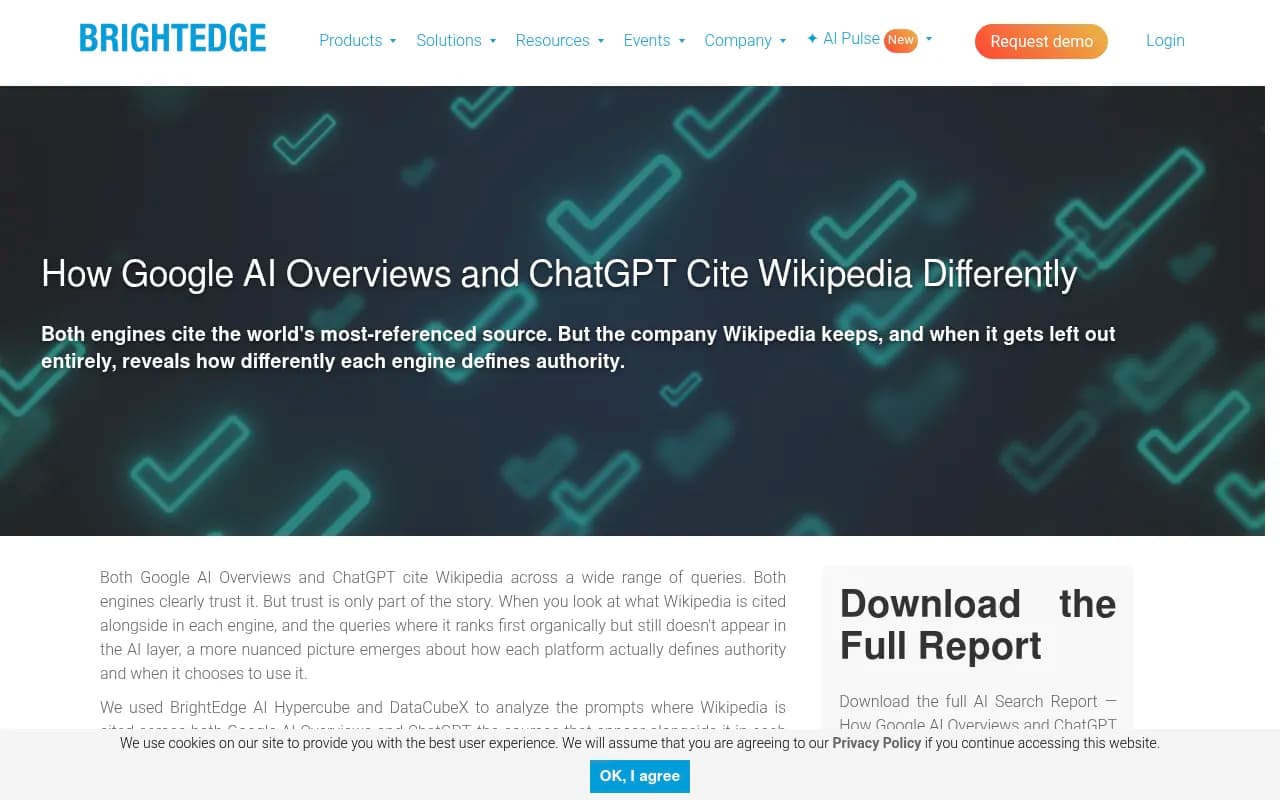
According to Surfer SEO's analysis of 46,000+ queries, YouTube accounts for roughly 23.3% of all AI Overview citations, with Wikipedia at 18.4%. That's a huge share for a single domain. And per BrightEdge's research, even when Wikipedia holds the #1 organic position, it still doesn't always appear in the AI layer — which tells you that citation decisions are about more than rank.
The AI Overview feature has expanded fast. It went from appearing on 31% of queries in February 2025 to 48% by February 2026, according to Otterly.AI's tracking data. That's a massive surface area where your brand either shows up or doesn't.
Why Wikipedia wins (and what it's actually doing right)
Wikipedia doesn't win because Google has a soft spot for it. It wins because it does several things consistently that most brand and business content doesn't.
It answers the question directly, at the top
Wikipedia articles almost always open with a clear, definitional answer to the implied question. The lead paragraph of any Wikipedia article is essentially a featured snippet written in advance. Google's AI doesn't have to hunt for the answer — it's right there in the first two sentences.
Most business content does the opposite. It opens with a hook, a story, a statistic, or a vague promise. The actual answer to the question is buried three paragraphs down, after the reader has been "warmed up." AI models don't warm up. They scan for the answer and move on.
It's structured in a way machines can parse
Wikipedia uses consistent heading hierarchies, short paragraphs, definition-first writing, and internal links that signal topic relationships. This isn't just good UX — it's exactly what a language model needs to extract clean, citable information.
Your blog post with a 200-word intro, three nested subheadings, and a conclusion that circles back to the intro is harder for an AI to parse cleanly.
It covers topics comprehensively without being promotional
This is the one that hurts most. Wikipedia has no agenda. It doesn't need you to buy anything, sign up for anything, or believe that its product is better than the competition. That neutrality is a trust signal. AI models are trained to avoid citing content that reads as promotional, because promotional content is more likely to be biased or incomplete.
If your content about "what is [your product category]" is really a soft pitch for your product, AI models will sense that and skip you.
It has deep entity authority
Wikipedia is one of the most heavily cross-referenced sources on the internet. Thousands of other authoritative pages link to it, cite it, and reference it. In terms of entity recognition — how well Google understands what a page is "about" — Wikipedia pages are about as clean as it gets.
The citation collapse: what the data actually shows
BrightEdge's research found something counterintuitive: Wikipedia holding the #1 organic position doesn't guarantee it appears in the AI Overview. The format of the content has to match what the query needs. This is the key insight most SEO guides miss.
A query like "what is photosynthesis" needs a definitional answer. A query like "best project management software" needs a comparative list. A query like "how to fix a leaking pipe" needs sequential steps. If your content is formatted as a blog post when the query needs a definition, you won't get cited — even if you rank first.
Jim Yu's April 2026 analysis found that 76% of AI Overview citations came from the top-10 pages organically. So ranking matters, but it's table stakes. The format question is what separates cited pages from uncited ones within that top-10 group.
Seven reasons your content isn't getting cited
1. Your answer is buried
If a reader (or an AI) has to scroll past 300 words to find your actual answer, you've already lost. Put the answer first. Then explain, expand, and add context.
2. You're writing for humans who browse, not AI that scans
Humans tolerate narrative warmup. AI models don't. Structure your content with the assumption that the first paragraph of each section will be extracted and used in isolation.
3. Your content is too promotional
Any sentence that reads like a sales pitch reduces your citability. "Our industry-leading platform helps businesses achieve unprecedented growth" will never appear in an AI Overview. "Project management software helps teams coordinate tasks, deadlines, and resources across a shared workspace" might.
4. You're missing the specific question
AI Overviews are triggered by specific queries. If your content covers a topic broadly but doesn't answer the specific question a user is asking, it won't be cited for that query. This is where answer gap analysis becomes genuinely useful — you need to know which specific questions are being asked that your content doesn't answer.
5. Your page has thin entity signals
Google needs to understand what your page is definitively about. Vague, general content that touches on many things without clearly being the authoritative source on any of them won't get cited. Entity clarity matters.
6. You lack external validation
Wikipedia is cited by thousands of authoritative sources. Your blog post might have zero external links pointing to it. AI models weight external validation — backlinks, mentions, citations from credible sources — when deciding what to trust.
7. Your content format doesn't match the query type
A query asking "what is X" needs a definition. A query asking "how to X" needs steps. A query asking "best X for Y" needs a comparison. If your format is mismatched, you won't get cited regardless of quality.
How to actually fix it: a practical framework
Step 1: Audit what you're missing
Before you write a single word of new content, figure out which questions AI models are answering in your topic area where you're not being cited. This isn't something you can do by guessing — you need to see the actual prompts and the actual responses.
Tools like Promptwatch show you exactly which prompts your competitors are being cited for but you're not. That's the gap. That's where you start.
Step 2: Restructure existing content for direct answers
Go through your top-ranking pages and ask: does the first paragraph answer the implied question? If not, rewrite the opening. Add a "what is X" definition block at the top of any informational page. Use clear H2 and H3 headings that mirror the questions users actually ask.
A simple structure that works:
- Lead with the answer (1-2 sentences, definitional)
- Expand with context (why it matters, how it works)
- Add specifics (data, examples, nuance)
- Address related questions (anticipate follow-up queries)
Step 3: Write content that matches query intent exactly
For every piece of content you create, identify the specific query type it needs to serve:
| Query type | Format that gets cited |
|---|---|
| Definitional ("what is X") | Clear definition in first paragraph, structured overview |
| How-to ("how to X") | Numbered steps, each step as a heading |
| Comparison ("X vs Y") | Side-by-side comparison, clear recommendation |
| Best-of ("best X for Y") | Structured list with criteria, specific recommendations |
| Factual ("when did X happen") | Direct answer first, then context |
Step 4: Build entity authority on the page
Use structured data (Schema.org markup) to tell Google exactly what your page is about. For articles, use Article schema. For products, use Product schema. For FAQs, use FAQPage schema — this one is particularly useful for getting cited in AI Overviews because it maps directly to question-answer pairs.
Make sure your page clearly establishes:
- What the topic is (entity definition)
- Who the author is and why they're credible (E-E-A-T signals)
- What related topics connect to this one (entity relationships)
Step 5: Get external citations pointing to your content
Wikipedia wins partly because it's cited everywhere. You need the same thing. This means:
- Getting your content referenced in industry publications
- Building links from authoritative sources in your niche
- Getting mentioned in Reddit discussions and YouTube videos (both of which AI Overviews cite heavily)
- Publishing data or research that others will cite
Step 6: Track what's working
Once you've made changes, you need to know if they're working. This means monitoring which of your pages are being cited in AI Overviews, for which queries, and how that changes over time. Page-level citation tracking is how you close the loop.
Tools that can help
A few tools worth knowing about for this specific problem:
For tracking AI Overview citations and gaps:
Promptwatch is the most complete option here — it tracks citations across 10 AI models including Google AI Overviews, shows you answer gaps vs competitors, and has content generation built in so you can act on what you find.
Otterly.AI is a more affordable entry point if you're just starting to monitor AI visibility.
BrightEdge is worth knowing about for enterprise teams — their research on Wikipedia citation patterns (referenced in this guide) comes from their AI Hypercube data.
For content optimization:
Surfer SEO and Clearscope both help you optimize content for search visibility, though neither is specifically built for AI Overview citation optimization.
For structured content and content gaps:
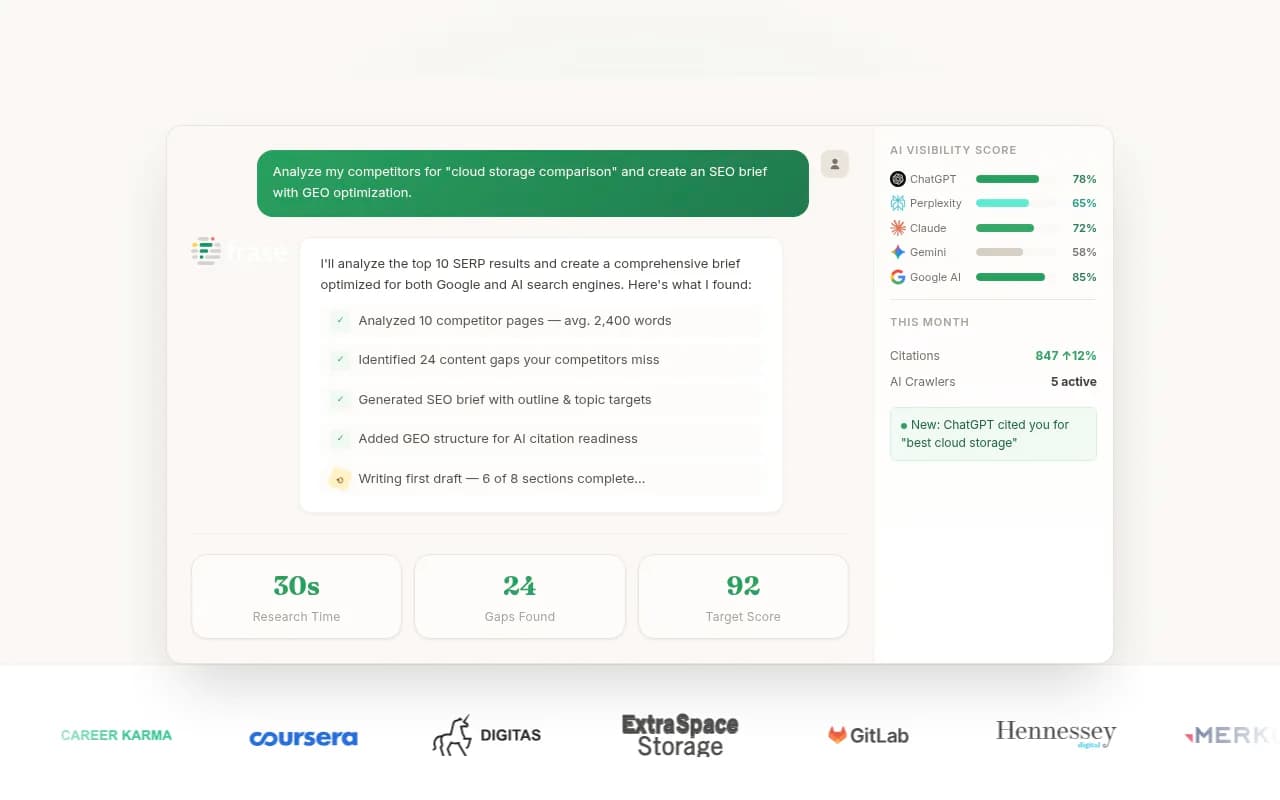
Frase is useful for mapping your content against what's actually appearing in search results, including AI-generated answers.
A comparison of approaches
| Approach | Effort | Impact on AI citations | Time to results |
|---|---|---|---|
| Restructure existing content (answer-first) | Low | High | 2-4 weeks |
| Add FAQ schema markup | Low | Medium-High | 1-3 weeks |
| Fill answer gaps with new content | Medium | High | 4-8 weeks |
| Build external citations/links | High | Medium | 2-6 months |
| Publish original data/research | High | High | 3-6 months |
The restructuring work is the highest-ROI starting point. You already have the content — you just need to make it more machine-readable and answer-first. That alone can move the needle faster than writing new content from scratch.
What Wikipedia actually can't do (and you can)
Here's the thing Wikipedia can't do: it can't publish original research, proprietary data, first-hand case studies, or expert opinions from named individuals. It can't have a byline from someone with 15 years of hands-on experience in your field. It can't include a customer story or a real-world example from your specific industry.
These are the things that make content genuinely citable in a way Wikipedia can't compete with. AI models are increasingly weighting first-hand expertise and original data. A page that says "based on our analysis of 10,000 customer accounts, we found that..." is doing something Wikipedia structurally cannot do.
The goal isn't to out-Wikipedia Wikipedia on general knowledge. It's to be the definitive source on the specific, specialized questions in your niche — the ones where your actual experience and data give you an edge no encyclopedia can match.
That's the content that gets cited. Not because it's longer or better-optimized, but because it's the only place on the internet where that specific answer exists.
Where to start this week
If you're looking at this problem and wondering where to begin, here's a concrete starting point:
- Pick three pages that rank in your top 10 organically but aren't being cited in AI Overviews.
- Read the first paragraph of each. Does it answer the implied question directly? If not, rewrite it.
- Check whether you have FAQ schema on any of them. If not, add it.
- Look at the AI Overview that appears for the query you're targeting. What sources are being cited? What format are they using? Match that format.
That's a morning's work. It won't solve everything, but it will tell you a lot about why your content is being skipped — and it will start moving things in the right direction.