Key takeaways
- Most AI visibility tools measure brand mentions, not whether a specific product or SKU appears in a shopping answer. For ecommerce, that gap matters more than any dashboard score.
- Product-level tracking is gated to Enterprise plans at several vendors, according to Rank Prompt's July 2026 review of vendor pricing pages. Verify on each pricing page before you buy.
- A budget of 25 to 150 tracked prompts covers categories, not a 12,000-SKU catalog. Plan prompts around categories, use cases, price bands and comparisons.
- Promptwatch Data shows product pages (22.4%) and landing pages (16.8%) are the most cited content types in ChatGPT, so your own pages and feeds matter as much as third-party coverage.
- This guide does not report results from our own test. It gives you a 30-prompt, 8-platform method and a vendor-sourced comparison, so you can run the test on your own catalog.
A note on the title and what this guide is
The title promises a 30-prompt, 8-platform test. To be straight with you: we did not run and publish a proprietary benchmark for this article, and I am not going to invent leaderboard numbers. What you get is the test design (so you can run it in an afternoon, or a week), the tool landscape drawn from vendor pages and published comparisons, and a few opinions about what actually matters for a store.
Two caveats on sourcing. Most 'best AI visibility tools for ecommerce' lists are written by vendors, and nearly all of them rank themselves first. Cognizo's list puts Cognizo first, Rank Prompt's puts Rank Prompt first. Treat rankings from vendors as marketing and use their factual observations (tier gates, feed handling) as leads to verify.
Why ecommerce breaks ordinary AI visibility tools
A general visibility tool answers one question: did the assistant say your brand name? If you sell 12,000 SKUs and the shopper asked for a waterproof hiking boot under $150, that question is nearly useless. What you need to know is whether a specific boot appeared, in what position, with what price, and whether a competitor's product card took the slot.
The demand is not hypothetical. Rank Prompt cites Adobe data showing AI traffic to US retail sites grew 393% year over year in Q1 2026, and that AI traffic converted 42% better than non-AI traffic in March 2026. I have not verified those Adobe figures independently, so check the source before quoting them to your CFO. Cognizo cites Gartner's prediction that traditional search volume drops 25% by 2026.
Three things make ecommerce different:
- Shopping surfaces read feeds. ChatGPT, Google and Amazon read merchant feeds you control. Your robots.txt has nothing to do with that part of the pipeline.
- Product pages are weak assets. Rank Prompt reports Adobe scored US retail product pages at 66% machine readable, the lowest of any page type measured. Unverified by us, but it matches what I see on thin product templates.
- Prompt budgets do not scale to catalogs. Tracking thousands of SKUs one prompt at a time is not realistic on any plan.
What AI answers cite when shoppers ask commercial questions
Before you pick a tool, know what you are trying to move. Promptwatch Data's ChatGPT citation share by content type report (Sep 28 to Oct 4, 2026) breaks down what ChatGPT cites:
| Prompt type | Product pages | Landing pages | Listicles | Other notable |
|---|---|---|---|---|
| All prompts | 22.4% | 16.8% | 13.6% | How-tos 8.7%, comparisons 5.9% |
| Commercial prompts | 26.0% | 20.6% | 15.0% | Comparisons 7.9% |
| Branded prompts | 23.3% | 22.8% | n/a | Reviews 5.6% |
For commercial prompts, those four types make up almost 70% of citations. The practical read: your product pages and landing pages carry the load, 'best of' roundups decide a lot of the shortlist, and reviews matter most when someone already knows your name. The same report recommends comparable product pages with clear pricing and specs, being listed in the roundups ChatGPT cites, publishing your own comparison pages, collecting reviews on trusted third-party sites, and adding an FAQ page.
Shelf life matters too. Promptwatch Data's content half-life report found news loses half its cited pages in about five weeks, while landing pages and docs stay cited for months. Evergreen category pages beat seasonal blog posts.
Shopping cards are a separate, smaller surface. Promptwatch's ChatGPT Shopping usage data shows shopping features appear in only a low single-digit percentage of ChatGPT web-search responses, concentrated on commercial and transactional prompts, and the rate moves in steps (it roughly doubled overnight in late May, then fell back). That looks like OpenAI tuning when cards appear, so a single snapshot tells you very little. You need repeated runs.
The 30-prompt, 8-platform test design
Here is the test I would run on any store. It takes six prompt groups of five prompts each.
The six prompt groups
- Category discovery. 'Best running shoes for flat feet', 'best moisturizer for sensitive skin'.
- Use case and attribute. 'Waterproof hiking boots for wide feet'.
- Price-constrained. 'Best espresso machine under $400'.
- Head-to-head comparison. 'Brand A vs Brand B', and 'alternatives to [competitor]'.
- Branded and trust. 'Is [your brand] legit?', 'your brand reviews'.
- Gift and occasion. 'Gift for a coffee lover under $75'.
Pick five real prompts per group from Search Console queries, customer service tickets and People Also Ask. Do not invent prompts you wish people asked.
The eight platforms
ChatGPT (with ChatGPT Search), Google AI Overviews, Google AI Mode, Gemini, Perplexity, Microsoft Copilot, Amazon Alexa (product results) and Meta AI. Run each in the country and language your customers use. Responses differ between the real user interface and the API, so UI-based collection matters for shopping, where cards and sponsored placements only exist in the interface.
What to record per run
- Whether your brand appears, and in which position in the answer.
- Whether a specific product appears, and which one.
- Price, availability and claims the AI states about it (are they right?).
- Which URLs get cited, and whether any are yours.
- Which competitor took a product card.
- Sentiment of the description.
Run the set daily for at least two weeks. Because of the stepwise behavior in shopping features, a one-off run is a screenshot, not a measurement. Thirty prompts across eight platforms is 240 responses per run, so doing this by hand beyond a first pass is painful. That is where tools come in.
The tools worth shortlisting
The table summarizes how vendors position themselves. Claims come from vendor pages and the comparisons listed above, so confirm before you buy.
| Tool | Positioning for ecommerce | Watch out for |
|---|---|---|
| Promptwatch | End-to-end: real-UI tracking, ChatGPT Shopping and Alexa product results, crawler logs, visitor analytics, content agent | Shopping and Content Agent start on Business ($579/mo) |
| Profound | SKU-level tracking inside ChatGPT Shopping | Enterprise only, per Rank Prompt |
| Rank Prompt | Category and comparison queries, seven engines, from $49/mo | No product feed ingestion, so no pure SKU shelf tracking (its own disclosure) |
| Goodie | Amazon and Alexa for Shopping | Product-level tracking above entry plan, per Rank Prompt |
| Semrush AI Visibility Toolkit | Fits teams already in Semrush | SKU tracking gated higher, per Rank Prompt |
| Peec AI | Multi-market retail groups | Basic monitoring, no crawler or content layer |
| Yotpo Discover | AI visibility tied to reviews and catalog data | Tied to the Yotpo ecosystem |
| Cognizo | Ten platforms, UI scraping, ChatGPT Ads layer | Self-ranked first in its own list |
Promptwatch
Promptwatch is where I would start for a store that wants to fix problems, not just chart them. It monitors the real interfaces of ChatGPT, Google AI Overviews, AI Mode, Gemini, Perplexity, Copilot, Alexa and Meta AI, so the eight-platform test above maps directly to one setup. ChatGPT Shopping tracking shows which products AI recommends and which competitors it picks instead, and Alexa product results are covered too. AI crawler logs tell you whether bots can even read your product pages, which separates an access problem from a content problem. Visitor analytics measure what AI actually sends to your checkout.
The action side matters for lean ecommerce teams: the Action Board prioritizes gaps, and the Content Agent can write and publish to WordPress, Webflow or Framer. Pricing: Essential is $95/mo, Professional $245/mo, Business $579/mo. Shopping insights and the Content Agent begin on Business, and there is a 7-day free trial on monthly billing. Confirm at promptwatch.com/pricing. A free AI visibility report is a no-login way to get a first read.

Head-to-head pages exist if you are already weighing the big names: Promptwatch vs Profound, vs Peec and vs Semrush.
Profound
Profound is the usual name in enterprise ecommerce discussions, and Rank Prompt rates it best for SKU-level tracking inside ChatGPT Shopping while noting it is Enterprise only. If you have a large catalog and an enterprise budget, it belongs on your shortlist.

Rank Prompt
Rank Prompt is cheap, from $49/mo for seven engines by its own pricing, and aimed at category and comparison queries. It is transparent that it does not ingest a product feed, which is honest and rules it out for SKU shelf tracking. For a small store that wants to watch category prompts, that may be plenty.
Rank Prompt
Goodie, Semrush and Peec AI
Goodie is positioned for Amazon and Alexa shopping, which matters if you sell on Amazon.

The Semrush AI Visibility Toolkit makes sense when your ecommerce SEO team already lives in Semrush and wants one login. The tradeoff is a fixed prompt set and shallower AI-specific data than dedicated platforms.
Peec AI is a clean monitor for multi-market retail groups, but it stops at monitoring.

Ecommerce-specific entrants
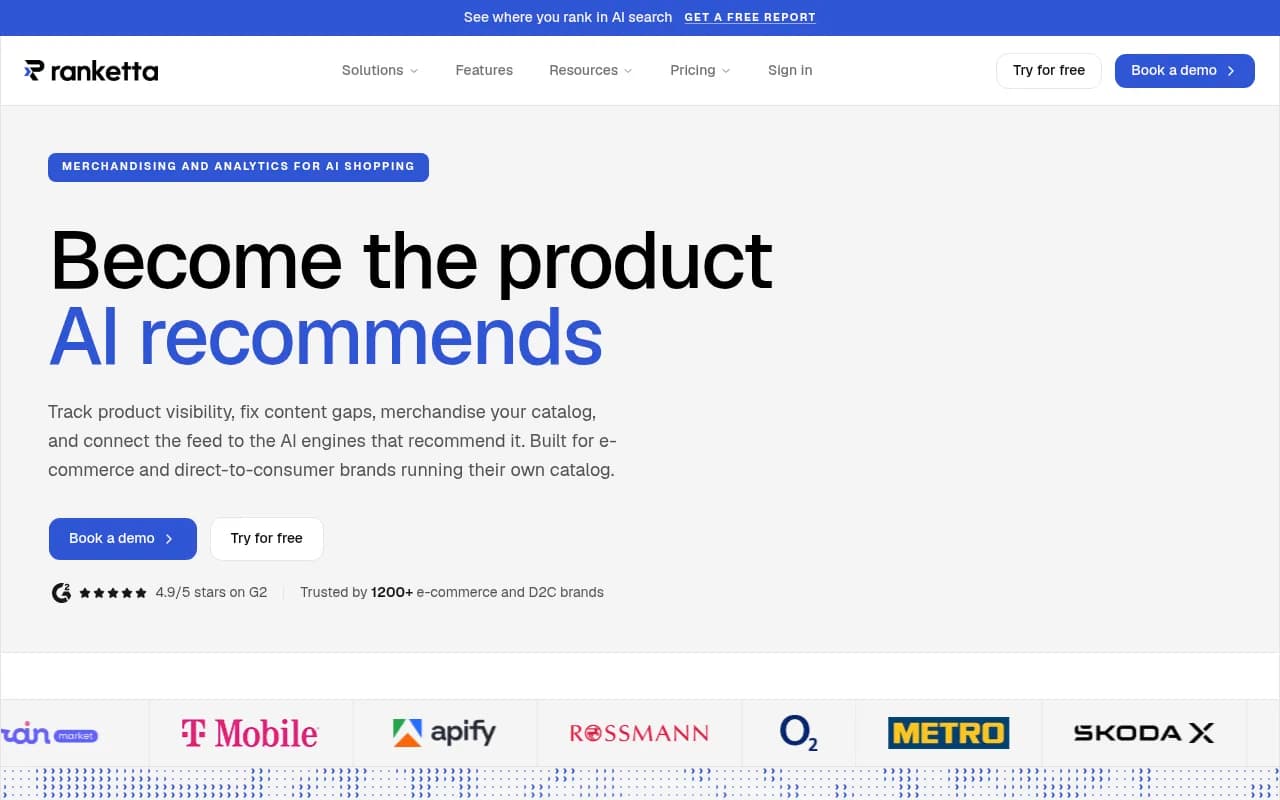
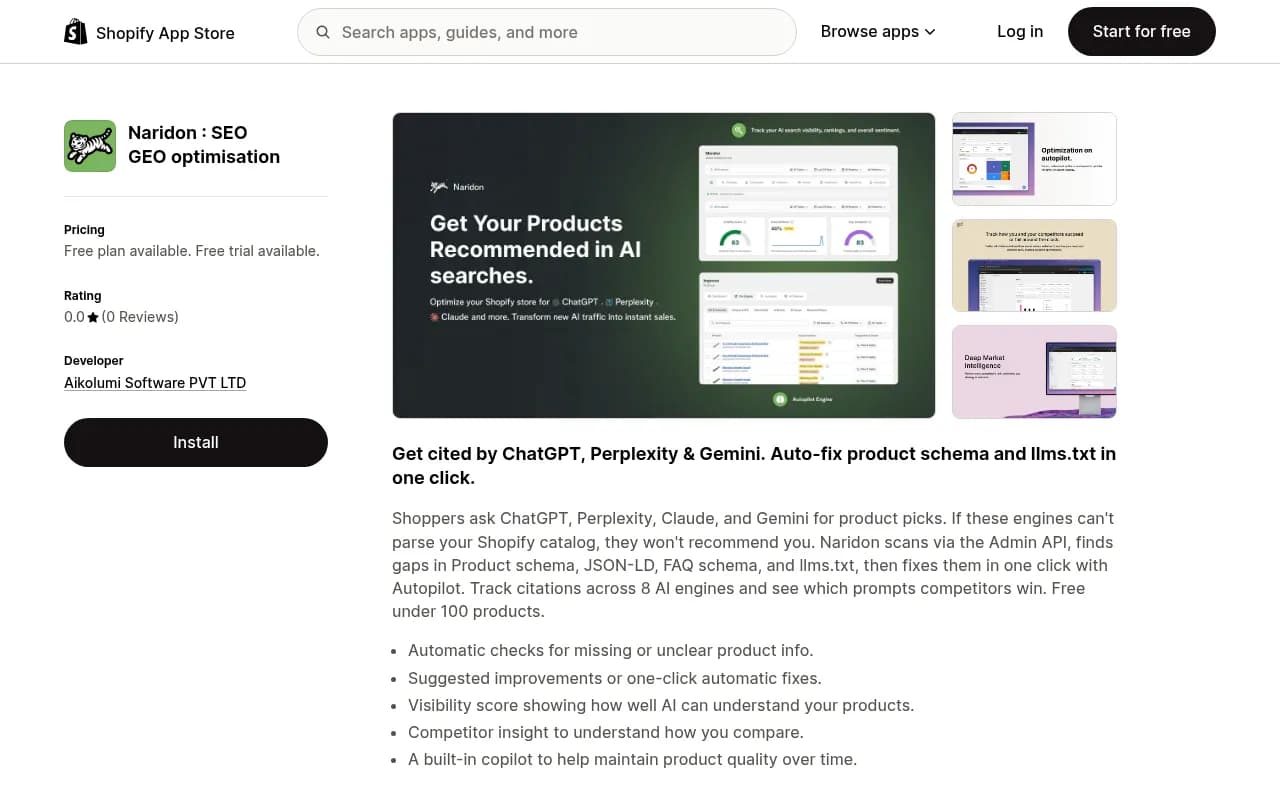
A few smaller tools in our catalog are built around catalogs rather than brands. Yotpo Discover ties visibility to review sentiment, Ranketta targets product-level tracking, Alhena AI focuses on ecommerce catalogs, and Naridon is Shopify-native. I have not tested them, so run the same 30 prompts through any trial before committing.
Yotpo Discover

For a wider scan, the GEO software directory at bestgeosoftware.com lists far more options.
Questions to ask every vendor
- Can you track a specific SKU or product card, and on which plan?
- Is data collected from real consumer interfaces or from APIs?
- Does the tool show which competitor product filled the card?
- Can I see AI crawler activity on product pages?
- Can it ingest or compare against my merchant feed?
- What is the real prompt limit, and how many responses per month does it cover?
- Does it measure traffic and conversions, or only mentions?
The last question is the one most buyers skip. A tool that only reports a score leaves you to figure out what to do next.
What to fix first, whatever tool you pick
Tools find the problem. These fixes move the numbers, going by the Promptwatch Data findings above:
- Complete Product schema, accurate prices and availability, and a clean merchant feed.
- Product pages that are easy to compare: price, specs, who it is for.
- Your own comparison pages and an FAQ.
- Presence in the roundups AI already cites for your category, and reviews on trusted third-party sites.
- Crawler access. Check that AI bots are not being blocked or erroring on product templates.
If you are choosing between tracking more prompts and fixing product pages, fix the pages first.
How I would choose
- Small store, tight budget: a low-cost monitor like Rank Prompt for category prompts, plus manual spot checks of shopping cards.
- Growing store that wants fixes and attribution: an end-to-end platform like Promptwatch, since crawler logs, traffic and content production sit in the same loop.
- Enterprise catalog with SKU needs: get quotes from Profound and Promptwatch Enterprise, and run your 30 prompts through both trials.
- Already deep in an SEO suite: use the suite's add-on as a baseline, but expect to outgrow it.
Run the same 30 prompts, same eight platforms, same two weeks in each trial. The tool that shows you which product is missing and why, rather than a single score, is the one worth paying for.