Key takeaways
- Most enterprise AI visibility tools monitor well. Far fewer act on what they find. Crawler logs, content execution and CMS publishing are where the real gaps are.
- The two main comparison sources for this market, Brandlight's and Promptwatch's, are both written by vendors, and each ranks itself first. Treat every ranking, including the ones below, as a starting point for your own pilot.
- Engine coverage differs more than vendor pages suggest. Brandlight says Profound covers 10 engines and Ahrefs Brand Radar skips Claude. Those are Brandlight's claims, so verify them in a demo.
- Pricing is mostly opaque at enterprise tier. Brandlight, Profound and Semrush's AI Toolkit are custom or contact-sales. Promptwatch publishes plan prices, so ask every vendor for a written quote for the plan you would actually buy.
- Use a short pilot: 50 to 100 real buyer prompts, two or three markets, and a request to see the page behind every gap.
What enterprise buyers actually need
A 20-seat startup can live with a dashboard that says "you were mentioned in 31% of answers." An enterprise cannot. You have multiple brands, several markets, a security team that reads vendor questionnaires, and a CMO who will ask what the number turned into.
So I would judge these tools on six things:
- Engine coverage on the plan you would buy, not the plan on the pricing page.
- Data collection: real user interfaces or API calls. Answers and citations can differ between the two.
- Crawler visibility: do you see which AI bots hit your site and fail, from server data?
- Execution: who writes and publishes the fix?
- Attribution: can you connect AI answers to visits and conversions?
- Governance: SSO, audit logs, roles, ISO 27001, GDPR, API and MCP access.
One piece of context before the tools. Brandlight's own analysis claims roughly 85% of the sources AI cites for category questions are third-party or social, such as review sites, editorial, Reddit and YouTube. Whatever the exact number is for your category, it means a tool that only watches your own domain misses most of the story. Citation sources matter as much as mentions. Promptwatch's Social Media Citations by AI Model report shows how uneven this is: from Sep 28 to Oct 4, 2026, ChatGPT got 0.46% of its citations from social platforms while Google AI Overviews got 12.2%.
Engines behave differently, so per-engine tracking matters
Promptwatch's average sources per response data (published Sept 2025) puts ChatGPT at about 5 sources per web-search answer, Google AI Overviews at about 10, and Perplexity at almost exactly 10. Microsoft Copilot swung from under 2 to nearly 17 within a few weeks before settling low. A tool that blends engines into one score hides all of that. Ask whether you can see visibility, position and citations per engine, per market.
Crawler behavior shifts too. In Promptwatch's AI crawler traffic report (June 8 to Sept 6, 2026), OpenAI made up 79.8% of IP-verified AI crawler requests in the week of Aug 31 to Sept 6, down from 94.8% in the week of June 8. If a provider is large in that mix but near zero in your logs, you may be blocked. Only tools with real crawler logs can tell you that.
The shortlist at a glance
| Tool | Best for | Standout | Pricing model |
|---|---|---|---|
| Promptwatch | Teams that want monitoring plus execution in one platform | Crawler logs, content gaps, Content Agent, CMS publishing, attribution | Published plans ($95, $245, $579/mo), Enterprise custom |
| Brandlight | Multi-brand, multi-market global enterprises | Strategy partner service, governance across markets | Custom, contact sales |
| Profound | Large brands wanting broad engine coverage and agency mode | Citation analytics, prompt volumes, agent analytics | Custom after free trial |
| Scrunch | Brands wanting monitoring plus agent-ready pages | Enterprise full fan-out data | From $250/mo Core, enterprise custom |
| AthenaHQ | Mid-to-large teams wanting blindspot analysis | Content blindspots, fact checking on Enterprise | Starter around $295/mo per third-party listing |
| Semrush AI Toolkit | Teams already living in Semrush | AI visibility alongside SEO data | $199/mo per domain, Semrush One Advanced custom |
| Ahrefs Brand Radar | Teams with Ahrefs data culture | Large pre-collected response index plus custom prompts | From about $199/mo standalone |
| Peec AI | Smaller or mid-size teams needing cheap tracking | Simple prompt-metered tracking | From $95/mo |
| Bluefish | Enterprise marketing and agentic commerce | Enterprise suite, MCP | Enterprise |
| Botify | Technical SEO teams at large sites | Crawl-scale technical data | Enterprise |
| BrightEdge / Conductor | Enterprise SEO shops adding AI search | Existing enterprise SEO workflows | Enterprise |
| Adobe LLM Optimizer | Adobe Experience Cloud customers | Fits inside Adobe stack | Enterprise |
Pricing notes come from vendor pages and third-party listings, and I have not re-verified every figure. Confirm before you budget.
1. Promptwatch
Promptwatch is the one I would put at the top of a pilot for teams that want the fix as well as the report. It tracks ChatGPT, Gemini, Claude, Perplexity, Google AI Overviews, AI Mode, Copilot, Meta AI and Alexa from real interfaces, then ties that to IP-verified crawler logs, visitor analytics, content gap analysis and a Content Agent that publishes to WordPress, Webflow or Framer. Agent Chat, an Action Board and an MCP server with 110+ tools sit on top.

In Promptwatch's own 2026 comparison of 22 tools, it is the only one scoring full marks on all six core capabilities: prompt tracking, citation trends, crawler logs, visitor analytics, content gap and offsite mentions. That is a vendor-authored claim, so run the test yourself. What I find more convincing is the structure: a drop in visibility turns into a specific page to fix, and the published page is then followed through crawls, citations and traffic.
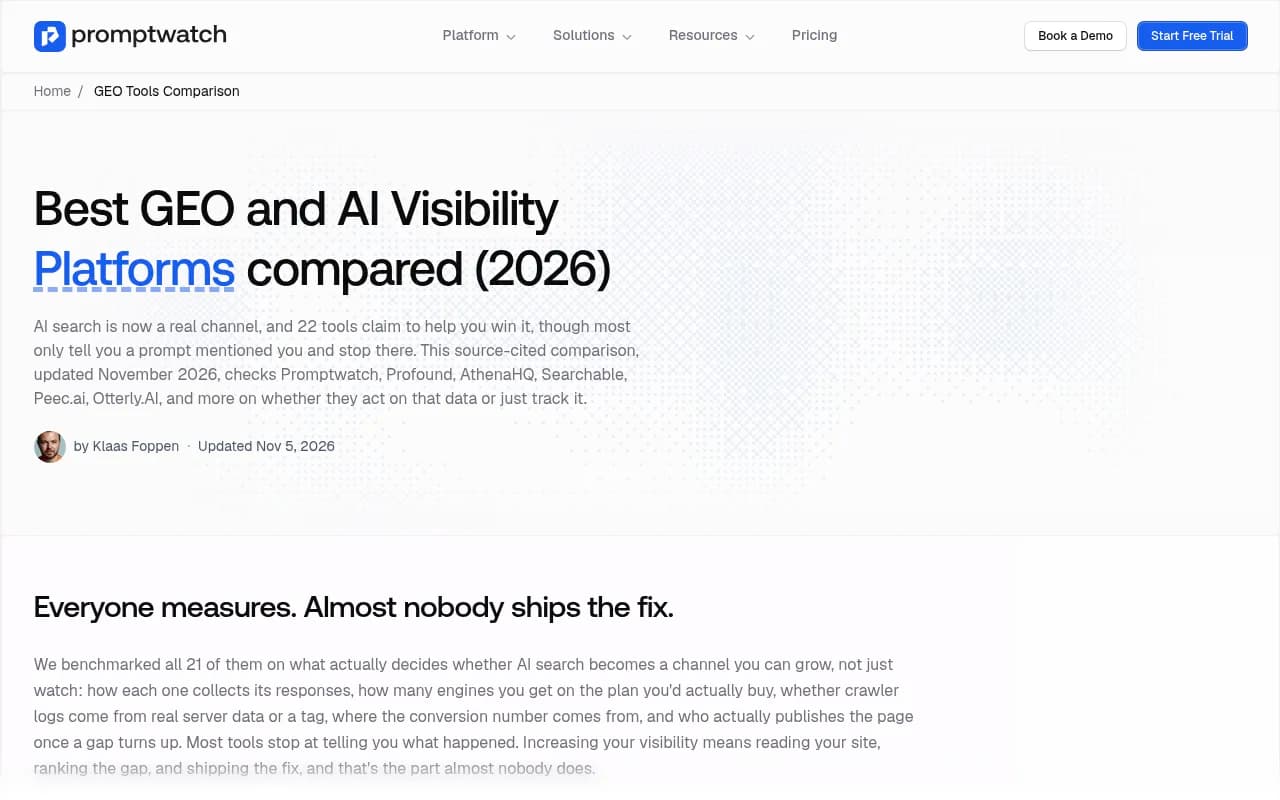
For enterprise procurement, it is ISO/IEC 27001 certified and GDPR compliant, with SSO, audit logs, a white-label portal and 50,000 API/MCP requests per hour on Enterprise. Business at $579/mo is the first plan with the Content Agent, hourly tracking, local GEO targeting, Fact Check, Shopping and Ads Radar. Confirm current prices at promptwatch.com/pricing.
Downsides: the Content Agent is not on the agency plans, and the sheer feature count means onboarding takes some deliberate scoping. Start with the free AI visibility report or the 7-day trial.
2. Brandlight
Brandlight pitches itself as the intelligence layer global CMOs use to govern how AI systems represent their brands across engines, markets and products. It covers ChatGPT, AI Overviews, AI Mode, Gemini, Perplexity, Copilot and Claude, adapting per market (for example using Claude where Copilot is paywalled).

The strength is the service layer: a strategy partner plus the platform, aimed at Fortune 500-class organizations that need to change how AI describes them. Pricing is custom, and a third-party tracker reports enterprise tiers reaching up to $25K per month. Promptwatch's comparison flags Brandlight as thinner on integrations (export-only for several, REST API on Enterprise) and sales-assisted for content generation. Brandlight ranks itself first in its own roundup and Promptwatch ranks it around 11th or 12th. Both are biased, which is the point: pilot it.
3. Profound
Profound is the name that comes up most in enterprise shortlists. Its Answer Engine Insights includes Citation Analytics, plus Prompt Volumes and Agent Analytics, and it offers an agency mode with brand configurations and pitch environments. Brandlight says it covers 10 engines; other write-ups say up to 9, so ask for the exact list.

Published enterprise features such as Search Console, Slack, CMS publishing, REST API and MCP are Enterprise-gated. Profound publishes no self-serve price beyond its free trial, so budget conversations start with sales. See the head-to-head at Promptwatch vs Profound for a vendor-side view, and ask Profound for its own.
4. Scrunch
Scrunch pairs monitoring with agent-ready pages for your site. Core starts around $250/mo with 125 prompts, and full fan-out data and the Fact Check beta sit on Enterprise. Good if you want a content-serving angle for AI agents, less so if you need crawler logs and attribution out of the box.

5. AthenaHQ
AthenaHQ bundles 11 models on a Starter plan listed at $295/mo and adds content blindspots and enterprise fact checking. Goodie AI recently published a comparison framing AthenaHQ as "enterprise-gated GEO", which is a rival's spin, but it does match the pattern that the interesting features sit behind the enterprise tier.

6. Semrush AI Visibility Toolkit
If your organization already runs on Semrush, the AI Toolkit is the path of least resistance. A listing puts it at $199/mo per domain, and Semrush One Advanced has moved to custom pricing with unlimited prompt tracking. The tradeoff: it is an SEO suite adding AI tracking, so crawler logs and AI traffic attribution are the questions to press on.
7. Ahrefs Brand Radar
Brand Radar offers custom prompts plus an AI Visibility Index of pre-collected responses, and recently added entity extraction to response tracking. Brandlight claims it does not track Claude. Ahrefs has said it prioritizes proprietary data infrastructure over software UI, which suits analysts who live in exports.

Before buying, check whether your niche questions exist in the index or need custom tracking.
8. Peec AI
Peec is a clean, cheap prompt tracker with metered prompts, models and projects. Entry pricing is cited at $95/mo with 50 prompts and 3 models, with extra models as add-ons. It is a fit for a single business unit pilot, less so for a multi-market rollout.

9. Bluefish
Bluefish positions as an enterprise marketing suite for the generative internet, with agentic commerce features. MCP access is Enterprise-only in Promptwatch's matrix.

10. Botify
Botify comes from technical SEO, so it is strongest where crawl and indexation at huge-site scale matter. Think of it as the technical base layer for AI search readiness rather than a brand-sentiment tool.
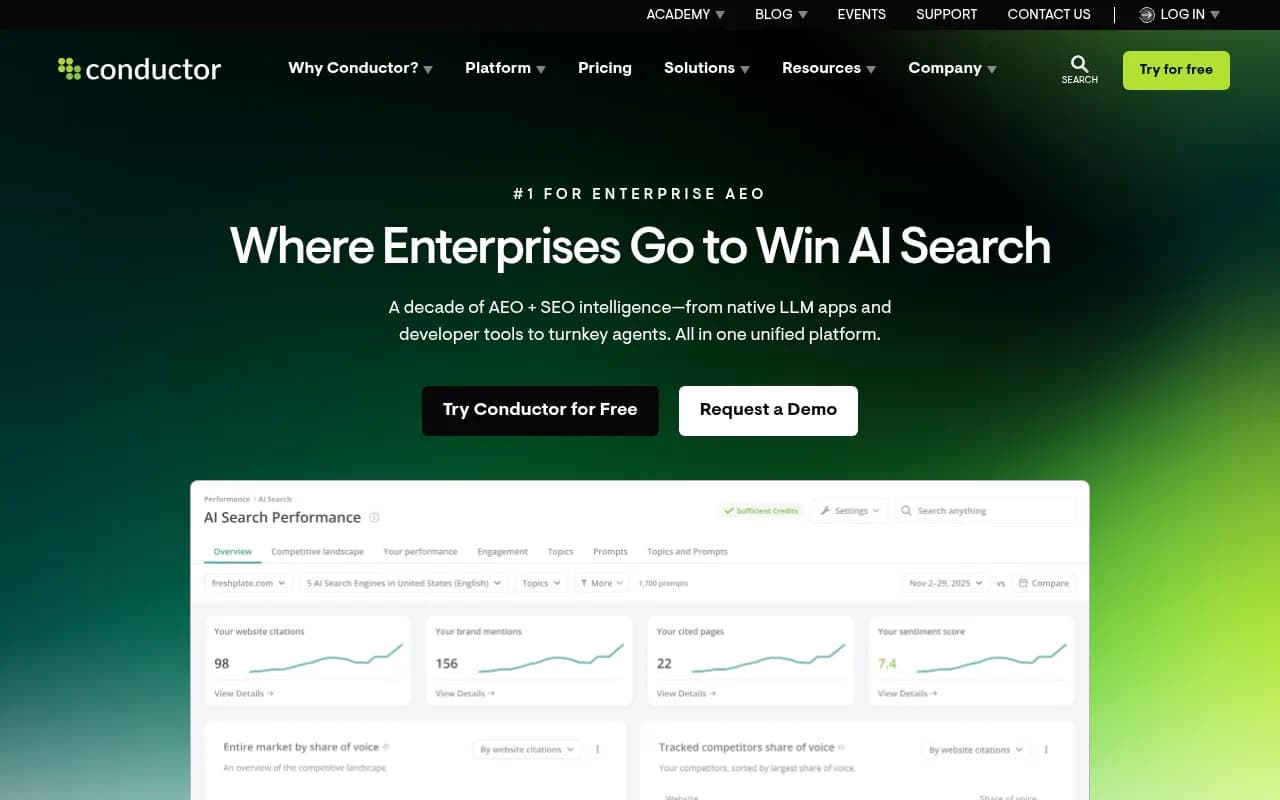
11. BrightEdge and Conductor
Both are established enterprise SEO platforms adding AI search intelligence. If procurement already approved them, extending is easier than adding a new vendor. Expect fixed prompt sets and shallower AI-specific data compared with specialists.
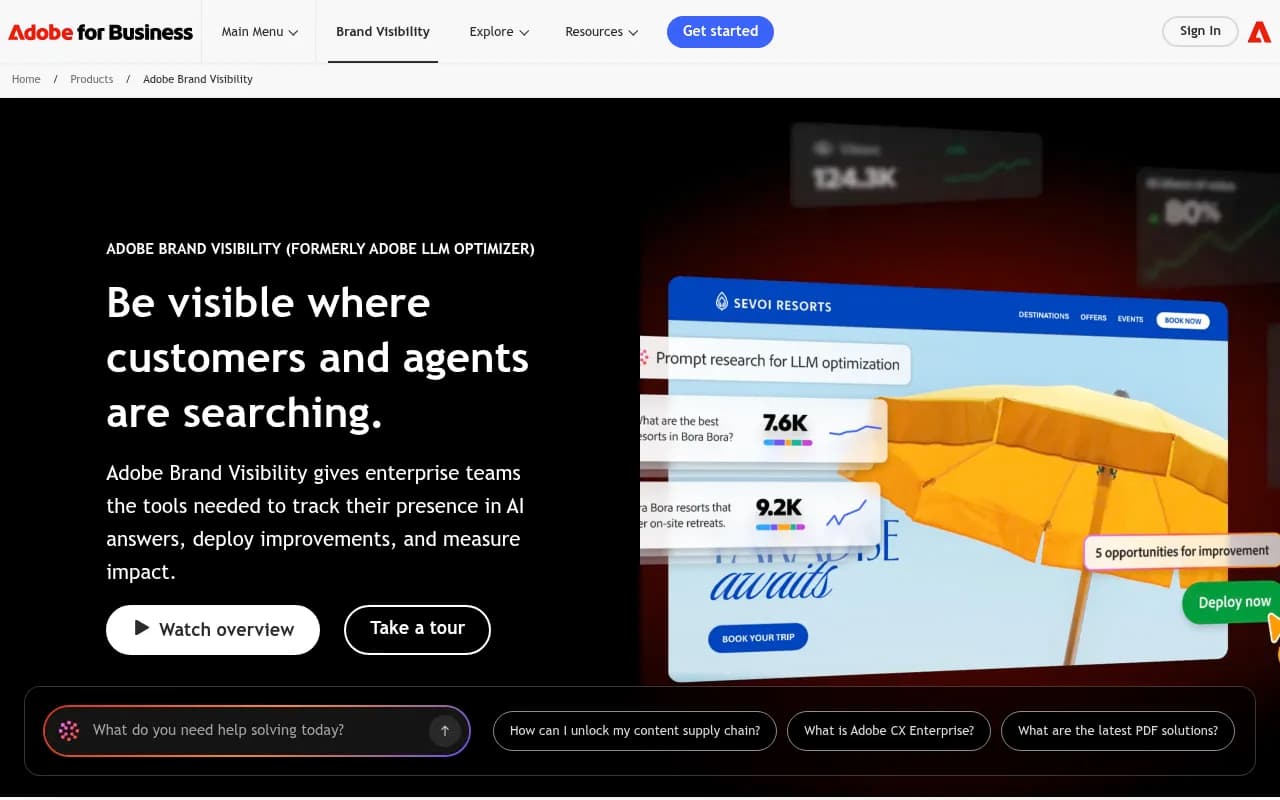
12. Adobe LLM Optimizer
For Adobe Experience Cloud shops, the LLM Optimizer keeps GEO inside the stack you already govern. The tradeoff is the same as any suite: convenience over depth.
Enterprise feature comparison
This table summarizes what Promptwatch's 2026 comparison reports for several vendors. It is vendor-authored, so treat it as claims to test.
| Capability | Promptwatch | Profound | Brandlight | Otterly.AI |
|---|---|---|---|---|
| Crawler logs | Yes, IP-verified | Not marked | Server logs | New |
| Visitor analytics | Yes | Not marked | Attribution | Not marked |
| Content gap | Yes | Uncited prompts | Structural | URL audits |
| Content generation | Content Agent with CMS publishing | Not listed | Sales-assisted | Not listed |
| REST API / MCP | Yes, every plan | Enterprise | REST on Enterprise, no MCP | From $189 |
| Search Console | Yes | Enterprise | Export only | Not marked |
Read the conflicts honestly. Brandlight shows server logs and attribution here, which contradicts the notion that only one vendor has them. Demand a live demonstration of each.
How to run an enterprise pilot
Build the prompt set from real buyers
Take 50 to 100 prompts from sales calls, support tickets and Search Console. Include branded, competitor comparison and category prompts. Cover each market and language separately, because a monitor's location and language should not mix.
Ask for the page behind every gap
A vendor that says "you are missing from 'best X for Y'" should show which answer, which sources were cited, and which of your pages should have won. If they cannot, you are buying a chart.
Test the access layer
Check whether the tool can show AI bots hitting your site from server data and flag blocks in robots.txt, CDN or WAF rules. Free tools such as Promptwatch's AI Crawler URL Inspector give a quick sanity check before you commit.
Price the plan you would really buy
Compare on prompts, responses, engines, markets and seats at your actual scale. Ask what happens when you exceed an allowance, and which features sit only on Enterprise. Write it down.
Run the security review early
SSO, audit logs, role scoping, ISO 27001 and data residency can kill a deal in week eight. Raise them in week one.
Which tool for which team
| If you are... | Start with |
|---|---|
| A global multi-brand group wanting a hands-on strategy partner | Brandlight, with Promptwatch or Profound in the pilot for comparison |
| An enterprise team that wants to monitor, fix and prove impact in one place | Promptwatch |
| A large brand with an agency model and broad engine needs | Profound |
| An SEO org already on Semrush or Ahrefs | Their AI add-ons as a baseline, then test a specialist |
| A technical SEO team on a huge site | Botify plus a monitoring tool |
| An Adobe shop | Adobe LLM Optimizer |
For wider browsing, the directories at bestgeosoftware.com and ai-rank-tools.com list many more options than fit here.
Need a human to run it?
Software only gets you so far. If you want an agency to run the program, 1001 SEO Media handles technical SEO, content and GEO work and uses Promptwatch as its AI visibility platform. That is a disclosure as much as a recommendation: it is also the company behind this site.
Bottom line
Pick two or three tools, run the same prompts on each for four weeks, and judge them on whether they told you something you could act on. The tool with the prettiest score is rarely the one that moves citations. For my money, the ones that connect crawler data, content gaps and publishing in a single loop are the ones worth the enterprise budget, and that is where I would start.