Key takeaways
- Sentiment inside AI answers is not the same signal as sentiment on social media. It's shaped by which sources the model cites that week, and citation sources shift constantly.
- Promptwatch's own data shows ChatGPT's citation share of reddit.com fell from roughly 3.8% to 0.5% in a matter of days in August 2026. A tool that can't tell you whether a sentiment dip is a real brand problem or a citation-source reshuffle will send you chasing ghosts.
- Profound, Mentionova, and Otterly.AI have built dedicated sentiment features (theme-level breakdowns, Net Sentiment Score, drift alerts); Scrunch, AthenaHQ, ZipTie, and Semrush bundle sentiment into broader visibility suites.
- Negative sentiment detection speed matters: vendor benchmarks suggest AI-native classification catches issues in 5-15 minutes versus 2-4 hours for keyword-based alerts, though treat those numbers as directional rather than independently verified.
- If you want a platform that goes beyond flagging a spike and actually helps you fix the underlying content, look for one with crawler logs and content generation built in, not just a sentiment score.
Why sentiment tracking inside AI answers is harder than it sounds
Here's the thing nobody tells you when you start monitoring brand sentiment in ChatGPT or Google AI Overviews: a "negative spike" on your dashboard might have nothing to do with your brand's actual reputation. It might just be the model switching which sources it trusts that week.
I say this because Promptwatch's research on Reddit citations makes the point embarrassingly clear. ChatGPT's share of citations pointing to reddit.com sat at a steady average of around 3.8% from mid-July through early August 2026. Then, over the course of about a week, it collapsed to 0.5%, an 86% relative drop. The slide started the same day ChatGPT Search changed how it runs its query fan-outs (it began using the site: operator at scale), and it kept falling until it cratered on August 14. Promptwatch's data on Reddit citations dropping in ChatGPT shows this wasn't a gradual decline tied to anything a brand did. It was a retrieval-behavior change at the engine level.
Now imagine you're a brand that gets a lot of its negative mentions filtered through Reddit threads (which is common, since customer complaints tend to live there). If your sentiment tool doesn't separate "source mix changed" from "sentiment actually got worse," you'd have seen your negative mention volume crash on August 14 and assumed you'd fixed a PR problem you hadn't touched. Or the reverse: a brand that leans on Reddit for positive social proof could see sentiment scores swing the other way for reasons that have nothing to do with customer happiness.
Google's AI surfaces are more forgiving here. AI Overviews' Reddit citation share only dipped about 11% relative over the same window, and AI Mode fell about 30%, both gradual rather than a cliff. That asymmetry alone tells you something useful: if a sentiment spike shows up on ChatGPT but not on Google's AI surfaces, treat it with more suspicion than if it shows up everywhere at once.
What actually drives a negative sentiment spike (and what doesn't)
Before picking a tool, it helps to know what you're actually trying to catch. A few patterns worth knowing:
Old complaints resurface as "new" spikes. Promptwatch's Reddit citation research found that cited posts skew old. About 60% of the Reddit threads ChatGPT cited were more than six months old, and 22% were over two years old. So a sudden wave of negative sentiment in an AI answer might be an AI model surfacing a complaint thread from 2024, not a fresh wave of unhappy customers. Any tool worth paying for should let you click into the exact cited text and see its publish date, not just a sentiment score.
Engine-wide shifts masquerade as brand-specific ones. On March 4, 2026, average citations per ChatGPT response dropped across every model variant (GPT-5.3, GPT-5.4, GPT-5-Mini) around a model rollout, per Promptwatch's data on the citation drop after GPT-5.3. If your sentiment volume cratered that week, check whether it happened to competitors too before you panic.
Citation volatility varies wildly by engine. Perplexity is boringly consistent, citing around 10 sources per answer with almost no week-to-week variance, according to Promptwatch's data on average sources per response. Microsoft Copilot, on the other hand, swings from under 2 sources to nearly 17 within a few weeks. If you're judging sentiment trends on Copilot, do it monthly. Weekly snapshots there are mostly noise.
Not every platform carries the same risk. Reddit dominates social citations overall (3.36% average share), with ChatGPT especially dependent on it (5.19% of its citations, more than 20x its next social source). AI Overviews and Grok lean harder on YouTube. If you're worried about negative sentiment, know which platform your brand's AI visibility actually runs through, per Promptwatch's data on social media citations by AI model, because that tells you where to watch for trouble first.
Comparing the platforms built for sentiment monitoring
A handful of tools have moved past generic "brand mentioned: yes/no" tracking into something closer to real sentiment analysis. Here's how the main ones stack up.
| Platform | Sentiment approach | Alerting | Starting price | Best for |
|---|---|---|---|---|
| Profound | Theme-level sentiment (positive/negative by specific attribute), drills into source text | Slack integration for mention alerts | Custom (enterprise); limited free trial | Enterprise brands needing granular theme breakdowns |
| Otterly.AI | Net Sentiment Score (-100 to +100), prompt- and response-level drill-down | Dashboard-based, no dedicated spike alert | ~$29/mo (Lite) | Smaller teams wanting a simple sentiment score |
| Mentionova | 5 typed drift events including sentiment shift, with before/after text diffs | Next-morning alerts after each scheduled run | ~$99/mo (Starter) | Teams who want diff-based, fast root-causing |
| Scrunch AI | Named sentiment analysis feature across Core and Enterprise tiers | Not a headline feature | $250/mo (Core) | Brands with competitors already worth tracking |
| AthenaHQ | Real-time sentiment intelligence plus hallucination detection | Credit-based monitoring, unlimited topics | $295/mo (Starter) | Brands worried about false claims as much as sentiment |
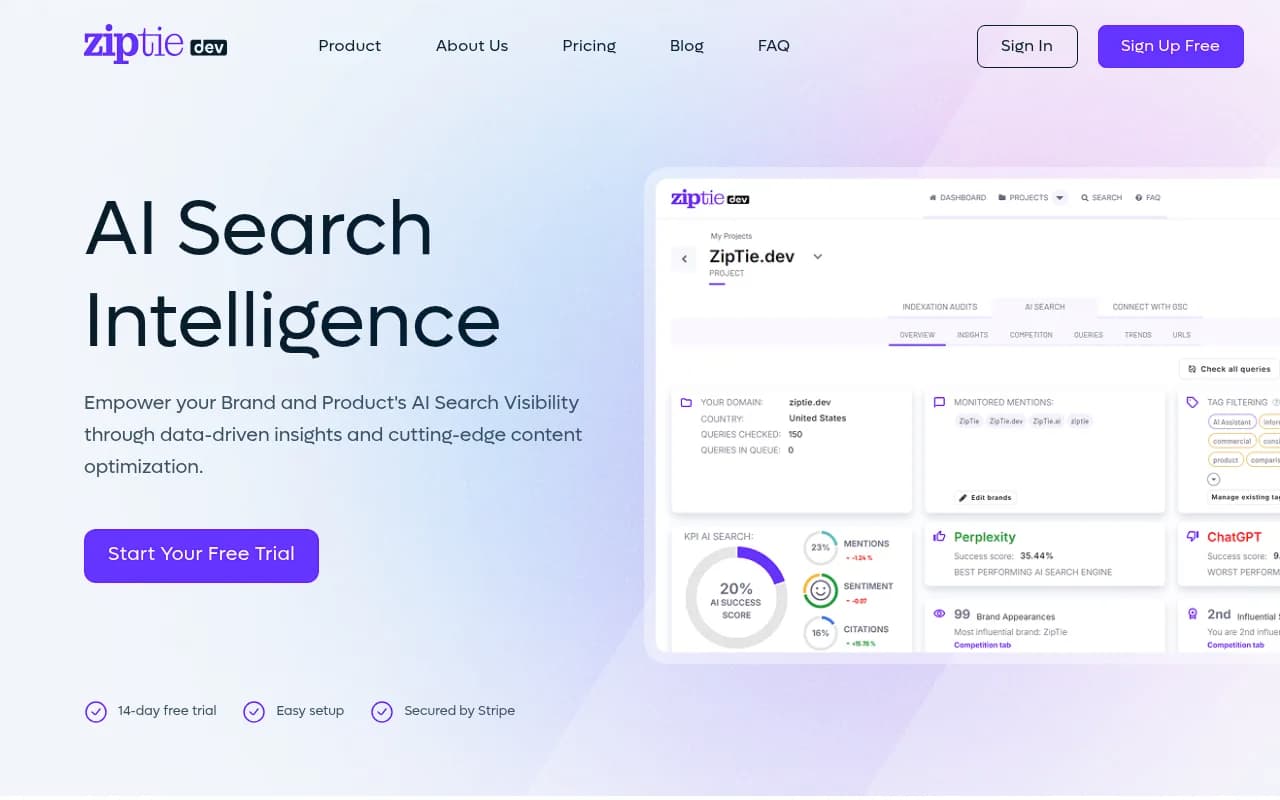
| ZipTie | Basic positive/neutral/negative tagging, retains full answer text | Simple, check-based | $69/mo (Basic) | Budget-conscious teams wanting raw answer visibility |
| Semrush AI Visibility Toolkit | Sentiment bundled into brand performance reporting | Standard reporting cadence | $99/mo per domain | Teams already in the Semrush ecosystem |




A tactic worth stealing from Otterly's own playbook: don't just wait passively for negative sentiment to surface. Run deliberately adversarial prompts, things like "which [category] tools should I avoid," alongside your normal tracking prompts. It forces the model to reveal negative associations it might not volunteer in a neutral query, which gives you a head start instead of finding out from a customer screenshot.
The detection speed problem
One vendor, AmICited, makes a claim worth taking seriously even if the exact numbers are self-reported: traditional keyword-based alert systems reportedly miss around 60% of customer complaints because complaints rarely use explicitly negative language. Sarcasm, backhanded comparisons, and "it's fine I guess" phrasing slip right past a keyword filter. The same source claims AI-powered sentiment classification detects issues in 5-15 minutes at 85-92% accuracy, versus 2-4 hours and 40-50% accuracy for keyword matching. Treat the specific percentages as directional, not gospel, but the underlying logic holds up: if your monitoring tool is still doing simple keyword matching on AI-generated answers, you're going to miss the complaints that matter most, the subtle ones.
There's also a context problem that volume-based alerting gets wrong. One negative mention in a major outlet or a high-authority AI answer can do more reputational damage than fifty scattered mentions in a niche forum thread nobody reads. If your tool treats every mention equally, you'll either get alert fatigue from noise or miss the one mention that actually matters.
Hallucinations are a cousin of sentiment spikes, not the same thing
Worth separating out: sometimes what looks like a negative sentiment problem is actually an AI model fabricating something false about your brand, like confusing a rebrand with a shutdown. That's a hallucination, and it's a distinct risk from genuine negative sentiment, because it can persist for months and shape perception even though nothing real happened. AthenaHQ bundles hallucination detection alongside its sentiment tracking for this reason, and it's a sensible pairing. If you catch a hallucination, the fix usually isn't content on your own site. It's correcting the third-party pages the model is pulling from, and in some cases using a platform's own feedback mechanism (Perplexity has one) to flag the inaccuracy directly.
Where a broader visibility platform like Promptwatch fits
Most of the tools above are built primarily to detect and score sentiment. Promptwatch approaches the same problem from a different angle: instead of stopping at "here's your sentiment score," it ties sentiment-relevant signals back to the underlying causes, which pages AI crawlers are actually reading, which third-party sources are driving a citation, and whether a traffic or visibility dip lines up with an engine-wide retrieval change or something specific to your brand.

That context matters a lot for sentiment work specifically, because, as the Reddit citation data above shows, a huge share of what looks like a "sentiment spike" is actually a citation-source reshuffle. Promptwatch's crawler logs (Agent Analytics) show exactly when AI bots visited your pages and what they read, which helps separate a real reputation event from engine noise. Its Offsite Mentions feature also catches your brand being named inside third-party pages that AI cites, even when there's no link back, which is often where negative framing actually originates. Once you've identified a real problem, the Content Agents and Unified Actions can turn that into a prioritized fix list and, if you want, generate and publish corrective or clarifying content straight to your CMS rather than leaving you with a dashboard and no next step.
It isn't purpose-built as a sentiment classifier the way Profound or Mentionova are, so if sentiment scoring is literally your only requirement, those two are worth a closer look first. But if you want sentiment monitoring folded into a wider system that also explains the why and helps execute the fix, it's the stronger long-term pick.
A practical checklist before you buy
A few questions to ask any vendor before signing up, based on everything above:
- Can I see the exact cited text behind a sentiment score, including its publish date? (Old Reddit threads masquerading as fresh complaints are common.)
- Does the tool separate engine-wide retrieval changes from brand-specific drops? Ask for an example from a past model rollout.
- How fast does an alert actually fire after a spike happens, hours or days?
- Does pricing scale with the number of prompts and engines you need, or will you hit a ceiling fast? Otterly's base plans, for instance, exclude Claude, Gemini, and AI Mode unless you pay for add-ons.
- Is hallucination detection bundled in, or will you need a second tool for that?
If you're still weighing options beyond what's covered here, the GEO software directory at bestgeosoftware.com is a decent place to compare feature sets side by side, and ai-rank-tools.com focuses specifically on the rank-tracking side of this category if sentiment is only one piece of what you need.
Bottom line
Don't buy a sentiment tracker that only gives you a number. Buy one that shows you the text behind the number, flags when a spike is actually a platform-wide retrieval shift, and ideally helps you act on what's real. Profound and Mentionova are the sharpest dedicated sentiment tools right now. Scrunch and AthenaHQ are solid if you want sentiment bundled into a wider competitive-intelligence suite. And if you want the whole loop, detection, diagnosis, and a fix, closed in one place, that's where a platform like Promptwatch earns its price tag.