Key takeaways
- Almost every serious AI visibility platform now ships an API, an MCP server, or both. The real differences are which plan unlocks access, whether the MCP can write as well as read, and how much history and volume you can pull.
- Access gating varies a lot. Some vendors include MCP from under $100 a month, while others (Profound, and Peec AI's REST API) keep it for Enterprise contracts.
- Data teams should check five things: auth method, rate limits, date range per request, write permissions, and whether the data comes from real AI interfaces or from raw model APIs.
- Most "best of" lists on this topic are written by vendors who rank themselves first. Treat plan details as self-reported and confirm them on pricing and developer docs pages before you sign.
- Run a 30-day pilot that pulls one quarter of data into your warehouse and connects the MCP to the assistant your analysts actually use.
Why API and MCP access matters for data teams
AI visibility data is only useful if it leaves the vendor dashboard. Your analysts work in BigQuery, Looker Studio, Snowflake, notebooks, and increasingly in assistants like Claude, ChatGPT, Cursor, or Claude Code. If a platform can't get data into those places, someone ends up exporting CSVs every Monday.
An API and an MCP server solve slightly different problems.
An API is for code. A scheduled job pulls visibility, citations, sentiment, and share of voice into a warehouse, a BI tool, or a client report. You care about pagination, rate limits, history depth, and stable schemas.
An MCP server is for conversation. An analyst or an agent asks "which competitor gained share of voice in ChatGPT last month?" and the assistant calls the platform's tools to answer. You care about which tools are exposed, how sign-in works (OAuth or API key), and whether write actions are possible, such as adding prompts or queueing content.
Most teams end up wanting both. The API feeds the dashboards that run on a schedule. The MCP handles ad hoc questions that nobody wants to write SQL for.
How I evaluated these platforms
A short caveat first. The comparison sources I drew on are mostly vendor blogs: Geoptie, KIME, seoClarity, Siftly, Lightsite, and NodeMaven all publish lists that put their own product on top. Claims like "MCP and API in all paid plans" or "no monthly request cap" are self-reported. I flag where something is unverified, and you should check pricing and docs pages directly. Pricing in this guide was current at the time of research and changes often.
Here is what I looked at.
| Criterion | Why a data team cares |
|---|---|
| Plan gate for API and MCP | Decides whether you can pilot without an enterprise contract |
| Auth method | OAuth is easy for analysts, scoped API keys are better for pipelines |
| Read vs write | Write access lets agents add prompts, move tasks, or publish content |
| Rate limits and date range | Determines whether a full quarter fits in one request |
| Data source | Real UI monitoring and API model outputs can differ in answers and citations |
| Governance | SSO, audit logs, roles, ISO 27001 or SOC 2 matter for procurement |
The data-source row deserves a note. Promptwatch Data shows how much citation behavior differs by engine: ChatGPT cites about 5 sources per web-search answer, Google AI Overviews about 10, and Perplexity almost exactly 10 every day. Microsoft Copilot swung from under 2 to nearly 17 sources within weeks before settling at the low end. So any pipeline that compares engines needs normalisation, and Copilot data needs a skeptical eye.
Fanout depth is not constant either. In Promptwatch's ChatGPT query fanout data, average fanouts per response were 2.15 in early December and about 1.84 by early March, then 1.0 when the series resumed in April. Average query length fell from roughly 117 characters to about 53. If you store fanouts, log them as a time series and never treat them as a constant.
Quick comparison
| Platform | Best for | MCP from | API from | Notes |
|---|---|---|---|---|
| Promptwatch | End-to-end GEO with read and write API and MCP | See pricing page | See pricing page | REST API v2, hosted MCP, official ChatGPT and Claude connectors |
| Profound | Enterprises needing SDKs and SSO | Enterprise | Enterprise | TypeScript and Python SDKs, MCP launched Oct 2025 |
| Peec AI | Teams that mostly query through an assistant | $95/mo | Enterprise (custom) | REST Customer API is Enterprise only |
| seoClarity ArcAI | Existing seoClarity enterprise customers | All paid plans (self-reported) | All paid plans (self-reported) | SOC 2 compliant per vendor |
| SE Ranking | SEO teams wanting AI and classic data together | $129/mo | $129/mo | Per vendor research, unverified |
| Geoptie | Agencies and in-house teams without an enterprise contract | $99/mo | $99/mo | 48-tool MCP, self-reported no monthly request cap |
| Otterly AI | Small teams that want fixed quotas | $189/mo | $189/mo | Per third-party comparison |
| Ahrefs Brand Radar | Ahrefs users | $129/mo | $129/mo | Per third-party comparison |
| Scrunch | Agencies on Scrunch | $500/mo | $500/mo | OAuth MCP, API reserved for higher tiers |
Everything except Promptwatch and Profound in this table comes from third-party listings I could not verify on vendor pages, so confirm before you budget.
Promptwatch
Promptwatch is the platform I'd start with if the goal is to feed data into your own stack and also act on it, because the API and MCP cover the whole loop: monitoring, citations, crawler logs, visitor analytics, site audits, content, and publishing.

The hosted MCP server exposes 110+ read and write tools and works with Claude, Claude Code, ChatGPT, Cursor, Lovable, Codex, and any MCP client, with one-click OAuth or an API key. It is also listed as an official ChatGPT plugin and a Claude connector. The REST API v2 covers visibility, prompts, responses, citations, sentiment, crawler and visitor analytics, shopping, Ads Radar, site audit, content, and publishing. Date ranges go up to 92 days, so a full quarter fits in one request, which matters when you backfill a warehouse. Keys can be scoped to a project, an organization, or read-only.
A few things matter specifically to data teams:
- Data comes from the real interfaces of ChatGPT, Google AI Overviews, Google AI Mode, Gemini, Perplexity, Copilot, Meta AI, and others, per country and language, rather than only model APIs. How Promptwatch collects data explains the difference.
- IP-verified AI crawler logs and visitor analytics sit in the same API, so you can join "was it crawled" to "was it cited" to "did it convert" without stitching three vendors together.
- Rate limits scale by plan, from 500 requests per hour on Essential up to 50,000 on Enterprise. An organization audit log (Business and above) records whether a change came from the dashboard, the API, an MCP client, or Agent Chat. That is the sort of thing security reviews ask about.
- It is ISO/IEC 27001 certified and GDPR compliant, with SSO on Enterprise.
- A Looker Studio connector and PDF and CSV exports cover the non-code consumers.
Plans start at $95 a month (Essential) and every plan includes MCP and API access, with request limits that rise by tier. Business is $579 a month and adds the automated Content Agent, hourly tracking options, and Fact Check. Confirm current numbers at promptwatch.com/pricing. A third-party integration guide describes the API's dual-level auth, time-series pagination, and async polling workflows, but treat that as secondary and read the official docs.
Where it is weaker: it is a broader product than a pure data feed, so if all you want is a raw SERP-style data pipe, a vendor like DataForSEO may be simpler. For agencies, there are separate plans with pitch projects through the API. Comparison pages like Promptwatch vs Profound go deeper on specific rivals.
If you want to see what the data looks like before committing, the 7-day free trial or the free AI visibility report are the free starting points.
Profound
Profound is the heavyweight in this category, and its developer story is solid. It launched an MCP server, a TypeScript SDK, and a Python SDK on October 15, 2025. The MCP runs with npx -y @profoundai/mcp and is hosted at mcp.tryprofound.com. The SDKs install with @profoundai/client or pip install profound. They cover visibility reports, citation data, and Agent Analytics bot logs, and the vendor names ChatGPT, Claude Desktop, Cursor, and Cline as supported clients.

The catch is access. Third-party sources, including an October 2026 comparison from Alexandrya.AI, say API and MCP are Enterprise only and individually priced. Profound's own pricing page shows a 7-day trial with 50 prompts a day across ChatGPT, Gemini, and Google AI Overviews, so you can't test the API on a self-serve plan. If you have a procurement process and want SDKs plus SSO, it's a reasonable fit. If you want to prototype next week, it isn't.
seoClarity ArcAI
seoClarity already sells enterprise SEO, with rank tracking, log file analysis, and a ranking data API. ArcAI extends that into AI visibility. The vendor says ArcAI's API and MCP server are available in all paid subscriptions and that it is SOC 2 compliant. Both are self-reported in seoClarity's own comparison post.
The appeal is consolidation. If your data team already pulls from seoClarity, one more endpoint in the same account is easier than onboarding a new vendor. The downside is that suite vendors tend to bolt AI tracking onto fixed prompt sets, so ask how flexible prompt and market configuration is.
Peec AI
Peec is popular with teams that mostly want to ask an assistant about their data. Its MCP server starts at $95 a month, which is among the cheapest entry points. The REST Customer API is the sticking point: per Geoptie's comparison, it is Enterprise only and custom-priced. Extra models start at $30 a month on Starter.

So Peec works well for analysts living in Claude or ChatGPT, and less well for a data engineer who wants a nightly warehouse load without an Enterprise contract. A separate comparison also notes hourly monitoring on Enterprise, with daily monitoring and a 6-hour lag otherwise.
SE Ranking
SE Ranking's pitch is one connector for classic SEO and AI data. ScrapeGraphAI names it the best all-around API for AI visibility for agencies and SaaS teams, citing LLM mention tracking, AI Overview monitoring, white-label output, and its REST API. Another listing puts API and MCP at $129 a month. I couldn't verify quotas on SE Ranking's own site, so check them.
It's a good pick when your team needs rankings, audits, and backlinks in the same account as AI mentions. It is less compelling if AI visibility is the main workload and you need deep citation and crawler analysis.
Geoptie
Geoptie sells flat-priced access: a 48-tool MCP server and REST API on its $99 Professional plan, tracking seven engines through one key. The "no monthly request cap" claim is the vendor's own. Its publication ranks itself first in its comparison, so read that list with that in mind.
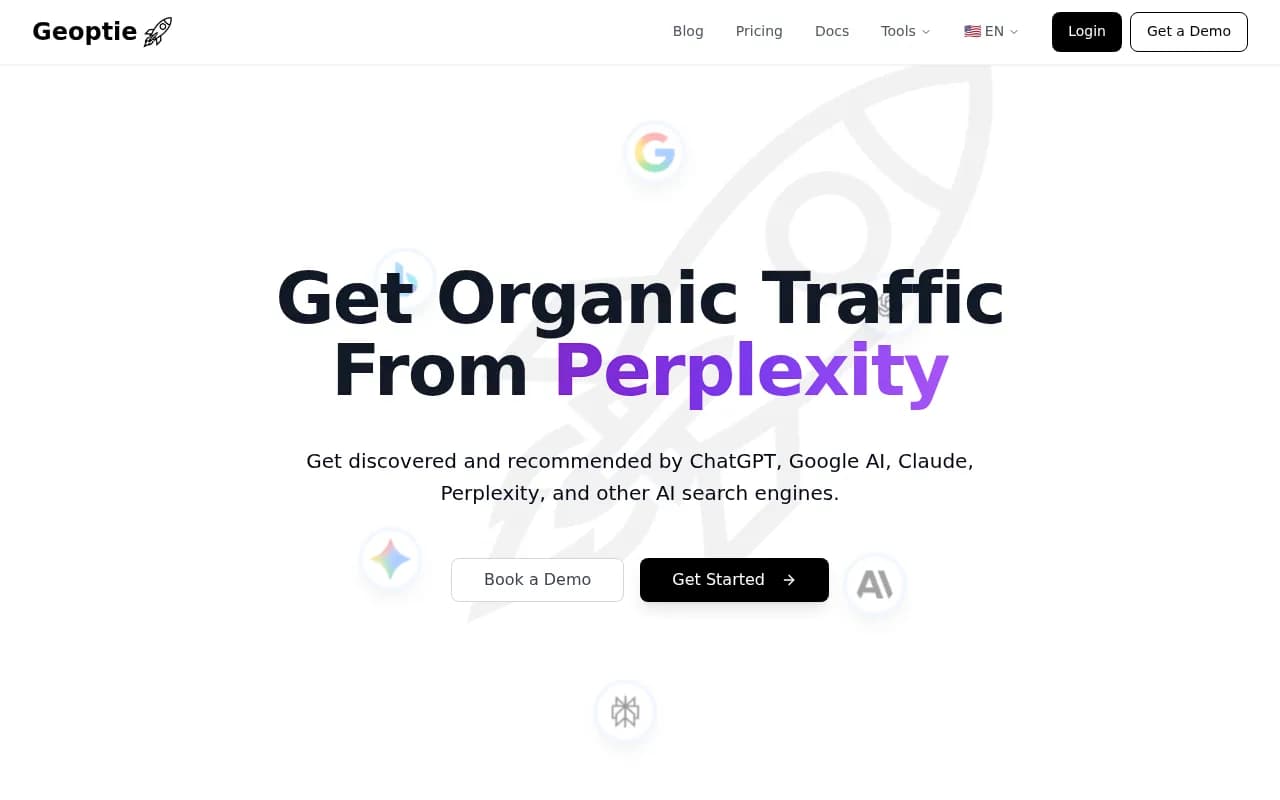
It suits agencies and smaller in-house teams who want data in their own reports without an enterprise sales cycle. For regulated enterprises, check the security certifications and SSO story, which I didn't find documented in the research.
Other platforms worth a look
A few more names showed up in the research, usually with thinner or unverified API details.
- Otterly.AI is listed at $189 a month for API and MCP with fixed quotas.

- Ahrefs Brand Radar, listed at $129 a month, makes sense if your team already lives in Ahrefs.

- Scrunch has an OAuth MCP server, with API access reserved for agency and enterprise plans.

- LLM Pulse is called out by NodeMaven for API depth.

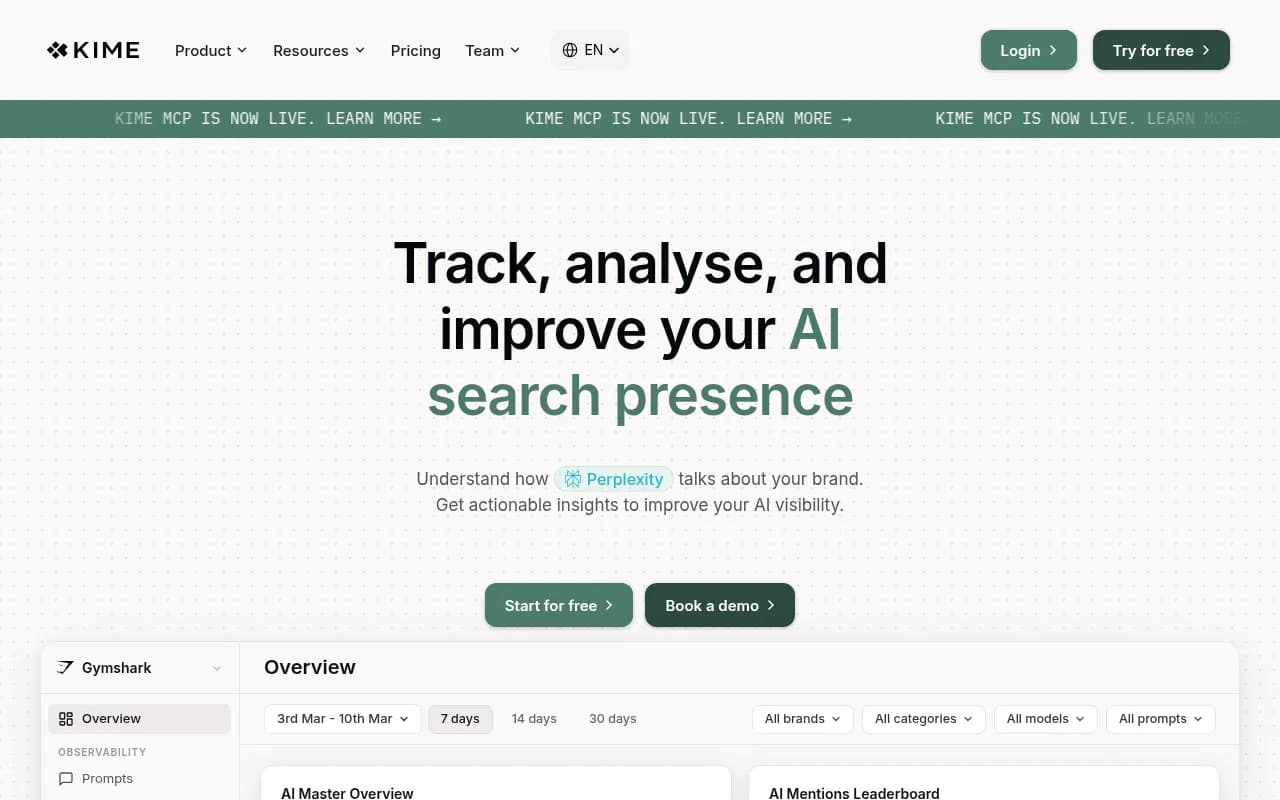
- KIME bundles an MCP and API with agentic execution at around 99 euros a month, but its own list ranks it first.
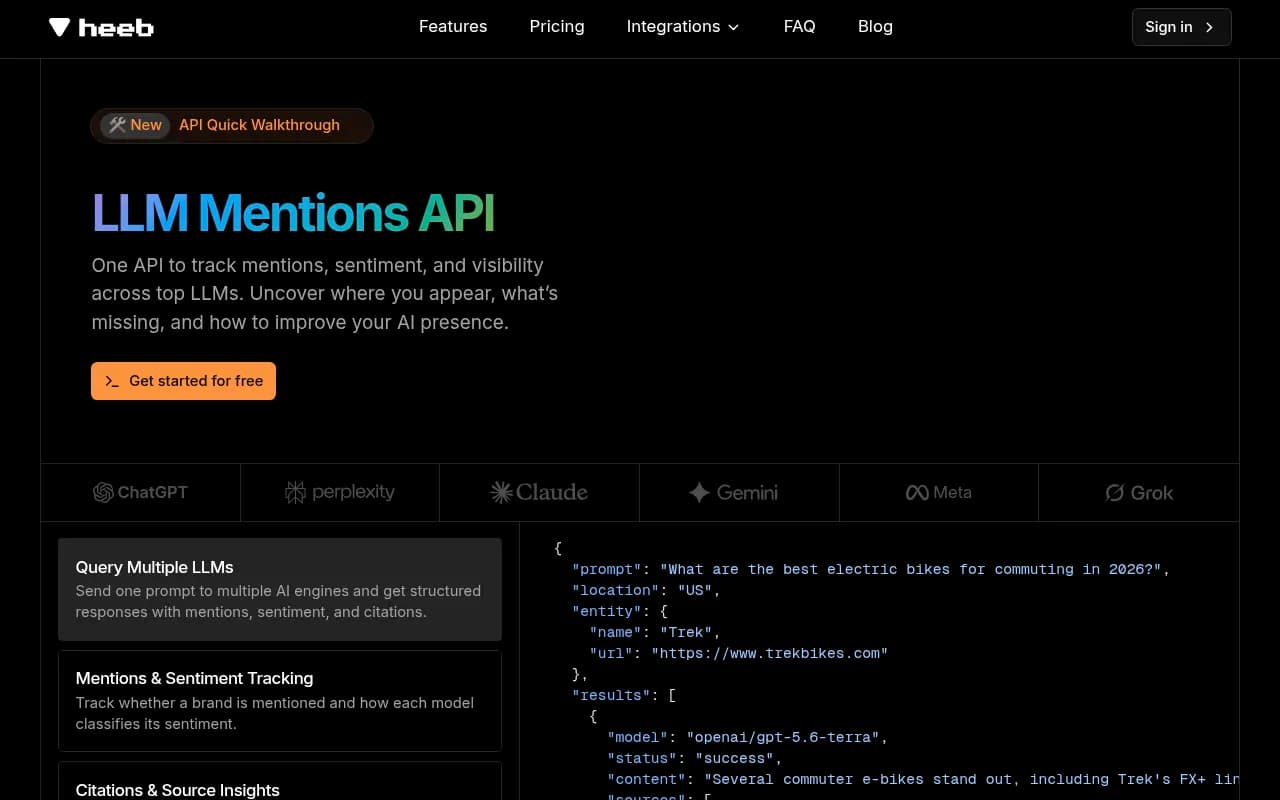
- Heeb.ai is a developer-oriented LLM Mentions API if you want a narrow data source rather than a platform.
For a broader look, the GEO software directory lists more options, and ai-rank-tools.com covers rank trackers specifically.
What to check before you buy
Auth and governance
OAuth is convenient for analysts. Scoped API keys (read-only, project, organization) are what you want for pipelines, so a leaked key can't rewrite your monitors. Ask about audit logs, roles, SSO, and certifications. ISO 27001 and SOC 2 both show up in this category, so ask for the actual report.
Read and write
A read-only MCP answers questions. A read-write one can add prompts, queue content, and move tasks. That's powerful, and it's also a risk if agents run unattended, so check whether writes are logged and attributable.
Volume, history, and cadence
Ask how many requests per hour you get, how far back one call can reach, and how often prompts run. A tool that tracks daily but throttles you at a few hundred requests an hour may not fit a multi-brand warehouse load.
Data source
User-facing answers and citations can differ from raw model API output. If your report is meant to reflect what customers see, real-interface collection matters. If you want to see what models believe from training data, API-model tracking is useful. The best setups have both and label them.
Schema stability
Request a sample response and the changelog. Engines change fast, and platforms that rename metrics break dashboards. The Copilot swings and fanout drift above are a reminder that the source data moves too.
A 30-day pilot for data teams
- Week 1: get API and MCP access on a trial or a low tier. Confirm the plan actually unlocks both before you do anything else.
- Week 1 to 2: pull one full quarter of visibility, citations, and sentiment into your warehouse. Note how many requests that takes and whether pagination behaves.
- Week 2 to 3: build one dashboard in Looker Studio or your BI tool, and compare engines using normalised citation counts.
- Week 3: connect the MCP to the assistant your analysts use and test five real questions. Time the answers.
- Week 4: run a security review covering key scopes, audit logs, and data residency, then score the vendors side by side.
For GEO-specific details, such as why some pages get crawled and not cited, the Promptwatch Academy has metric definitions and how-tos that help you design the right tables.
Which one should you pick?
| If you need | Start with |
|---|---|
| One platform covering monitoring, crawler logs, traffic, and content, with read and write API and MCP | Promptwatch |
| SDKs and SSO, and you have enterprise budget | Profound |
| An assistant-first workflow on a small budget | Peec AI |
| AI data next to classic SEO data | SE Ranking or seoClarity |
| A flat-priced API for client reports | Geoptie |
My blunt view: the cheapest way to get burned is to buy on a listicle. Get a trial key, pull a quarter of data, and see how the platform behaves before you commit to an annual contract.
About the author of this guide
This guide is published by 1001 SEO Media, an SEO and GEO agency that uses Promptwatch as its AI visibility platform. We've tried to flag vendor-reported claims honestly, and you should verify every plan detail on the vendor's own pricing and docs pages.