Key takeaways
- A free AI visibility scan is a snapshot of one moment, on a few engines, with a prompt set you did not choose. It answers "are we in the conversation at all?" and not much more.
- The best free method is manual: write 15 to 20 real buyer questions, run them in ChatGPT, Gemini, Perplexity and Google, and record who is named and who is cited.
- Free checkers from Semrush, Ahrefs, HubSpot, Frase, Conductor and Scrunch are worth running once each. Compare the results instead of trusting any single score.
- Free tools keep no meaningful history, cannot alert you when a competitor moves, and cannot show crawler activity or AI-driven traffic. Those gaps are where paid platforms earn their fee.
- Citation behaviour differs by engine and shifts over time, so measure each engine separately and re-check monthly.
Why free AI visibility tools exist at all
Every vendor in this category has the same problem: nobody knows what AI visibility looks like until they see their own number. So they give the number away. Semrush lets you run its checker three times a day without an account. Frase, Leapd, Conductor, Scrunch, Ahrefs and HubSpot all have some version of a no-card scan.
That is useful to you. It is also lead generation, and it is worth keeping both facts in mind. The scan is designed to show you a gap and then sell you the plan that closes it. Some of them do exactly what they say. Others hand you a score that looks authoritative and means little.
This guide covers what the free options give you, where they mislead, and a method that costs nothing and beats most of them.
Start with the free method that is not a product
One of the research sources for this guide made a point I agree with: the manual method is the baseline every paid tool gets measured against, not a fallback for people who cannot afford software.
Here is how to do it properly.
- Write 15 to 20 questions a real buyer would ask. Mix three types: category questions ("best project management tools for agencies"), comparison questions ("X vs Y"), and brand questions ("is [your brand] any good").
- Run each one in ChatGPT, Gemini, Perplexity, Copilot and Google AI Overviews. Use a fresh chat each time so earlier answers do not bias the result.
- Record two separate things: whether your brand is mentioned, and whether your domain is cited as a source. A mention is a name appearing in the answer. A citation is a linked source, which is closer to a backlink than a brand nod. They are different findings.
- Note whether the facts about you are correct. Wrong pricing or a discontinued feature in an AI answer is a problem a dashboard score will never flag.
- Put it in a spreadsheet and repeat monthly.
It takes an afternoon. It is slow, and the numbers are noisy because AI answers vary run to run. But you learn more from reading 20 actual answers than from any single score.
The free checkers worth running once
These are the free or free-tier options that turned up in research. Run two or three, compare, and treat disagreement between them as information.
| Tool | What is genuinely free | The catch |
|---|---|---|
| Semrush free AI visibility checker | Three runs per day, no account. Returns a 0 to 100 visibility score, mentions, audience reach, top topics and topic volume | Snapshot only. Ongoing tracking needs the paid toolkit |
| Frase AI Visibility Checker | Reads your domain and names the engines citing you, no card | Quick reading, not a monitoring system |
| Ahrefs Brand Radar | Free instant preview; custom prompts included on paid Ahrefs plans | Full value only if you already pay for Ahrefs |
| HubSpot AEO Grader | Free grader for brand visibility in answer engines | Ongoing monitoring is a paid add-on |
| Conductor AI Visibility Analysis | Account-free checker | One-off snapshot, three engines, no history |
| Scrunch instant audit | No card required | Less detail than the paid plan |
| Google Search Console and Bing Webmaster Tools | Fully free, and reportedly now include AI visibility reporting | Search-engine-owned data only, not ChatGPT or Perplexity |
A few notes on this list.
Semrush
The free checker is the most detailed of the no-signup options. The score, mentions and topic breakdown give you a decent baseline. Be careful about the paid side: one research source found the vendor's own pricing page shows trial buttons while its knowledge base says the AI Visibility Toolkit does not offer a free trial. Verify before you plan around a trial.
Ahrefs Brand Radar

Good for competitor and market research, and the free preview is a fast way to see how you compare. If you already pay for Ahrefs, custom prompts come with the plan, which makes it the cheapest route to ongoing tracking you will find.
Frase
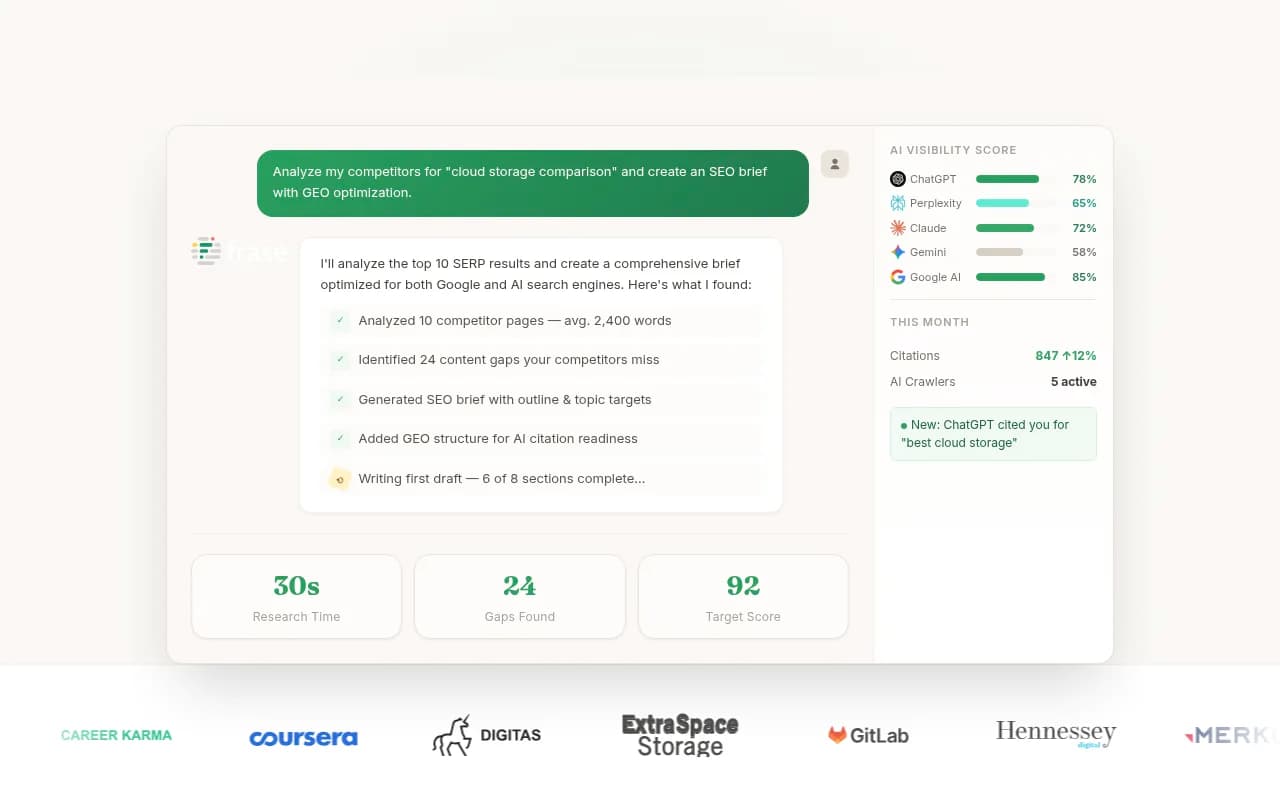
Frase's checker names which engines cite your domain, and its GEO Score grades a single page from 0 to 100 on how quotable it is. The page-level grade is the more useful half, because it points at something you can edit.
HubSpot AEO tools

The AEO Grader is a sensible first stop if your team already lives in HubSpot. Otherwise it is one more scan to compare.
Conductor and Scrunch
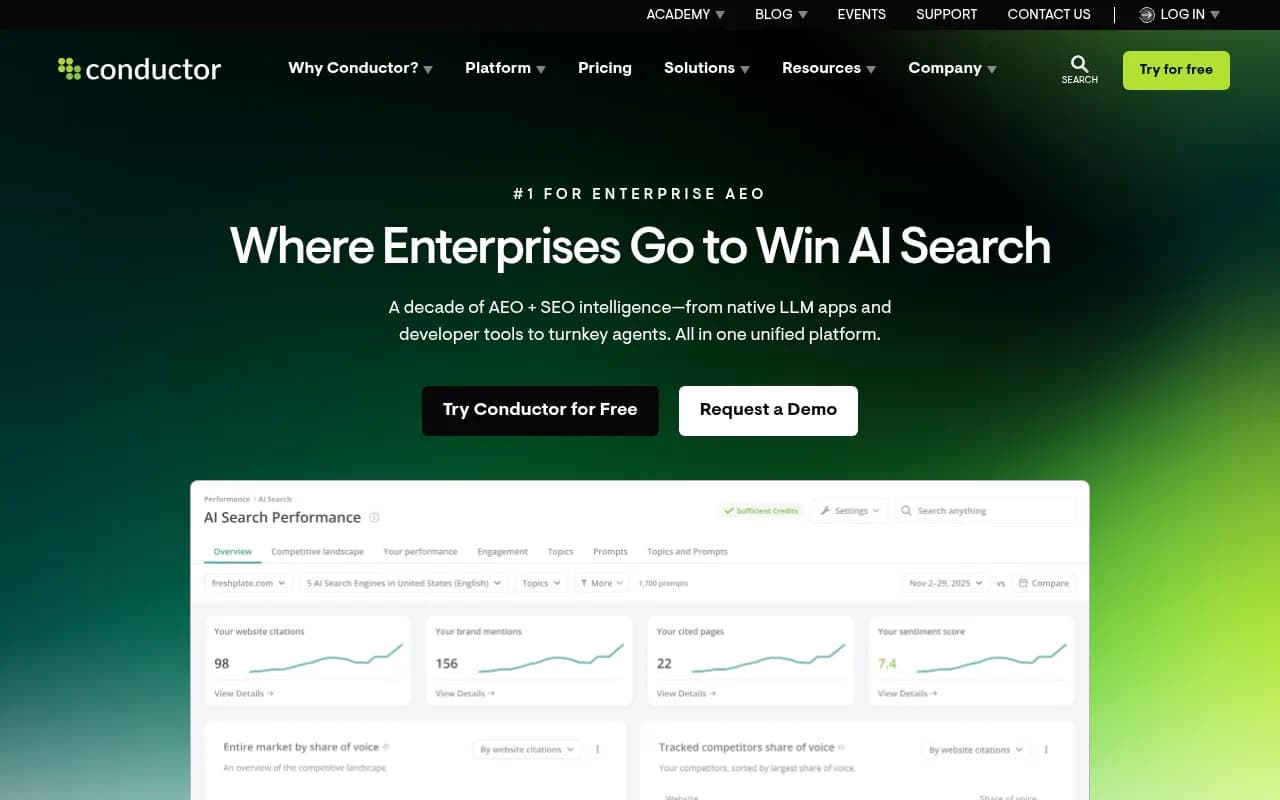
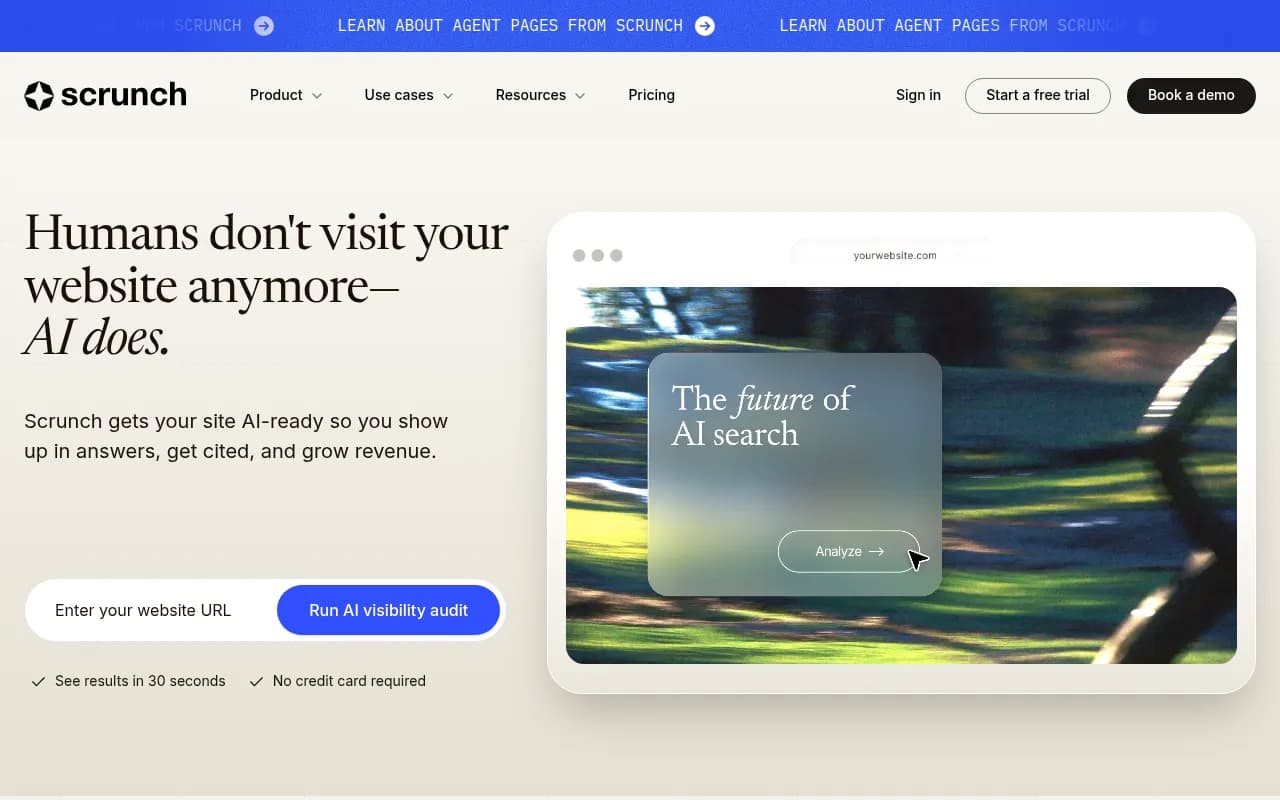
Both offer instant audits with no card. Neither keeps history on the free tier, so screenshot or export what you get.
Google and Bing
Google Search Console and Bing Webmaster Tools are the only free sources with first-party data. Research for this guide mentioned a free Google AI visibility report launching on August 31, 2026, but I could not verify that detail independently, so check what your own Search Console account actually shows before relying on it.
Free tiers that are not really free
Watch for the gap between "free" and "free for a while." AthenaHQ's entry plan came with a one-time credit grant rather than a monthly refill, according to one roundup. Several "free" tools are a trial with a card wall. Read the limits before you build a process on top of one.

Goodie also publishes a free AI Visibility Index and an LLMs.txt generator. These are fine, but they answer different questions. An industry index is not a check of your prompts. And the evidence for llms.txt moving citations is thin: Ahrefs reported that 28% of domains now publish one and 97% of those get zero requests for it.
What a free scan tells you
Used correctly, a free scan is good for four things.
- Whether you exist. If a scan finds no mentions across any engine, you have a basic visibility problem and the fix is likely content and third-party coverage, not tooling.
- Who you are compared to. Most scans name competitors that show up where you do not. That list is often more useful than your own score.
- A rough baseline. A 0 to 100 score is not precise, but it gives you a number to beat next quarter.
- Factual errors. If an engine describes you wrongly, you found a concrete task.
What a free scan misses
This is the part the vendors skip.
It is a single point in time
AI answers move. Promptwatch's average sources per response data shows that engines cite very different numbers of sources: ChatGPT about 5 per web-search answer, Google AI Overviews about 10, and Perplexity almost exactly 10 every day, while Copilot's average swung from under 2 to nearly 17 within weeks. A scan that lumps these together, or catches one on a odd day, can mislead you. Measure each engine separately.
Citation habits change under you
ChatGPT's behaviour has shifted repeatedly in 2026. Promptwatch's data on the site: operator shows ChatGPT Search started using site: queries at scale on August 8, 2026, jumping from about 0.4% to about 17% of fanout queries. Its Reddit data shows reddit.com's share of ChatGPT citations falling from roughly 4% to 0.5% on August 14, 2026. A free scan from last month may describe a citation world that no longer exists.
The prompts may not match what the engine searches
Most checkers run prompts they chose. ChatGPT, though, answers by running its own searches. Promptwatch's query fanout data shows those searches getting shorter: average query length fell from about 117 characters in December to around 53 characters by April. If a scan tests long conversational prompts, it may not reflect the short keyword-style queries ChatGPT actually fires.
Social and source mix differ by engine
In Promptwatch's social citation data for Sep 28 to Oct 4, 2026, ChatGPT drew 0.46% of its citations from social platforms while Google AI Overviews drew 12.2%. A blended score hides that completely. If your strategy leans on Reddit or YouTube presence, a blended free score will tell you almost nothing.
No history, no alerts, no multi-brand support
One roundup was blunt about this: every free option either keeps no history or depends on an account staying active, and alerting on change is a paid feature across the category. An agency running three or more client brands will outgrow free immediately.
No crawler logs, no traffic
None of the free scans tell you whether AI crawlers can actually read your pages, which pages they fetch, or how much AI-referred traffic converts. A scan can say you are not cited. It cannot say whether that is because the crawler hit errors, because the content is weak, or because the engine prefers other sources.
Is free enough for you?
| Situation | Free enough? | Why |
|---|---|---|
| Solo founder tracking one brand on 15 to 20 prompts | Yes | Manual method plus one or two checkers covers it |
| Quarterly "are we in the conversation" board check | Yes | A week of prompts and one scan answers it |
| Agency with three or more clients | No | Free tiers do not support multiple brands |
| You need to know when a competitor overtakes you | No | Alerts are paid everywhere |
| You want to link visibility to traffic and revenue | No | Needs analytics and crawler data |
| You want to fix gaps, not just see them | No | Needs content workflows |
When to move to a paid platform
The line is simple. If you are only asking "do we show up," stay free. When the question becomes "why not, and what do we do about it," you need history, per-engine tracking, crawler data and some way to act.
The paid market splits into monitors and platforms that also help you fix things.
| Tool | Entry price (verify on vendor site) | Strength |
|---|---|---|
| Otterly.AI | From about $29/mo | Small-budget monitoring |
| Peec AI | From about $95/mo (roughly EUR 85) | Mid-market teams and agencies |
| Leapd | From $39/mo | Tracking plus article writing |
| Scrunch | Core plan around $250/mo | Monitoring plus agent-ready pages |
| Profound | Enterprise, custom | Large-brand monitoring and analytics |
| Promptwatch | From $95/mo, free Explore tier | Monitoring plus crawler logs, traffic and content execution |
Promptwatch is the one I would point to if you want the loop closed. It tracks the real interfaces of ChatGPT, AI Overviews, AI Mode, Gemini, Perplexity and others, adds IP-verified AI crawler logs and visitor analytics, and then its Content Agent and Action Board help you do something about the gaps. It also has a free tier (ChatGPT only, 10 prompts), which is a better trial than a one-off scan because it keeps history.




For a wider set of options, the GEO software directory at bestgeosoftware.com lists more tools by category. Promptwatch also publishes free utilities, including a no-login AI visibility report and an Agentic Readiness Check that tests which AI crawlers can read your site.
A practical free workflow
If you want to spend nothing for a month, this is the order I would follow.
- Build your 15 to 20 prompt list and run it manually in four or five engines. Record mentions and citations separately.
- Run Semrush, Frase and one more free checker on your domain. Note where they disagree with your manual results.
- Open Search Console and Bing Webmaster Tools and see what first-party AI data they show you.
- Check your robots.txt and CDN rules so you are not blocking AI crawlers by accident. A scan cannot see this and it is a common cause of invisibility.
- Pick the three prompts where a competitor is named and you are not. Read the pages the engine cited and work out what they have that you lack.
- Re-run in 30 days. If the picture changed, you have a reason to invest in tracking.
One of the Quora answers in the research said it well: most people run one report and never look at it again. The scan is not the product. The follow-up is.
Frequently asked questions
Is there a completely free AI visibility tool?
Yes, in the sense that several checkers need no card and no signup. Semrush's allows three runs a day. None of them give you ongoing monitoring for free.
Are free AI visibility scores accurate?
They are directional. Different vendors use different prompts, engines and scoring, so two tools will give different numbers for the same brand. Use the score for trend and comparison, not as a measurement.
Do schema markup or llms.txt improve AI citations?
The evidence is weak. Ahrefs found no meaningful citation lift from schema across 1,885 pages studied, and most llms.txt files go unrequested. Content and third-party mentions matter more.
How often should I re-check?
Monthly at minimum for manual checks. If AI search drives real revenue for you, daily monitoring on a paid tool is more sensible, given how quickly citation behaviour has changed this year.
The bottom line
Run the manual test first, add two or three free checkers, and keep every result in one spreadsheet. If it shows you are invisible, fix content and crawler access before buying anything. If it shows you are visible but cannot tell why or whether it lasts, that is the point at which a paid platform with history and crawler data starts paying for itself.
See our broader tool coverage at surferstack.com if you want to compare more options side by side.