Key takeaways
- Jasper dropped its old Creator plan. In 2026 it's Pro at $59-$69/mo per seat or custom Business pricing, positioned squarely at enterprise brand governance, not solo writers or small teams.
- The tools below split into three camps: cheap general writers (Rytr, Copy.ai), SEO/GEO-focused platforms (Writesonic, Surfer SEO, Frase, Scalenut), and voice-specific tools (HyperWrite, Sudowrite, Anyword).
- "Sounding like a robot" is mostly a training problem, not a model problem. The tools that fix it let you upload past writing, set a persona, or run a dedicated humanizer pass rather than hoping the default output is good.
- If AI search visibility matters to your content strategy, note that how-to and comparison content is gaining citation share in ChatGPT Search while listicles and social posts are losing ground, per Promptwatch's citation-type tracking. Worth factoring into what you actually ask these tools to write.
- There's no single best pick. Rytr wins on price, Writesonic and Surfer SEO win if you care about getting cited by AI search engines, and Sudowrite is the only one worth using if you're writing fiction.
Why people are actually leaving Jasper in 2026
Jasper used to be the default "AI copywriter" answer. That's changed. The platform has spent the last year rebuilding itself around Canvas, Agents, Content Pipelines, and something it calls Jasper IQ, a stack of brand governance tools (Brand Voice, Visual Guidelines, Knowledge, Governance) clearly aimed at marketing departments with a CMO and a budget, not a solo blogger or a three-person startup.
That shift shows up in the pricing. Pro is $59/mo billed yearly, $69/mo month to month, and covers 5 seats with no API access. Business is custom, and reports of enterprise contracts running into the tens of thousands per year aren't unusual anymore. There's a 7-day trial, but it asks for a card up front, so you can't really kick the tires without committing.
The other complaint that keeps surfacing in reviews has nothing to do with price. It's that the output still needs a real edit pass. Brand Voice and Knowledge Base setup takes real time to configure properly, and when people skip that step, the drafts come back sounding like every other AI draft: flat, hedgy, and full of the same handful of words. If you've read enough AI content you start noticing the tells: "delve," "leverage," "unlock the potential of," "in today's fast-paced world." None of that is exclusive to Jasper, but paying $59-$69 a month for text you still have to rewrite is where a lot of people draw the line.
What to actually look for in an alternative
Word count limits are the easy thing to compare and the least useful. What decides whether a tool earns a place in your workflow long-term is quieter: does it let you set a voice once and have every draft inherit it, does the free tier let you test it without a credit card, and does it produce the content format your audience (and increasingly, AI search engines) actually rewards. Product pages, how-to guides, comparisons and documentation are pulling more citation share in ChatGPT Search lately, while generic listicles and social posts are losing it, according to Promptwatch's citation-type data. If part of your goal is getting your content picked up by AI answers, that's worth knowing before you pick a tool.

The 9 alternatives
1. Copy.ai - best free tier for short-form volume
Copy.ai has a genuine free plan (limited credits, one seat, chat access) and unlimited Brand Voices on every paid tier, which agencies managing several clients tend to like. It's repositioned itself as a "GTM AI platform" with workflow automation layered on top of content generation, which means copywriting is no longer really the headline feature. Paid plans run from roughly $49/mo self-serve up to $1,000+/mo for the enterprise workflow tier. Good for quick marketing copy, weak for long-form.
2. Rytr - best value, period
Rytr has a genuinely free-forever plan: 10,000 characters a month, no card required. The paid Saver tier is $9/mo for unlimited characters, and Premium is $29/mo with 35+ languages and built-in plagiarism checks. It covers 40+ use cases and isn't trying to be an enterprise platform, which is exactly why it works for solo creators. It won't out-write Jasper on a 3,000-word pillar page, but for product descriptions, ad variations, and email drafts at this price it's hard to argue against.

3. Writesonic - now an AI search visibility platform with a writer attached
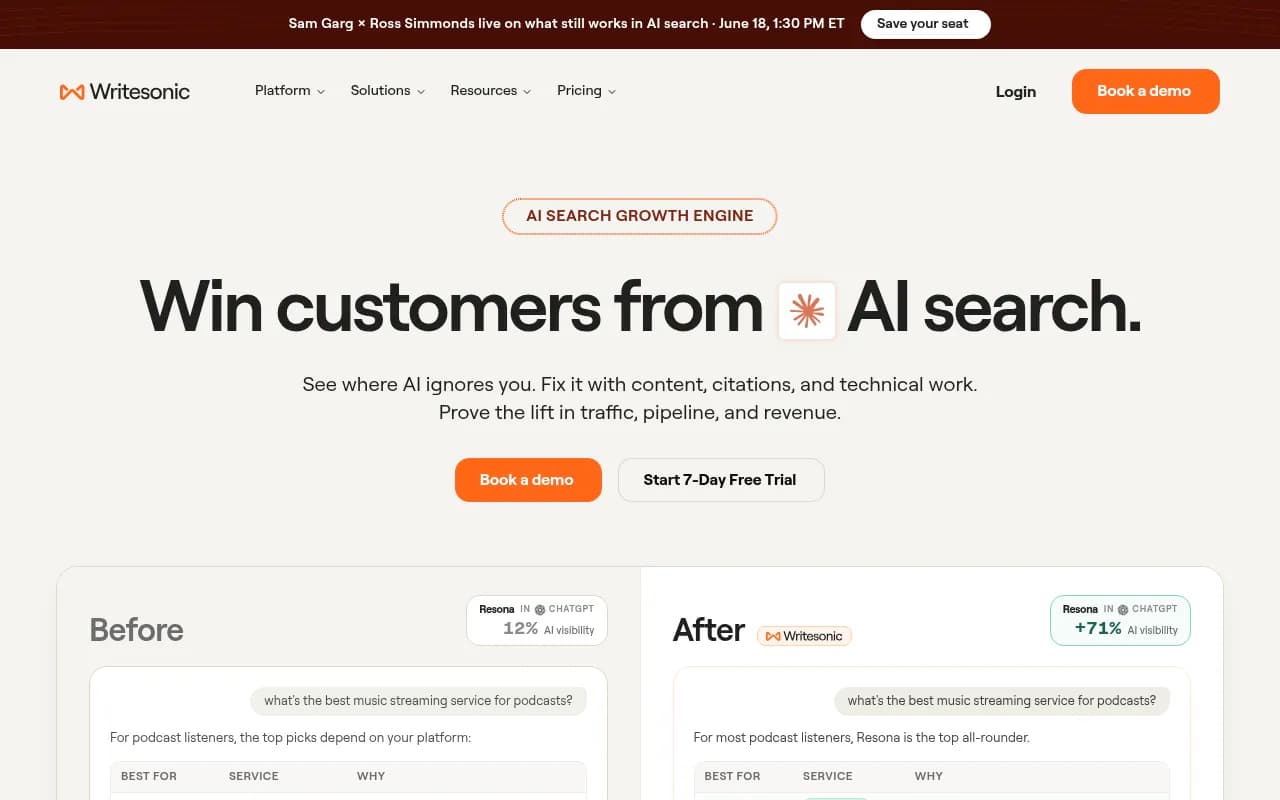
Writesonic has moved hard into GEO territory. Its Professional plan ($199/mo annual, $249 month to month) bundles 100 articles a month with tracking of 100 AI prompts across ChatGPT, Gemini, and Google AI Overviews, plus site audits. There's a cheaper Lite tier (~$39/mo) if you just want the article generator without the GEO tracking. If your content strategy is now "write it and check whether AI cites it," this is one of the few tools built for that loop natively.
4. Surfer SEO - content optimization with a built-in humanizer
Surfer rebranded parts of itself around AI visibility tracking across Google and AI engines, but the core product is still content optimization, and it now ships a built-in AI detector plus a "Humanizer" from its Discovery tier ($49/mo annual) up. Higher tiers (Standard ~$79/mo, Pro ~$145/mo) add more content-editor capacity, and API access requires the top $299/mo tier. If your problem is specifically that your drafts read as AI-written and you want a tool that flags and rewrites those passages, Surfer is one of the few that builds this in rather than bolting it on.

5. Frase - research-driven content, cited by AI included
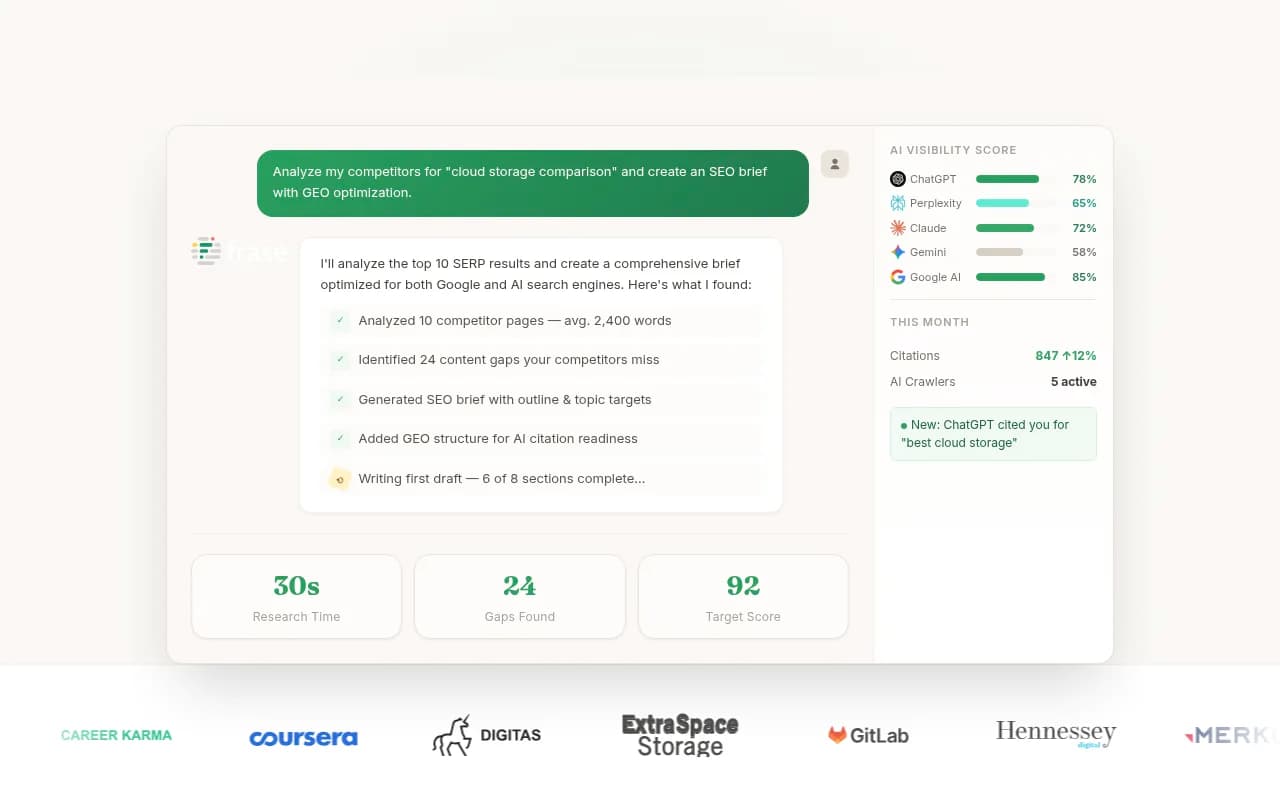
Frase's current tagline is literally "Rank on Google. Get cited by AI." Starter is $39/mo billed yearly. It's built around SERP research first: it pulls competitor structure and questions before you write, which tends to produce more grounded content than a blank-prompt writer. FraseCMS, its hosting add-on, has a free tier included up to 100K page views a month, which is a nice bonus if you're publishing a lot of thin pages that don't need a full CMS.
6. Anyword - predictive scoring for copy that has to convert
Anyword's differentiator isn't the writing, it's the scoring. Every draft gets a data-driven prediction of how well it's likely to perform, based on the audience you specify. Starter is $39/mo annual (1 seat, 1 brand voice, 50 predictions/mo), Data-Driven is $79/mo annual. This is the one to reach for if you're running ad copy variants and need a signal on which version to actually ship, not just more words.

7. Sudowrite - the only one on this list built for fiction
Sudowrite is not a general marketing writer and doesn't pretend to be. It runs a proprietary fiction-trained model ("Muse") alongside Claude, GPT, and DeepSeek, so you pick the model per generation. Pricing runs $10-$44/mo depending on tier and billing, with a unique 12-month credit rollover on the top plan. Story Bible, Describe, Rewrite and Brainstorm are built specifically for novel-length work, and by most accounts an 80,000-word draft costs somewhere between $10 and $180 depending on model choice. If you're writing a novel and Jasper feels like using a hammer on a screw, this is the fix.
8. HyperWrite - the one literally marketed against sounding robotic
HyperWrite's Premium tier ($19.99/mo, $16/mo annual) is marketed explicitly around "Custom Personas" that make the AI write like you, not like a robot. You train up to 3 personas on Premium, 10 on the $44.99/mo Ultra tier, and it includes unlimited in-line TypeAhead suggestions plus a research mode ("Scholar") that cites real sources. There's a free plan too, with limited monthly credits. Of everything on this list, this is the tool that's most directly aimed at the exact problem in this guide's headline.

9. Scalenut - scaled SEO content production
Scalenut automates more of the SEO workflow end to end, starting around $20-$49/mo depending on the source, and it's built for teams producing SEO content at volume rather than one-off pieces. It handles keyword clustering, briefs, and optimization scoring in one pipeline, which cuts down the number of separate tools you'd otherwise need to stitch together.

Comparison table
| Tool | Starting price | Best for | Free tier, no card | Writes like you |
|---|---|---|---|---|
| Copy.ai | Free / ~$49/mo | Short-form marketing copy | Yes | Needs editing |
| Rytr | Free / $9/mo | Best value, general writing | Yes | 1 tone match |
| Writesonic | $39/mo (content only) | SEO + AI-search visibility | Trial only, gated | With brand setup |
| Surfer SEO | $49/mo (annual) | Optimization + humanizer | No | Built-in AI detector/fix |
| Frase | $39/mo (annual) | Research-first content | No | Depends on inputs |
| Anyword | $39/mo (annual) | Performance-predicted ad copy | No | Scored, not styled |
| Sudowrite | $10/mo (annual) | Fiction/novels | No (trial, no card) | Model-dependent |
| HyperWrite | Free / $16/mo (annual) | Custom voice personas | Yes | Explicitly, via Personas |
| Scalenut | ~$20-49/mo | Scaled SEO content ops | No | With brief setup |
A word on "humanizer" tools
A separate category worth flagging: tools like Undetectable AI, priced from about $9.99/mo for 10,000 words of humanized text up to $49/mo for unlimited with API access. These exist to run your AI draft back through a rewrite pass specifically to dodge AI detectors. That's a genuinely different goal from just writing in your own voice from the start, and it comes with more ethical baggage, especially if you're publishing content that claims to be human-written when it isn't. Worth knowing these exist, worth thinking carefully before leaning on them as your main strategy.
The actual fix for robotic AI content
Most of the "AI tells" people complain about (delve, leverage, foster, tapestry, "in today's fast-paced world," the Not-X-But-Y sentence structure) come from models defaulting to safe, generic phrasing when they don't have a strong voice to anchor to. Every tool on this list that actually solves that does it the same way: you feed it real examples of your own writing, or you set a persona, or you run a manual edit pass to vary sentence length and cut the filler transitions. None of them fix it by magic. The tools that pretend otherwise are usually the ones you end up rewriting from scratch anyway.
If you're choosing based on budget alone, start with Rytr's free tier or Copy.ai's free credits and see whether the voice-training features get you close enough before paying for anything. If your actual goal is getting content that AI search engines cite, not just content that reads well, put Writesonic or Surfer SEO ahead of the pack, and keep an eye on how citation patterns shift, Promptwatch's data tracks this kind of thing monthly across ChatGPT, Gemini, AI Overviews, and Perplexity, which is a useful sanity check before you commit a content calendar to any one format.