Key takeaways
- City-level tracking is not one feature. Some tools only change the country or city label on a query, while others pin the request to exact coordinates. Ask which one you are buying.
- Local brands need a different test than national brands: does the tool capture what AI actually answers from a specific place, and does it turn gaps into fixes for a specific location?
- For multi-location brands and agencies that want tracking plus execution, Promptwatch's coordinate-level targeting is the most granular option in this list. Local-SEO-first tools like BrightLocal and Local Falcon fit teams already living in map rankings and listings.
- Vendor-written comparisons are biased. BrightLocal's own roundup recommends itself and rules out Semrush, Ahrefs, Profound, Peec AI and Scrunch for local tracking. Read those as a starting point, then run a trial.
- Pricing changes often. I have only quoted prices I could confirm, and you should check each vendor's pricing page before buying.
A note on how this comparison was built
The original idea behind this guide was a hands-on test: run the same local prompts through seven tools and compare. I don't have that dataset, and I'm not going to invent one. What follows is based on vendor documentation, the published BrightLocal comparison (Oct 14, 2026), roundups from Zapier and community threads, and Promptwatch's own research data. Where I couldn't confirm a detail, I say so and tell you what to test yourself.
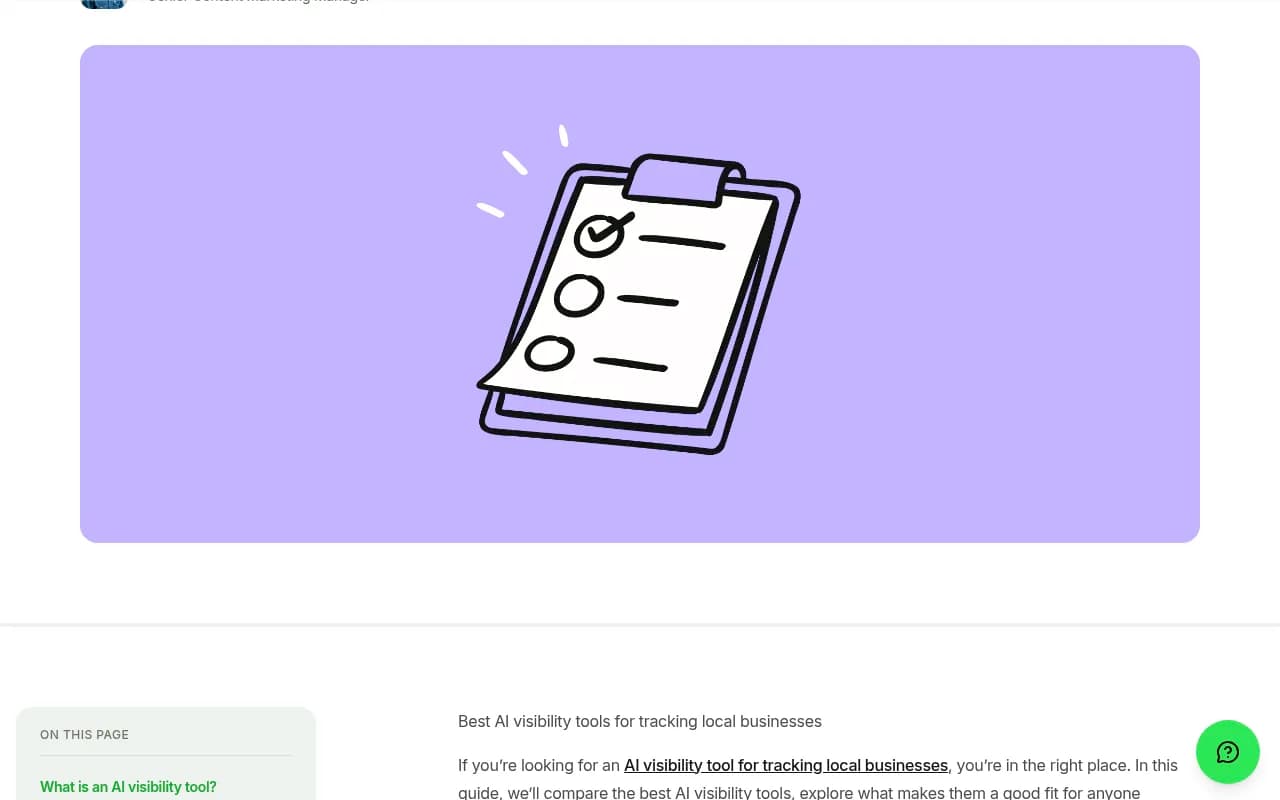
The BrightLocal page is worth reading for its criteria alone: location-level versus brand-level tracking, which AI platforms are covered, whether gaps become fixable local actions, prompt customization, and pricing model. I use a similar checklist below.
Why local AI visibility is its own problem
Ask ChatGPT for "best emergency plumber" and the answer depends heavily on where it thinks you are. The same is true of Google AI Overviews and AI Mode. A national average visibility score hides the fact that you may be the first recommendation in Leeds and invisible in Manchester.
There is a second wrinkle. Promptwatch Data on ChatGPT query fanouts (Dec 2025 to April 2026) shows the searches ChatGPT runs behind a response are short keyword strings, with average length falling from roughly 117 characters in December to about 53 once fanouts returned in April. My inference, not the report's claim: a city name or "near me" in that short string is what carries location. So a tool that only records the final answer and never the fanout queries tells you less about why you did or didn't show up.
And platforms shift without warning. On August 8, 2026, ChatGPT began using the site: operator at scale, jumping from 0.37% to 16.8% of fanout queries overnight, per Promptwatch's report. If ChatGPT is searching domains directly, your city and location pages need to be crawlable and indexed. That is an inference for local pages, but a cheap one to act on.
What to check before you buy
How location is actually applied
There are roughly three levels. Country only. City or state, where the tool labels or routes the query by region. And exact coordinates, where the AI answers as if asked from a specific spot. For a franchise with 40 stores in one metro area, city-level is too coarse. For a single-location dentist, it is probably fine.
Which AI surfaces are covered
Some local tools track Google's map pack plus a couple of AI surfaces. Others cover ChatGPT, Gemini, Perplexity, AI Overviews and AI Mode. Confirm that the surface your customers use is covered at the location level, not just at brand level.
Whether gaps turn into actions
A score per city is nice. A list of what to change on which location page is better. BrightLocal flags this in its own criteria, and I agree it is the most important one.
Prompt control
Can you write prompts like "urgent care open now near me", add personas, and group them by location? Fixed prompt sets are a weakness for local work.
The seven platforms at a glance
| Tool | Location granularity | Best for | What to verify in a trial |
|---|---|---|---|
| Promptwatch | Country on every plan; state and city on Business and agency plans; exact coordinates (20 m to 5 km radius) on Business, Agency Scale and Enterprise | Multi-location brands and agencies that want tracking plus content execution | Which of your AI surfaces honor the pin versus the city label |
| BrightLocal | Local SEO heritage, now with AI visibility | Teams already managing listings, reviews and local rankings | AI coverage depth and per-location prompts |
| Local Falcon | Grid-based local scanning | Map-pack style geographic visualization | How far AI surfaces extend beyond maps |
| Yext Scout | Enterprise brand and location data | Large brands with verified listings data | Pricing and how granular location tracking is |
| Birdeye Search AI | Location-level tracking | Brands already using Birdeye for reviews | AI model coverage and prompt flexibility |
| Search Atlas | All-in-one SEO platform with AI visibility | Teams wanting one SEO suite | Whether city-level AI tracking is per prompt |
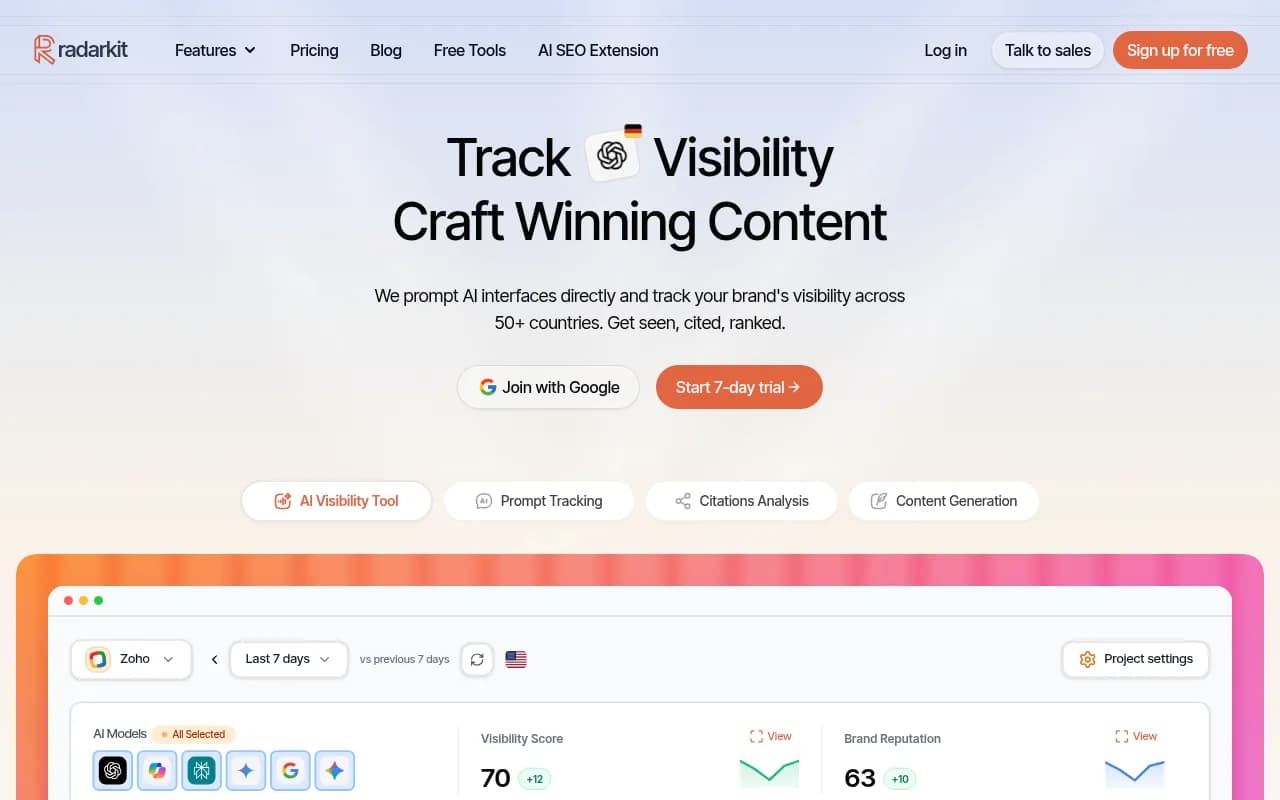
| Radarkit | AI and GEO tracker, recommended in a community thread for local-first workflows | Smaller teams and agencies testing local GEO | Reporting depth and exports |
The tools, one at a time
Promptwatch
Promptwatch is the one in this list I'd point agencies and multi-location brands to first, and it is also the platform 1001 SEO Media uses for AI visibility work. The local feature is concrete: you pin a monitor to exact coordinates (search a place or drop a pin, with an accuracy radius from 20 m to 5 km), and ChatGPT, Google AI Overviews and Google AI Mode answer as if asked from that spot. Other models use the monitor's country, state and city. That distinction matters, and Promptwatch states it plainly rather than implying every model is hyper-local.

A monitor's language and location are fixed when you create it, so markets never mix. That keeps a Leeds monitor from polluting a Manchester one, but it does mean you create one monitor per location or cluster. Local targeting is on Business ($579/mo), Agency Scale ($799/mo) and Enterprise. State and city tracking is also on Kick-off ($199/mo) and Growth ($399/mo) agency plans, which have no coordinate targeting. Business adds the Content Agent, Fact Check, ChatGPT Shopping insights and Ads Radar, and prompts can run every 12, 6 or 1 hours. Confirm all of this on the pricing page.
What separates it from tracker-only tools is what happens after the score. Content gap analysis maps your pages against the prompts AI answers, the Action Board prioritizes fixes, and the Content Agent can write and publish to WordPress, Webflow or Framer. IP-verified crawler logs show whether AI bots actually read your location pages. That last one answers the "is it an access problem or a content problem" question that local teams hit constantly. There is a 7-day free trial on monthly plans and a free AI visibility report if you only want a first look.
The tradeoff: it is a broad platform, and if all you want is a map grid for a single storefront, you will pay for more than you use.
BrightLocal
BrightLocal has long been a staple for local rankings, citations and reviews, and it now includes AI visibility. If your team already lives in it, adding AI tracking there is the lowest-friction route.
The caveat is the one I raised earlier. Its comparison article is written by a vendor with a competing product, and it explicitly would not recommend Semrush, Ahrefs, Profound, Peec AI or Scrunch AI for local tracking. Some of that judgment may be fair, because those tools were built for brand-level monitoring. But treat the ranking as marketing and test.
Local Falcon
Local Falcon is known for geographic grid scans: you see how visibility changes block by block around a business. BrightLocal recommends it for local tracking, and it appears in Cheers' list too. It is not in our tools catalog, so I can't give you a card, and I haven't verified its current AI surface coverage. The visual map is its appeal. Check how many AI platforms it covers beyond Google surfaces.
Yext Scout
Zapier picked Yext Scout as its local tracking choice. It comes from Yext, whose business is verified brand and location data, which gives it a plausible edge for enterprises with hundreds of locations.
Yext Scout
I haven't verified its pricing or the depth of its per-city tracking, so ask for a demo with your actual locations loaded.
Birdeye Search AI
Birdeye describes Search AI as local AI visibility with location-level tracking. It makes the most sense if you already use Birdeye for reviews and messaging, because reviews are one of the inputs local AI answers lean on.
Search Atlas
Search Atlas is an all-in-one SEO platform with AI visibility inside. BrightLocal lists it among its recommended local options. If you want one subscription for traditional SEO and AI tracking, it deserves a look, but check whether city-level targeting applies per prompt or only per project.
Radarkit
Radarkit was the top pick in an r/aeotips thread about local-first workflows. That is a community recommendation, not a controlled test, and the thread's author may have a stake. It's a reasonable one to trial if you are a smaller team.
Tools BrightLocal rules out, and why that is not the whole story
BrightLocal says Semrush, Ahrefs, Profound, Peec AI and Scrunch AI are not recommended for local tracking. The likely reason is that they were designed around brand-level visibility with country-level targeting. If you're a national brand with a few key markets, that may not matter. If you have 200 stores, it does. Test your own use case rather than trusting any single list, mine included.

A simple trial plan
Spend one week on each of your two finalists with the same inputs:
- Pick three locations in different cities, plus two in the same city.
- Write 15 prompts: some "near me", some with city names, some competitor comparisons.
- Check whether results differ between same-city locations. If they don't, the tool is only city-level.
- Look for the fanout queries or sources behind each answer, not just the final text.
- Ask what the tool tells you to do about the weakest location, and whether it can help do it.
- Verify that your location pages are being crawled. Crawler logs settle this faster than guessing.
Which one should you pick
- Agencies or multi-location brands wanting tracking and content execution in one place: Promptwatch.
- Teams anchored in local listings and reviews: BrightLocal, or Birdeye if you already use it.
- Visual map-style scans: Local Falcon.
- Large enterprise with verified location data: Yext Scout.
- One SEO suite: Search Atlas.
- Small team experimenting: Radarkit.
If you want a wider shortlist, the GEO software directory at bestgeosoftware.com lists more options by category. Whatever you pick, run the trial plan first. The gap between city-label and coordinate-level targeting only shows up when you test it on your own locations.