Key takeaways
- Generic clinics rarely get cited for broad medical questions. ChatGPT leans on NIH, FDA, NHS, Mayo Clinic, and Cleveland Clinic for informational queries, so your realistic GEO win is branded and local prompts, not "what causes migraines."
- Local GEO tools split into two camps: geo-grid and reputation platforms (Local Falcon, BrightLocal, Birdeye) built for map-pack and review visibility, and AI-citation trackers (Promptwatch, Profound, Otterly.AI, Ahrefs Brand Radar) built to monitor and improve how LLMs talk about you.
- Your social media investment should follow your traffic mix. Google AI Overviews pulls 12.2% of citations from social platforms (YouTube, Facebook, Reddit), while ChatGPT pulls under 1%. Picking the wrong channel wastes budget.
- You don't need Mayo Clinic-level domain authority to get cited. Mid-authority sites (DR 46-75) earned 46% of ChatGPT citations in August 2026, and DR 0-45 sites still picked up nearly a third.
- Before paying for a platform, run a manual audit: ask ChatGPT, Gemini, Perplexity, and Google AI Overviews your top 10 patient questions by hand. It's free and tells you most of what a $300/month tool would show in month one.
Why "GEO for clinics" is a different game than GEO for everyone else
Most GEO advice assumes you're trying to get a blog post cited for a broad informational question. Healthcare doesn't work that way. When someone asks ChatGPT "what are the symptoms of plantar fasciitis," the model isn't reaching for a random podiatry clinic's blog. It's reaching for NIH, PubMed, the FDA, or Mayo Clinic, because health answers carry real-world risk and LLMs are tuned to default to institutional sources.
Promptwatch's healthcare citation data backs this up with numbers that are honestly a little sobering for independent practices. Across six NIH subdomains, NIH alone accounts for 5.46% of all ChatGPT healthcare citations tracked between September 9 and October 8, 2026, more than the FDA, NHS, CMS, and SAMHSA combined (Promptwatch's healthcare citation share report). Government and public-health sites as a category take 7.06% of citations, medical research another 5.46%. Hospitals and clinics, as a bucket, get just 0.89%. Mayo Clinic (0.49%) and Cleveland Clinic (0.4%) are basically the only individual hospital systems that crack the top 20. Review and directory sites like Doctify and WebMD sit at 0.23% each.
So if your GEO strategy is "write more educational blog posts about conditions and hope ChatGPT cites us instead of NIH," that's a losing bet for a solo practice or small group. The actual opportunity for local clinics is branded and near-me prompts: "is Dr. Patel's dermatology practice good," "best orthodontist in Austin," "[Clinic Name] reviews." On branded prompts, the citation mix changes entirely in your favor, with reviews jumping to 5.6% share (roughly 3x the baseline) and FAQ pages to 4.8% (Promptwatch's content-type citation data). That's the lane local GEO platforms are built for.
The two categories of local GEO tool, and why you probably need one from each
Working through the tool landscape for healthcare specifically, there's a clean split worth understanding before you buy anything.
Geo-grid and reputation platforms answer "are we showing up in the map pack and are our listings accurate." They track rankings across a visualized grid of locations around each clinic, monitor Google Business Profile health, and increasingly bolt on basic AI-mention tracking as a feature, not the core product.
AI-citation and GEO platforms answer a different question: "when someone asks an AI assistant about us by name or about services we offer, do we show up, and why or why not." These tools track prompts across ChatGPT, Gemini, Perplexity, Claude, and Google AI Overviews, show you citation trends, and in the better cases actually help you close content gaps.
Most multi-location healthcare groups end up running one tool from each bucket, because neither does the other's job well.
Geo-grid and local reputation tools
Local Falcon is the clearest fit if your main worry is the 3-pack and you want a visual way to see ranking variance across neighborhoods. It's credit-based: Starter at $24.99/month (7,500 credits) up to Premium at $199.99/month (63,150 credits), with 15-20% off annual billing. It tracks AI visibility at the location level across ChatGPT, Gemini, Google AI Overviews, AI Mode, and Grok, and has proprietary metrics like Share of Local Voice and a newer Share of AI Voice score. It also ships an MCP integration, so you can pull data into Claude or another AI agent directly.
BrightLocal is the more mature, dashboard-heavy option for citation tracking, geo-grid rank tracking, GBP monitoring, and review management. Pricing scales with location count across three plans (Track, Manage, Grow), roughly $31 to $989+/month depending on tier and locations, about 25% cheaper billed annually. It doesn't generate content or track LLM citations with any depth, so treat it as the operations layer, not the AI-visibility layer.
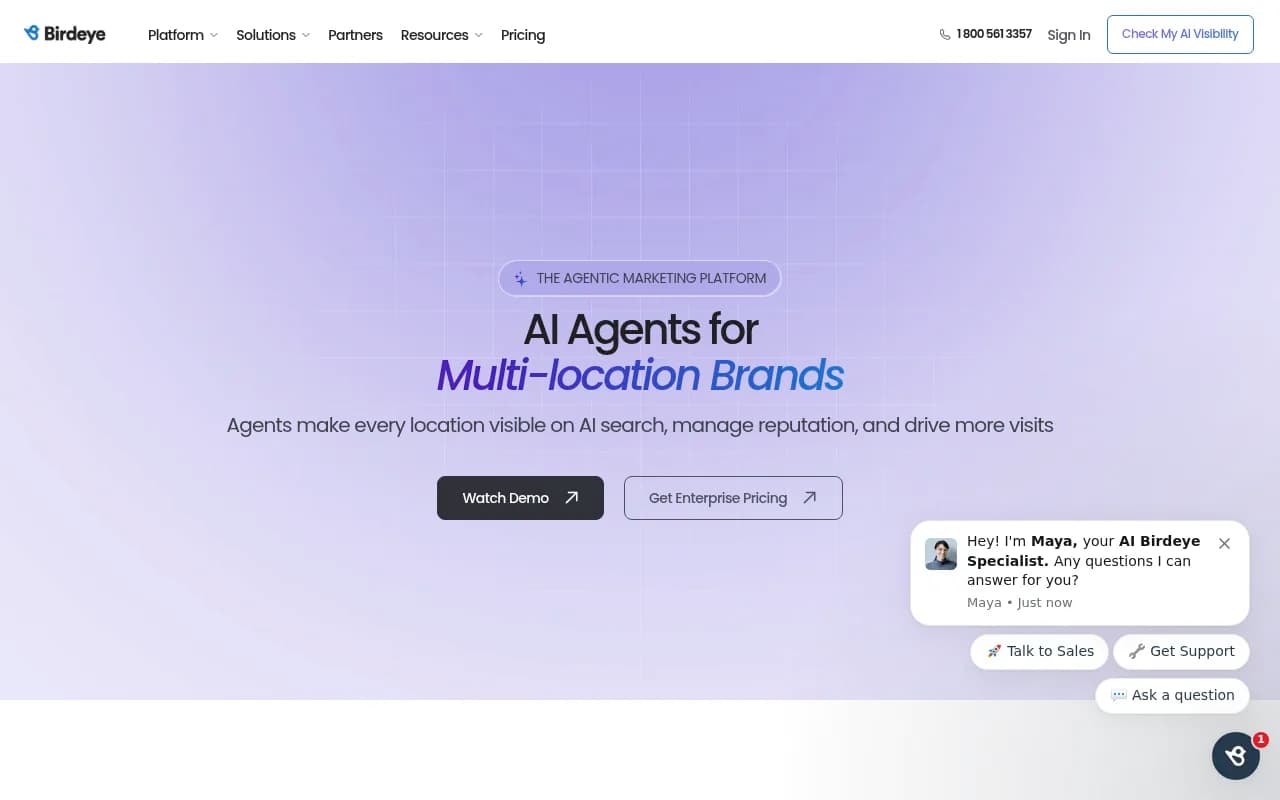
Birdeye Search AI targets the enterprise end of multi-location healthcare. Pricing is custom and quote-only, but it ties AI visibility (Share of Answer across ChatGPT, Gemini, Perplexity) directly to your reviews, listings, and NAP accuracy, with agentic workflows that can auto-correct listings or trigger review requests. For a health system with dozens of locations where listing drift is a real problem, that tie-in matters more than it sounds.
AI-citation and GEO tracking platforms
This is the category where the "do we show up when AI is asked about us" question gets answered, and where the tooling has matured fastest in 2026.
Promptwatch is the one I'd point most healthcare marketing teams toward first, mainly because it doesn't stop at monitoring. It tracks ChatGPT, Gemini, Claude, Perplexity, Grok, and Google AI Overviews/AI Mode, shows crawler logs so you can see exactly when AI bots hit your clinic's service pages (and whether they errored out), and includes Content Agents that can draft and publish GEO-optimized service and condition pages straight to your CMS. For a clinic group juggling location pages, insurance pages, and provider bios across multiple sites, that publishing loop is the difference between a report that tells you you're invisible and a workflow that fixes it. Pricing starts at $95/month for a single site with 50 tracked prompts, scaling to $245/month for multi-site coverage with automated content generation.

Profound is the enterprise alternative worth knowing about specifically because it's SOC 2 Type II and HIPAA-compliant, which NoGood calls out as the deciding factor for pharma and some hospital systems. Entry pricing is reported anywhere from $99 to $499/month depending on the source, and it tracks 10+ AI platforms. The tradeoff: G2 reviewers describe it as recently unstable and the dashboard as overwhelming for smaller teams.

Otterly.AI is the budget option at $29/month for a Lite plan, scaling to $489/month, covering ChatGPT, Perplexity, Google AI Overviews, and Copilot. Narrower platform coverage than Profound or Promptwatch, but a reasonable starting point for a single-location practice that just wants a monthly check on whether it's being mentioned at all.

Ahrefs Brand Radar ($199/month per index, $699/month for all indexes) is analytics-only, no content or optimization tooling, tracking six AI platforms. Fine if you already run Ahrefs for traditional SEO and want AI monitoring bolted on without switching tools.

Semrush AI Visibility Toolkit ($99/month per domain, requiring an active Semrush plan) covers four platforms with 25 tracked prompts. One agency CMO quoted in industry coverage called it not worth $99/month on its own, which tracks with how thin the prompt allowance is for a multi-service clinic.
Goodie AI, positioned specifically for healthcare and pharma, starts at $399/month, tracks 11+ AI models including Amazon Alexa+, and is SOC 2 Type II/SSO compliant. Its "AEO Content Writer" is built with MLR (medical-legal-regulatory) review bottlenecks in mind, which matters if your content has to pass compliance before publishing.

Comparison table
| Tool | Category | Starting price | AI platforms tracked | Content generation | Best for |
|---|---|---|---|---|---|
| Promptwatch | AI citation/GEO | $95/mo | ChatGPT, Gemini, Claude, Perplexity, Grok, AI Overviews/Mode | Yes, with CMS publishing | Groups wanting tracking plus actual content fixes |
| Local Falcon | Geo-grid + AI | $24.99/mo | ChatGPT, Gemini, AI Overviews, AI Mode, Grok | No | Map-pack visibility at the per-location level |
| BrightLocal | Geo-grid + reputation | ~$31/mo (1 location) | Limited/basic | No | Citation and GBP management at scale |
| Birdeye Search AI | Reputation + AI | Custom quote | ChatGPT, Gemini, Perplexity | Agentic listing fixes | Enterprise multi-location health systems |
| Profound | AI citation | ~$99-499/mo | 10+ platforms | No | HIPAA/SOC 2-sensitive organizations |
| Otterly.AI | AI citation | $29/mo | ChatGPT, Perplexity, AI Overviews, Copilot | No | Single-location practices on a budget |
| Goodie AI | AI citation + content | $399/mo | 11+ platforms | Yes, MLR-aware | Pharma and larger systems needing compliance review |
What actually moves the needle before you buy anything
A few things from the research are worth doing regardless of which platform you pick, because they're either free or cheap and they fix the stuff that tools can't.
First, run the manual audit. Ask ChatGPT, Gemini, Perplexity, and Google AI Overviews your top 10 to 15 patient questions by hand, including your branded name and your service-area terms. Discovered Labs' research suggests this gives you roughly 80% of what a paid tool surfaces in its first month, and the general advice is that paid monitoring only pays for itself once you're past roughly 5,000 monthly organic visits or a $2,000+ average deal value. A lot of solo and small-group practices fall under that line and should start manual.
Second, fix your Google Business Profile data before you touch anything else. A UK physiotherapy group with eight locations found their listings were suppressed by wrong GBP categories (generic "Physical Therapist" instead of "Sports Physiotherapy Clinic"), stale attributes, and a leftover phone number from a previous tenant. Fixing it over 60 days lifted inbound GBP calls by 38% and pushed new-patient form submissions up 27% year over year. No GEO platform fixes that for you; it's a manual listing-by-listing cleanup.
Third, match your social investment to the AI engine your patients actually use. If your funnel runs more through Google AI Overviews, YouTube and Facebook content genuinely helps, since social platforms make up 12.2% of AI Overviews citations, led by YouTube at 4.28% (Promptwatch's social media citation breakdown by AI model). If most of your traffic comes through ChatGPT, skip the social push entirely; social citations there have collapsed to under half a percent, including Reddit, which fell from 5.19% to 0.09% in a single tracking window. Put that budget into your own service pages instead.
Fourth, add the schema. Physician, MedicalOrganization, MedicalCondition, and Service schema with a proper worksFor link between individual providers and your parent organization gives AI crawlers a structured way to verify who you are. None of the tools above replace this; it's a one-time technical fix your web developer or agency should do regardless of which platform you choose.
Finally, invest your content effort in the page types that stick around. Service and landing pages retain 78% of their citations after 30 days and 69% after 60, the longest half-life of any content type tracked. Press releases, by contrast, lose half their citations within about 36 days (Promptwatch's content half-life data). If you're updating one page a month, make it the service page with your hours, insurance list, and provider bios, not another press release.
Picking a stack that fits your size
A solo practice or small group of two to three locations probably doesn't need more than a geo-grid tool (Local Falcon at the entry tier) plus a manual AI-prompt audit run quarterly. A regional group of five to twenty locations is where a dedicated GEO platform starts earning its keep, and that's where Promptwatch's combination of multi-model tracking, crawler logs, and automated content publishing tends to save the most staff time, since it closes the loop from "we're invisible for this query" to "here's a published page that fixes it" without a separate content team. Enterprise health systems with compliance requirements should weigh Profound or Goodie AI primarily on their HIPAA/SOC 2 posture first, features second.
If you want to browse the wider category beyond what's covered here, the GEO software directory at bestgeosoftware.com tracks a broader set of platforms, and 1001 SEO Media works directly with healthcare and multi-location brands on both the technical SEO and GEO side if you'd rather hand the execution to a specialist team than run it in-house.