Key takeaways
- Bloomreach announced the acquisition of AthenaHQ on November 16, 2026. The price was not disclosed.
- Existing AthenaHQ accounts, contracts, and support stay intact. The first combined product use cases are slated for early 2027, per MarTech.
- AthenaHQ's headline feature, the Athena Citation Engine (ACE), is Enterprise-only on AthenaHQ's own plans page. Starter buyers do not get it.
- The open question is whether AI citations can be tied to actual sales. Nobody has proven that on this combined platform yet.
- If you are mid-evaluation, you do not need to panic-switch. You do need to ask a few pointed questions about roadmap, pricing, and standalone support.
Disclosure up front: this site is published by 1001 SEO Media, which uses Promptwatch, a direct competitor of AthenaHQ. I have tried to stick to what the sources say and flag where details are missing.
What actually happened
Bloomreach, the customer engagement company behind the Loomi AI, announced on November 16, 2026 that it had acquired AthenaHQ, an answer engine optimization (AEO) platform. Financial terms were not disclosed. Forbes, MarTech, and the Business Wire release all cover the same core facts.
The pitch is simple. Increasingly the "customer" doing the searching and shopping is an AI agent acting for a person. If the agent can't find your brand, it won't recommend it. Bloomreach says AthenaHQ lets it help brands improve AI visibility and then turn that visibility into measurable revenue.
Raj De Datta, Bloomreach's CEO, framed AI search as a store shelf: when OpenAI or Google asks brands for product sets with live prices, that is the shelf, and AthenaHQ helps decide what goes on it.
The people and the product
AthenaHQ is Y Combinator-backed and was founded by Andrew Yan (ex-Google) and Alan Yao (ex-ServiceNow). Customers named in the release include Coinbase, Cozy Earth, Nuvadermis, and Datmos. Yan, Yao, and the whole team are joining Bloomreach.

The product centers on ACE, a proprietary machine learning model that scores a piece of content on how likely it is to be cited by AI, then points teams toward actions: creating on-brand content around real AI search demand, engaging the sources that shape AI recommendations, and optimizing product content. It connects to Shopify, Google Analytics 4, and Claude and ChatGPT through MCP.
Why this pairing is less odd than it looks
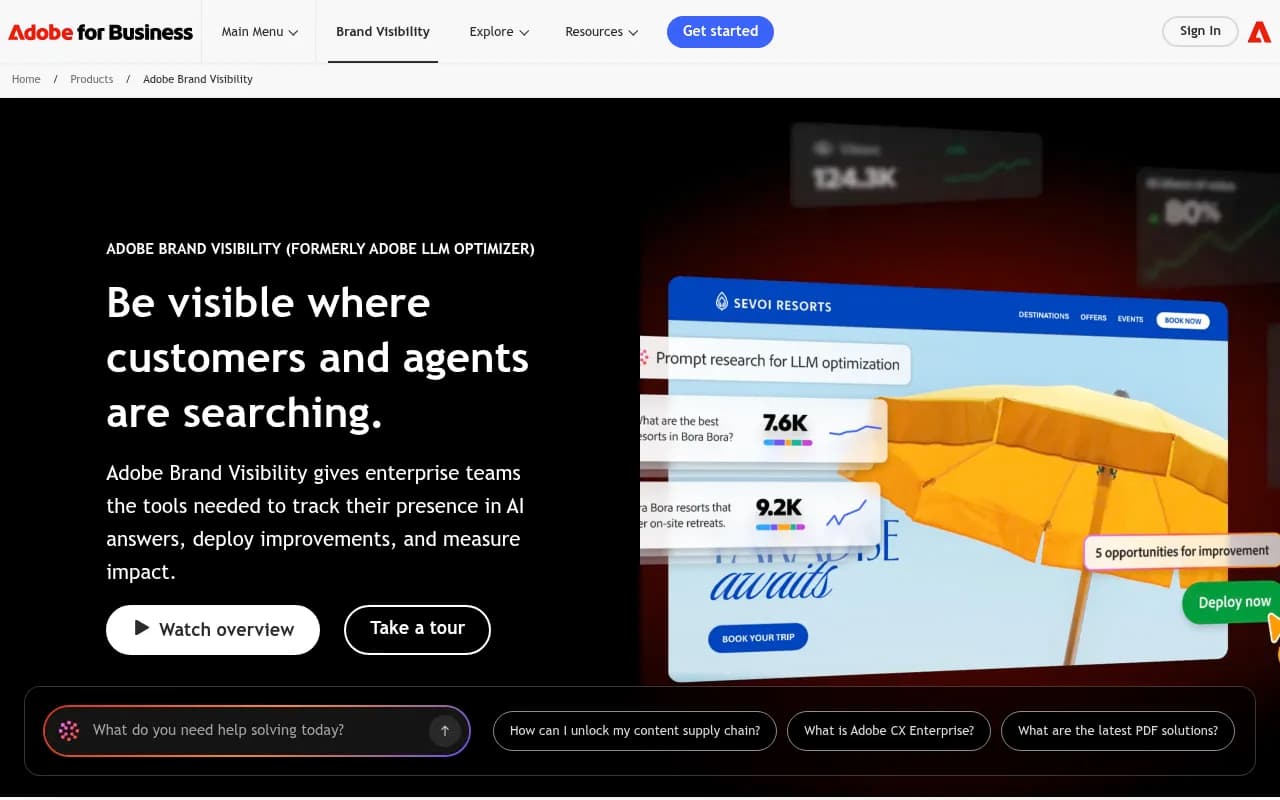
MarTech's Mike Pastore points out that product discovery is Bloomreach's origin, predating its email business. The 2021 Exponea acquisition added a CDP and marketing automation. In January 2026, Bloomreach launched Loomi Connect, which pushes retail catalog intelligence into ChatGPT apps and other AI experiences via MCP. Loomi Connect feeds catalogs to AI apps. AthenaHQ covers how brands earn visibility in the answers. Pastore compares it to Adobe's Semrush acquisition, and Adobe already has its own LLM Optimizer in the same space.
That comparison is the real story. AI visibility is getting absorbed into bigger suites. Standalone tools are becoming features.
What changes for current AthenaHQ customers
Less than you might fear, at least for now. The facts we have:
- Existing accounts, contracts, and support arrangements remain in place.
- The team is staying.
- First combined use cases arrive in early 2027.
What we don't know is a longer list. I found nothing on whether AthenaHQ stays a standalone product, whether pricing will change, how it will be bundled with Bloomreach, or what happens at contract renewal. There is also no independent analyst commentary yet. Treat any confident prediction on those points, including mine, as a guess.
What the vendor's own pricing says
This matters more than the press release. According to AthenaHQ's plans page:
- Starter is $295 per month (17% cheaper billed annually), with 3,600 credits per month, where one credit equals one AI response.
- Starter is limited to a single region and language, and has no ACE, no Recommendation Engine, no persona targeting, no advanced content agent, and no BI dashboards. API access and extra credits are paid add-ons.
- Enterprise is custom priced and adds ACE, the Recommendation Engine, multi-country support, persona targeting, BI dashboards (Tableau, Power BI, Looker), and a certified GEO/SEO specialist. Cognizo's review also lists SSO, an audit log, API access, a 2-hour SLA, and a Slack channel.
- Both plans monitor ChatGPT, Perplexity, AI Overviews, AI Mode, Gemini, Claude, Copilot, Grok and more, with unlimited competitor tracking and sentiment.
So the feature Bloomreach is highlighting is the one a Starter buyer can't use. If you read the announcement and thought "I want ACE," you are probably talking to enterprise sales.
Third-party sources also disagree with each other. Cognizo and Ryze mention a free Essential tier (300 credits), while Capterra shows a $95 starting price that looks stale. The vendor page is the source to trust. Confirm everything on athenahq.ai/plans before you buy.
The question the deal doesn't answer
Martech.org asked it directly: can the combined platform prove AI citations drive sales? The release says every workflow includes governance, clear ownership, and measurement so brands can prove revenue impact. That is a claim, not evidence. Attribution from an AI answer to a purchase is hard, partly because referrer data is unreliable. ChatGPT, for example, stopped sending a referrer on October 8, 2026, so teams now lean on utm tagging and server-side signals.
If you are evaluating any tool in this category, ask to see how it connects a citation to a visit and a conversion. Don't accept a visibility score alone.
What to optimize for regardless of vendor
The tool choice matters less than what you do with the data. Promptwatch Data's report on which content types ChatGPT cites the most (Sep 28 to Oct 4, 2026) is useful here, especially for ecommerce brands:
| Content type | Share of ChatGPT citations |
|---|---|
| Product pages | 22.4% |
| Landing pages | 16.8% |
| Listicles | 13.6% |
| How-tos | 8.7% |
| Documentation | 7.5% |
| General articles | 6.1% |
| Comparisons | 5.9% |
| News | 5.7% |
| FAQ | 3.3% |
| Reviews | 1.7% |
For commercial prompts, product pages climb to 26.0% and landing pages to 20.6%, and those two plus listicles and comparisons make up almost 70% of citations. So Bloomreach's focus on product content is well aimed. Product and landing pages are the main citation surface.
Shelf life matters too. In Promptwatch's content half-life data, landing pages and docs stayed cited longest, while news lost half its pages within 36 days. Evergreen commercial pages are a better bet than news-style posts.
How to evaluate your options now
If you are a current AthenaHQ customer
- Read your contract for assignment, renewal, and price change clauses.
- Ask your account manager in writing whether the product stays standalone and for how long.
- Export your historical prompt and citation data so you are not locked in.
- Check whether the features you rely on sit in Starter or Enterprise, since the combined roadmap will likely favor Enterprise.
If you are shopping
The central split in this market is between tools that report and tools that act. Plenty of platforms show you a score. Fewer help you publish the fix and then measure whether the fix worked. Questions worth asking any vendor:
- Does it collect data from real AI interfaces or only APIs?
- Does it show AI crawler activity on your site, so you can tell an access problem from a content problem?
- Can it attribute AI traffic and conversions?
- Does it help produce and publish content, or only recommend it?
- Is it independent, or tied to a suite you may not use?
On that last point, a Bloomreach-owned AthenaHQ will probably fit best for brands already on Bloomreach or heavily Shopify-based. If you aren't, you could end up paying for suite gravity you don't use.
Alternatives worth a look
Here is a quick comparison of tools in the same space. Prices for competitors quoted by Ryze are third-party and unverified, so confirm on each vendor's site.
| Tool | Strength | Notes |
|---|---|---|
| Promptwatch | Monitoring plus content creation, publishing, crawler logs, and traffic attribution | Essential $95/mo, Professional $245/mo, Business $579/mo |
| Profound | Enterprise analytics | Higher price points |
| Peec AI | Simple tracking | Reported around $95/mo |
| Otterly.AI | Budget monitoring | Reported around $29/mo |
| Scrunch | Monitoring plus agent-ready pages | Reported around $300/mo |
| Semrush AI Visibility | Inside an existing SEO suite | Reported $99 per domain |
| Adobe LLM Optimizer | Adobe Experience Cloud shops | Enterprise |
Promptwatch
Promptwatch is the option I would put first for teams that want the whole loop in one place. It tracks ChatGPT, Gemini, Claude, Perplexity, Google AI Overviews, AI Mode, Copilot and others from the real interfaces, then goes further: IP-verified AI crawler logs, visitor analytics for AI-referred traffic, a Content Agent that writes and publishes to WordPress, Webflow, or Framer, and ChatGPT Shopping insights for product visibility. The Shopping and Content Agent features start on the Business plan. For ecommerce teams worried about the product shelf, ChatGPT Shopping tracking is the relevant piece.

You can start with the 7-day free trial or the free AI visibility report, and confirm pricing at promptwatch.com/pricing.
Other tools to consider
Profound targets enterprise analytics buyers.

Peec AI is a lighter tracker with smart suggestions.

Otterly.AI is the budget monitoring pick.

Scrunch pairs monitoring with agent-ready pages.

For ecommerce catalogs specifically, product-level trackers are worth a look.
Yotpo Discover
For a wider survey, the GEO software directory at bestgeosoftware.com lists far more options.
What this deal signals
Three things stand out to me.
First, consolidation has begun. Adobe and Semrush, now Bloomreach and AthenaHQ. Expect more AI visibility startups to be bought by suites that want a GEO story.
Second, commerce is where the money is. Bloomreach's whole argument is about product shelves and live prices, which matches the citation data showing product pages as the top cited type.
Third, "dashboard" is becoming an insult. Even the customer quote in the release says AthenaHQ is "more than just a dashboard." Buyers now expect actions, content, and revenue measurement, not a chart of mentions.
Bottom line
If you use AthenaHQ today, nothing breaks in the short term, but get your contract questions answered before early 2027. If you are buying, decide whether you want an independent platform or one that will increasingly orbit a customer engagement suite. Either way, judge any tool on one test: can it show you a path from an AI answer to a visit to a sale?