Key takeaways
- ChatGPT has no ranking list. For SaaS you track mentions, citation position and share of voice across a fixed prompt set, not a single "rank".
- Promptwatch Data shows docs and help centers are the largest source group for software prompts (2.64% of software citations, Sep 28 to Oct 4, 2026), and vendor pages plus docs earn about 3x the share of review sites. Your docs are a ranking asset.
- Dev tools have a second audience: coding agents like Codex, Claude Code and OpenCode recommend SDKs and libraries. Few trackers cover them.
- Crawler logs tell you whether the problem is access (blocked bots) or content (nothing worth citing). Prompt trackers alone cannot separate the two.
- Verify every price on the vendor's own page. Published prices for these tools differ between sources.
Why SaaS and dev tools need a different approach
Most ChatGPT rank tracking guides are written for consumer brands. Run a prompt like "best running shoes" and count mentions. Fine.
SaaS and developer tools are messier. Buyers ask comparison questions ("Tool A vs Tool B for a 20-person team"), integration questions ("does X work with Postgres"), and how-to questions that docs answer directly. Developers also increasingly never open a browser. They ask an agent in their terminal which library to use, and the agent picks one.
So you are tracking at least three surfaces:
- ChatGPT and other answer engines for buyer prompts.
- Your docs, changelog, GitHub repo and review profiles as cited sources.
- Coding agents that recommend tools and write code against your API.
A tracker that only reports "your brand was mentioned 14 times" will miss most of that.
What "rank" actually means in ChatGPT
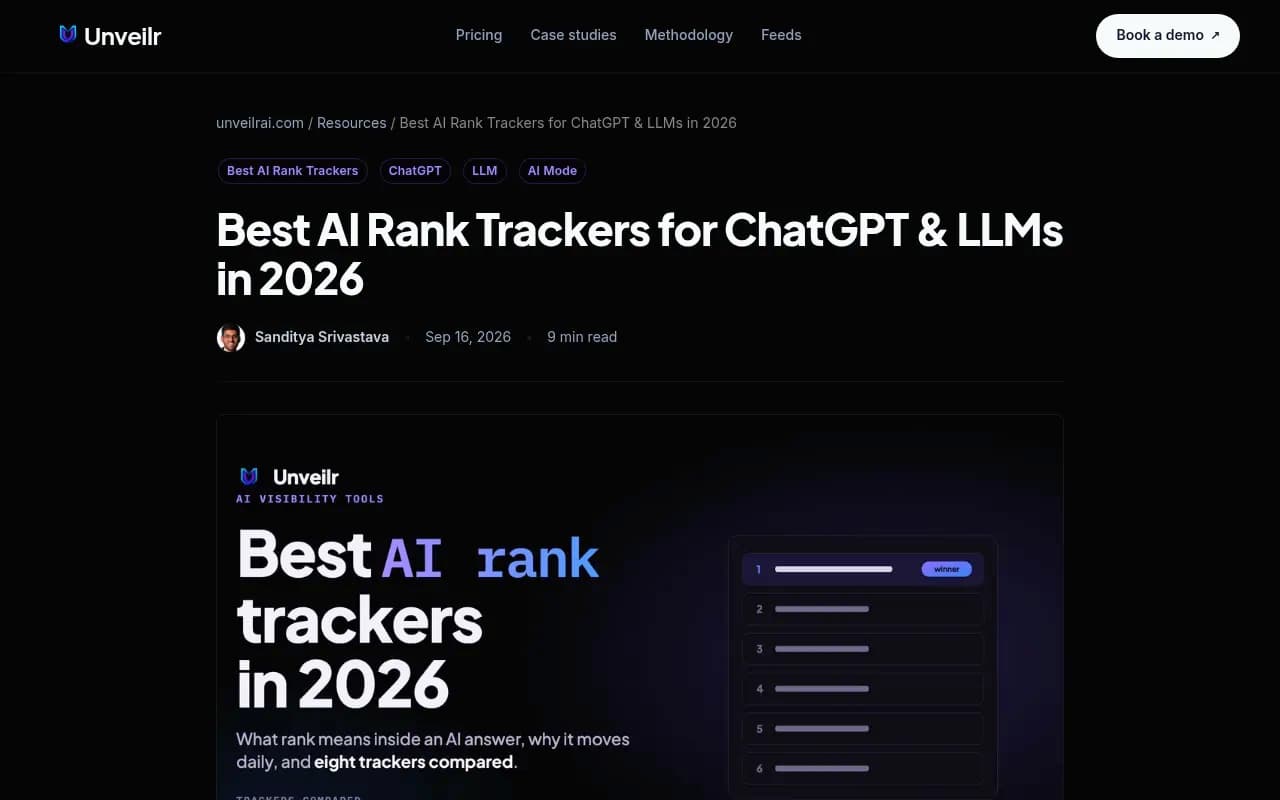
ChatGPT retrieves sources at query time, synthesizes an answer and names a handful of brands. There are no ten blue links. The Unveilr guide breaks rank in an AI answer into three readings, and I think that framing is right:
- Mention order: where your brand sits in the text of the answer.
- Citation position: where your URL sits in the source list.
- Share of voice: your mentions divided by all brand mentions across a prompt set.
A tool that reports one blended number hides which of these moved. Share of voice is the steadiest because AI answers vary run to run. Position is the noisiest. Treat a single day's position change as noise.
Fan-outs matter more than the prompt
ChatGPT turns your question into one or more web searches. Promptwatch's query fan-out data shows average fanouts per response were about 2.15 in early December 2025 and about 1.84 by early March 2026, with average query length dropping from roughly 117 characters to the high 80s. In April the data returned at 1.0 per response and about 53 characters. Other pages on the report say a prompt can trigger 3 to 8 or more searches, so behavior clearly varies by prompt and over time. Read the ChatGPT query fanouts report before drawing conclusions for your own category.
The practical takeaway for docs is stable either way: the searches ChatGPT runs are short and keyword-like. Put the product and category first in titles and H2s, and build focused pages for the sub-questions: X vs Y, pricing, alternatives, how-to.
Also worth knowing: on August 8, 2026 ChatGPT began using the site: operator at scale, going from about 0.4% to about 17% of fanout queries (Promptwatch Data). That means ChatGPT increasingly searches inside specific domains. If your docs are well structured and crawlable, that is good for you.
What the data says about software citations
Promptwatch Data's software citation report covers organic software prompts in ChatGPT from Sep 28 to Oct 4, 2026. The numbers are shares of all software citations:
| Source type | Share of software citations |
|---|---|
| Docs and help centers | 2.64% |
| Vendor sites | 2.01% |
| Review sites and analysts (G2, Gartner, Capterra, Software Advice) | 1.57% |
| GitHub | 1.2% |
| App stores | 0.47% |
By domain, GitHub leads at 1.2%, then learn.microsoft.com at 0.98% and G2 at 0.73%. AWS docs sit at 0.41%, Google Cloud docs at 0.35%, Gartner at 0.34%, Capterra at 0.32%, Intercom at 0.28% and Zapier at 0.24%.
Two things stand out. First, the concentration is low. The 23 domains in the chart add up to only 7.89% of software citations, so the long tail is huge and a smaller vendor can absolutely get cited. Second, vendor pages and docs together earn 4.65%, roughly 3x the share of review sites and analysts. Everyone obsesses over G2 listings. Your own docs probably matter more.
The content-type angle backs this up. Promptwatch's content half-life report found landing pages and docs stay cited longest, while news loses half its pages within 36 days. Docs are durable. A blog post about a launch is not.
And product pages are the most cited content type in ChatGPT at 22.4% of citations (Sep 28 to Oct 4, 2026). If your pricing and feature pages are thin, fix those before anything exotic.
What to track: a SaaS and dev tool prompt set
Start with 30 to 50 prompts, not 500. Split them:
- Category prompts: "best [category] tool for [use case]"
- Comparison prompts: "[you] vs [competitor]", "[competitor] alternatives"
- Integration prompts: "[category] tool that integrates with [platform]"
- Technical prompts: "how do I [task] with [your SDK or API]"
- Pricing and procurement prompts: "[you] pricing", "is [you] SOC 2 compliant"
- Persona variants: developer, engineering manager, CTO, ops lead
Tag each by intent so you can read results per segment. A drop in technical prompts points at docs. A drop in comparison prompts points at your comparison pages and review profiles.
Coding agents: the surface most trackers skip
If you sell an API, SDK, database, auth service or any developer-facing product, coding agents are now a distribution channel. When someone asks Claude Code or Codex to "add authentication to this app," the agent chooses a library. That choice is a ranking event, and no traditional tool measures it.
This is a real gap in the market. Most trackers in the catalog monitor ChatGPT, Perplexity, Gemini and Google surfaces. Promptwatch is one of the few that tracks how Codex, Claude Code and OpenCode recommend tools, SDKs and docs.
Practical steps for coding agents regardless of tool:
- Keep quickstarts short, current and copy-pasteable. Agents lift from them.
- Publish an llms.txt and make sure docs render without JavaScript.
- Version your docs clearly so agents do not recommend deprecated methods.
- Check whether bots like ClaudeBot or OAI-SearchBot are blocked by robots.txt, your CDN or your WAF.
One note on markdown: Promptwatch Data found markdown files make up just 0.05% of AI search citations. Markdown versions of docs help agents, not AI search. Do not expect them to move ChatGPT citations.
Crawler access: the check that saves months
Before you pay for any prompt tracker, check whether AI bots can read your docs. Docs sites are often behind aggressive bot protection, and that quietly kills visibility.
Promptwatch's AI crawler traffic report (IP-verified requests, Jun 8 to Sep 6, 2026) shows OpenAI at 79.8% of verified AI crawler requests in Aug 31 to Sep 6, down from 94.8% in Jun 8 to 14. Spoofed user agents are excluded. The report's advice is simple and good: compare your own logs to that mix. If a provider is big in the chart but near zero in your logs, you are probably blocking it. Also separate training bots from answer-time fetchers, because blocking one does not need to mean blocking the other.
Meta is another one to watch: Meta-WebIndexer went from about 2% to nearly 38% of tracked crawler requests between mid-July and August 9, 2026 (Promptwatch Data). Check your rules for it.
Comparing ChatGPT rank trackers for SaaS
Prices below come from vendor blogs and comparison posts and differ between sources. Confirm on each vendor's pricing page before buying.
| Tool | Strength for SaaS and dev | Crawler logs | Coding agents | Reported entry price |
|---|---|---|---|---|
| Promptwatch | Tracking plus content gap analysis, crawler logs, AI traffic, publishing | Yes, IP-verified | Codex, Claude Code, OpenCode | Free tier; paid from $95/mo |
| Profound | Enterprise monitoring and analytics | Not a focus | Not stated | Varies by source |
| Peec AI | Clean daily tracking of visibility, position, sentiment | No | No | $95/mo (50 prompts) per Unveilr |
| Otterly.AI | Cheap multi-engine monitoring | No | No | About $29/mo |
| ZipTie | Focused tracking with optimization hints | No | No | $69/mo or custom, sources differ |
| Rankscale | Many engines, credit-based refresh | No | No | From $20/mo |
| KIME | Tracking plus an action center | No | No | EUR 99/mo |
Promptwatch
Promptwatch is the one I would shortlist first for a SaaS or dev tool company, mainly because it covers the three surfaces above in one place. It tracks real user interfaces of ChatGPT, Google AI Overviews, AI Mode, Gemini, Perplexity and Copilot, and also Codex, Claude Code and OpenCode. IP-verified crawler logs show whether bots actually reach your docs and where they hit errors. Visitor analytics connect AI referrals to signups. Then the Content Agent and content gap analysis help you fill the gaps, with publishing to WordPress, Webflow or Framer.
The local plan ladder is easy to reason about: Essential at $95/month covers 50 prompts and all models, Professional at $245/month adds a Knowledge Base and AEO articles, Business at $579/month adds the automated Content Agent. Confirm on promptwatch.com/pricing.

Profound
Profound is a strong monitoring and analytics platform aimed at larger brands. It makes sense if you have an enterprise budget and mostly need reporting for leadership. It lacks the crawler-log and coding-agent angle that matters for dev tools.

Peec AI
Peec AI is a tidy tracker reporting visibility, position, sentiment and share of voice daily. Good for a marketing team that wants dashboards without much setup. It will not tell you why you are missing.

Otterly.AI
Otterly.AI is the budget pick for monitoring across engines, popular with agencies running several brands. Monitoring only, so pair it with your own analytics.

ZipTie
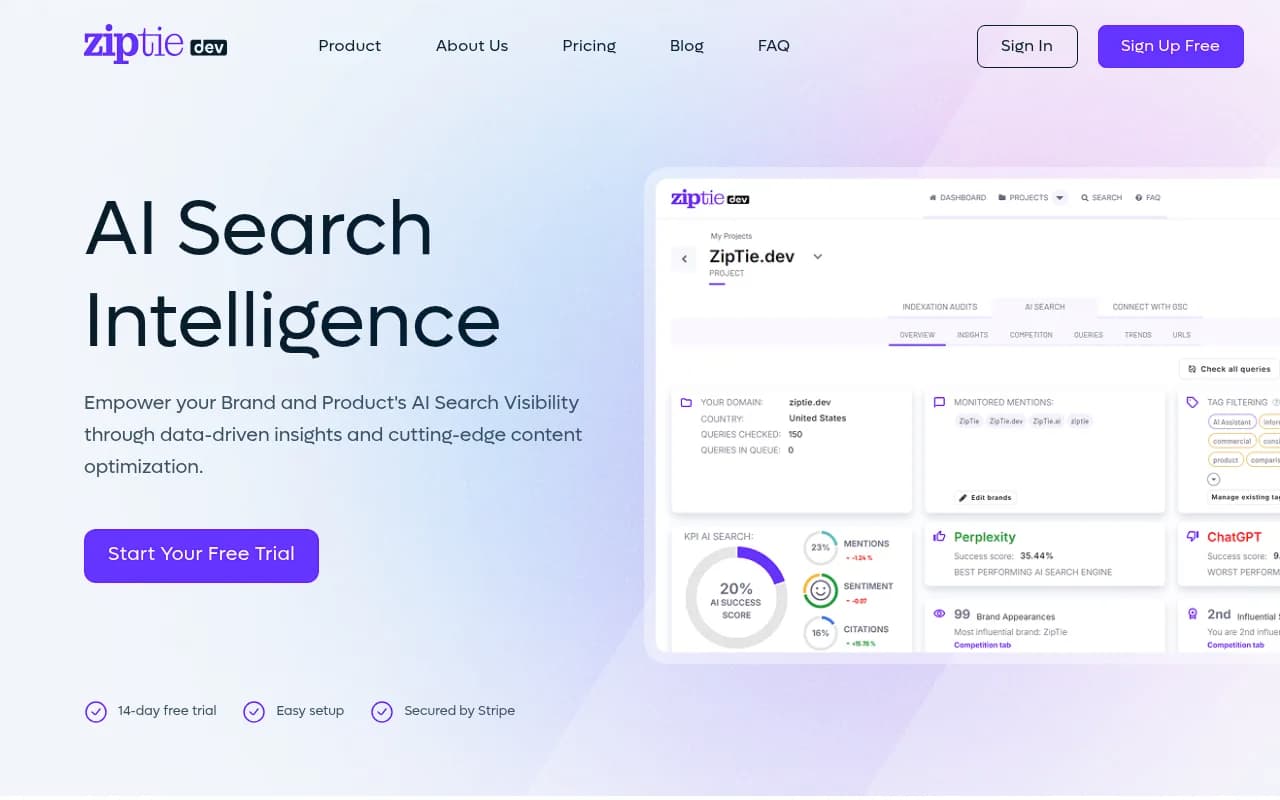
ZipTie leans toward actionable recommendations over raw dashboards. Pricing is listed inconsistently across sources, so ask for a quote or check the configurator.
Rankscale
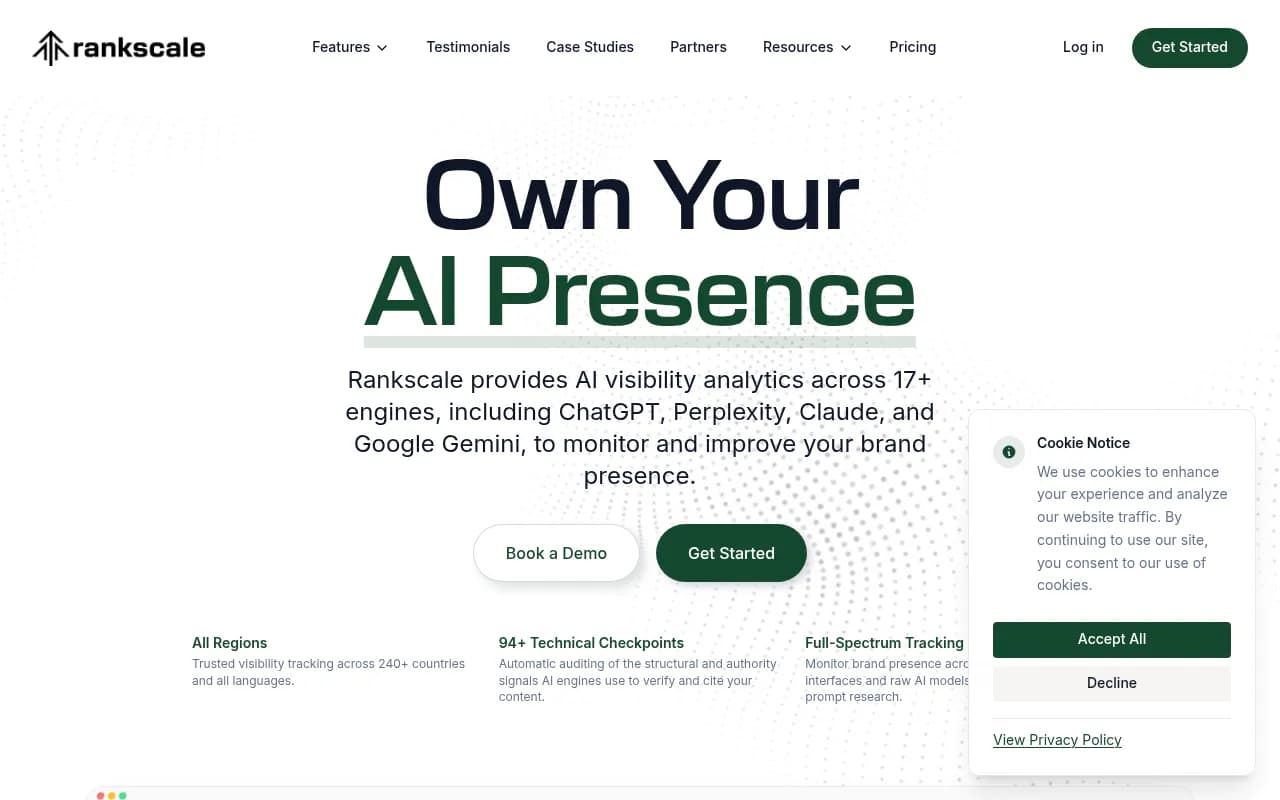
Rankscale is cheap and covers many engines on a credit model. Fine for experiments, though credit-based refresh means you should watch consumption.
KIME
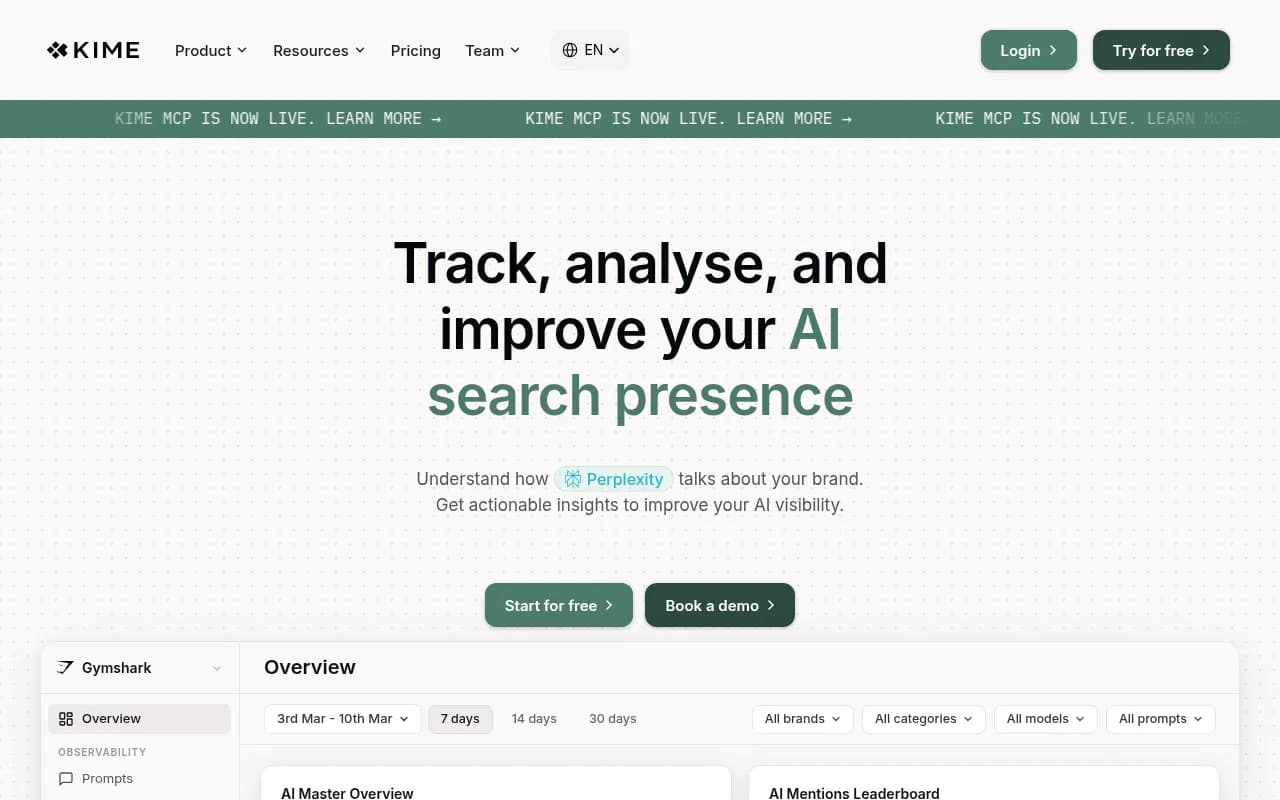
KIME pairs tracking with an action center and multi-seat access. Its own blog claims roughly 60% of organic traffic now comes from AI responses. I would not repeat that figure; it is a vendor claim and implausible.
Other options worth a look
If you want a broader view, Nightwatch extends classic rank tracking into AI search, and Ahrefs Brand Radar or the Semrush AI Visibility Toolkit suit teams already living in those suites. Expect fixed prompt sets and less AI-specific depth. For a bigger list, browse the AI rank tracker directory.

Which tool for which team
- Seed-stage dev tool, tiny budget: Otterly.AI or Rankscale to establish a baseline, then run the free Promptwatch tier or an AI visibility report.
- Series A to C SaaS with a content team: Promptwatch, because the gap between "we are invisible" and "here is the page to publish" is where the work is.
- API or SDK company: Promptwatch for coding agent coverage. I am not aware of many alternatives that do this.
- Enterprise with procurement requirements: Profound or Promptwatch (ISO/IEC 27001 certified, GDPR compliant), depending on whether you want monitoring only or execution.
- Already deep in an SEO suite: start with Ahrefs Brand Radar or Semrush and add a dedicated tracker if prompt depth feels shallow.
A 30-day plan
Week 1: access and baseline
Check robots.txt, CDN and WAF rules for every AI bot. Run a free AI visibility scan. Build your 30 to 50 prompt set and start tracking.
Week 2: map prompts to pages
For each prompt, note which of your pages should answer it. Anything without a page is a content gap. Anything with a page that never gets cited is a quality or structure problem.
Week 3: fix docs and comparison pages
Rewrite titles and H2s to read like the short queries ChatGPT runs. Add focused pages for pricing, alternatives and integrations. Keep your G2 and Capterra profiles current and keep a public GitHub presence, which matches Promptwatch's takeaways from the software citation data.
Week 4: measure
Look at share of voice per prompt segment, citation rate per page and AI-referred signups. Do not react to daily position swings. Re-audit after any major ChatGPT update, since the March 4, 2026 GPT-5.3 rollout visibly changed citations per response (Promptwatch Data).
Mistakes I see most often
- Tracking a single blended rank number and calling it a KPI.
- Buying a tracker before checking whether bots can reach the docs.
- Measuring brand mentions without measuring citations to your own domain.
- Ignoring coding agents when the product is an API.
- Publishing launch news and expecting it to stay cited. News fades in weeks; docs last.
- Trusting vendor rankings of coding agents or traffic claims without a source.
Bottom line
For SaaS and dev tools, ChatGPT visibility mostly comes down to crawlable docs, strong product pages and a few well-kept third-party profiles. Pick a tracker that can tell you which of those is failing, and if you ship developer tooling, make sure it also sees what coding agents recommend. Start with the crawler check this week; it costs nothing.