Key takeaways
- ChatGPT has no ranked list, so agency reporting has to move from keyword positions to prompt-level mentions, citations, and share of voice per client.
- The features that separate agency tools from single-brand tools are multi-client workspaces, white-label reports, flexible seats, and pricing that does not scale linearly per client.
- Almost half of ChatGPT responses cite 10 or more domains, so single-prompt checks are noise. Track many prompts per client and report brand-specific and organic prompts separately.
- Promptwatch, Scrunch AI, Otterly.AI, Peec AI, Nightwatch, and Rankability each fit a different agency profile. The table below sorts them out.
- Check every price on the vendor's page before you quote a client. Most comparison articles online are written by vendors who rank themselves first.
Why agencies need a different kind of ChatGPT tracker
A freelancer tracking one brand can get by with almost anything. An agency with fifteen clients cannot. You need a workspace per client, reports you can put your logo on, seats for account managers and strategists, and a pricing model that does not punish you for adding the sixteenth client.
The underlying problem is also different from Google rank tracking. ChatGPT retrieves several sources at query time, writes one answer, and names a handful of brands. There is no position 4 to move up to. What you measure instead is whether the client is mentioned, whether their domain is cited, who else shows up in the same answer, and how the model describes them.
One piece of context before the tool list. Most of the roundups ranking these tools are written by vendors. KIME's guide ranks KIME first, and Leapd's guide ranks Leapd's own product first. Some of those guides also repeat claims, like a figure that 60% of organic traffic now comes from AI answers, that carry no source. I would not repeat that number to a client. Treat the pricing in those articles as a starting point and verify it.
What to measure for each client
Before comparing tools, settle on the metrics. Otherwise you will end up comparing dashboards instead of capabilities.
- Mention rate: the share of tracked prompts where the client is named.
- Citation rate: how often the client's own domain appears in the sources.
- Share of voice: the client's mentions against named competitors.
- Position in the answer: first-named brands tend to get more attention.
- Sentiment: how the model frames the brand.
- Co-cited sources: the third-party pages, listicles, and forums that surround the client in answers.
Why single-prompt checks mislead
Promptwatch Data looked at how many unique domains ChatGPT cites per response between Sep 28 and Oct 4, 2026. 47.6% of responses cited 10 or more domains, and 66.1% cited at least 8. Only 6% cited three or fewer. These are crowded answers, and which brand lands in them varies from run to run.
That has a practical consequence: a client report that says "we ranked in ChatGPT for this prompt" is close to meaningless. Track dozens of prompts per client and report trends.
Report prompt types separately
The same dataset splits by prompt type. Organic prompts with no brand named cited 10+ domains 52.5% of the time. Competitor comparison prompts hit 49.1%. Brand-specific prompts only 21.3%, with 5 domains the most common count. Those are different games. A brand-specific prompt tells you about reputation and accuracy. An organic prompt tells you about discovery. Mix them into one score and you will hide the problem the client actually has.
Expect the ground to shift
Fanout behavior, meaning the web searches ChatGPT runs behind a single answer, changes in steps after model updates. Promptwatch's query fanout data showed average searches per response drifting from about 2.15 in early December to about 1.84 by early March, then 1.0 in April. Separately, ChatGPT began using the site: operator at scale on August 8, 2026, jumping from roughly 0.4% to 17% of fanout queries. A prompt set and page phrasing that worked in one quarter can go stale in the next, so plan a quarterly prompt review into every retainer.
What agencies should look for in a tool
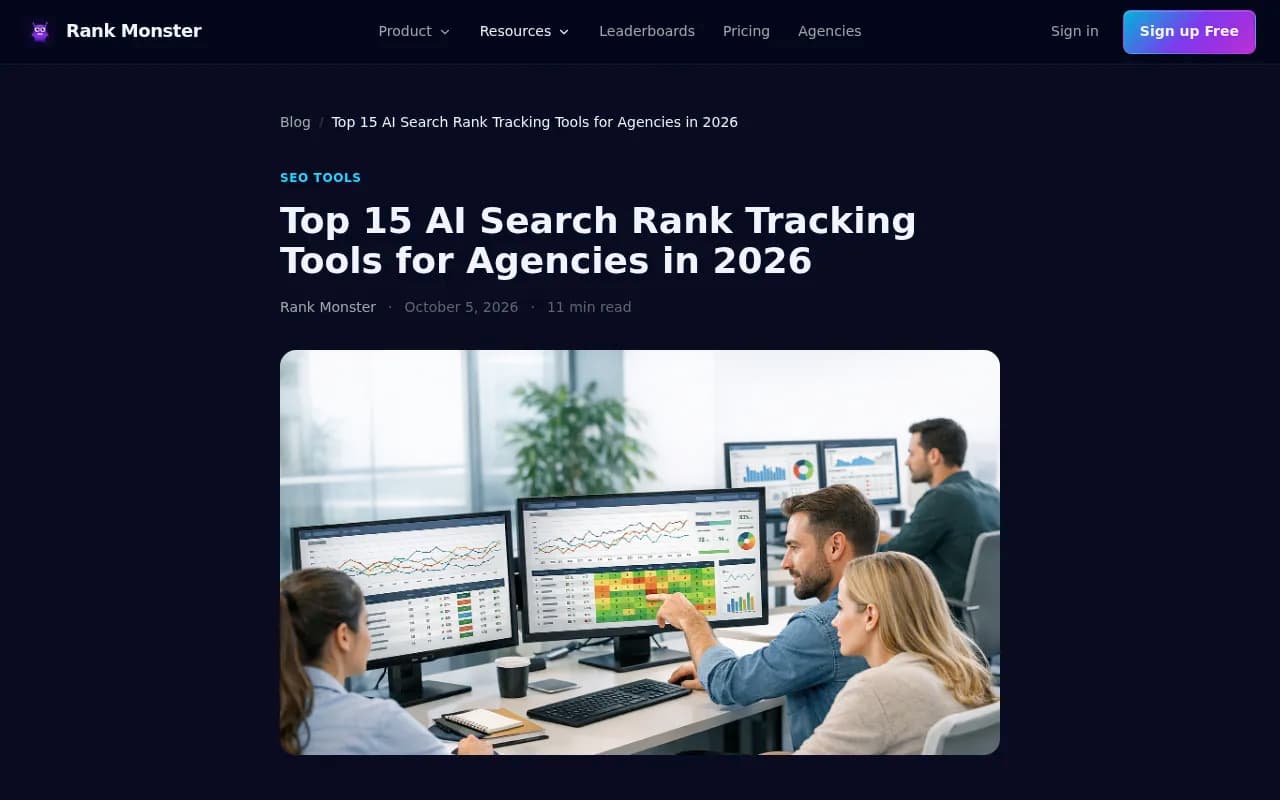
The Rank Monster guide frames this around three dimensions: platform coverage, client capacity, and reporting automation. I would add a fourth, which is whether the tool helps you do anything about what it finds.
Client capacity and pricing model
This is the one that bites later. Rank Monster's own example: a tool covering 100 accounts for a flat $5,000 a year beats one charging $50 per account per month, which comes to $60,000 a year at that scale. That example is illustrative and comes from a vendor blog, but the arithmetic point is right. Model your cost at 5, 15, and 40 clients before you commit.
White-label and client access
Can you export PDFs with your branding? Can a client log in to a read-only view? If you are building a reporting deliverable, this matters more than any individual metric.
Real interface data
User-facing ChatGPT answers and citations can differ from API outputs. Tools that collect from the real interface give you something closer to what your client's customers actually see.
From insight to action
Some tools stop at showing the gap. Peec AI's own review text says as much: you see the gap, and building the fix requires other tools. That is fine if your agency has a content team. If it does not, or if you want to productize the fix, look for content gap analysis and publishing built in.
Multi-client tools compared
| Tool | Agency angle | Notable strength | Watch out for |
|---|---|---|---|
| Promptwatch | Agency plans with unlimited projects, 10 seats, white-label reports and branded client access | Tracking plus crawler logs, AI traffic analytics, and content creation | Agency plans exclude the Content Agent and AEO articles |
| Scrunch AI | Agency Partner Program, multi-region | Competitor analysis by persona, topic, and geography | Higher price tier for smaller shops |
| Otterly.AI | White-label reports and multi-client management | Low entry price | Monitoring focus |
| Peec AI | Multi-brand, multi-market, unlimited seats | Citation gap analysis | No content generation or site audit |
| Nightwatch | White-label reporting for client-facing teams | Classic rank tracking plus AI add-on | AI is an add-on to an SEO tool |
| Rankability | Unlimited client portfolios, centralized reporting | Pairs tracking with content optimization | Content-first rather than tracking-first |
Promptwatch
Promptwatch is the one I would look at first if you want tracking and execution in one place. Agency plans start at $199/mo (Kick-off), with Growth at $399/mo and Scale at $799/mo. All three include unlimited projects, pitch projects and prompts, 10 seats, all AI models, country, state, and city tracking, crawler logs, visitor analytics, site audit, custom reports, and MCP and API access. Scale adds an audit log and local GEO/SEO targeting at exact coordinates.
It monitors the real interfaces of ChatGPT, Google AI Overviews, AI Mode, Gemini, Perplexity, Copilot, and others. The parts agencies tend to like are the IP-verified AI crawler logs (so you can tell a client whether GPTBot is even reaching their pages), visitor analytics that tie AI referrals to conversions, and white-label PDF exports with branded read-only client access. One limit to know: agency plans do not include the Content Agent, AEO articles, or the Knowledge Base. Those sit on Business and Enterprise. Confirm current details at promptwatch.com/pricing.

Scrunch AI
Scrunch is built around competitive analysis that breaks results down by persona, topic, and geography, which suits agencies with multi-region clients. It also runs an Agency Partner Program. Expect enterprise-leaning pricing.

Otterly.AI
Otterly is the name that comes up most often for agencies on a tighter budget, with white-label reports and multi-client management. Several roundups list a low entry price, but verify current tiers before you plan around it. It is a monitoring tool, so pair it with your own content process.

Peec AI
Peec is built for teams managing multiple brands across multiple markets, and every plan includes unlimited seats. Its citation gap analysis shows which sources AI engines trust in a category and which ones competitors use that you do not. Its higher tier was listed around EUR 425 a month for 350 prompts in April 2026 vendor-written reviews, so confirm that. No content generation, no site audit.

Nightwatch
Nightwatch comes from classic rank tracking and has extended into AI search, with white-label reporting for client-facing teams. If your clients still live in Google keyword reports, one tool for both is convenient.
Rankability
Rankability pairs AI visibility tracking with content optimization and targets agencies and content-driven SEO teams. Choose it if the deliverable you sell is content, not a dashboard.
Others worth a look
Search Party is positioned specifically around agency-focused AI search visibility. KIME markets multi-seat access for agencies. Profound targets enterprise brands and the agencies serving them. For more options in the category, the GEO software directory at bestgeosoftware.com lists many of them.

How to choose, by agency type
| Agency profile | Likely fit | Why |
|---|---|---|
| Small, 3 to 10 clients, tight budget | Otterly.AI or Nightwatch | Low entry price, white-label reporting |
| Mid-size, wants tracking and fixes in one stack | Promptwatch | Unlimited projects, crawler logs, traffic attribution |
| Multi-region or enterprise clients | Scrunch AI or Promptwatch Scale | Geo and persona breakdowns, local targeting |
| Content-heavy retainers | Rankability | Tracking tied to content optimization |
| Strong in-house content team, analysis-heavy | Peec AI | Citation gap data, unlimited seats |
A practical setup for each new client
- Build a prompt set of 30 to 50 prompts, split into organic, competitor comparison, and brand-specific groups.
- Add the client and three to five real competitors. Let the tool auto-discover others if it can.
- Record a baseline for mention rate, citation rate, and share of voice before you change anything.
- Find the third-party sources that appear alongside the client: listicles, review sites, forums. These are how brands get into crowded answers.
- Check crawler access. If AI bots are blocked or hitting errors, no content work will help.
- Report monthly, with trends over several weeks and not single-day snapshots.
- Review the prompt set quarterly, since fanout behavior changes after model updates.
Questions to ask before you sign
- What does it cost at 10, 25, and 50 clients, and what is the per-response or per-prompt limit?
- Is data collected from the real ChatGPT interface or an API?
- Can clients get branded read-only access?
- Does the tool track countries and cities, not just one region?
- Can I export raw data, or connect via API or MCP?
- What happens to my historical data if I cancel?
If you would rather hand the whole thing to specialists, agencies like 1001 SEO Media run GEO programs as a service, but for in-house agency work the questions above will get you most of the way.
Bottom line
The tools are converging on the same dashboards, so decide on three things: how your costs scale with client count, how good the white-label and client access is, and whether you need the tool to help ship fixes. For deeper rank-tracker comparisons, the AI rank tracking directory at ai-rank-tools.com is a good next stop. Run a two-week trial with two real clients on your shortlist, and judge them on which one produced a report you would actually send.