Key takeaways
- Competitor framing is how an AI answer describes you next to a rival: the adjectives, the order, and the sources behind each claim. It can differ from what your homepage says.
- One answer proves nothing. SparkToro's study of repeated prompts, reported by Search Engine Journal, found ChatGPT almost never returns the same brand list twice. Count how often a brand appears across runs instead of where it sits in one answer.
- Your ChatGPT competitors are the three to five brands named most often in the answers. They may differ from the rivals in your sales battlecards.
- Read the sources, not just the sentence. If a rival's comparison page is what ChatGPT quotes about you, their framing has become the engine's framing.
- Fix framing with pages that state pricing, features and audience plainly, then re-measure under the same conditions.
What competitor framing actually means
Most teams ask a narrow question: are we mentioned? That matters, but it is the first of three questions. The second is how you are described. The third is whose pages the model leaned on to describe you.
Picture a buyer typing "Klue vs Crayon for a mid-market SaaS company" into ChatGPT. The answer will name a few vendors, give each a one-line character, and cite a handful of sources. If the model calls a rival "enterprise-grade" and calls you "affordable", that is the picture the buyer carries into the sales call. It does not matter what your homepage says.
I find this the most underrated part of AI visibility work. Share of mentions is easy to chart. Framing is messier, because it lives in adjectives, and nobody builds a dashboard for adjectives until a deal is lost to them.
Why one answer tells you almost nothing
ChatGPT builds a fresh competitor list for each answer from what it learned in training and, when search is on, from the pages it pulls in. OpenAI's help article on search says ChatGPT typically rewrites your query into one or more targeted queries before sending them to search providers. So the same question can return different sources, and different brands, from one run to the next.
SparkToro ran 2,961 prompts with 600 volunteers and, as Search Engine Journal reported, found that ChatGPT returned the same brand list less than 1% of the time, and the same list in the same order less than 0.1% of the time. The share of answers naming a given brand was far steadier than any list position. One caveat: SparkToro sells audience research tools, and this is a company study, not a peer-reviewed paper. Treat the exact figures as directional, but the pattern matches what anyone sees when they rerun a prompt.
The practical consequence is blunt. A competitor that shows up in 70 of 100 runs while you show up in 20 is beating you, even if you happened to come first the one time you checked by hand. Stop reporting position. Report "named in x of N runs".
Query fan-outs add another layer of variation. Promptwatch's ChatGPT query fanout data showed average searches per response falling from 2.15 in early December 2025 to about 1.84 by early March 2026, with average query length shrinking too. Each of those short searches is a separate retrieval that a rival's page can win. If you want the mechanics, the query fan-outs guide explains it.
Set up runs you can compare
Before writing a single prompt, fix the conditions. Otherwise you measure noise.
- Use the same engine and plan every time.
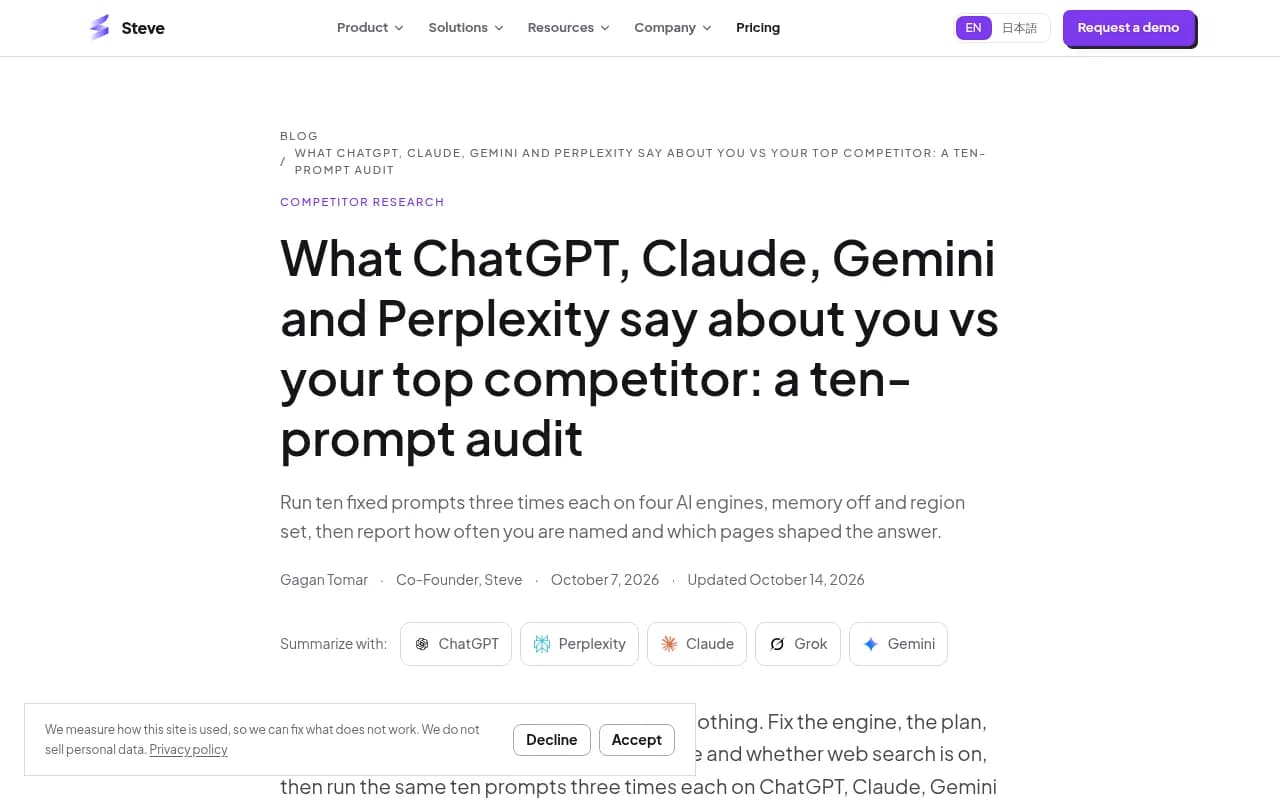
- Turn memory off or use temporary chats. In one ten-prompt audit published by Steve (hiresteve.ai), ChatGPT referred to "your previous questions" inside chats that had been opened fresh, so account memory had linked the answers.
- Keep web search either always on or always off.
- Pin the region and language. If you care about Japan, measure from Japan.
- Repeat each prompt at least five times, three at an absolute minimum, then divide each brand's appearances by total runs.
- Compare only runs made under identical conditions. Weekly single runs mostly measure sampling noise, so a monthly cadence with the same prompts is more honest.
The prompt set that exposes framing
A useful set mixes four types of prompt. You want some that never name you, some that name you, some that name a rival, and some that ask for alternatives.
| Prompt type | Example | What it reveals |
|---|---|---|
| Category, unbranded | "Best CI software for a B2B SaaS PMM team, with pros and cons" | Whether you are in the consideration set at all |
| Head-to-head | "[You] vs [Rival] for a 200-person company. Where is each stronger?" | The adjectives and strengths assigned to each side |
| Alternatives | "Best alternatives to [Rival]" | Whether the model treats you as a replacement |
| Branded | "Is [You] a good fit for small teams?" | Accuracy of claims, and which pages are quoted |
| Persona-led | "Which tool fits a head of sales who needs Slack alerts?" | Framing for a specific buyer |
Read each answer for four things: your position in the text, how long and deep your description is, the framing word (leader, affordable option, niche tool, legacy player), and any negative claims. Then write down the three or four words used most for each major rival and for you. The gap between those lists is your positioning brief.
What a first run can look like
Steve's published audit is a useful reality check. On 10 September 2026 the team put eight buyer questions about competitive-intelligence software to ChatGPT, each in a new chat with web search on. Steve was named in none of the seven answers that described a problem without naming a vendor. Klue appeared in all eight and Crayon in seven. Asked by name, ChatGPT described Steve accurately and cited only its own pages, but flagged that the hard numbers came from Steve's marketing rather than independent sources.
That last detail is the kind of thing a mention counter never shows you. The model was accurate, and still unconvinced.
Find your real ChatGPT competitor set
Do not start from your sales battlecards. ChatGPT may name brands you rarely meet in deals: a large suite, a free tool, a review site. Run your category prompts, tally every brand named, and keep the three to five that appear most often. That is your ChatGPT competitor set.
Review sites, directories and forums are not rivals, but they decide which rivals get named. Keep a separate list of them. Promptwatch's software citation data for Sep 28 to Oct 4, 2026 shows GitHub, Microsoft's docs and G2 leading ChatGPT citations for software prompts, which is a good reminder that a directory can outrank every vendor in the source list.
Read the sources, not the sentence
Framing does not come from nowhere. Most of it is stitched from pages the model fetched. So for every answer, log the cited URLs and sort them into three piles:
- Your own pages. This is the baseline you want when the question is about you.
- Third-party pages: reviews, directories, news, forums.
- Rival-authored pages, especially comparison pages.
The third pile is the one that hurts. A competitor-written comparison page cited for a question about you means their framing has become the engine's framing, and your list of wrong claims will usually trace back to it.
The volume of sources is worth knowing too. Promptwatch Data on unique domains per ChatGPT response (Sep 28 to Oct 4, 2026) found that 49.1% of competitor comparison prompts cite 10 or more domains, and only 0.35% cite a single domain. ChatGPT almost never settles a comparison with one site. For brand-specific prompts the picture is tighter: the most common count was 5 domains, and only 21.3% cited 10 or more. Expect your rival's site to be cited next to yours, and expect third parties to carry weight.
Which content types get cited matters as well. In Promptwatch's content type report for the same week, product pages took 22.4% of ChatGPT citations and landing pages 16.8%. For branded prompts, reviews rose to 5.6%, more than triple their overall share. That tells you where the framing material comes from: your own product and landing pages, plus reviews.
Positioning gap prompts
Once you know how the model frames both sides, use ChatGPT itself to find the messaging gap. Paste actual page text into the chat so it reasons over copy you can see, not whatever it half remembers.
- "Here is the homepage and pricing page copy for [rival]. List every claim they make, grouped by buyer concern."
- "Here is our copy for the same pages. Do the same."
- "Which buyer concerns does only one company address, and which does neither?"
- "For each gap, write the question a buyer would type into ChatGPT that would expose it."
The fourth prompt is the useful one, because it turns a messaging gap into a trackable prompt you can add to your set. Avoid leaning on the model for facts about rivals without checking them. It will sound confident either way, and older guides that rely on stale training data are no longer a safe reference.
Tools that automate the measuring
You can do all of this by hand in a spreadsheet, and I recommend doing it once so you learn what the answers look like. After that, repeated runs across several engines get tedious fast. Pick a tool by what it does after the dashboard: does it show framing and sources, or only mentions?
Promptwatch tracks how ChatGPT, Gemini, Perplexity, Google AI Overviews and others mention and cite you, and it pulls the individual claims AI makes about you and your competitors into Brand Narrative, grouped under themes like Pricing, Features and Reputation. That is close to a framing audit running continuously. Fact Check on Business plans then helps trace an inaccurate claim back to the page it came from. It also handles the next step, with a Content Agent that writes and publishes pages against the gaps.

Other options differ mostly in how deep they go on competitors:




| Tool type | Good at | Usually missing |
|---|---|---|
| Prompt trackers (Otterly.AI, Peec AI) | Cheap, regular mention counts | Crawler logs, content creation, deep framing analysis |
| Enterprise monitors (Profound) | Broad monitoring and reporting | Execution, and cost is higher |
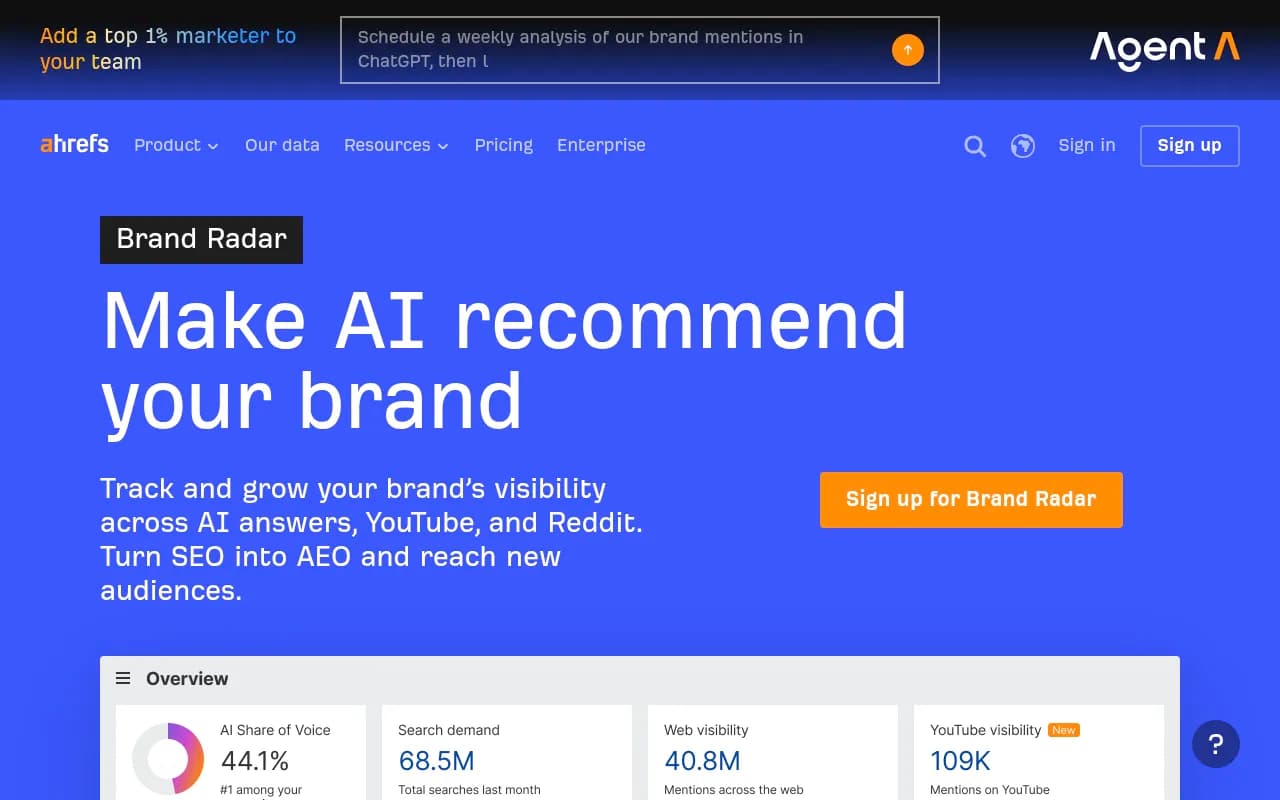
| SEO suites (Semrush, Ahrefs Brand Radar) | Fits an existing SEO workflow | Fixed prompt sets, shallow AI-specific data |
| End-to-end platforms (Promptwatch) | Framing, sources, content fixes, and measuring the result | Needs a Business plan for the Content Agent |
If you want to browse more options, the GEO software directory at bestgeosoftware.com lists many of them side by side.
Turning findings into fixes
Turn each finding into a brief with one job. Here is how the common patterns map to actions.
| What you see | Likely cause | Fix |
|---|---|---|
| Absent from category prompts, rival in all of them | Thin coverage of the buyer's question | Publish pages that answer that exact question with your own data and facts |
| Described as "cheap" or "basic" | Third-party reviews or old copy | Put pricing, features and "who it's for" on your own pages; update review profiles |
| Rival's comparison page is cited about you | You have no comparison page of your own | Publish your own comparison pages for the rivals you are most often compared with |
| Claims about you are wrong | A specific page states or implies them | Find the page, correct it, and re-run |
| Named only when asked by name | Weak presence in category content | Build content for unbranded prompts first |
Two cautions. First, do not copy the rival's answer. ChatGPT already has it, so a near copy gives it little reason to add you. Second, news content ages fast. Promptwatch's content half-life report found that news pages lose half their citations in about five weeks, while landing pages and docs keep most of theirs for months. Durable framing belongs on durable pages.
Because fan-out queries are short, write headings the way people search: "X vs Y", pricing, alternatives. Each one is a separate retrieval you can win.
If you would rather hand the strategy and execution to a team, an agency such as 1001 SEO Media works on GEO alongside technical SEO and content, and uses Promptwatch for AI visibility tracking.
A simple monthly routine
- Keep a fixed set of 15 to 30 prompts across category, head-to-head, alternatives and branded types.
- Run each at least five times under identical settings.
- Record named-in-x-of-N for you and each rival, the framing words, and every cited URL.
- Flag claims that contradict your own site and trace each to a source.
- Pick one rival and one gap to close this month, publish, and compare the next run against the baseline.
Get a baseline before changing a single page. That gives you a number to beat and tells you which competitor to study first. A no-login option is the free AI visibility report, which scans how ChatGPT, Gemini and Perplexity talk about your brand.
FAQ
What ChatGPT prompts reveal my competitive positioning?
Ask which tools fit a specific buyer's needs without naming your company, then ask for a comparison between you and a named rival. The descriptions show how the model positions each option. Add "alternatives to [rival]" to see whether you are treated as a replacement.
How many times should I run each prompt?
At least five, in temporary chats with consistent search settings. Divide each brand's appearances by total runs. A single run describes one sample, not your visibility.
Should I track my position in the answer?
No. Position changes between otherwise identical runs. Appearance rate is steadier, and it is the number to report.
How often should I re-check?
Monthly for hand-run audits, using the same prompts and settings. Automated tools can run daily, which smooths the noise through volume.
What if the model says something wrong about us?
Find which cited page states the claim. It is often a third-party or rival page, sometimes your own outdated copy. Fix or answer it at the source, then re-measure.