Key takeaways
- The five platforms split into two groups. Conductor, BrightEdge and seoClarity are suites for governance, reporting and content workflow. Botify and Lumar are technical platforms for crawling, logs and indexation.
- Most of the public comparison content is written by a competitor. Conductor's ranking ranks Conductor first, and Indexable AI's ranking promotes Indexable AI. Treat every claim as a lead to verify in a demo.
- Price is mostly opaque. Only seoClarity publishes numbers, and even its own pages disagree ($2,500 vs "start at $3,000 per month"). The other four require a quote.
- AI search coverage is the area where vendor claims conflict the most. Make each vendor show you which engines they track, live, on your own prompts.
- A common 2026 setup pairs one suite with one technical crawler and a dedicated AI visibility tool, rather than expecting one contract to do everything.
The short version
If you want the answer before the detail: buy a technical platform (Botify or Lumar) when the problem is millions of URLs, JavaScript rendering or crawl budget. Buy a suite (Conductor, BrightEdge or seoClarity) when the problem is many teams, shared reporting and content guidance. Mixing those two jobs in a single RFP is how enterprises overpay for one and under-use the other.
Here is the whole field at a glance.
| Platform | Type | Best for | Published pricing |
|---|---|---|---|
| Conductor | Suite | Cross-team content workflow, AEO and SEO governance | Not published, usage-based plans |
| BrightEdge | Suite | Executive reporting, automated on-site optimization | Not published |
| seoClarity | Suite | Data scale, keyword depth, price transparency | Published tiers, but sources conflict |
| Botify | Technical | 500K to millions of URLs, crawl, logs, rendering | Not published |
| Lumar | Technical | Crawling plus accessibility and QA testing | Not published, request form |
A word on sources before you read any comparison
I went through the main public comparisons for this guide, and almost every one has a seller behind it. Conductor's "best enterprise SEO platforms" list ranks Conductor #1, Botify #3, seoClarity #4 and BrightEdge #5. seoClarity's own comparison pages claim better review scores than both Conductor and BrightEdge. Indexable AI's list puts its own product first. A US Tech Automations post sells a ticketing layer on top of the same five tools.
None of that makes them useless. It means you should read them as vendor positioning. Where two sources contradict each other below, I say so rather than pick a winner.
The two categories, and why they matter
Enterprise SEO platforms are not interchangeable. The split below drives almost every buying decision.
Suites
Conductor, BrightEdge and seoClarity answer questions like "what should we publish, are we winning the SERP, and how do I show leadership?" They bundle keyword and rank data, content guidance, reporting and workflow, and they are sold to teams with many stakeholders.
Technical platforms
Botify and Lumar answer "can search engines fetch, render and index our pages?" They crawl at very large scale, and Botify in particular combines crawl data with log files so you see what bots actually did rather than what they could do. They are rarely a replacement for a suite. Conductor's own guide says Botify is best paired with a content or workflow platform, which is self-interested but also fair.
Conductor
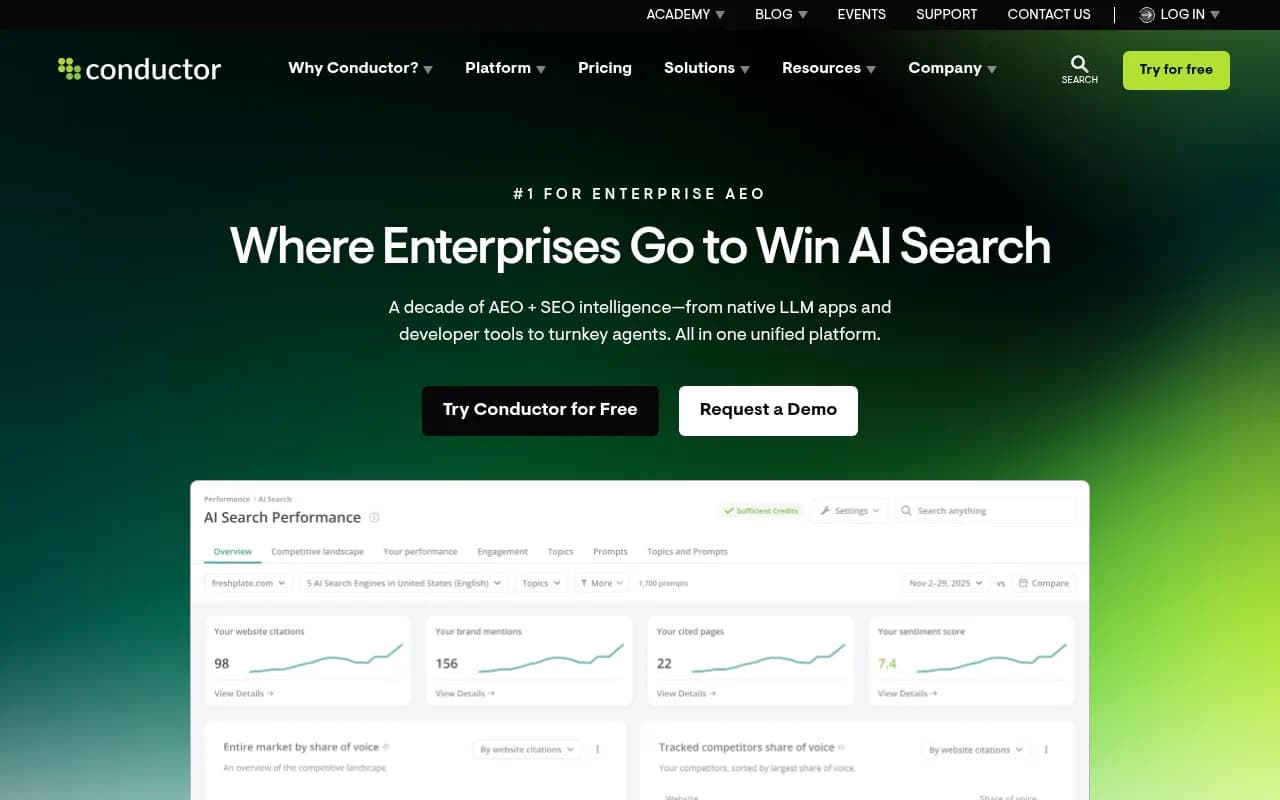
Conductor positions itself around content collaboration and, more recently, AEO (answer engine optimization). Its marketing calls it "the #1 Enterprise AEO Platform" and describes AgentStack, which includes apps inside ChatGPT, Claude and Copilot, an MCP server and prebuilt agents. It names ChatGPT, Gemini, Copilot and Claude as covered engines.
Where it fits: mid-to-large in-house marketing teams where SEO, content and comms work from the same platform and share performance data with leadership. A third-party estimate puts it at roughly $75K to $250K a year, with a UI described as cleaner than BrightEdge's.
Where to push: technical SEO is weaker than Botify's. Conductor also lists SOC 2, ISO 42001 and ISO 27001 certifications according to the Indexable AI page, which is worth confirming in security review rather than taking from a competitor's article.
BrightEdge
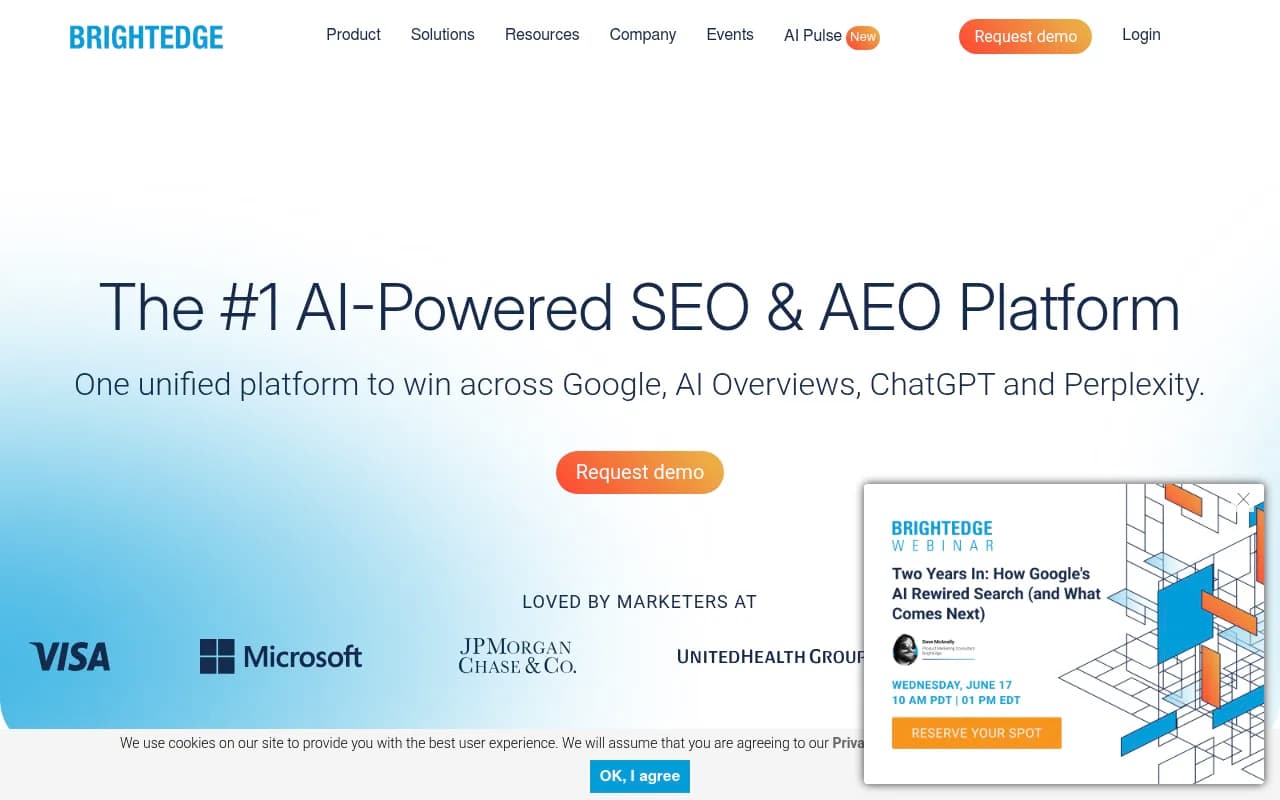
BrightEdge is the long-running incumbent. Its pitch is reporting and governance for large organizations tracking performance across regions and business units, plus automation. It markets Autopilot as handling "fully automated optimizations on your website," and its AI products include AI Hyper Cube, AI Catalyst and Agent Edge.
One conflict is worth settling in your demo. BrightEdge says it covers Google, AI Overviews, ChatGPT and Perplexity. Conductor's guide claims BrightEdge's coverage of standalone engines like ChatGPT and Perplexity is limited. Both statements come from interested parties. Ask BrightEdge to show ChatGPT and Perplexity tracking on your own brand and competitors, and judge from that.
Pricing is unpublished and its pricing URL reportedly returns a 404. A third-party estimate of $150K to $500K+ a year is a rough guide only. Criticisms that recur: a steeper learning curve and an older interface. It suits Fortune 1000 teams with dedicated SEO analysts and existing data infrastructure to connect.
seoClarity
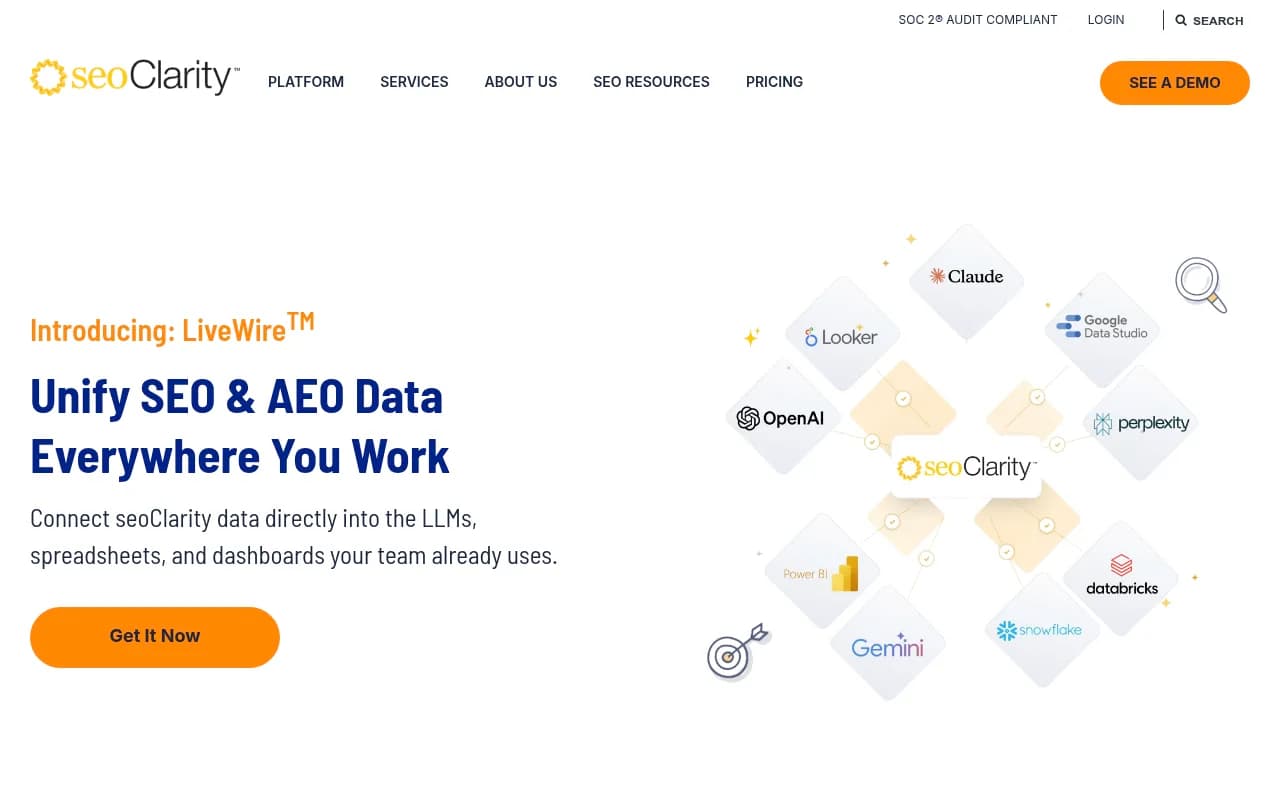
seoClarity is the data-scale pick and the only one of the five that publishes pricing. Its pricing page lists tiers reported as $2,500, $3,200 and $4,500 a month. I could not load those numbers directly, and seoClarity's own BrightEdge-vs-Conductor page says packages "start at $3,000 per month." Pricing also varies by tracked keywords, domains and capabilities, so treat any figure as a starting point and get a written quote.
What it claims: unlimited competitive comparisons, crawl projects and data downloads (up to 1M rows), 120+ automated insights, and more than 3,500 brands served. Its product modules include Clarity ArcAI (AI Search Visibility Tracking, AI Overviews Tracking, AI Bot Activity), log file analysis, an SEO crawler, a split tester, Schema Optimizer, Page Optimizer and ClarityAutomate for deploying changes. It displays a SOC 2 audit compliant badge.
The review scores seoClarity quotes (Capterra 4.8, G2 4.5, versus lower numbers for BrightEdge) come from its own comparison page. Check G2 yourself. Third-party estimates of $100K to $300K a year are consistent with the enterprise tiers.
Botify
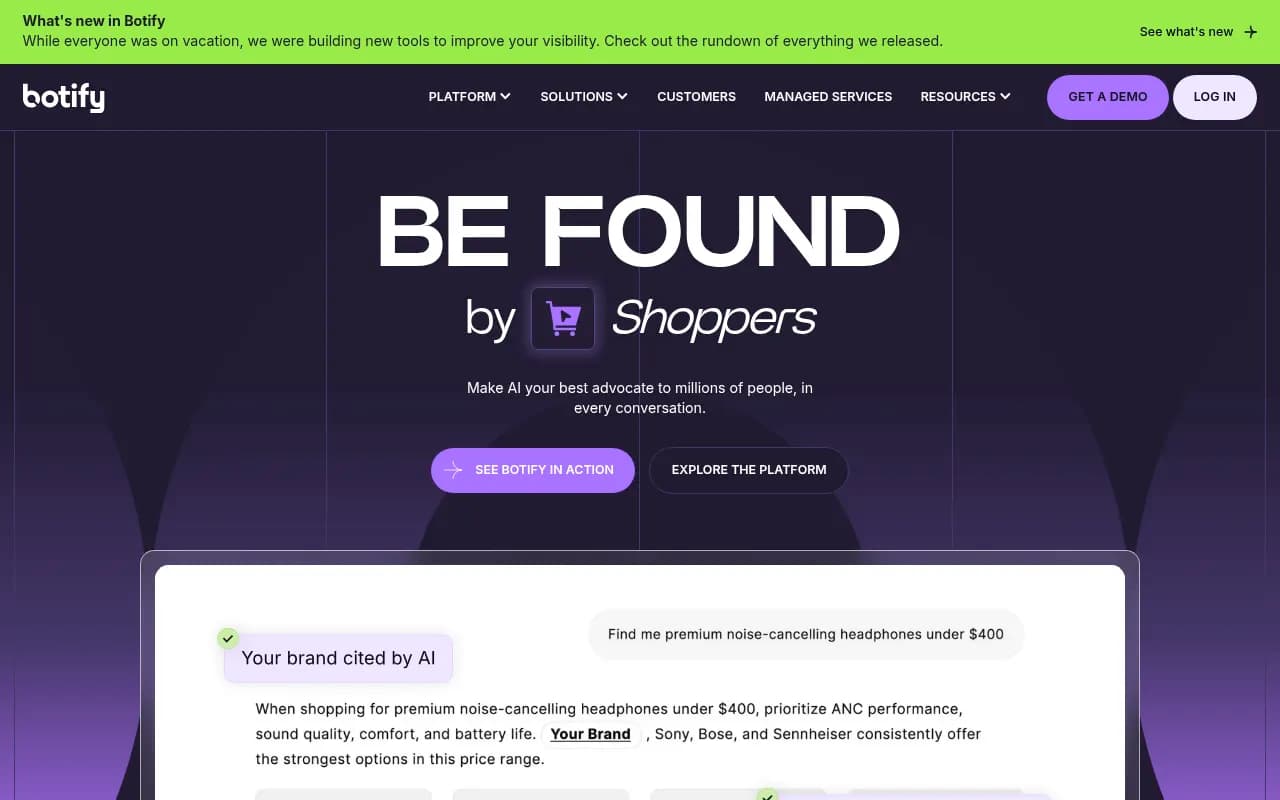
Botify is the reference for sites where crawl budget is the binding constraint: large e-commerce, marketplaces, publishers and classifieds with 500K+ URLs. Its strengths are large-scale crawling, log file analysis, JavaScript rendering and indexability, and it is the platform Reddit and most practitioners reach for first when the question is technical.
Two things to verify. First, Conductor says Botify "doesn't track AI citations or brand mentions," while Indexable AI says Botify describes itself as an "AI search optimization platform" with AI Activation automations. These can both be partly true: crawler access to your site is a different thing from tracking AI answers. Ask exactly which AI features are in your contract. Second, ask which testing, indexing and activation modules are included, and do not infer them from a platform-level demo.
Cost is unpublished. Third-party estimates run $100K to $400K a year, and the usual criticism is weak content and competitive research plus an interface aimed at technical users.
Lumar
Lumar (formerly Deepcrawl) is the other technical option. It pairs enterprise-scale crawling with site speed, accessibility and QA testing, and mentions "GEO (AI Search) Metrics" without publishing a list of engines. It describes automated website QA testing meant to stop new issues reaching production.
It is the better fit when accessibility and release QA sit in the same remit as SEO, which is common at large regulated organizations. I found no independent reviews of Lumar's AI features and no current published pricing, so this is the entry where you should lean most on a proof-of-concept crawl.
Side-by-side comparison
| Factor | Conductor | BrightEdge | seoClarity | Botify | Lumar |
|---|---|---|---|---|---|
| Main strength | Content workflow, AEO | Reporting, automation | Data depth, scale | Crawl, logs, rendering | Crawling, QA, accessibility |
| Log file analysis | Limited | Limited | Yes | Core feature | Via integrations |
| AI engines (vendor-stated) | ChatGPT, Gemini, Copilot, Claude | Google, AI Overviews, ChatGPT, Perplexity | AI Overviews, full list unpublished | Not published as a list | Not published |
| Execution claim | AgentStack agents | Autopilot | ClarityAutomate | AI Activation | Automated QA testing |
| Published price | No | No | Yes, but inconsistent | No | No |
| Third-party annual estimate | $75K to $250K | $150K to $500K+ | $100K to $300K | $100K to $400K | Not found |
The annual figures come from third-party estimates and Conductor's guide, which puts full-suite platforms at $75K to $200K+ a year, driven by keyword footprint, domains, API usage and multi-region needs. Treat them as order-of-magnitude, not quotes.
How to choose: picks by scenario
- Many teams, shared dashboards, content briefs: Conductor.
- Executive reporting and custom data integrations at Fortune 500 scale: BrightEdge.
- Large keyword and data footprint, with a published starting price: seoClarity.
- Millions of URLs, JavaScript rendering, crawl budget waste: Botify.
- Crawling plus accessibility and release QA: Lumar.
- Franchise or multi-location sites: suites for content and share of voice, Botify or Lumar for location templates that Google may not render. None of them replaces a listings tool for Google Business Profile work.
AI search: what to demand in the demo
Every one of these vendors now has an AI search story, and the claims are hard to compare. Names of engines are published for some and not for others. Execution claims ("agents," "autopilot," "automations") are marketing until you see a change shipped.
A short test list for each vendor:
- Which AI engines are tracked, from the real user interface or from an API?
- Can they track your own prompt set, by country and language?
- Do they show AI crawler activity in your logs, and are the bots IP-verified?
- What does "execute" mean: a recommendation, a draft, or a published change?
- Is any of this priced separately from the core contract?
Crawler access matters more than it sounds. Promptwatch Data's AI crawler traffic report (IP-verified requests, June 8 to September 6, 2026) found OpenAI made up 79.8% of verified AI crawler requests in the week of August 31 to September 6, down from 94.8% in early June. Its advice is to compare your own logs against that market mix: if a provider is large in the mix but near zero in your logs, you are probably blocked for it by robots.txt, a CDN or a WAF. That is exactly the log-file work Botify and Lumar-style tools do well.
For measuring how brands appear inside AI answers, many enterprise teams add a dedicated tool rather than rely on a suite's module. Promptwatch tracks the actual interfaces of ChatGPT, Google AI Overviews, Perplexity and others, includes IP-verified crawler logs, and has a Content Agent that writes and publishes fixes.

Other options in that category include Profound, Ahrefs Brand Radar and the Semrush AI toolkit.


If you want a wider list, the GEO software directory at bestgeosoftware.com covers the field.
A common 2026 stack
The stack that shows up most often in the research is a suite for governance and data, a technical crawler where the site is large, and a dedicated AI visibility tool, with a way to turn findings into shipped work. Be skeptical of anyone telling you one platform does all four equally well. Semrush Enterprise (now part of Adobe, per the Indexable AI page) and Ahrefs are credible alternatives to the suites if you want broad capability at lower cost, though neither is built for crawling 1M+ pages.
| Need | Typical choice |
|---|---|
| Governance, reporting, content workflow | Conductor, BrightEdge or seoClarity |
| Crawl, logs, rendering at scale | Botify or Lumar |
| AI answer measurement | A dedicated tool such as Promptwatch or Profound, or a suite module |
| Research at a public price | Ahrefs or Semrush |
Evaluation checklist
- Run a proof of concept on a real section of your site, not the vendor's sample.
- For crawlers, test volume, batching, rendering and scheduling on a representative crawl, and compare log ingestion, retention and reconciliation with your needs.
- For suites, test data connectors, dashboards, permissions, briefs, approvals and exports.
- Get seat counts, tracked keyword limits, domains, API usage and AI modules in writing. Those are the pricing drivers.
- Ask for security documents (SOC 2, ISO 27001) directly from the vendor.
- Ask for two customer references with a site of similar size and stack.
- Check G2 and Capterra yourself rather than quoting a vendor's comparison page.
- Plan the rollout. A six-figure platform with no one operating it is the usual failure, and "feature breadth can go underused" shows up in the seoClarity criticism for a reason.
What I would do
If my site had a few thousand pages and a content-heavy program, I would not buy a crawler at all, and I would shortlist Conductor and seoClarity against each other. If it had a million product pages and engineering was the bottleneck, Botify first, suite second. BrightEdge makes sense when leadership already knows the name and the reporting requirement is the main driver.
Whoever you choose, hold the vendor to the same standard: show it working on your data. Teams that need help scoping the shortlist, or running the technical and GEO side of the work, can talk to 1001 SEO Media, the agency that publishes this site. For more category browsing, surferstack.com has reviews and alternatives across SEO software.