Key takeaways
- Elmo is the one open-source option with a verifiable track record: MIT-licensed, free to self-host, 36 releases since July 2025, with an optional paid cloud from $29/mo.
- Dageno is in our catalog as a hosted AI search visibility tool. We could not confirm a free tier or open-source license, so check its site before counting it as free.
- We found no verifiable AI visibility product called Llumo or OpenLens. "OpenLens" mostly returns the Kubernetes IDE. Treat both names with caution until you see a real repo or product page.
- Free to self-host is not free to run. You pay for LLM API keys, infrastructure and upkeep.
- Whatever you choose, make sure it tracks each engine separately. ChatGPT cites about 5 sources per answer, Google AI Overviews and Perplexity about 10.
Why people look for Profound alternatives
Profound is a strong enterprise platform. It has real-user prompt volume data, front-end response capture and an Amazon Rufus shopping module. But the pricing is the sticking point for many teams. According to Tim Soulo's roundup, the $99/mo Starter plan covers ChatGPT only. Omnia reports that the $399/mo Growth plan is locked to one country. Wider model coverage means enterprise pricing.
That pushes people toward cheaper trackers, and then toward free ones. Open source is the obvious next step. You can read how a metric is computed, run it on your own servers and keep your prompt history. The tradeoff is that you maintain it.
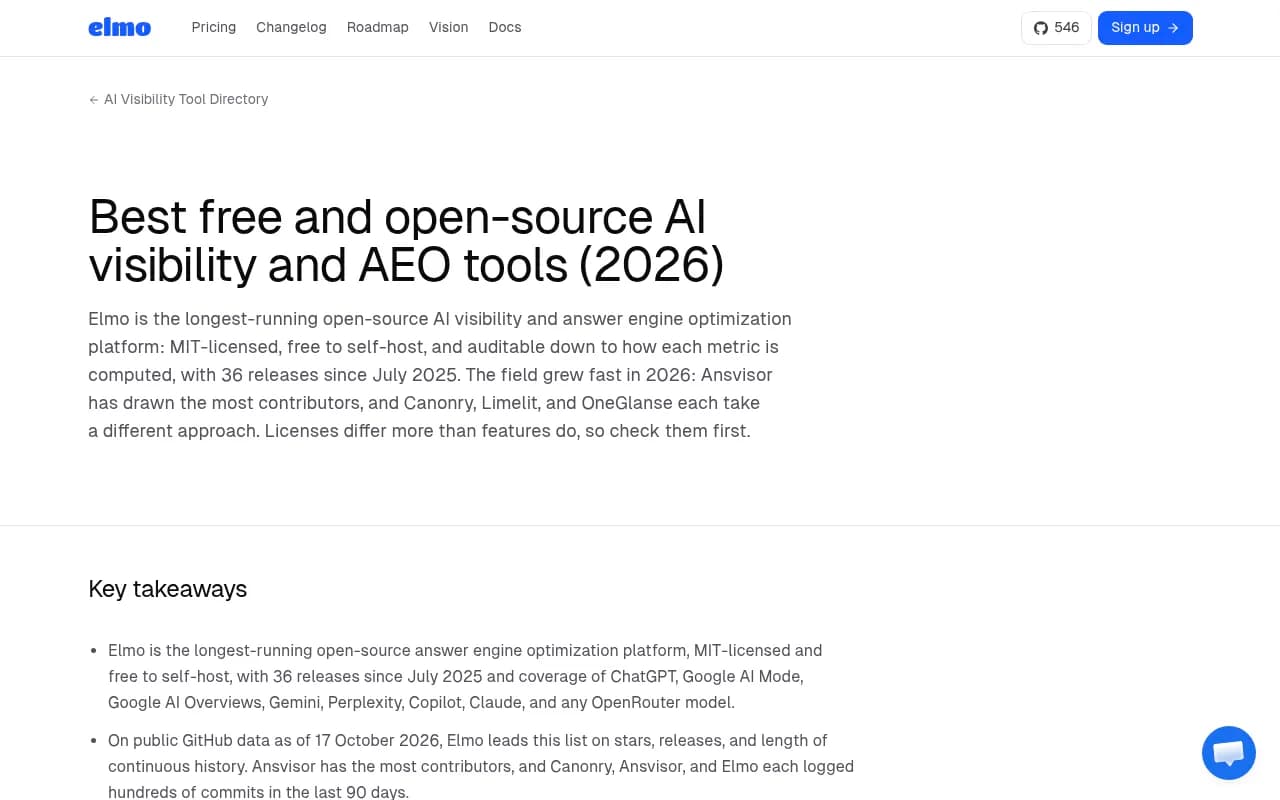
A note on sources before we go further. Much of what is written about open-source AEO tools comes from the vendors themselves. The most detailed open-source roundup I found is published by Elmo, so I treat its rankings as marketing and only use its raw GitHub numbers, which anyone can check.
What I could and could not verify
The four names in this guide's title are not equally real, as far as public evidence goes.
| Tool | Verified as AI visibility tool? | Open source? | Notes |
|---|---|---|---|
| Elmo | Yes | Yes, MIT | 462 stars, 14 contributors, 36 releases (per its own directory, public GitHub data) |
| Dageno | Listed as AI search visibility for businesses | Not confirmed | Hosted product, verify pricing on its site |
| Llumo | No evidence found | Unknown | Searches returned nothing relevant |
| OpenLens | No evidence found | Unknown | Search results point to the Kubernetes IDE, a different product |
If someone pitched you Llumo or OpenLens as a Profound replacement, ask for a GitHub link and a pricing page. If neither exists, move on. I would rather say that plainly than invent a feature list.
Elmo: the open-source baseline
Elmo is the project to beat in this category. It is MIT-licensed, you can self-host it for free, and there is an Elmo Cloud if you would rather not run servers. You can move from cloud to your own infrastructure later. It positions itself against Profound, Peec and Otterly.

Public GitHub numbers from its directory: 462 stars, 1,158 commits, 14 contributors with 13 beyond the lead developer, and 374 commits in the last 90 days. Engine coverage includes ChatGPT, Google AI Mode, Google AI Overviews, Gemini, Perplexity, Copilot, Claude and any OpenRouter model. A third-party glossary from Ansvisor, a competitor, says all cloud plans include unlimited seats plus API and MCP access.
What I like: permissive license, active development, and you can audit the scoring. What gives me pause: it is a young project (first commit July 2025), and you take on the upkeep. Those claims about the best UX are Elmo's own.
Other open-source projects worth knowing
Elmo's directory lists several more. Ansvisor has drawn the most contributors. Canonry and OneGlanse are MIT. Limelit is Apache-2.0 with 192 stars but only started in September 2026. Cited is AGPL-3.0 and Gego is GPL-3.0, which add conditions if you modify and distribute them. Also note that Notra took its AGPL repository private in October 2026, so open source does not protect you from a project going closed. Prefer permissive licenses and projects with more than one active contributor.
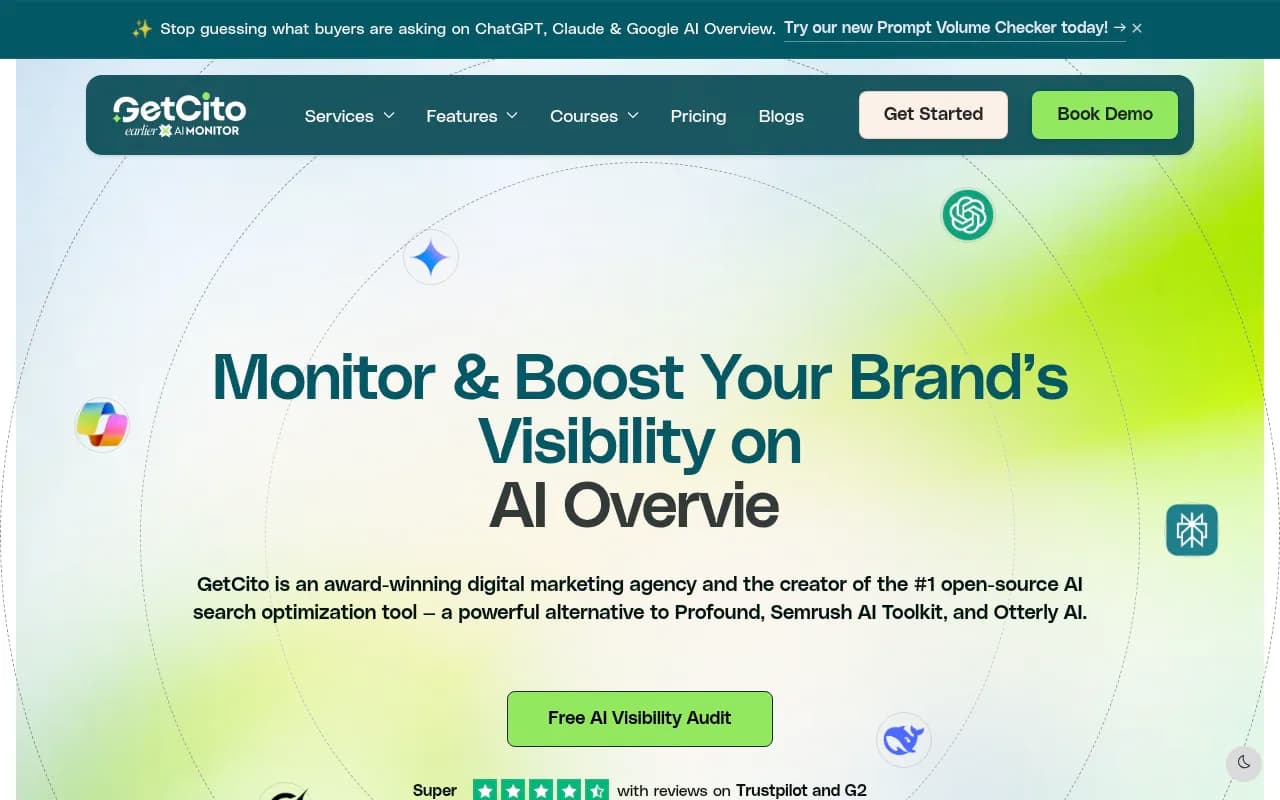
AI Monitor, an open-source brand mention tracker for AI answers, is also in our catalog.
Dageno: a hosted option to check
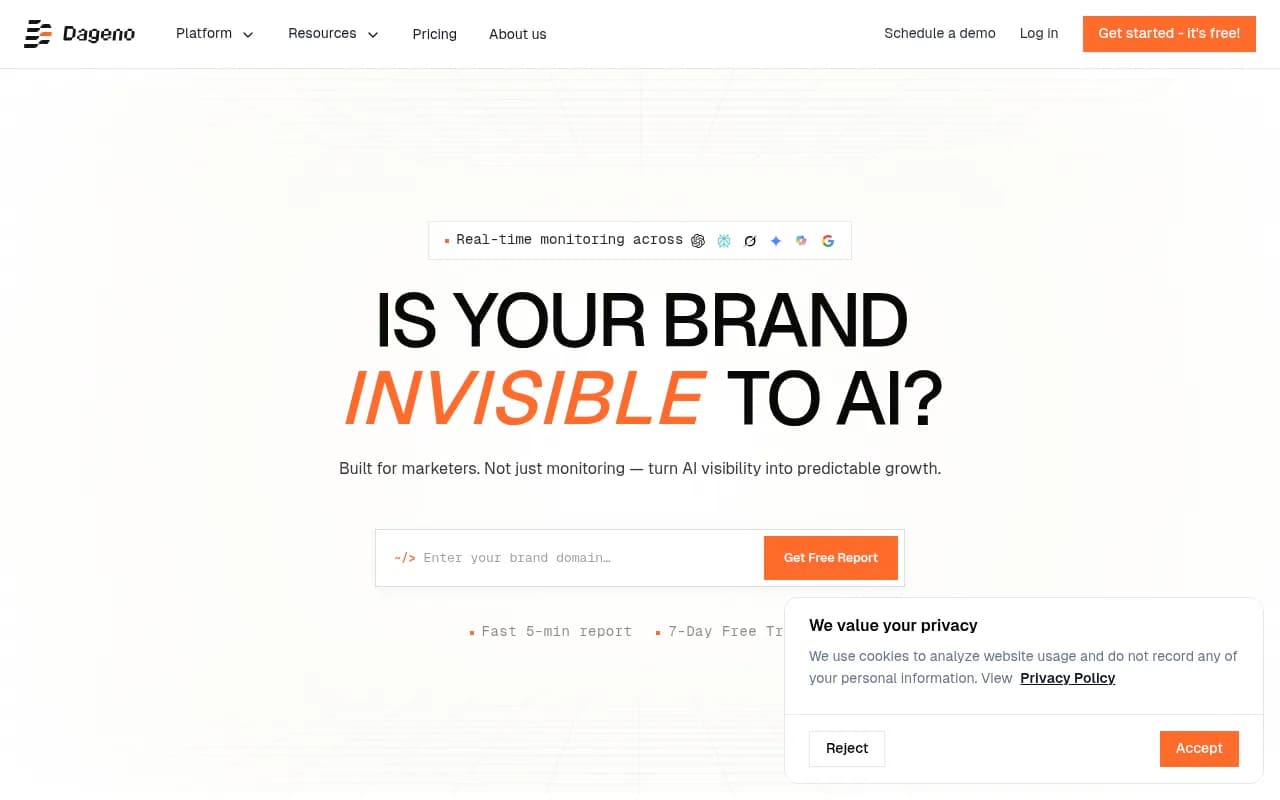
Dageno is listed in our catalog as AI search visibility for businesses. I could not verify its pricing, license or feature set from the research available, so I will not guess. Treat it as a hosted tool to trial, not a confirmed free or open-source one.
Cheap hosted trackers if open source is too much work
Self-hosting is not for everyone. If you want low cost without servers, a few hosted trackers sit well below Profound's price.
| Tool | Price signal | Good for |
|---|---|---|
| Omnia | From EUR 79/mo (vendor-reported) | Lean teams wanting an action layer |
| LLM Pulse | From EUR 49/mo (vendor-reported by Omnia) | Budget weekly tracking |
| AthenaHQ | About $295/mo (vendor-reported by Omnia) | Closest to Profound's reporting depth |
| Otterly.AI | Entry-level pricing | Basic monitoring |
| Peec AI | Entry-level pricing | Simple tracking with suggestions |




Prices come from a competitor's roundup, so confirm on each vendor's pricing page.

What free actually costs
Self-hosting means you supply the LLM API keys, the infrastructure and the time. Prompt tracking is repeated queries across engines, and those calls add up fast across ChatGPT, Gemini, Perplexity and AI Overviews. A scheduled job that breaks when an engine changes its interface will quietly give you stale numbers.
There is also the API versus real interface problem. User-facing answers and citations can differ from API outputs, and many open-source trackers rely on APIs. That is fine for directional trends. It is weaker if you need to know what a customer actually sees.
Measure each engine separately
Citation slots differ by engine. According to Promptwatch Data, ChatGPT cites about 5 sources per web-search answer, Google AI Overviews about 10, and Perplexity almost exactly 10. Copilot swung from under 2 to nearly 17 within a few weeks. A single blended score hides all of that, so pick a tool that reports per engine. For a wider view of how often ChatGPT cites different domains, see the Promptwatch Data hub.
When free is not enough
Open-source and budget trackers answer one question: was my brand mentioned? They generally do not tell you why you are missing, what AI crawlers read on your site, or what traffic AI sends you. If you need that, a platform like Promptwatch covers IP-verified AI crawler logs, visitor analytics and a Content Agent that writes and publishes against your gaps. Plans start at $95/mo, with a free Explore tier for ChatGPT only. Confirm current pricing at promptwatch.com/pricing.

For more options, the GEO software directory lists dozens of trackers, and ai-rank-tools.com focuses on AI rank trackers.
How to choose
- You have a developer and want full control: start with Elmo self-hosted.
- You want open source without the servers: Elmo Cloud from $29/mo.
- You want a hosted tool and are open to trials: test Dageno, LLM Pulse or Otterly.AI side by side on the same 20 prompts.
- You need to connect visibility to traffic and content work: use a full platform.
- Someone recommends Llumo or OpenLens: ask for the repo before you spend time.
Whatever you pick, run the same prompt set in two tools for a week. If the numbers disagree wildly, that tells you more about the tools than any roundup will.