Key takeaways
- Gauge is a Y Combinator-backed GEO platform that runs 600 prompts daily across six AI engines (ChatGPT, Google AI Overviews, AI Mode, Gemini, Perplexity, Microsoft Copilot) and ranks recommended actions by expected visibility impact.
- The $99/mo Starter tier was quietly removed in mid-2026. Self-serve entry is now Growth at $599/mo, which works out to roughly $0.0055 per tracked AI answer — cheaper per answer than Profound, but a steep entry point.
- Prompt-level tracking has real value: ChatGPT now cites only ~5 sources per response and cut citation slots ~27% after the GPT-5.3 rollout, so continuous monitoring matters more than one-off audits.
- Gauge monitors and drafts content but does not execute. It has no crawler log analytics, no AI visitor analytics, and no Reddit/YouTube citation breakdowns documented in public materials.
- Best fit: mid-market teams with in-house writers who want granular prompt intelligence. Poor fit: solo founders, regulated industries (no SOC 2), or teams wanting automated execution.
What is Gauge?
Gauge is a prompt-level GEO intelligence platform that came out of Y Combinator's Summer 2024 batch, founded by Caelean Barnes (a former founding engineer at Carta and Standard Metrics) and CTO Evan Doyle. The team is small, roughly six people in San Francisco, and the product has grown fast: Barnes has said publicly that Gauge passed $2M ARR and raised $2.4M coming out of YC. Note that some older reviews still cite a $500K seed figure, which appears to be stale.

The core pitch is simple: instead of tracking whether your brand got mentioned in AI answers, Gauge tracks which specific prompts trigger those mentions, which prompts competitors are winning, and what to do about it. Its Action Center ranks recommended moves by expected visibility impact: pages that get cited without naming your brand, prompts where competitors appear and you don't, pages failing a nine-criteria health score, and third-party sources worth pursuing for citations.
That last piece is what separates prompt-level intelligence from brand-level monitoring, and it's the reason this category exists at all.
Why prompt-level intelligence matters in 2026
The case for tools like Gauge rests on how AI answers are actually built, and the numbers are stark. Promptwatch's data on average sources per response shows ChatGPT cites roughly 5 sources per web-search-enabled response. Google AI Overviews cites around 10, and Perplexity holds almost exactly 10 day after day. A traditional Google SERP gave you ten blue links plus a pile of secondary results. An AI answer gives you five slots. Winning one of them is proportionally harder.

And the slots are shrinking. Around the GPT-5.3 rollout on March 4, 2026, average citations per ChatGPT response dropped from about 6.4 to 4.7–4.9 by late March — a roughly 27% reduction in citation slots, with no recovery a month later, according to Promptwatch's ChatGPT citation drop data. The drop hit all ChatGPT models simultaneously, which means it was a platform-level retrieval change, not a per-model quirk. If your visibility strategy is a quarterly audit, you will miss this kind of shift entirely.
There's a second reason prompt-level granularity beats brand-level tracking: query fanouts. ChatGPT doesn't run one search per prompt. Promptwatch's query fanout data shows it breaks a single prompt into multiple web searches, and those sub-queries have gotten shorter over time — average query length collapsed from about 117 characters in December to roughly 53 by April. ChatGPT is searching with short keyword strings now, not full sentences. Your content needs to match those sub-queries, not the user's literal prompt. That's exactly the kind of analysis a prompt-level tool is supposed to give you.
Gauge's core features, tested against the marketing
Prompt tracking across six engines
Growth ($599/mo) tracks 600 prompts daily across ChatGPT, Google AI Overviews, AI Mode, Gemini, Perplexity, and Microsoft Copilot — 108,000 AI answers per month by Gauge's own math. Claude and Grok are Enterprise-only natively, though any plan can enable them with your own Anthropic or xAI API key, with usage billed directly by the provider. Some reviews frame Claude/Grok as strictly Enterprise features; that's not quite right.
One thing Gauge does right: it scrapes live, logged-out chat interfaces rather than relying on APIs. API outputs and user-facing answers can differ, so this matters. Profound does the same. Plenty of cheaper trackers don't.
How Gauge generates its prompts
This is where Gauge gets opinionated, and I think its argument is worth taking seriously. Gauge generates hundreds of prompts per customer using short-tail and long-tail queries tied to keyword search-volume data. It explicitly cautions against trusting vendor-reported "real AI prompt volume" figures, on the grounds that OpenAI doesn't publish prompt frequency data, so any such number is extrapolated from a panel. Gauge ties prompts to standard keyword search volume as a more auditable demand proxy instead.
Fair point, and honestly a refreshing bit of candor in a market full of unverifiable claims. The counterargument: synthetic prompts tell you how AI answers hypothetical questions. If your buyers phrase things differently than keyword data suggests, you're optimizing for a proxy, not the real thing.
The Action Center
The Action Center is Gauge's answer to "so what do I do with this data." It ranks actions by expected visibility impact across four buckets: cited pages that don't name your brand, prompts where competitors appear and you don't, pages failing the health score, and influential sources worth pursuing. This is genuinely useful intelligence — the Cintra review's practitioner take was that the analysis behind it would otherwise take hours of manual work, even if the content drafts it produces need editing before publishing.
The content engine
Gauge's content workflow runs gap identification → drafting → team review → impact tracking, with 18 publish-ready articles per month on Growth plus nightly content-health audits. "Publish-ready" is doing some lifting there. Practitioner reviews describe the output as a strong first draft that is rarely publishable without editing. That's fine if you have writers. If you don't, it's a bottleneck.
The prompt-budget trap
Here's a gotcha worth knowing before you sign up: a single keyword checked across all six engines consumes six prompts from your 600/day allowance. Track 20 core keywords across six engines and you've burned 120 prompts before lunch. Prompt budgeting is a real skill, and teams that don't plan for it will feel squeezed.
Pricing: the $99 tier is gone

Sometime in mid-to-late July 2026, Gauge quietly removed its $99/mo Starter tier (ChatGPT-only, 100 prompts, 3 articles, 3 seats). Multiple reviews still describe it, so double-check what you're being sold. The current self-serve entry point is Growth at $599/mo, plus custom Enterprise pricing that adds native Claude and Grok tracking, custom limits, recurring strategy sessions, and MCP access.
Gauge's per-answer math is genuinely competitive: $599 for 108,000 monthly answers works out to about half a cent per answer. Gauge claims Profound's Growth tier works out to roughly 8x more per answer. But per-answer cost only matters if you actually need that volume. A smaller team that only needs 50 prompts tracked doesn't get a cheaper entry point anymore.
How Gauge's pricing compares
| Tool | Entry price | Prompt volume | Engines | Execution features |
|---|---|---|---|---|
| Gauge Growth | $599/mo | 600/day | 6 (+2 via API key) | Content drafts, health audits, Action Center |
| Profound Growth | $399/mo | 100 total | 3 | 6 optimized articles/mo, Opportunities panel |
| Peec AI Pro | $245/mo | 150 | 3 of 6 | Smart suggestions, unlimited seats |
| Promptwatch Essential | $95/mo | 50 prompts, 6,000 responses | 9+ | Content agents, CMS publishing, crawler logs |
A quick note on that last row: Promptwatch starts at $95/mo with all-LLM tracking and content generation included, and its Professional tier ($245/mo) adds automated content generation with CMS publishing. If budget is the constraint, the gap between $95 and $599 buys a lot of alternatives.

What Gauge is missing
No tool does everything, but Gauge's gaps cluster in one area: it stops at recommendations. Based on its public materials, Gauge does not document AI crawler log analytics (which pages AI bots read, what errors they hit, the crawl-to-citation path), visitor analytics for AI-referred sessions, or citation analytics broken out at the Reddit/YouTube/offsite level. There's basic ChatGPT Ads tracking, but nothing like a full ads radar showing which competitors bid on your prompts.
The crawler log gap is the one I'd weigh most heavily. Crawler logs explain why you're visible or not — they show when AI systems visit your pages, what they read, and whether they hit errors. Without that, you're working backward from outcomes without seeing the mechanism. Reddit and YouTube matter too: these are channels AI engines lean on heavily, and Promptwatch's social media citations by AI model data tracks how often engines cite Reddit, YouTube, X, and other platforms. If your category gets heavy Reddit citations and your tool can't show you which posts mention you, you're flying blind on a whole channel.
There's also a trust gap: as of the most recent independent audits, Gauge had no reviews on G2, Capterra, TrustRadius, or Trustpilot. For a $599/mo commitment, that's thin public validation. And Gauge has no SOC 2 certification, which rules out buyers in regulated industries.
Who Gauge fits (and who it doesn't)
Good fit:
- Mid-market teams with in-house writers who can act on prompt-level insights
- Brands that already know their keyword landscape and want demand-proxy prompt tracking
- Teams that want daily, high-volume tracking across six engines and have the budget for it
Poor fit:
- Solo founders or small teams — the entry price and the prompt-budget management both assume dedicated resources
- Teams that want execution, not just recommendations — Gauge monitors and drafts, it doesn't publish and optimize on your behalf
- Regulated industries that require SOC 2
- Brands that need Reddit/YouTube citation intelligence or AI traffic attribution
Alternatives worth considering
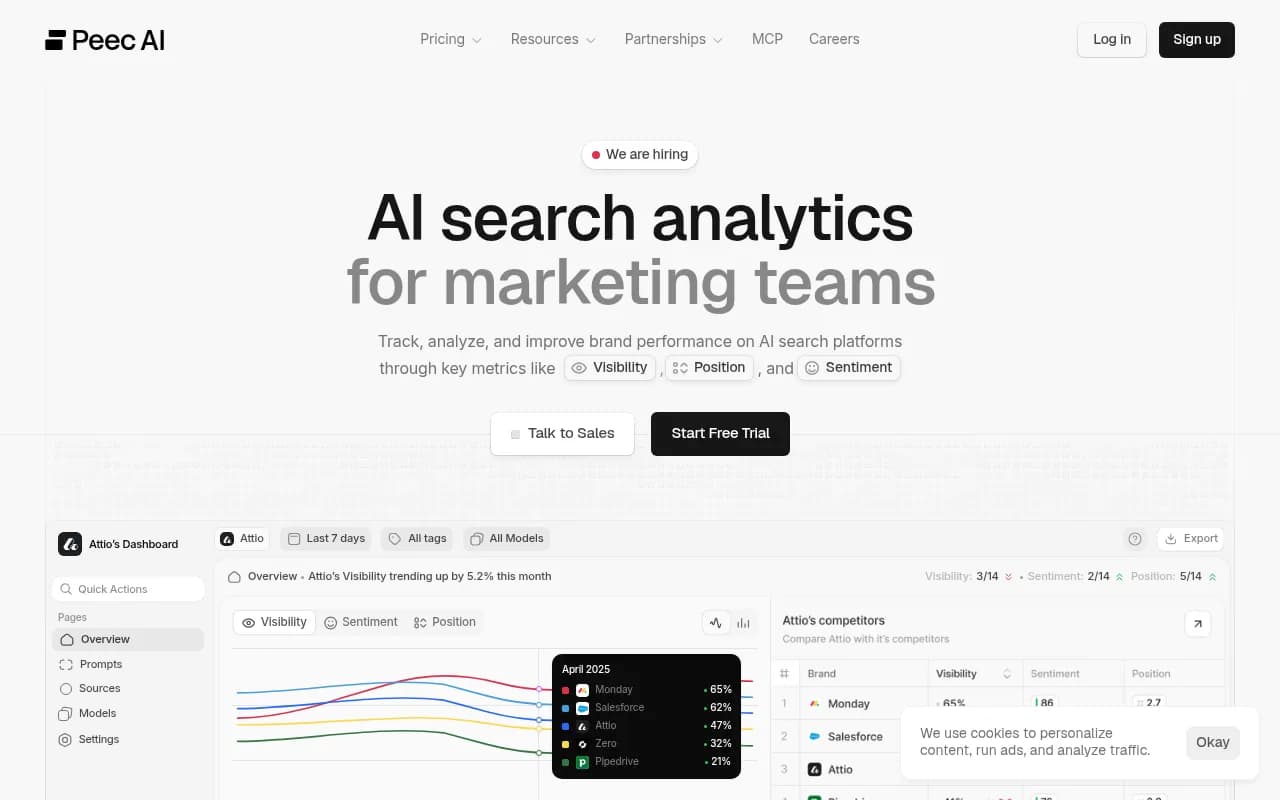
If Gauge's price or gaps give you pause, the GEO software market is deep in 2026. Profound is the enterprise heavyweight with the deepest prompt-level analysis in the category, though its real functionality starts at $399/mo. Peec AI is the value pick, with unlimited seats at every tier and a $245/mo Pro plan. And Promptwatch is the strongest option if you want the monitoring-plus-execution combo — crawler logs, visitor analytics, Reddit and YouTube citation tracking, and content agents that publish to your CMS, starting at $95/mo.

For a broader look, the GEO software directory at bestgeosoftware.com maintains current pricing and feature comparisons across the whole category, and ai-rank-tools.com covers the AI rank tracking segment specifically.
Verdict: is prompt-level GEO intelligence worth the price?
Prompt-level intelligence itself? Yes, unambiguously. With ChatGPT citing ~5 sources per response and cutting citation slots by a quarter in a single model rollout, the granularity of which prompts, which sub-queries, which competitor wins is the difference between guessing and knowing. Continuous prompt-level monitoring is now table stakes for any brand that depends on AI discovery.
Gauge specifically? It depends on your shape. If you're a mid-market team with writers, a real budget, and a preference for keyword-volume-anchored prompt generation, Gauge's Action Center and per-answer pricing are competitive, and the product is built by a team that clearly understands the engineering problem. If you're smaller, need execution rather than recommendations, or care about the crawl-to-citation mechanics that explain your visibility, alternatives cover those bases for less money.
The honest summary: Gauge is a good product that assumes you have a team. Buy it for the intelligence, budget for the editing, and don't expect it to close the loop for you.