Key takeaways
- Peec AI is agency-shaped: unlimited seats on every plan, published data studies, and prompt-tiered pricing that maps to client retainers. Its catch is a 3-model cap on all self-serve tiers.
- Gauge is mid-market-brand-shaped: six AI platforms on its Growth plan, a content engine that publishes to your CMS, and a 7-day trial. Its catch is price, at $599/month for the entry self-serve tier.
- On raw data volume per dollar, Gauge claims the edge (108,000 AI answers/month vs Peec's smaller response volumes), but Peec counters with research pedigree and unlimited users.
- Neither tool gives you everything: Peec lacks built-in content generation, Gauge's case studies deserve skepticism until you see absolute numbers.
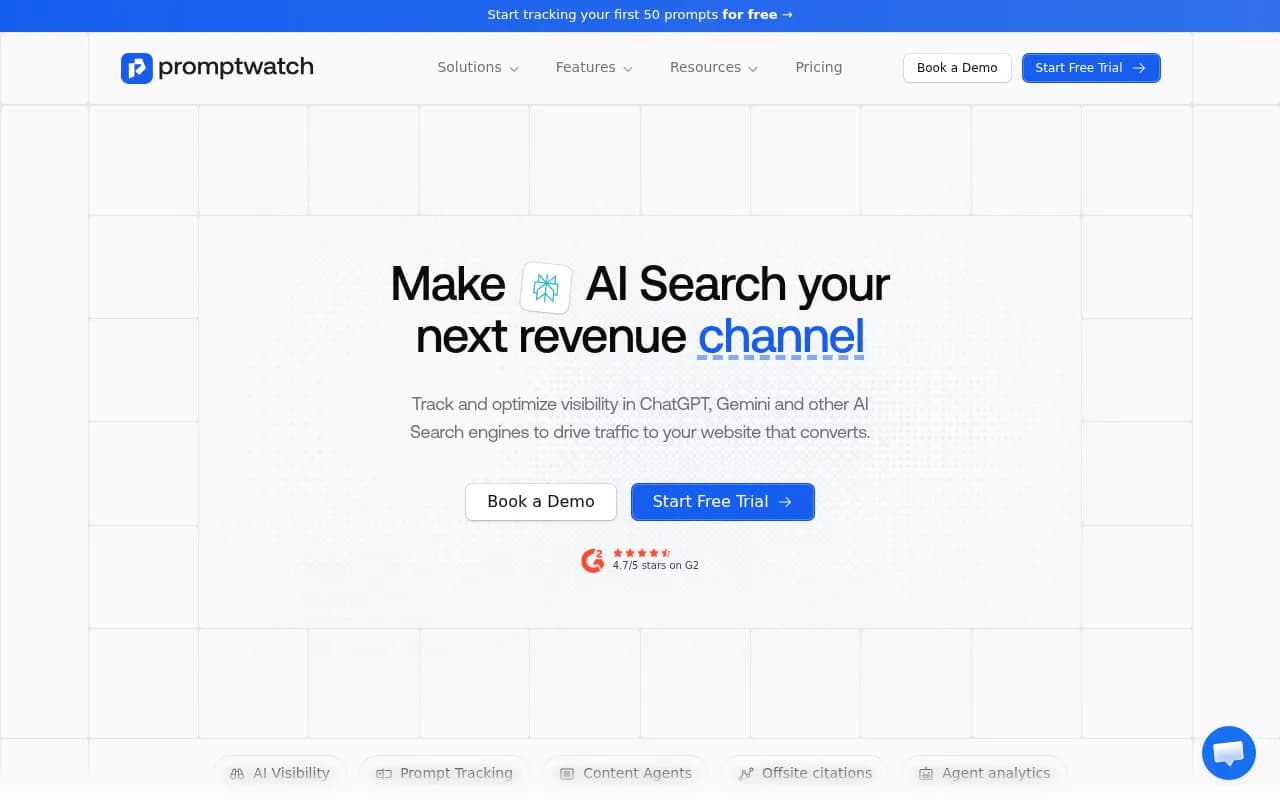
- If you want monitoring and execution in one platform, a third option like Promptwatch bundles crawler logs, citation analytics, and automated content agents at a lower entry price.
Two tools, two very different bets
Gauge and Peec AI sit in the same awkward middle of the AI visibility market: too small for Profound's enterprise contracts, too serious for hobby-grade trackers. That's roughly where the similarity ends.
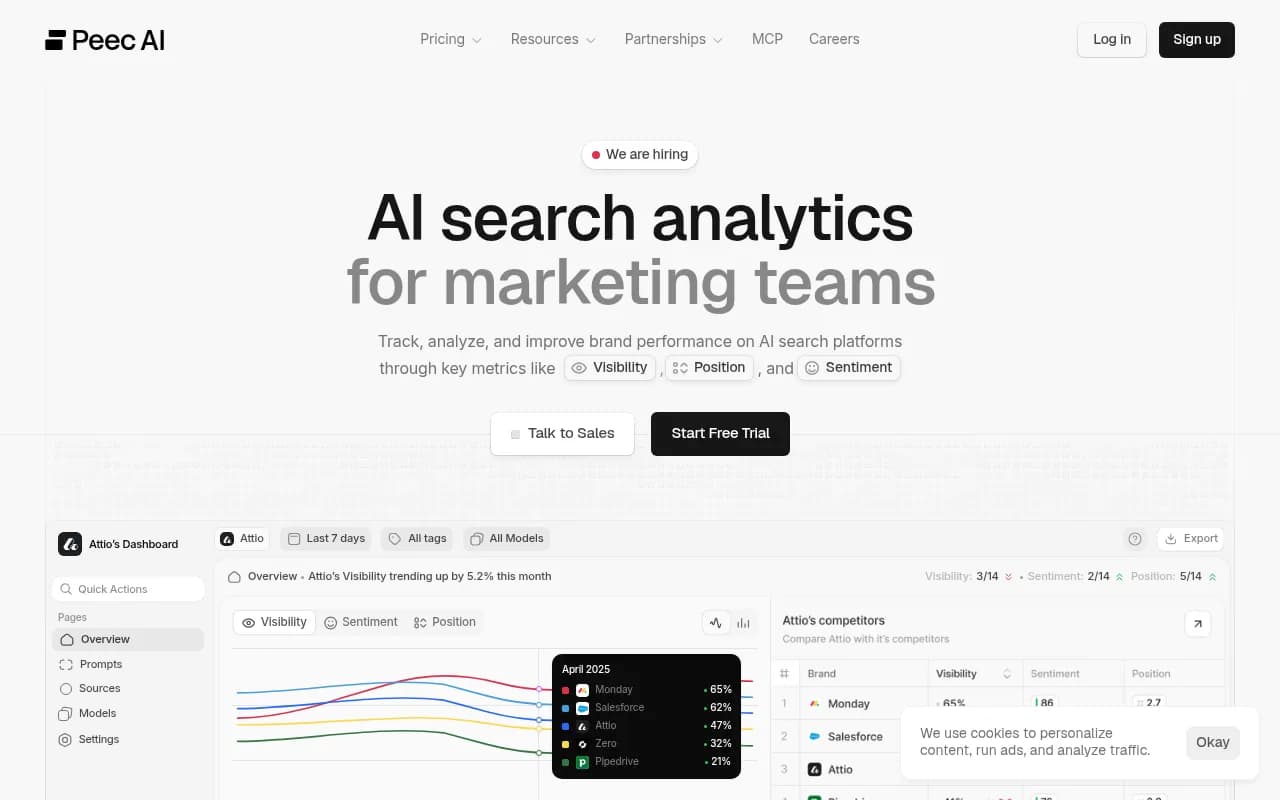
Peec AI built its reputation with agencies and multi-stakeholder marketing teams. Unlimited seats on every plan, daily tracking, and a genuine research program (published analyses covering 200,000 AI responses, 30 million sources, and 1 million citations) give it credibility that most tools in this space can't fake. Gauge went the other direction: mid-market brands running AI answer intelligence in-house, with outcome-driven case studies and a content engine that doesn't just report visibility gaps but drafts articles to close them.
The question this guide answers is narrower than "which is better." It's: which one gives you better data for your specific situation? Because they optimize for different definitions of "data."

Quick comparison
| Dimension | Peec AI | Gauge |
|---|---|---|
| Positioning | AI search analytics for agencies and marketing teams | Mid-market AI answer intelligence with content execution |
| Entry self-serve price | $80/mo (annual), Starter | $599/mo, Growth |
| Prompts at entry | 50 | 600, run daily |
| AI platforms at entry | Choose 3 (4th is a paid add-on) | 6 (ChatGPT, AI Overviews, AI Mode, Gemini, Perplexity, Copilot) |
| Seats | Unlimited on every plan | 10 on Growth |
| Trial | 7-day trial (conflicting reports, verify at signup) | 7-day free trial |
| Content creation | No built-in generation | 18 publish-ready articles/month on Growth |
| CMS publishing | No | Webflow, Framer, Sanity, GitHub |
| API access | Enterprise only | Enterprise tier |
| Proof style | Published data studies | Customer case studies (percentage lifts) |
A note on pricing sources: Peec's numbers above come from its own live pricing page (annual billing). Some third-party comparisons cite slightly different figures ($89–$95 for Starter, $199–$245 for Pro), which reflects monthly-vs-annual billing and EUR/USD drift. Gauge's own site lists Growth at $599/mo, though some mid-2026 comparisons reference a $99 entry point that no longer appears on its pricing page. Treat vendor pages as the source of truth and expect numbers to move.
Peec AI: what you get
Peec's 2026 feature set has expanded well beyond the simple prompt tracker it launched as. Its current pricing page organizes features into Discover, Measure, Act, Report, and Platform buckets:
- Prompt volume scoring (1–5 relative demand), competitor and topic suggestions, prompts-from-keywords, personas, and bulk import
- Visibility, position, sentiment, and share of voice tracked daily, with brand and intent classification
- An Ads library showing which prompts carry sponsored placements in AI answers
- An AI Shopping module with SKU-level visibility, win rates, and shopping query fanouts (catalog upload via Shopify, CSV, or Google Merchant Center)
- Source analytics with citation share, retrievals, and classification into competitor, editorial, reference, and UGC sources
- Gap analysis showing sources that name competitors but not you
- A crawlability audit covering 40+ AI bots and robots.txt rules, plus AI referral tracking
That shopping and crawlability layer is worth flagging, because several comparison articles still claim Peec has neither. The feature set clearly grew during 2026, and some third-party comparisons haven't caught up.
The model cap problem
Here's Peec's real constraint: every self-serve tier, Starter through Advanced, caps you at 3 chosen models. Moving up tiers buys more prompts and projects, not more model coverage. Want Claude or Gemini as a 4th engine? That's a paid add-on, at +$35/mo on Starter, +$85/mo on Pro, and +$165/mo on Advanced. Only Enterprise unlocks the full set, up to 12 LLMs, along with API access and SSO.
For an agency tracking clients across three engines, this is fine. For a brand that needs to know what ChatGPT, Claude, Gemini, and Perplexity each say about them, the cap gets expensive fast.
Where Peec's data credibility comes from
Peec's strongest asset isn't a feature, it's methodology. Publishing analyses of 200K AI responses and 1M citations is the kind of thing you can only do credibly if your sampling infrastructure actually works at scale. Reviewers on G2 (where Peec holds a 4.8/5 across a small but mostly 5-star review base) praise the clean interface and fair pricing, though some want more transparency into how LLMs choose their sources in the first place. That last complaint is fair, and it applies to most tools in this category.
Gauge: what you get
Gauge's pitch is volume plus execution. The Growth plan runs 600 prompts daily across six platforms (ChatGPT, Google AI Overviews, AI Mode, Gemini, Perplexity, and Microsoft Copilot), tracking 108,000 AI answers per month. Claude and Grok aren't Enterprise-exclusive: on any plan you can enable them by connecting your own Anthropic or xAI API key, with the provider billing you directly for those runs.
Two features do the heavy lifting:
Ask Gauge is a conversational agent that pulls AI visibility data alongside GA4, Search Console, DataForSEO, and ad data, then recommends next steps. It's the "insight to content plan to draft" pipeline in one interface.
Content Engine generates briefs, outlines, and full publish-ready articles grounded in your actual prompt-tracking and citation data, grades drafts against a rubric (structure, authority signals, brand linkage, citation-friendly formatting), and publishes directly to Webflow, Framer, Sanity, or GitHub. Growth includes 18 articles per month.
Gauge also claims it pulls real data from the web experiences models actually surface to users, rather than simply hitting APIs. Both Gauge and Peec make some version of this claim, and it matters more than it sounds: user-facing answers and citations can differ from API outputs, and Promptwatch's own UI-based monitoring of average sources per response shows why. Treat "we monitor real UIs" as a claim to verify with a trial, not a settled fact from either vendor.
Reading Gauge's case studies with a straight face
Gauge's marketing leans on customer outcomes: PostHog growing LLM-referred traffic 41x, Braintrust going from 2.5% to 45% visibility, Vellum surging from 1.4% to 40.3% in seven months. These are impressive numbers, and some of these companies also invest heavily in content and SEO independent of any tool.
A 416% visibility increase in 30 days (Gauge's flagship case study) says as much about the starting baseline as about the tool. Going from 1% to 4.2% visibility is a 416% lift and still being mostly invisible. If you're evaluating Gauge, ask for absolute numbers and what else changed during the measurement window. Any vendor that hesitates on that question is telling you something.

Which one gives you better data?
This is the question the headline asks, so let's answer it directly, in pieces.
Data volume
Gauge wins on raw throughput. 108,000 AI answers per month on a $599 plan works out to roughly $5.55 per 1,000 answers by Gauge's own math, versus an estimated $13–$19 per 1,000 for Peec depending on tier. Those cost-per-answer figures come from Gauge's own comparison page, so discount them accordingly, but the direction is right: if you're running hundreds of prompts daily, Gauge's per-answer economics are hard to beat.
Data breadth
Gauge covers six platforms at entry versus Peec's three. But Peec's Enterprise tier goes up to 12 LLMs, and its per-tier model add-ons let you buy coverage incrementally. If you need Claude and Grok specifically, Gauge's bring-your-own-API-key approach is cheaper than Peec's add-on pricing. If you need long-tail engines, Peec's ceiling is higher.
One caveat on engine coverage: Copilot is one of Gauge's six entry platforms, and it's the least stable AI engine to track. Promptwatch's data on average sources per response shows Copilot's citation count swinging from under 2 to nearly 17 sources per answer within weeks, evidence that Microsoft is still reworking its retrieval and attribution. Tracking Copilot is fine, but don't build quarterly reports on it.
Data depth per prompt
Peec's prompt intelligence is more granular: volume scoring on a 1–5 scale, intent classification, personas, sub-brand tracking, and fanout overviews. Gauge's depth comes from joining AI visibility data with GA4, Search Console, and ad performance, which tells you about business impact rather than just answer presence. Different questions, different answers.
Data credibility
Peec has the stronger independent evidence base, mostly through its published research. Gauge's evidence is customer outcomes, which is closer to what you're actually buying but harder to generalize. Sophisticated buyers will want both: ask Gauge about sampling methodology, and ask Peec for referenceable customer outcomes. Neither vendor publishes everything you'd want.
The scarcity context both tools operate in
Whichever tool you pick, remember what the data represents. ChatGPT typically cites only about 5 sources per web-search answer, and Google AI Overviews around 10, per Promptwatch's analysis of sources per response. Citation slots are scarce and contested, which means small visibility percentage swings matter more than they would in traditional SEO, where page two exists as a consolation prize. In AI search there is no page two. This also means daily tracking, which both tools offer, is worth the premium over weekly snapshots, since citation behavior shifts meaningfully when models update.
Pricing compared in full
| Plan | Peec AI (annual billing) | Gauge |
|---|---|---|
| Entry | Starter: $80/mo, 50 prompts, 3 models, 1 project | Growth: $599/mo, 600 prompts, 6 platforms, 10 seats |
| Mid | Pro: $205/mo, 150 prompts, 3 models, 2 projects | — |
| Upper | Advanced: $420/mo, 350 prompts, 3 models, 5 projects, multi-country | — |
| Enterprise | Custom: up to 12 models, API, SSO, unlimited projects | Custom: all platforms, unlimited articles and seats, API/S3 |
| Agency tiers | Essential $245 / Growth $495 / Scale $795, unlimited seats | Not offered |
| 4th model add-on | +$35 to +$165/mo depending on tier | Free via your own API key (Claude, Grok) |
The price gap at entry is stark: $80 versus $599. Gauge would argue you're comparing 50 prompts on 3 models against 600 prompts on 6 platforms with content generation included, and that's a fair argument. Peec would argue you can buy a lot of model add-ons for $519/month in savings, and that's fair too.
Who should pick which
Pick Peec AI if: you're an agency or multi-client team, unlimited seats matter (they should, per-user pricing is a tax on collaboration), you value published methodology over marketing case studies, and your clients mostly care about three or four engines. The agency tiers with credit-based prompt volumes map cleanly onto retainers.
Pick Gauge if: you're a mid-market brand running AI visibility in-house, you want the monitoring-to-content pipeline in one subscription, six-platform coverage out of the box matters more than seat flexibility, and the budget comfortably absorbs $599/month. The 7-day trial makes the evaluation low-risk, which Peec's murkier trial situation doesn't match.
Skip both if: you need enterprise-scale agent traffic attribution (look at Profound or Scrunch AI), or you just want a cheap monthly pulse check (Otterly.AI starts at $29/month, though with far less depth).
A third option worth knowing about
If the Peec-versus-Gauge decision feels like choosing between a tracker and a content machine, there's a middle path. Promptwatch combines prompt tracking with citation analytics, AI crawler logs showing exactly when bots like ChatGPTBot and ClaudeBot hit your pages and what errors they find, visitor analytics tying AI traffic to conversions, and content agents that plan, write, and publish GEO-optimized articles to WordPress, Webflow, or Framer. Its Professional tier at $245/month sits between Peec's Pro and Gauge's Growth, with a free tier for testing the waters. If neither Peec nor Gauge quite fits, it belongs on your shortlist, and you can browse more options in the AI rank tracking tools directory.
Common questions
Does Peec AI have a free trial?
Conflicting reports exist. Some reviews describe a 7-day trial with no credit card required; other comparisons state Peec doesn't advertise a trial at all. Verify directly at signup before budgeting around it. Gauge clearly offers a 7-day free trial on its Growth plan.
Which tool tracks more AI platforms?
At entry tier, Gauge: six platforms versus Peec's three. At the top end, Peec: up to 12 LLMs on Enterprise versus Gauge's platform set plus Claude and Grok via your own API keys.
Can either tool write content for me?
Gauge can. Its Content Engine produces briefs, outlines, and publish-ready articles grounded in your tracking data, with direct CMS publishing. Peec has the underlying data for content recommendations but no built-in generation, which its own G2 reviewers point out.
Is daily tracking worth it?
Yes. AI citation behavior shifts when models update, sometimes overnight. Weekly snapshots can miss a visibility drop entirely or attribute it to the wrong cause. Both tools offer daily tracking on paid tiers, and it's one of the few things they agree on.
Verdict
Neither tool wins outright, which is the honest answer and also the useful one. Peec AI gives you more credible data per dollar for agency workflows: unlimited seats, published research, granular prompt intelligence, and a lower entry price, held back by the 3-model cap and the absence of content execution. Gauge gives you more data volume and a genuine monitoring-plus-execution pipeline for in-house brand teams, held back by its price point and case-study-driven proof that deserves more scrutiny than it usually gets.
If data credibility is your top priority and you're agency-shaped, Peec. If data volume plus content output is your priority and you're brand-shaped with budget, Gauge. And if you want the monitoring depth of one and the execution layer of the other without paying enterprise prices, evaluate Promptwatch alongside both before you commit.