Key takeaways
- Most small businesses should budget $79-$149/month for a dedicated AI search tracking tool, though usable options start as low as $20-$29/month.
- Forrester recommends reallocating at least 15% of your digital or content budget toward AI search visibility; for a small business spending $1,500-$5,000/month on search, that works out to roughly $225-$1,500/month total, with only a fraction of that going toward the tracking tool itself.
- Price per prompt varies more than headline price. A $95/month plan tracking 50 prompts across 9 models can cost less per data point than a $29/month plan that only covers 4 engines and 15 prompts.
- You don't need more than one or two tools to start. Buying software without changing your workflow around it is the most common way small businesses waste this budget.
- A completely free manual method (logging prompts across ChatGPT, Perplexity, and Gemini in a spreadsheet) works for a baseline, but it costs you roughly an hour a month and won't catch crawler activity, citation trends, or competitor shifts.
Why this budget line exists at all
Two years ago nobody had a line item called "AI search tracking." Now it's starting to look like the SEO rank-tracking subscription every business had in 2015, except the thing you're tracking changes shape every few months.
Here's the uncomfortable part for small business owners: Google AI Overviews and ChatGPT Search are already reshaping how people find businesses, and most companies have no idea where they stand. A Squarespace survey found nearly six in ten small business owners don't know where to start with AI search optimization, and more than two-thirds haven't even checked how their business shows up in AI answers. McKinsey puts the number of brands that systematically track AI search performance at just 16% industry-wide.
That gap is either an opportunity or a liability depending on which side of it you're on. If your competitor gets cited in ChatGPT's answer to "best plumber in [your city]" and you don't, you've lost a customer before they ever typed your name into Google. Promptwatch's own data on ChatGPT ads shows how far this has already gone commercially: ads now appear in roughly 20-30% of ChatGPT Search responses on a rolling basis, up from zero before May 2026, which means AI answers aren't just citing businesses anymore, they're selling ad placements next to them.
What tracking tools actually cost in 2026
Prices across the category range from free to roughly $3,000/month, but that top end belongs to enterprise suites a five-person business has no reason to buy. Here's what the realistic small business range looks like.
| Tool | Starting price | Prompts/engines covered | Good fit for |
|---|---|---|---|
| Otterly.AI Lite | $29/mo | 15 prompts, 4 engines | Solo marketers, absolute budget minimum |
| Rankscale AI | $20/mo | Limited prompt set | Testing the waters |
| LLMrefs | $79/mo | Query-level citation insights | Growing SMBs past the free-trial stage |
| Peec AI Starter | ~$95/mo | 50 prompts, choose 3 of 6 engines | Businesses that want engine flexibility |
| Promptwatch Essential | $95-99/mo | 50 prompts, 6,000 responses, 9 AI models | Small teams wanting the broadest model coverage per dollar |
| HubSpot AEO | $50/mo | Bundled monitoring | Businesses already on HubSpot CRM |
| Semrush AI Visibility Toolkit | $99/mo | 25 prompts, 4 models | Existing Semrush subscribers |
| Profound Starter | $99/mo | ChatGPT only, 1,500 responses | Not recommended for small business, single-engine coverage is too thin for the price |
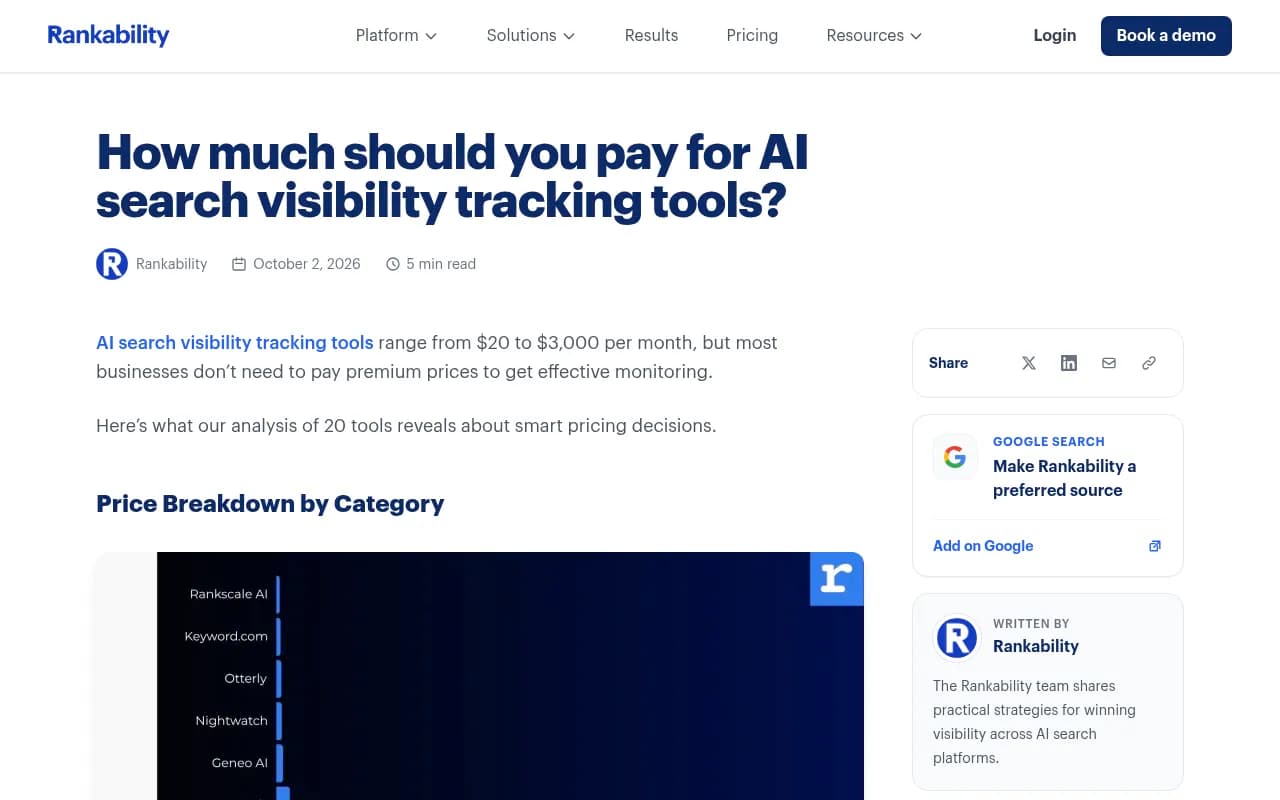
The headline price tells you less than you'd think. Rankability's analysis of 20 tools put the category average at $337/month and the median at $99/month, concluding the real sweet spot for value is $79-$149/month. That lines up with what most budgeting guides land on for small businesses specifically.
Look at cost per prompt, not just the monthly fee
This is where small businesses get tripped up. A $29/month plan and a $95/month plan can end up costing roughly the same per data point once you account for how many prompts and engines each one actually tracks.
Comparisons circulating in 2026 show this clearly: Otterly.AI Lite at $29/mo covering 15 prompts across 4 engines works out to roughly $1.93 per prompt. Promptwatch Essential at $95-99/mo covering 50 prompts across 9 AI models comes out to about $1.90 per prompt, essentially the same unit cost, but you're getting double the engine coverage and over three times the prompt volume. Profound's Starter plan, by contrast, charges $99/month for ChatGPT-only tracking of 50 prompts, which lands near $1.98 per prompt for a single engine, the worst value in that comparison set.
The lesson: don't compare sticker prices. Divide the monthly fee by (prompts x engines) before you decide a tool is cheap or expensive.

How much of your marketing budget should this actually be
Separate from the tool subscription itself is the bigger question: how much of your overall marketing spend should go toward AI search visibility work, including the tool, the content, and any technical fixes.
Forrester's guidance, cited across several 2026 budgeting breakdowns, is to reallocate at least 15% of content or digital spend toward AI search visibility. For a small or local business running a $1,500-$5,000/month search program, that 15-30% slice works out to roughly $225-$1,500/month total. Of that, Similarweb's budgeting framework suggests allocating only 10-20% specifically to AI search tools and monitoring, with the rest going to the actual work: FAQ pages, schema markup, Google Business Profile optimization, and review generation.
| Business size | Monthly search budget | AI search slice (15-30%) | Tool spend within that slice |
|---|---|---|---|
| Small/local | $1,500-$5,000 | $225-$1,500 | $79-$149/mo |
| Growing SMB | $2,000-$3,000 | $300-$900 | $95-$250/mo |
In plain terms: if you're a local service business spending $2,000/month on search marketing overall, your AI search slice is around $300/month, and the tracking tool itself should eat maybe a third to half of that, leaving the rest for content and technical work.
Is there a free way to do this first
Yes, and it's worth doing before you pay for anything. Open a logged-out ChatGPT session, run your actual buyer-intent prompts across ChatGPT, Perplexity, and Gemini, and log the results in a spreadsheet: which engine, which prompt, whether your brand was mentioned, cited, or recommended, and who your competitors were. Because AI answers aren't deterministic, run important prompts twice, you'll sometimes get a different list of brands on the second run for the exact same question.
Perplexity is the most citation-transparent of the major engines, which makes it the best free diagnostic starting point. This manual approach costs about an hour a month and gives you a real baseline before you commit to a subscription. What it won't give you is crawler log data, citation trend history, or competitor alerts, which is where a paid tool starts to earn its keep once you've outgrown the spreadsheet.
Mistakes that waste this budget
A few patterns show up repeatedly in how small businesses blow this budget:
Buying more than one or two tools before you've even acted on the data from the first one. A tool sitting next to an unchanged workflow doesn't help anyone, no matter how good its dashboard looks.
Gaming your own prompt list. Your visibility score is only ever as honest as the prompts you choose to track. Add a bunch of topics you already win on and your score inflates without your actual visibility changing. Freeze your prompt list before you start and record a real baseline, then resist the urge to add easy wins later.
Jumping straight to an enterprise tool because it has the most features. Profound-tier platforms get expensive fast once you add the people needed to actually act on the data, with realistic total cost (tool plus content plus technical fixes) running $15,000-$25,000/month for businesses that go all-in. That's not a small business number, and it's not meant to be.
Not verifying current pricing before you commit. Vendor pricing pages in this category are notoriously inconsistent, sometimes different numbers appear on different pages of the same vendor's own site. Check the live page before you budget a specific figure.
A realistic starting budget by business stage
For a true startup or solo operator just getting curious: start with the free manual method for a month, then move to a $29-$79/month tool like Otterly.AI or LLMrefs once you know what prompts matter to your business.

For an established small business with $2,000-$5,000/month in search spend already: budget $95-$150/month for the tracking tool itself, inside a broader AI search allocation of $300-$1,000/month that also covers content and technical fixes.

For a growing SMB or small agency managing multiple client brands: look at credit-based agency plans or tools offering broader model coverage per dollar, since you'll want consistent tracking across more than one or two engines as AI Overviews, AI Mode, and ChatGPT Search diverge in what they cite.
The bottom line
$79-$149/month for the tool itself is the realistic small business range in 2026, inside a broader AI search allocation of 15-30% of your existing search or content budget. Don't buy based on the sticker price alone, divide by the number of prompts and engines actually covered before comparing two tools. And don't buy a second or third tool until you've changed your actual workflow around the first one. For readers who want to keep comparing options as pricing shifts throughout the year, the GEO software directory at bestgeosoftware.com tracks a wider set of tools and current pricing across the category.