Key takeaways
- Google says AI features draw on the same index and ranking systems as regular Search. There is no separate AI checklist, so strong local SEO is the foundation.
- Three things do most of the work: a complete Google Business Profile with steady real reviews, one specific page per service and per city, and the same business details repeated consistently across the web.
- AI Overviews lean on Google-owned and social sources more than ChatGPT does. In Promptwatch Data for Sep 28 to Oct 4, 2026, social platforms earned 12.2% of AI Overview citations, so YouTube, Facebook and Instagram profiles matter for local brands.
- Schema helps Google understand a page. It is not a trigger that buys you a citation.
- Measure with branded search, calls, direction requests and AI visibility tracking, not a single rank number.
Why local businesses should care
Search "emergency plumber near me" or "do I need a permit to replace a furnace" and there is a good chance an AI-generated answer sits above the map pack. Some sources claim AI Overviews appear on a large share of local searches (one Facebook post says 68%, another source says roughly one in six US searches). Those numbers vary wildly and I would not build a strategy on any of them. What matters is simpler: the answer box is now the first thing many searchers read, and the businesses named or linked in it get seen before the map pack and the ten blue links.
The good news is that you are not learning a new discipline. The same signals that win the map pack are what AI Overviews pull from. The work is mostly about doing the basics thoroughly and in a way a machine can read.
How AI Overviews pick local sources
Google's AI features documentation says AI Overviews and AI Mode use the same core systems and index as regular Search. Behind the scenes, Google breaks a question into several related searches, gathers candidate pages for each, and assembles an answer from the ones that look most relevant and reliable.
For a local business that means pages and profiles that already rank, answer the question directly, and are confirmed by other places on the web. A useful mental model: Google's AI needs something specific to quote and several independent places that agree with it.
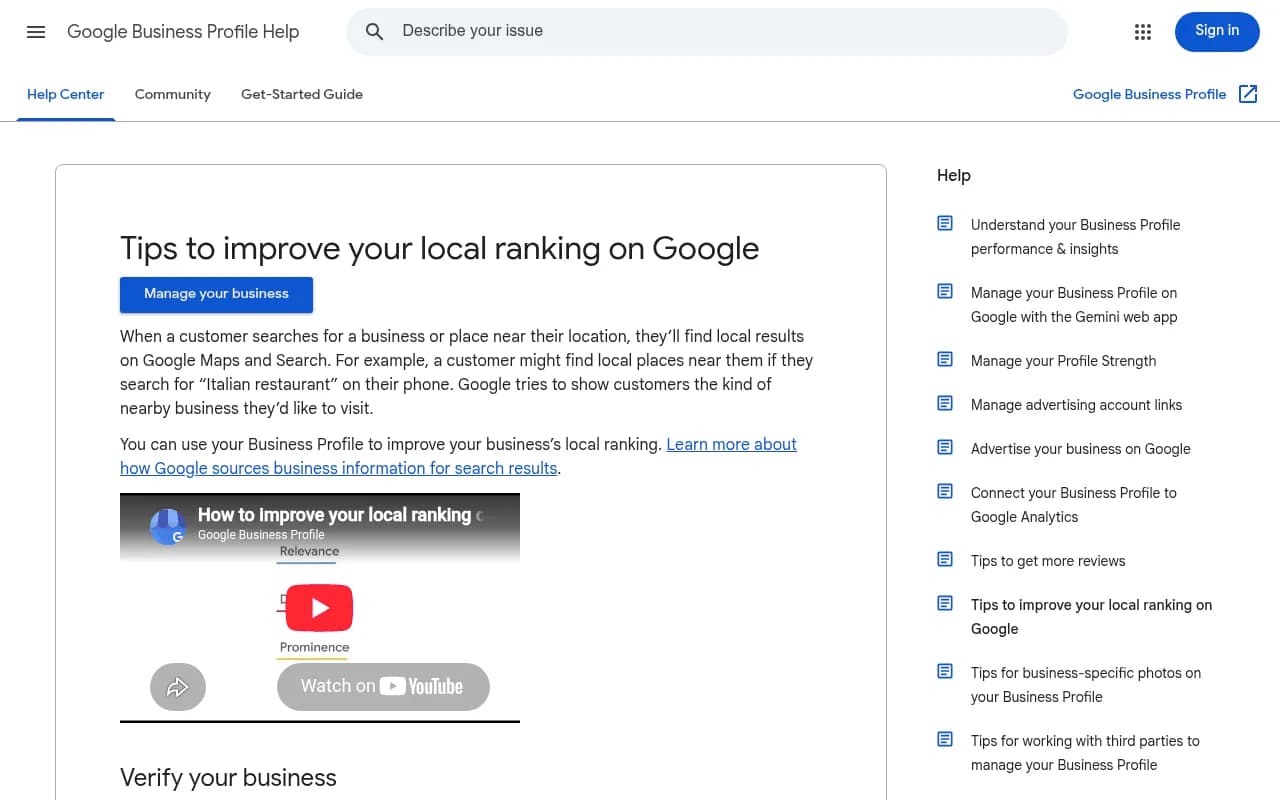
Google's own local ranking guidance is short and worth reading once: verify the business, keep information complete and accurate, respond to reviews, and add photos and videos. Relevance, distance and prominence still drive local results.
Step 1: Get your Google Business Profile in order
The profile is the single most important local asset. Google's AI Overviews often cite Google-owned properties, and Promptwatch Data on Google AI Overview citation share for June 2026 shows YouTube at 4.16% and google.com at 2.30% of citations, both 2026 highs. google.com went from 0.37% in January to 2.30% in June. That was a partial month, so treat the momentum as directional, but the recommendation holds: where Google answers with its own properties, get represented inside them.
Checklist for the profile:
- Verify the listing so Google knows you are authorized to represent the business.
- Choose the right primary category and add secondary ones that match real services.
- Fill in every field: hours (including special hours), address or service area, phone, website, attributes, services.
- Keep name, address and phone identical to what is on your website. Small mismatches cause real confusion.
- Upload original photos and short videos of actual jobs, staff and premises. Stock images add nothing.
- Post updates now and then. Activity signals a live business.
Step 2: Build a review engine
Reviews are public, indexed and full of specific language about what you do. One of the research sources makes a good point: a review that says "great service" is nice, but one describing the exact problem you fixed is real content about your business that AI can lift from.
You cannot write your customers' reviews, but you can shape the process:
- Ask within 24 to 48 hours of finishing a job, while it is fresh.
- Send a direct review link by text or email. Remove every click you can.
- Add a light prompt such as "tell us what specifically helped" to nudge detail.
- Reply to every review, good or bad. Responses are indexed too and show you are accountable.
- Aim for a steady trickle (at least two or three a month) rather than a burst followed by silence.
Do not buy reviews or gate them. It is against Google's rules and it is the one shortcut that can actually hurt you.
Step 3: Build service pages and location pages
This is where most local sites fall short. A single page listing everything you do gives AI one thing to quote. A set of focused pages gives it many.
One page per service
Each page should cover what the service is, how it works, who it is for, what is included and roughly what it costs. Put a direct answer near the top. A practical pattern is a question as a heading followed by a 40 to 70 word answer with a real number in it, for example a typical price range, a typical timeframe, or a call-out fee. "It depends" is the answer AI skips.
One page per area you serve
If you cover four towns, write four pages, each genuinely about that town: local landmarks, common issues in that area's housing stock, permit rules, named neighborhoods, real jobs you did there. Templates with the city name swapped in are thin and easy for Google to discount. Two good location pages beat twenty empty ones.
Show real people and real work
Add an About page with named people, licenses and insurance, and before-and-after photos from actual jobs. Keep important information in plain text. Google can only quote what it can read, so do not bury prices or service areas inside images.
Keep the site fast and clean
Mobile-first design, clear headings and fast loading make your content easy to parse. That is basic technical hygiene, but it is still the gate everything else passes through.
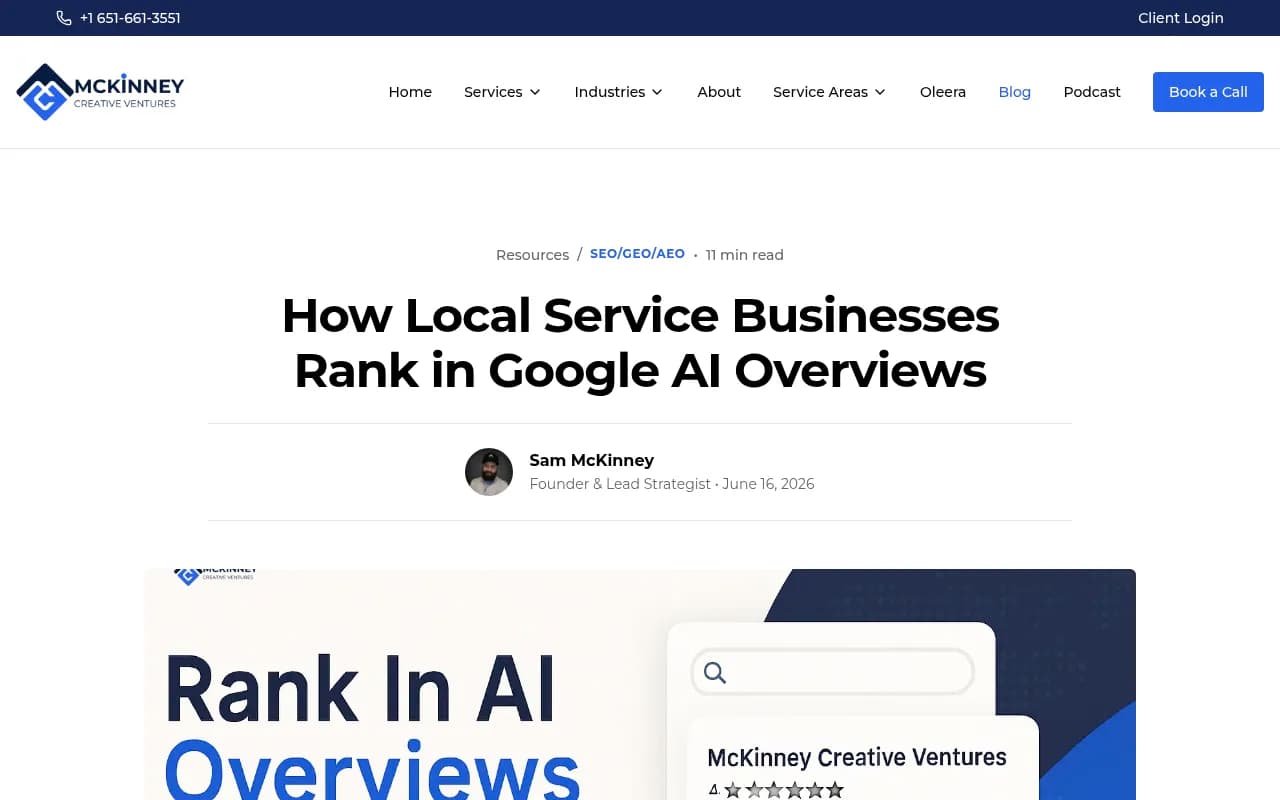
This local guide from McKinney Creative Ventures frames it well: content that directly answers customer questions, local authority from a complete profile and real reviews, and a technically sound site. All three at once.
Step 4: Add structured data, with realistic expectations
Mark up the business with LocalBusiness schema and FAQ content so the answers are machine-readable. Make sure the markup describes what is visibly on the page and matches your profile details exactly. Be honest with yourself about what this does: it sharpens Google's understanding of the page, but it is not a switch that earns a citation. Plenty of businesses with perfect schema and thin content get nothing.
If you manage schema across many pages, an entity-focused tool like InLinks can automate part of it.
Step 5: Reinforce your entity across the web
AI systems recognise entities by seeing consistent facts in many places. When a dozen sources describe your business with the same name, phone number, services and area, confidence rises.
- Keep citations (directory listings) consistent: same name, address, phone everywhere.
- Get listed on the industry and local directories your customers actually use, and in Yelp or equivalent review sites.
- Earn third-party mentions. A local publication including you in a "most trusted [service] in [city]" piece is exactly the corroboration AI looks for. So is a short guest piece for a local association.
- Use the same service descriptions on your site, profile and directories.
Step 6: Treat Google's own ecosystem as a channel
This is the part most local guides skip. According to Promptwatch Data from Sep 28 to Oct 4, 2026, social platforms earned 12.2% of Google AI Overview citations, roughly 26 times ChatGPT's share (0.46%). Platform shares in AI Overviews that week:
| Platform | Share of AI Overview citations |
|---|---|
| YouTube | 4.28% |
| 2.38% | |
| 2.15% | |
| 1.61% | |
| 1.55% | |
| TikTok | 0.22% |
For a local business whose customers find you through Google, that suggests a practical order of work: a YouTube channel with short, useful videos (how a repair works, what a quote includes), then complete and active public Facebook and Instagram pages. Reddit matters as well. Promptwatch's Reddit data shows ChatGPT cutting Reddit citations sharply in August 2026, while Google surfaces declined more gradually, so local subreddit threads that AI Overviews cite are still worth reading for the exact questions prospects ask.
What does not work
- Hunting for a secret AI markup. There is none.
- Mass-producing city pages with swapped place names.
- Fake or incentivized review campaigns.
- Keyword-stuffing the business name in your profile.
- Pages that say "call for a quote" and nothing else.
A 90-day sequence
| Timeframe | Focus | Output |
|---|---|---|
| Weeks 1 to 2 | Profile and consistency | Verified, complete profile; NAP matches site and directories |
| Weeks 2 to 4 | Review process | Automated review requests, reply routine in place |
| Weeks 3 to 8 | Service pages | One page per core service with direct answers and price ranges |
| Weeks 6 to 10 | Location pages | Genuinely local pages for your top areas |
| Weeks 8 to 12 | Schema, social, mentions | LocalBusiness and FAQ markup, YouTube and Facebook activity, local press outreach |
Tools that help
You do not need a stack of software for this, but a few categories are useful.
Tracking whether you appear
Traditional rank trackers will not tell you if an AI Overview names you. An AI visibility platform will. Promptwatch tracks Google AI Overviews and AI Mode alongside ChatGPT, Gemini and Perplexity, with country tracking on every paid plan and state and city tracking from the Business plan, which matters when your whole market is a metro area. It also shows which of your pages get cited and where AI crawlers hit errors on your site.

Birdeye Search AI is aimed at local, location-level visibility, which is useful for multi-location brands.
Smaller options such as Otterly.AI work for basic monitoring on a budget.

For a wider view of the category, the GEO software directory lists more options.
Writing and optimizing pages
Content tools like Surfer SEO or Clearscope help you check that a service page covers the questions a topic needs.

Comparison
| Need | Option | Note |
|---|---|---|
| Track AI Overview mentions and citations | Promptwatch | Also covers crawler logs, content gap analysis and publishing |
| Location-level local visibility | Birdeye Search AI | Built around local listings and reviews |
| Budget monitoring | Otterly.AI | Basic prompt tracking |
| Page content checks | Surfer SEO, Clearscope | Optimization, not tracking |
| Entity and schema automation | InLinks | Internal links and markup |
How to measure progress
A single citywide rank number hides how you perform block by block, so use grid-style local rank tracking for map results. For AI Overviews, check a fixed list of 20 to 30 real customer questions monthly in each of your target towns and record whether you are cited, named or absent. Beyond that, watch the leading indicators: branded search growth, calls and direction requests from your profile, direct traffic rising against flat ad spend, and leads who arrive already informed. Expect early movement in the map pack within weeks of fixing the profile and citations, with stronger results over three to six months as reviews and content accumulate.
Common questions
Is ranking in AI Overviews different from regular local SEO?
Mostly no. Because AI features use Google's existing index and ranking systems, strong local SEO is the foundation. The added emphasis is on answering specific questions directly and showing real local experience.
Do I need a separate strategy for ChatGPT and Gemini?
The foundations overlap, but the sources differ. ChatGPT cites social platforms very little, while AI Overviews cite them far more, so channel priorities shift. Check each platform separately.
How many reviews do I need?
There is no magic number. Quantity, average rating, recency and your replies all count, so consistency beats a one-time push.
Bottom line
Fix your Google Business Profile first, then build a steady review flow, then write one specific page per service and per town with real numbers on it. Add schema as housekeeping, keep your details consistent everywhere, and put real effort into YouTube and Facebook because AI Overviews cite them. Then track a fixed set of customer questions each month so you know whether any of it is working. Agencies such as 1001 SEO Media handle this kind of local and GEO work if you would rather hand it off.