Key takeaways
- Government and public health sites earn the largest share of health citations in AI search, but the long tail is huge. In Promptwatch's ChatGPT healthcare data (Sep 9 to Oct 8, 2026), the top 20 domains earn only 15.54% of citations.
- YouTube is the biggest non-government lever for Google. SE Ranking's German health study found it was the most cited source in health AI Overviews (20,621 citations) while ranking only 11th in organic results.
- Organic rankings still matter. 54% of the specific URLs cited by health AI Overviews also sat in the organic top 20.
- Medical associations, peer-reviewed references and complete directory profiles are the realistic route for clinics and brands without a .gov domain.
- Many sensitive queries show no AI Overview at all, so pick your battles by query type.
Why this is harder in healthcare
Google is careful with health. Halcy's guide on healthcare AI Overviews notes that some sensitive queries may not trigger an AI Overview, and that when they do appear they lean on government health sites, major medical centers and established health information sites. Local practice websites are cited less often unless they carry strong authority signals.
There is also pressure from the outside. In January 2026 The Guardian published an investigation where medical charities reviewed AI Overviews and flagged answers on pancreatic cancer diets and liver blood tests as misleading. Google pushed back, saying the examples were taken out of context. Whatever you make of that argument, it means health content gets scrutinized harder than almost any other category. Sloppy, unreviewed pages are a bad bet.
The good news is that the citation pool is not closed. It is just not where most people assume.
What the data says about who gets cited
I want to be upfront about one limitation. I could not find a Promptwatch report specific to AI Overviews and healthcare. The healthcare source-share figures below come from ChatGPT, not Google. They still show what AI search systems tend to trust for health prompts, and the pattern is consistent with the AI Overviews data from SE Ranking.
The ChatGPT healthcare picture
Promptwatch Data's healthcare report covers organic healthcare prompts from Sep 9 to Oct 8, 2026:
- NIH is the top source at 5.46% of healthcare citations, spread across six nih.gov subdomains. PubMed Central is 2.38% and PubMed 2.33%.
- The FDA is second at 1.76%, and the NHS third at 1.1%.
- The top non-government sites are the American Society of Plastic Surgeons (0.64%), the American Academy of Dermatology (0.54%), Mayo Clinic (0.49%) and Cleveland Clinic (0.4%). Mayo and Cleveland are the only hospitals in the top 20.
- By source type: government and public health 7.06%, NIH and research databases 5.46%, medical associations 1.39%, hospitals and clinics 0.89%, reviews and directories 0.46%, pharmacies 0.28%.
The detail I find most useful: the AAD and ASPS together (1.18%) beat Mayo Clinic and Cleveland Clinic combined. A specialty association with a tight focus out-cites two famous hospital brands. That is a signal about topical depth, not brand size.
The Google AI Overviews picture
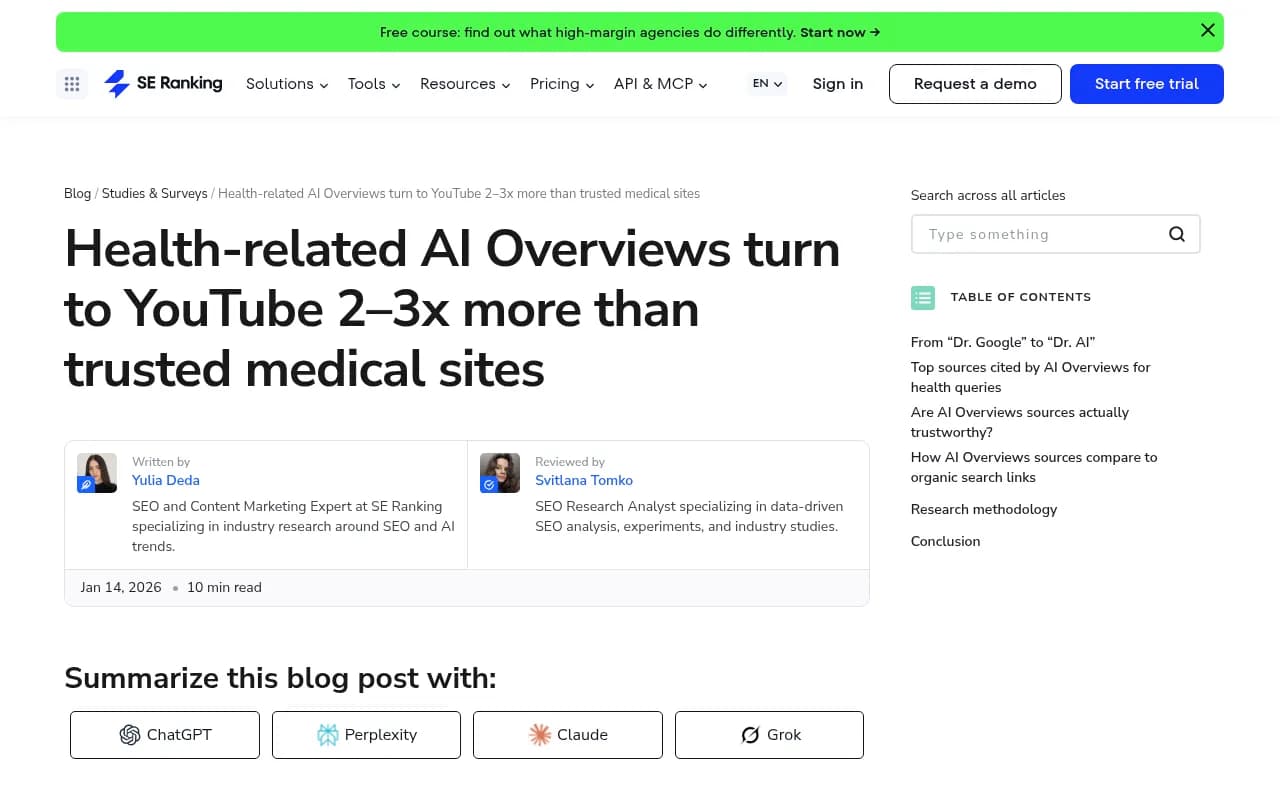
SE Ranking analyzed more than 50,000 German health searches and published the results in January 2026. Their finding was that health AI Overviews turn to YouTube far more than to trusted medical sites.
The numbers worth remembering:
- YouTube: 20,621 AI Overview citations, but only 5,464 appearances in organic results (11th place).
- The most cited individual medical sites sat around 1.2% to 1.5% each. Examples were herzstiftung.de (1.52%), stiftung-gesundheitswissen.de (1.47%), aok.de (1.37%) and barmer.de (1.24%).
- Most of the top non-YouTube sources were not government portals. They were health insurers, non-profits, a consumer health portal, a public broadcaster and a medical reference (MSD Manuals).
- 54% of cited URLs also appear in Google's organic top 20.
Caveat: this is German-language data. Treat it as directional for English-language markets, not a promise.
SE Ranking published the study, and [tool:se-ranking]
Step 1: Work out which queries are worth chasing
Not every health query gets an AI Overview. According to Halcy's breakdown:
| Query type | Example | Likely AI Overview? |
|---|---|---|
| Informational | what is spinal stenosis | Often |
| Treatment comparison | surgery vs physical therapy for herniated disc | Frequently |
| Direct medical advice | should I take ibuprofen with blood thinners | Often suppressed |
| Emergency | symptoms of stroke | Often suppressed |
| Local | orthopedic surgeon near me | Local pack, preserved path to practice sites |
So your realistic targets are informational and comparison queries. Skip fighting for emergency and dosage queries. For local intent, the local pack matters more than an AI Overview, so your Google Business Profile deserves more attention than a 3,000-word explainer.
Build a list of 50 to 150 queries your patients or readers actually ask, tag each by type, and track which trigger an overview. Prompt-level tracking tools help here. Promptwatch tracks the real interfaces of Google AI Overviews and ChatGPT with prompt volumes and difficulty, which makes it easier to see which questions are worth the effort.

Step 2: Win the organic page first
This is the unglamorous step and it is the one with the best evidence behind it. If 54% of cited URLs are already in the top 20, then an AI Overview citation is largely downstream of ranking. Halcy says the same: page-one sites are more likely to be cited.
Practical moves:
- Pick a page per condition or procedure and make it clearly the best on your site. Merge thin duplicates.
- Lead with a direct, two to three sentence answer, then expand. Extractable answers get cited.
- Use question-style subheadings that match how patients phrase things.
- Keep pages fresh. Officite's advice for medical practices is to refresh content regularly, since health information changes.
- Fix crawl and index problems before writing anything new.
For content scoring and briefs, tools like Surfer SEO or Clearscope can ground your outline in what already ranks.
Step 3: Show your medical credibility on the page
You cannot borrow a .gov domain. You can make your authorship impossible to doubt. Looking at the sources SE Ranking labeled as high quality, the common thread was physician or specialist review, certification and no-ads reference style.
What that means for your pages:
- Named author with credentials and a real bio page.
- A named medical reviewer, with a review date.
- Citations to primary sources inline, not a vague references dump.
- A clear editorial policy and an update log.
- Schema markup for the author, organization and medical content where it applies.
On citations specifically, Promptwatch's own takeaways for non-government sites are worth following: back up claims with peer-reviewed studies and link them on PubMed or PubMed Central, and align pages with FDA, CDC, NHS and NICE guidance, and link to it. Given that NIH properties alone outweigh the FDA, NHS, CMS and SAMHSA combined in ChatGPT's health citations, linking to the same sources the engines already trust is a sensible habit.
For entity and schema work, InLinks and WordLift are options.

Step 4: Use YouTube, because Google clearly does
This is the biggest opening for non-government publishers. Promptwatch Data's social media citations report (Sep 28 to Oct 4, 2026) shows social platforms make up 12.2% of Google AI Overview citations, roughly 26 times ChatGPT's share. YouTube is 4.28%, Facebook 2.38%, Reddit 2.15%, Instagram 1.61%, LinkedIn 1.55% and TikTok 0.22%.
So for Google specifically, video is a first-class channel, not a nice extra. A few practices:
- Turn your best-performing condition pages into 3 to 6 minute videos with the clinician on camera.
- Use the same question as the video title that you use as the page heading.
- Add accurate chapters, a full transcript and a link back to the matching page.
- Embed the video on the page so the two reinforce each other.
- Keep Facebook pages and Instagram profiles complete and active. Promptwatch's advice is to invest in YouTube first, then those two.
An honest caution: a flood of low-quality video will not help, and for health it could hurt. One properly reviewed video per core topic beats fifty rushed ones.
Don't count on Reddit as a growth channel in ChatGPT. Promptwatch's data shows reddit.com's share of ChatGPT citations dropped from about 4% to 0.5% on August 14, 2026 (report), while Google surfaces declined more gradually.
Step 5: Get named by the bodies AI trusts
This is where non-government publishers can punch above their weight. Medical associations earn 1.39% of healthcare citations in ChatGPT, more than hospitals and clinics at 0.89%. If you are a specialty practice, a device maker or a health brand, associations are your doorway.
- Contribute to or be listed by the professional bodies in your specialty.
- Offer clinician commentary for association newsletters and patient guides.
- Keep Doctify and WebMD doctor profiles complete. Reviews and directories are a small slice (0.46%), but cheap to maintain.
- Pursue earned coverage on reputable health publishers rather than generic guest posts.
If you want help with the outreach side, an agency like 1001 SEO Media covers digital PR and GEO work, though plenty of teams do this in-house.
Step 6: Mind the technical layer
AI systems cannot cite what they cannot read. Check:
- Robots.txt rules that block AI crawlers by accident.
- Server errors, slow pages and JavaScript-only content.
- Sitemap coverage and orphaned pages.
- Whether AI bots actually visit your health pages.
Crawler visibility is where many tools stop short. Promptwatch's IP-verified AI crawler logs show which bots hit which pages and what errors they get. Promptwatch Data's AI crawler traffic report covers weekly verified requests from June to September 2026 if you want a benchmark.
Step 7: Measure, then iterate
Track three things: whether an AI Overview appears for your query set, whether you are cited, and what traffic that brings. A few tools worth comparing:
| Tool | Strength | Best for |
|---|---|---|
| Promptwatch | Tracking plus content gap analysis, crawler logs, AI traffic and a Content Agent for fixes | Teams that want to act on the data, not only watch it |
| SE Ranking Visible | AI Overview tracking from the team behind the German health study | SEO teams already on SE Ranking |
| Semrush AI Visibility Toolkit | AI tracking inside a familiar SEO suite | Existing Semrush users |
| Knowatoa | AI Overviews and brand monitoring | Lightweight monitoring |
| Otterly.AI | Affordable prompt tracking | Small budgets |
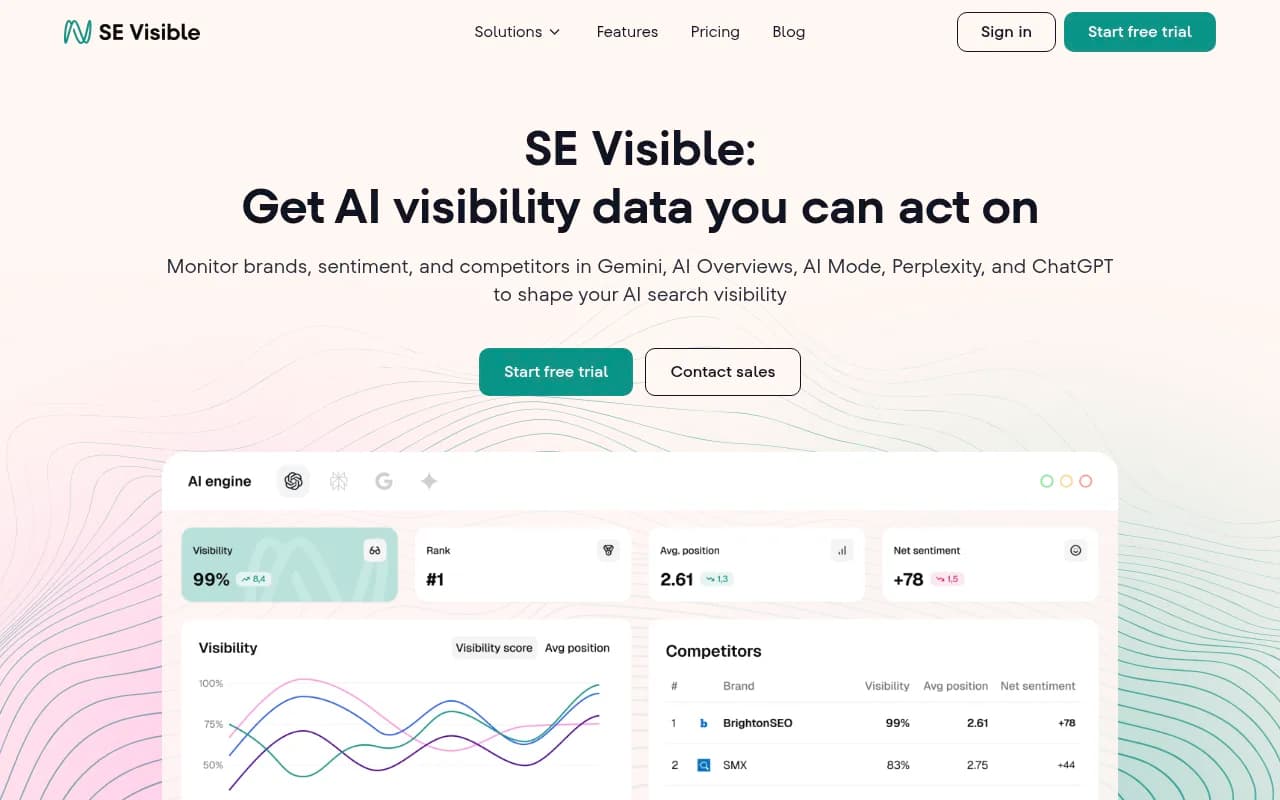


My view: for healthcare, tracking alone is not enough. You need to know why you are not cited, and that usually means a content gap, a crawl issue or a missing third-party mention. That is the gap between prompt trackers and platforms that connect citations to pages and traffic. For a wider list, the GEO software directory at bestgeosoftware.com is a decent place to browse.
A 90-day plan
- Weeks 1 to 2: build the query list, tag by type, check which trigger AI Overviews, and audit crawlability.
- Weeks 3 to 6: rewrite your top 10 to 15 pages with direct answers, named reviewers and primary-source citations.
- Weeks 5 to 9: record and publish videos for the five highest-opportunity topics, embed them and add transcripts.
- Weeks 6 to 12: pursue association listings, clinician commentary and directory profile cleanup.
- Week 12: compare citation presence, organic positions and AI-referred traffic against your baseline, then reprioritize.
What not to do
- Do not mass-generate health articles with no clinical review. It is the fastest route to being ignored, and potentially to harming readers.
- Do not chase emergency or dosage queries where overviews are often suppressed.
- Do not assume English results will match the German data. Verify with your own tracking.
- Do not treat markdown files or llms.txt as a shortcut. Promptwatch Data found markdown makes up only 0.05% of AI search citations (report).
The bottom line
You do not need a .gov domain. You need a page that already ranks, a named and credentialed reviewer, primary-source citations, a YouTube presence for Google, and mentions from the specialty bodies the engines already trust. The pool is wide: in ChatGPT's healthcare data, the top 20 domains hold under 16% of citations. Start with the 10 conditions you know best, do them properly, and measure what happens.