Key takeaways
- Google Alerts and page-change monitors cannot see AI answers. You need a tool that re-runs a fixed prompt set on a schedule and compares citations over time.
- Alert on aggregates and material events (a lost citation on a revenue prompt, a share-of-voice drop, a new competitor, a false claim), not on single-prompt flips. LLM answers are non-deterministic.
- Measure your noise floor for two weeks first, then set thresholds at roughly twice your normal variance.
- Severity depends on page type. A lost news citation is normal decay. A lost pricing or docs citation is not.
- Before reacting to a dip, check whether the platform changed. ChatGPT's citations per response dropped about 27% around March 4, 2026, and that looked like everyone's loss at once.
Why you need alerts at all
Most teams find out about AI citation changes the slow way. Someone pulls a report on Tuesday, notices a dip, and by then the answer engine has already settled on a different set of sources. Or traffic from ChatGPT drops in GA4 a week later and nobody can say why.
The fix is boring and mechanical: decide which changes matter, define a threshold for each, and route the signal to a place where someone will see it. The hard part is not the tooling. It is deciding what counts as a real change, because AI answers wobble constantly.
This guide covers that decision-making first, then the setup, then what to do when an alert fires.
What Google Alerts and page monitors can and can't do
It's tempting to start with tools you already have. Google Alerts surfaces mentions on indexable web pages. It does not see what ChatGPT, Perplexity or Gemini said in an answer. Get-ryze's write-up on AI brand mention alerts makes the same point: those tools find pages, not answers.
Page-change monitors like Visualping, where you describe the event in plain English in an "Alert me when" box, or PageCrawl, are useful for a different job. Use them to watch competitor pricing pages, your own key pages for accidental edits, or a robots.txt file that someone might break. They tell you a page changed. They do not tell you whether an AI engine cites it.
So you end up with two layers:
| Layer | What it watches | Example tools | Good for |
|---|---|---|---|
| Web mention alerts | Indexable pages that name you | Google Alerts | Press, blogs, forums |
| Page change alerts | Specific URLs changing | Visualping, PageCrawl | Competitor pages, your own key pages |
| AI citation alerts | Answers and sources in AI engines | AI visibility platforms | Gained or lost citations, share of voice |
| Crawler alerts | AI bots hitting your site | Server or CDN logs, crawler analytics | Blocked bots, new crawlers, error spikes |
The rest of this guide is about the third and fourth rows.
Step 1: Build a prompt set worth watching
Alerts are only as good as the prompts behind them. AI-Advisors suggests a fixed set of 10 to 30 prompts run weekly across ChatGPT, Perplexity, Gemini, Copilot and Claude. That is a sensible starting size. Fixed matters: if you keep changing the prompts, you cannot tell a real shift from a different question.
Good prompts fall into a few groups:
- Revenue prompts: the "best X for Y" and "X vs Y" questions a buyer asks before purchasing
- Brand prompts: "what is [your brand]", "is [your brand] worth it", pricing questions
- Category prompts: broader informational questions where you want to be a source
- Competitor prompts: how rivals are described and when they appear
Tag each prompt with its group and its importance. You will use those tags to set severity later.
Step 2: Choose the events worth alerting on
Not every fluctuation deserves a ping. Menra's alert guide boils it down to four triggers, and I think that list is about right:
| Alert type | Trigger | Suggested threshold |
|---|---|---|
| Share-of-voice drop | Your mention rate across a prompt set falls | 7-8 points below trailing 4-week average |
| Lost citation | A page that was cited stops being cited | First occurrence on a revenue prompt |
| New competitor mention | A rival appears in a prompt you tracked | First appearance in top 3 sources |
| Misinformation | AI states a false claim about you | Any occurrence |
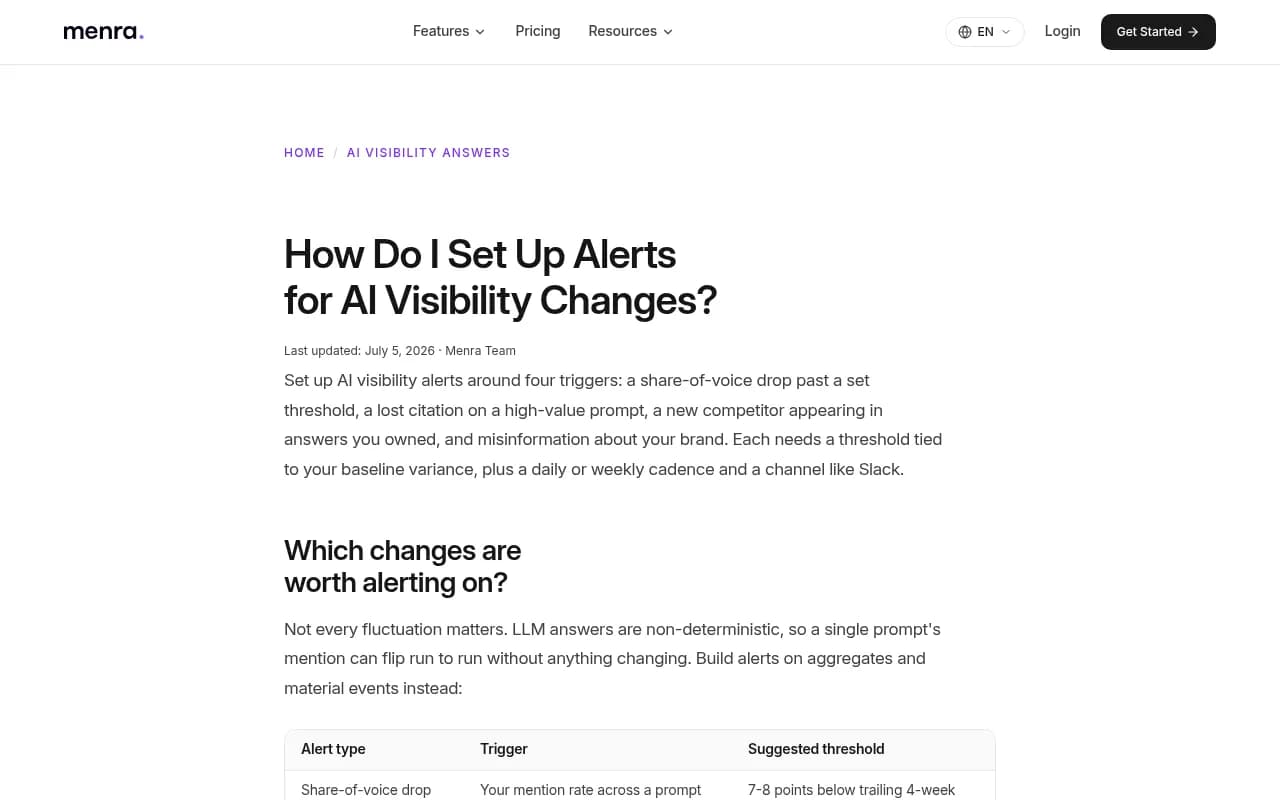
Two things are missing from that list that I would add. First, a gained-citation alert. The title of this guide says "starts or stops", and a new citation on a high-value prompt is worth knowing about, because it tells you which content is working. Second, a crawler alert: a sudden spike in errors from GPTBot, ClaudeBot or PerplexityBot often precedes a citation loss by days.
Step 3: Measure your noise floor
This is the step people skip, and it is why most alert setups get muted within a month.
Run your prompt set for two weeks without changing anything on your site. Record how much your share of voice swings from randomness alone. If it moves 3-4 points naturally, a 5-point alert fires constantly. Menra's rule of thumb is to set the drop threshold at about twice your observed variance. I'd follow it. The thresholds in the table above are starting points, not facts about your market.
LLM answers are non-deterministic. A single prompt can flip run to run with nothing changed on your end. That is why you alert on aggregates (share of voice across a cluster) and require persistence (the change shows up in two consecutive runs) before notifying anyone.
Step 4: Set severity by page type
Not all citation losses are equal, and Promptwatch Data has a useful benchmark here. In Promptwatch's content half-life report, which tracked every page ChatGPT cited on July 6, 2026 for 90 days, different content types decayed at very different speeds:
| Content type | Still cited after 30 days | Still cited after 60 days |
|---|---|---|
| Landing pages | 78% | 69% |
| Docs | 76% | 67% |
| Comparisons | 72% | 63% |
| Listicles | n/a | 60% |
| Product pages, reviews, how-tos | n/a | about 55% |
| News | half gone by day 36 | 41% |
The practical read: a lost citation on a news post is normal decay, so do not page anyone. A lost citation on a landing page, docs page or pricing page is much more unusual and deserves a high-severity alert. Landing and docs pages mostly stay cited for the whole 90-day window, so when one drops out, something specific probably happened.
A simple severity scheme:
- High: lost citation on a landing, docs, pricing or comparison page tied to a revenue prompt; any misinformation; AI crawler blocked or erroring on key pages
- Medium: share-of-voice drop past threshold; a competitor entering the top 3 sources
- Low: lost citation on news or blog content; gradual drift, rolled into a weekly digest
Step 5: Rule out platform shifts before you react
This is where alerts get embarrassing. Your alert fires, you rewrite three pages, and then you discover every site lost citations the same day.
Promptwatch Data shows how often that happens. Around the GPT-5.3 rollout on March 4, 2026, average citations per search-enabled ChatGPT response fell from about 6.4 sources to about 4.7-4.9, roughly 27% fewer, within a day of the rollout and with no recovery a month later. If your own citation count dropped that week, your content was probably fine.
Another example: Reddit's share of ChatGPT citations held at about 3.83% from July 18 to August 7, 2026, then fell to under 1% on August 14. Promptwatch is upfront that the cause is unknown and the size of the drop is provisional. And the surfaces did not move together: in AI Mode Reddit's share fell about 30.5%, while in AI Overviews it eased about 11.3%. That is why you track each surface separately.
The same month, ChatGPT began using the site: operator at scale in fanout queries on August 8, jumping from about 0.4% to about 17% of fanout queries, with searches per response nearly doubling. Changes like that can reshuffle which pages get retrieved.
Build these checks into your alert triage:
- Track citations per response alongside your own citation count, so you can tell "we lost visibility" from "the engine cites fewer sources overall"
- Keep a shared timeline of model releases and platform changes, and annotate it when an alert fires
- Compare which URLs were cited before and after, rather than only the totals
- For gradual drifts, use rolling trends instead of single-day comparisons
Step 6: Pick the tooling
You have three realistic routes.
Option A: an AI visibility platform with built-in alerts
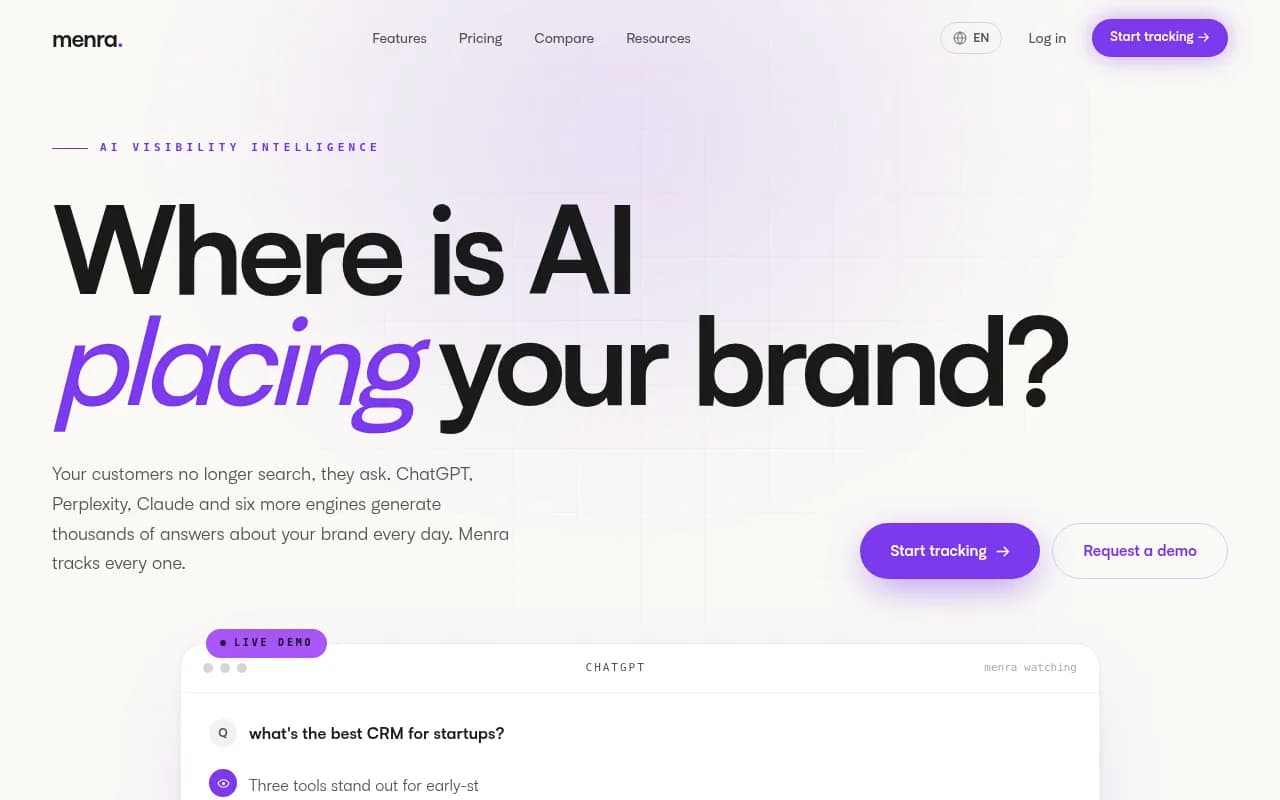
This is the least work. You load your prompts, the platform re-runs them on a schedule, and it flags threshold breaches. Menra is one example that re-runs prompts and flags breaches by exception.
For teams that want monitoring tied to action, Promptwatch tracks the real interfaces of ChatGPT, AI Overviews, AI Mode, Gemini, Perplexity and others, and adds IP-verified AI crawler logs, per-page citation data and an Action Board of prioritized fixes. That combination matters for alerting, because crawler errors and citation changes sit in one place, so you can see whether a lost citation lines up with a bot hitting errors.

Other platforms in the same category include Otterly.AI, Peec AI and Profound:



If you want to compare more options, the GEO software directory at bestgeosoftware.com and the AI rank tracking directory at ai-rank-tools.com list many more.
Option B: event-based triggers
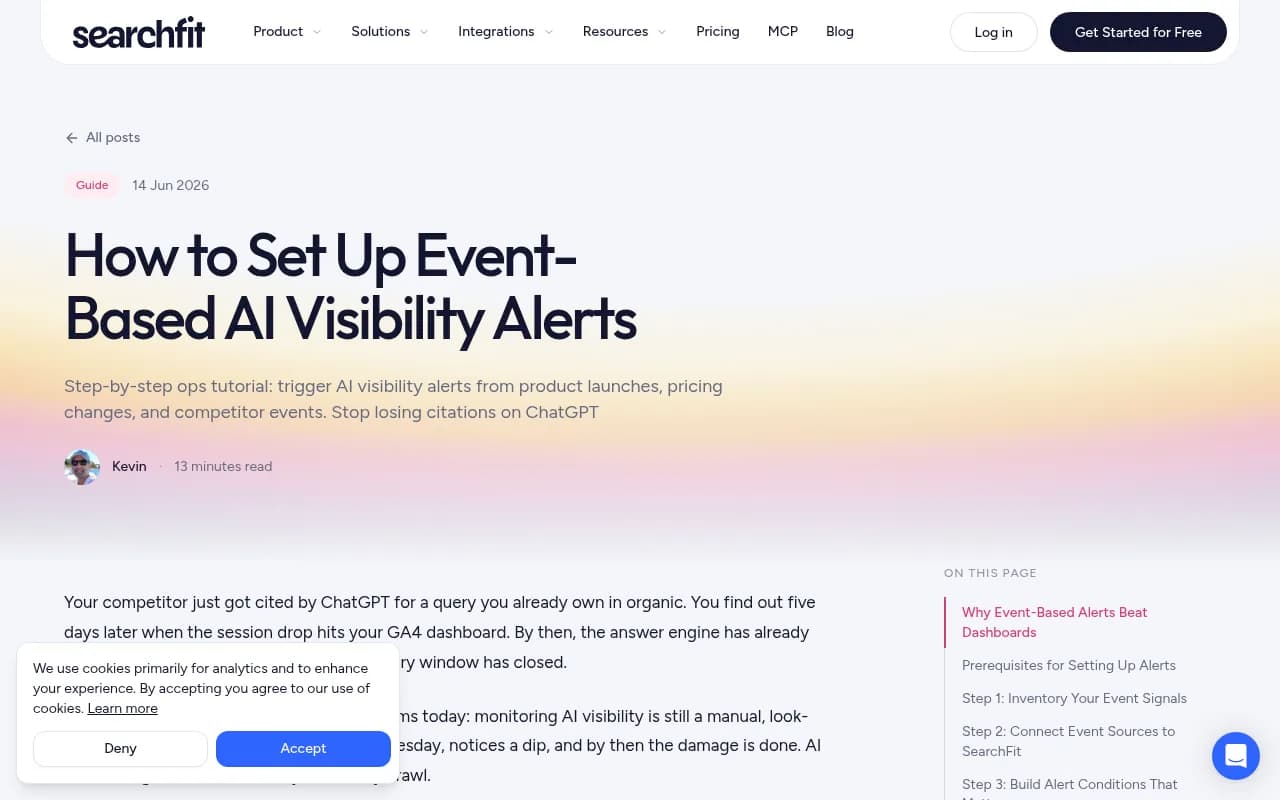
SearchFIT's approach ties visibility checks to business events: a CMS publish, a pricing update, a competitor's content push, a GA4 segment. The example I like is a limited feature release followed by a 24-hour visibility check on that feature's prompt cluster, then a decision on whether to broaden the rollout. Its claim that this cuts response time from days to hours is vendor marketing, but the idea itself is sound. A check triggered by a publish event tells you whether that specific change moved anything.
You can approximate this without special software. Most platforms with an API or a webhook-friendly workflow let you run a prompt-cluster check after a deploy. A CI step or a CMS webhook that calls the API and posts the result to Slack is enough.
Option C: a DIY stack
If you have engineering time, you can script it. Run your prompts through each engine's API or a monitoring tool on a schedule, store the cited URLs in a table, diff today against the trailing average, and post exceptions to Slack. Open-source options like Elmo exist for this.

Be aware of the catch: APIs can return different answers than the user-facing interfaces, so a DIY stack built on APIs may not match what real users see. That is the main reason many teams pay for a platform that checks the actual UI.
Step 7: Route alerts so people act on them
Split the channels by urgency:
- Real-time channel (Slack or email): misinformation, lost citation on a high-value page, crawler errors on key pages
- Weekly digest: share-of-voice trends, new competitor appearances below the top 3, gained citations, low-severity losses
Every alert needs an owner and a next step. An alert that says "citation lost" with no name attached will be ignored by everyone. A good alert message contains the prompt, the engine, the page that dropped, the previous and current state, and a link to the comparison of before and after.
Step 8: Respond to what fires
Here is a short playbook by alert type.
Lost citation
- Check the date against platform changes and look at citations per response.
- Check that the page still returns 200, is not blocked in robots.txt, and has not been edited or redirected.
- Look at crawler logs: did the AI bots visit recently, and did they hit errors?
- Look at who replaced you. If a competitor page now holds the slot, compare content, freshness and structure.
- Refresh the page and re-check within a week.
Gained citation
Figure out why. Which page, which prompt, which engine. Then do more of whatever it was. This is the cheapest content research you will get.
Misinformation
The fix is usually upstream. Correct the source the engine pulled from, publish an authoritative page that states the right fact, and re-check within a week. Catch it early, before it spreads across engines that cite each other.
New competitor
Open the cited page. Note what it has that yours does not: a comparison table, fresher data, original numbers. Then decide whether to update or build something new.
Step 9: Add crawler and page-level alerts
Citation alerts are lagging indicators. Crawler and page alerts are earlier warnings.
- Watch for AI bots receiving 4xx or 5xx errors on your important pages. This often shows up in CDN or server logs before citations change.
- Watch for new AI crawlers appearing in your logs. Promptwatch Data has tracked weekly verified AI crawler requests from OpenAI, Anthropic, Google, Perplexity and Mistral, and Meta-WebIndexer's share went from about 2% to nearly 38% of tracked crawler requests between mid-July and August 9, 2026. Your robots.txt rules should keep up.
- Use a page-change monitor such as Visualping or PageCrawl on your robots.txt, your pricing page and your top landing pages, so an accidental edit pings you the same day.
A sample alert configuration
Here is what a lean setup looks like for a mid-size SaaS site:
| Alert | Scope | Trigger | Channel |
|---|---|---|---|
| Lost citation | 10 revenue prompts, landing and docs pages | First occurrence, persists two runs | Slack, real time |
| Share-of-voice drop | Full prompt set (about 30) | 2x noise floor below 4-week average | Slack, daily |
| New competitor | Revenue and comparison prompts | First appearance in top 3 sources | Weekly digest |
| Misinformation | Brand and pricing prompts | Any occurrence | Slack, real time |
| Crawler errors | Top 50 pages | AI bot error rate above baseline | Email, real time |
| Gained citation | All prompts | First occurrence | Weekly digest |
Common mistakes
- Alerting on every single-prompt flip, then muting the channel by week three
- Setting thresholds before measuring the noise floor
- Treating all lost citations the same regardless of page type
- Tracking only one engine. Engines move differently, and Google's surfaces and ChatGPT often diverge
- Reacting to a platform-wide change as if it were your own problem
- Alerts with no owner
Where to start this week
Pick 15 prompts. Run them for two weeks without touching your site and write down the variance. Then turn on four alerts: lost citation on revenue pages, share-of-voice drop at twice your noise floor, any misinformation, and crawler errors on key pages. Add a calendar note for every model release you hear about. That is enough to catch most real changes and ignore most noise.
If you would rather have a team set this up and act on what the alerts find, 1001 SEO Media runs AI search and GEO programs, and it uses Promptwatch for the monitoring side.