Menra Review 2026
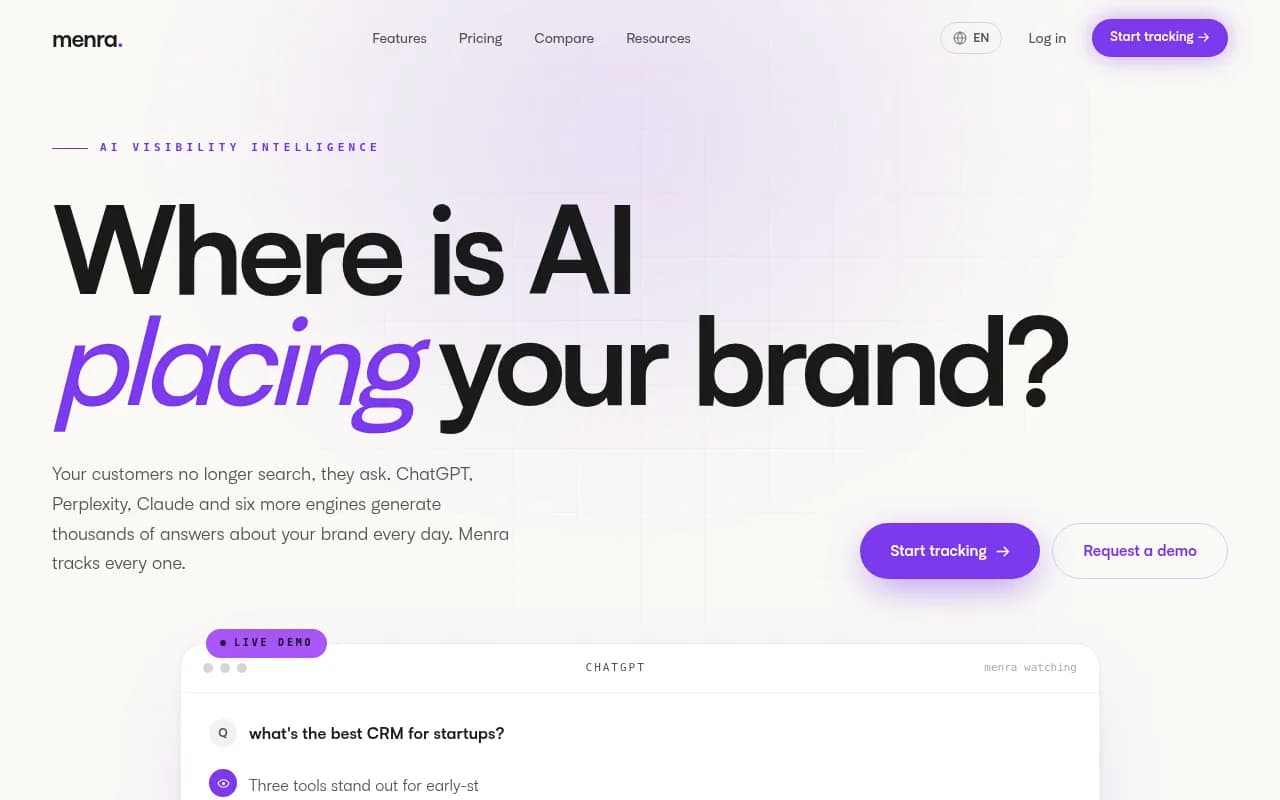
Tracks brand mentions across ChatGPT, Perplexity, Claude, Gemini and more, with AEO scoring and competitor gap analysis.
Key takeaways
- Menra is a budget-friendly AI visibility monitor at $69/month, tracking brand mentions across up to 9 AI engines (ChatGPT, Perplexity, and Gemini are core; Claude, Copilot, Grok, DeepSeek, Meta AI, and Google AI Overviews cost $20/month each as add-ons).
- Its strongest differentiators are deep-URL citation resolution (it tells you the exact page an engine cited, not just the domain) and a credit-based pricing model that keeps costs low for small prompt sets.
- It's a monitoring tool, not an optimization platform. Compared to Promptwatch, Menra lacks AI crawler logs, visitor analytics and traffic attribution, Reddit and YouTube citation tracking, ChatGPT Shopping and ads tracking, prompt volume and difficulty scoring, and automated content generation with CMS publishing.
- The product is very young (v1.2 shipped April 2026), has no third-party reviews on G2 or Reddit yet, no free tier, and its trial requires a credit card.
- Best suited for solo creators, small marketing teams, and budget-conscious agencies tracking a handful of brands. Enterprise buyers should look elsewhere until compliance attestations and a track record materialize.
What Menra does
Menra answers one question: when someone asks ChatGPT, Perplexity, or Gemini about your market, does your brand show up in the answer? You introduce your brand, name up to three competitors, and Menra builds a prompt set for you, from "best X" questions to niche comparisons. Setup genuinely takes about five minutes, and the first scan runs the same day.
Every day, Menra runs your prompt set across the engines you've enabled and parses each answer: who was mentioned, in what order, and which sources were cited. The output is a visibility score, a competitor comparison, and a citation map showing which pages AI engines are pulling from when they talk about your market.
The pitch is straightforward and honest about what it is: a measurement layer. The GEO recommendations it generates are meant to be turned into a content plan by your team, not executed for you.
What stands out
Deep-URL citation resolution
This is Menra's most interesting technical claim. Most AI visibility tools report citations at the domain level, which is frustratingly vague. Knowing that ChatGPT cited g2.com tells you almost nothing about what to do next. Menra resolves down to the specific page, so you can see that a particular comparison article or review is doing the work of representing your brand in AI answers. That's actionable in a way domain-level data isn't.
The credit economy
Menra collapsed its original three-tier pricing into a single $69/month plan with 100 credits, and I think the model mostly works. Daily automated runs don't consume credits, which is the right call, since recurring monitoring is the core job. Credits go toward manual runs (1 per platform), PDF reports (40, which feels steep), gap analyses (8 per competitor), and extra AEO content checks beyond the free monthly three. Top-up packs run $10 to $700 if you run dry mid-month.
For a solo creator or small team tracking one brand and 20 prompts, this is one of the cheaper entries into AI visibility monitoring. Menra's own comparison pages put Peec AI at $199/month for a similar prompt load, and Profound starts higher still. Those comparisons are self-published, so discount them accordingly, but the raw pricing gap is real.
The Menra Hub experiment
The odder part of the product is Menra Hub, a separate creator marketplace where brands post content briefs and creators get paid in USDC proportional to the citations their content generates in AI answers. Payouts run on Solana with a $50 minimum threshold. It's a genuinely novel idea, pay-for-outcome content creation, and it pairs logically with a visibility tool. But crypto payouts and manual KYC reviews suggest it's early, and I wouldn't buy Menra the product on the strength of the marketplace. Treat Hub as a watch-this-space side bet.
Where Menra falls short
It stops at monitoring
Menra shows you where you're invisible and hands you recommendations, but the doing is on you. There's no content gap analysis that maps your existing pages against AI responses, no automated content generation, no CMS publishing, no AI-generated task list. If your team has writers ready to act on insights, that's fine. If you're a one-person marketing operation hoping the tool will help close the loop, it won't.
Missing data layers
Several capabilities that separate full visibility platforms from prompt trackers are absent:
- No AI crawler logs. You can't see when ChatGPTBot or ClaudeBot visited your site, what they read, or whether they hit errors, which is often the actual explanation for why a page isn't getting cited.
- No visitor analytics or traffic attribution. Menra counts mentions, not the humans who clicked through from an AI answer.
- No Reddit or YouTube citation tracking, even though both are significant citation sources in AI answers.
- No ChatGPT Shopping or sponsored-placement tracking.
- No prompt volumes or difficulty scores. You're tracking prompts you (or Menra) guessed at, without data on how many people actually ask them.
Platform coverage is nickel-and-dimed
The "9 AI platforms" tagline is technically true but slightly oversold. The $69 plan covers three engines. Each additional one, Claude, Copilot, Grok, DeepSeek, Meta AI, Google AI Overviews, costs $20/month. Full nine-engine coverage runs $189/month before any credit top-ups. That's still competitive, but the headline number deserves an asterisk.
Trust signals are thin
No G2 reviews, no Capterra presence, no Reddit chatter, 47 LinkedIn followers. The company started as a Turkish-market tool in 2025 and expanded globally, and it shows in the polish level. The Enterprise tier advertises SOC 2 Type II and ISO 27001, but those claims apply to enterprise contracts only, and I'd want verification before relying on them. The trial requires a credit card, which is a reasonable filter for a small company but still a friction point.
Who it's for
Menra fits a specific niche: a solo founder or two-person marketing team that wants to know whether ChatGPT mentions their brand, has a small prompt set, and wants to pay under $100/month. A freelance consultant tracking a client's visibility against two competitors would also get value here, since competitor tracking is included rather than gated.
It's a poor fit for enterprises (compliance and track record aren't there yet), for agencies managing many brands (workspace seat limits and per-brand costs add up fast), and for teams that want the tool to produce content, not just insights.
The bottom line
Menra is a competent, affordable prompt tracker with one genuinely good technical idea (deep-URL citations) and a pricing model that respects small budgets. Its own comparison pages are candid about its limitations, which I respect, but the limitations are real: it's a young product with no independent reviews, no optimization loop, and a data model that stops at mentions and citations.
If you want monitoring on a budget and are willing to act on the insights yourself, Menra is worth the 14-day trial. If you want a platform that explains why you're invisible (crawler logs), measures actual AI-driven traffic, and then fixes the problem with generated and published content, Promptwatch covers that full stack, from citation analytics and Reddit/YouTube tracking through automated content agents with CMS publishing, at $95/month for its entry paid tier.
For a broader look at the category, the GEO software directory at bestgeosoftware.com and the AI rank tracking tools directory at ai-rank-tools.com both catalog the current field.

Tags:
Frequently asked questions
How much does Menra cost?
Does Menra have a free plan or free trial?
Which AI platforms does Menra track?
How does Menra's credit system work?
What is Menra Hub?
How does Menra compare to Promptwatch?
Is Menra good for agencies?
Are there any reviews of Menra?
Similar and alternative tools to Menra