Key takeaways
- Tracking data only becomes useful when you sort it by intent, position, and cited source, not by overall score.
- Match the content format to the prompt type. Commercial prompts reward product pages, comparisons and listicles; informational prompts reward guides and docs.
- Build clusters of focused pages around query fan-outs instead of one mega-page per topic.
- Plan refreshes on a schedule. Product pages and how-tos decay faster than landing pages and docs.
- Close the loop: every published page should be checked for crawls, citations and traffic, then fed back into the plan.
Why tracking data piles up and plans don't
Most teams I talk to have the same problem. They set up prompt tracking, watch a visibility number wiggle for a month, and then nothing changes on the content calendar. The dashboard is a report. A content plan is a set of decisions: what to write, in what format, by when, and how you will know it worked.
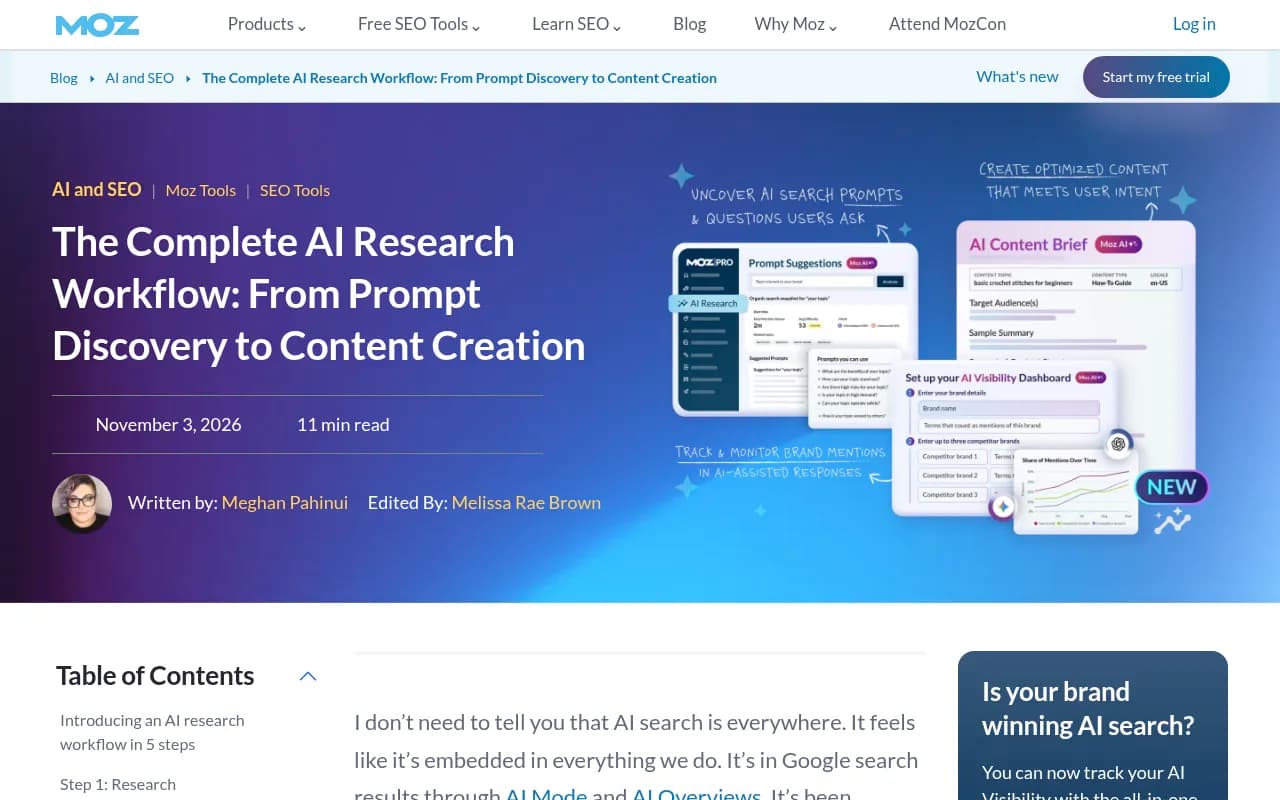
This guide walks through a five-step workflow that gets you from raw tracking data to a prioritized plan. It borrows the shape of the research, track, identify, create, monitor loop that Moz describes in its AI research workflow, but goes deeper on the middle part, where most plans fall apart: reading the data and picking formats.
The five steps:
- Build a prompt set that mirrors real buyers
- Segment the results and find the gaps
- Map each gap to a content format
- Turn gaps into a scheduled calendar, including refreshes
- Measure, then feed results back in
Step 1: Build a prompt set that mirrors real buyers
Garbage prompts produce garbage plans. Before you look at any score, check that the prompts you track are the ones your customers actually ask.
Where to source prompts
- Search Console queries and People Also Ask questions, rewritten as natural-language questions
- Sales call transcripts and support tickets (the phrasing is often better than anything keyword tools give you)
- Competitor comparison phrasing: "X vs Y", "alternatives to X", "best X for [role]"
- Pages already on your site, turned into the question they should answer
Tag every prompt by type (organic, brand-specific, competitor comparison) and by intent (informational, commercial, transactional, branded). You will use those tags in step 2, and retrofitting them later is miserable.
If you track several markets, keep them separate. A prompt asked in Germany and one asked in the US are different data points, and mixing them hides the gaps you actually care about.
Tools like Promptwatch bundle prompt volumes, difficulty scores and query fan-outs into the prompt research stage, which helps when you need to decide which prompts deserve tracking at all. Its prompt tracking runs against the real interfaces of ChatGPT, AI Overviews, Gemini and others, not only APIs.

How many prompts you need
Fewer than you think. A focused set of 50 to 150 prompts, grouped into 6 to 12 topics, is enough to see patterns. Hundreds of loosely related prompts just produce noise you will not act on.
Step 2: Segment the results and find the gaps
A single "visibility score" hides the cause of a problem. Read the metrics together, because each one points to a different fix. The Promptwatch metrics overview lays out the definitions; the practical reading looks like this:
| What you see | Likely problem | Content response |
|---|---|---|
| Low share of voice on a topic | Coverage: you have no page for it | Write new content |
| Mentioned, but late in the answer | Prominence: competitors are framed as the default | Strengthen comparison and category pages |
| Mentioned, but your domain is never cited | Content or crawlability | Create a citable source page, check bot access |
| Cited, but sentiment is weak | Reputation or inaccurate claims | Fix the pages teaching the wrong thing, earn reviews |
| Cited on third-party pages only | Offsite dependence | Pitch or contribute to those pages |
Moz's version of this is simple and worth stealing: if your brand appears second, third or fourth in a response while tracked competitors lead, or if the way you are described is off, that prompt becomes a content refresh candidate.
Look at what gets cited, not just who
For each gap, list the URLs the model cited. You are looking for the format and the source type. Are the cited pages listicles from review sites? Vendor docs? Forum threads? That tells you what the model considers an acceptable answer, and what you have to produce or earn a place on.
Source mix varies by engine and shifts quickly. In Promptwatch Data's social media citations report, ChatGPT got 0.46% of its citations from social platforms between Sep 28 and Oct 4, 2026, while Google AI Overviews got 12.2%. So a gap that needs a Reddit or YouTube answer is a very different plan for AI Overviews than for ChatGPT. Reddit's share of ChatGPT citations also fell from about 4% to 0.5% on August 14, 2026, per the Reddit citations report, so a plan built on seeding threads for ChatGPT needs a second look.
Score the gaps
Give every gap a quick priority score from 1 to 5 on three things: how valuable the prompt is (volume, buying intent), how winnable it is (difficulty, how weak the cited sources are), and how fast you can ship. Multiply them. Sort. That is your backlog, and it takes an afternoon in a spreadsheet.
Step 3: Map each gap to a content format
This is the step teams skip, and it costs them. The format you choose matters as much as the topic.
Promptwatch Data's content type report (Sep 28 to Oct 4, 2026) breaks down what ChatGPT cites:
| Content type | Share of ChatGPT citations |
|---|---|
| Product pages | 22.4% |
| Landing pages | 16.8% |
| Listicles | 13.6% |
| How-tos | 8.7% |
| Docs | 7.5% |
| General articles | 6.1% |
| Comparisons | 5.9% |
| News | 5.7% |
| FAQ | 3.3% |
| Reviews | 1.7% |
The split by intent is where it becomes a planning tool:
- Commercial prompts: product pages (26.0%), landing pages (20.6%), listicles (15.0%) and comparisons (7.9%) make up almost 70% of citations.
- Informational prompts: product pages still lead at 19.1%, but how-tos (10.7%), docs (8.5%) and articles (7.7%) carry more weight.
- Branded prompts: product pages (23.3%) and landing pages (22.8%) dominate, and reviews hit 5.6%, more than three times their overall share.
So the rule of thumb: commercial gaps get product pages, comparisons and listicles. Informational gaps get guides and docs. Branded gaps get your own site, an FAQ, and review coverage. A blog post is the default answer for almost everything, and it is often the wrong one.
Use fan-outs to size the content
One prompt rarely maps to one page. ChatGPT splits a prompt into several searches (the fan-out report says a single prompt can trigger 3 to 8 or more), and each sub-question is a chance to be cited or missed. The report's advice is practical: cover the sub-questions (comparisons, pricing, alternatives, how-tos), build clusters of focused pages rather than one mega-page, and write headings that read like short search queries with the entity and category first.
The average fan-out query also got much shorter, from about 117 characters in December 2025 to about 53 in April 2026. Short, entity-first headings match that behavior. You can explore fan-outs for free with the ChatGPT query fan-out generator, or read the query fan-outs guide for the concepts.
A worked example. Say you sell project management software and the prompt "best project management tool for agencies" shows you absent. The fan-outs suggest sub-questions on pricing, client collaboration, and alternatives to the market leader. Your content set might be one listicle-style category page, one comparison page, one pricing explainer, and one how-to on agency workflows. Four focused pages, each tied to a sub-question. That is a plan.
Step 4: Turn gaps into a scheduled calendar, including refreshes
Now you have a ranked backlog with formats attached. Put it on a calendar, and reserve a fixed share of capacity for refreshes, because content does not stay cited forever.
Plan refreshes from the half-life data
Promptwatch Data tracked every page ChatGPT cited on July 6, 2026, for 90 days. The content half-life report shows big differences by type:
| Type | Still cited after 60 days | Notes |
|---|---|---|
| Landing pages | 69% | 78% still cited at 30 days |
| Docs | 67% | 76% at 30 days |
| Comparisons | 63% | 72% at 30 days |
| Listicles | 60% | Cross 50% only in the final week |
| Product pages, reviews, how-tos | about 55% | Half-life of 74 to 77 days |
| News | 41% | Half gone after 36 days |
The planning implication is clear. Refresh product pages and how-tos on a schedule, roughly every 60 to 70 days. Landing pages, docs and comparisons can go longer between touches. Treat news as a short burst of visibility, not a durable asset, and do not build your core plan around it.
A sample monthly capacity split
- 40% new pages for high-priority gaps
- 30% refreshes of pages that are cited but slipping, or that rank below competitors in answers
- 20% supporting content for fan-out sub-questions
- 10% offsite work: reviews, third-party listicles, community answers where the engine still cites them
Adjust to your situation. A site with a thin library should skew toward new pages. A mature library should skew toward refreshes.
Check the technical floor first
Before commissioning anything, confirm AI crawlers can read the pages you already have. A page that bots cannot fetch will not get cited no matter how good it is. IP-verified crawler logs separate an access problem from a content problem, and the free Agentic Readiness Check shows which AI bots can reach your site. For more on how AI bots behave, see Promptwatch Data's AI crawler traffic report.
Who does the writing
There are three realistic options: your team writes everything, you use a general writing tool, or you use a platform that writes from your visibility gaps. Whichever you choose, ground the brief in the data you just collected: the prompt, its fan-outs, and the competitor pages the model already cites.
| Approach | Examples | Strength | Watch out for |
|---|---|---|---|
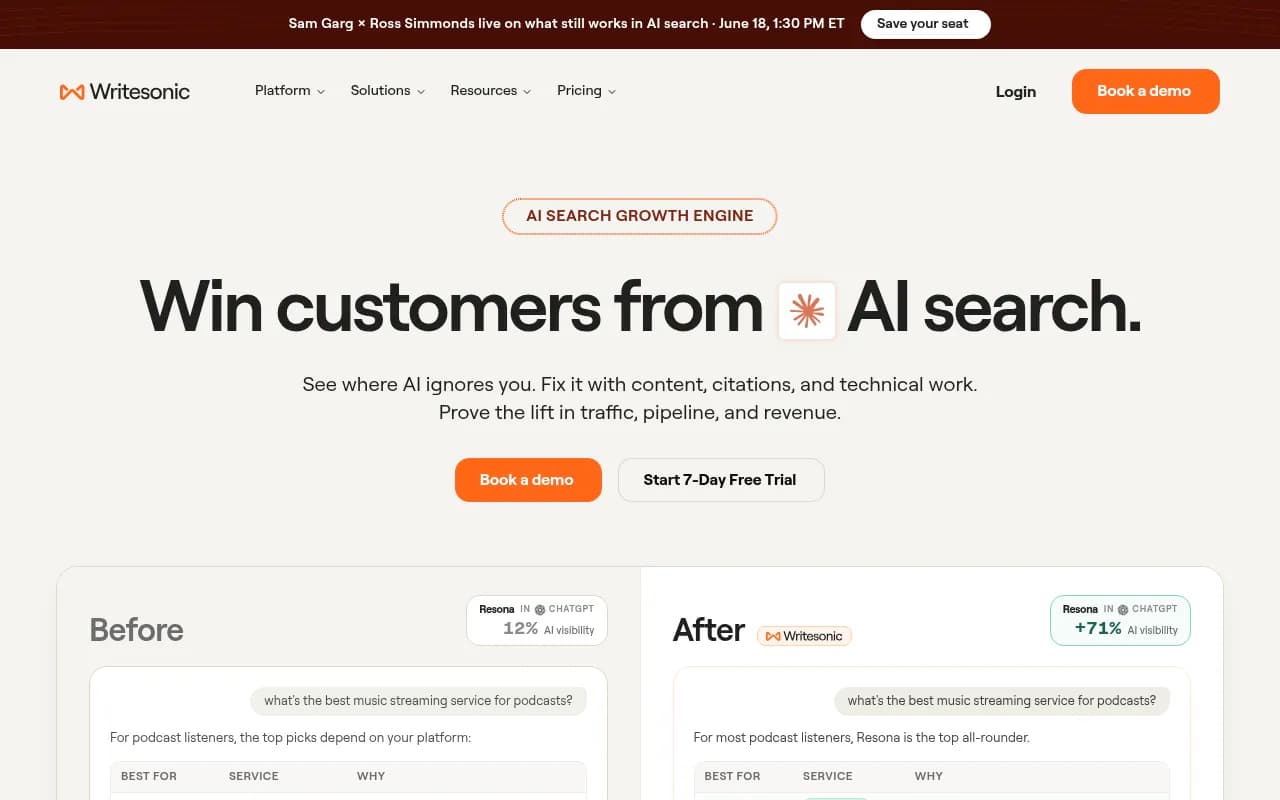
| Tracker plus content engine | Promptwatch, Writesonic GEO, Siftly | Briefs come from your actual gaps | Review output for accuracy and tone |
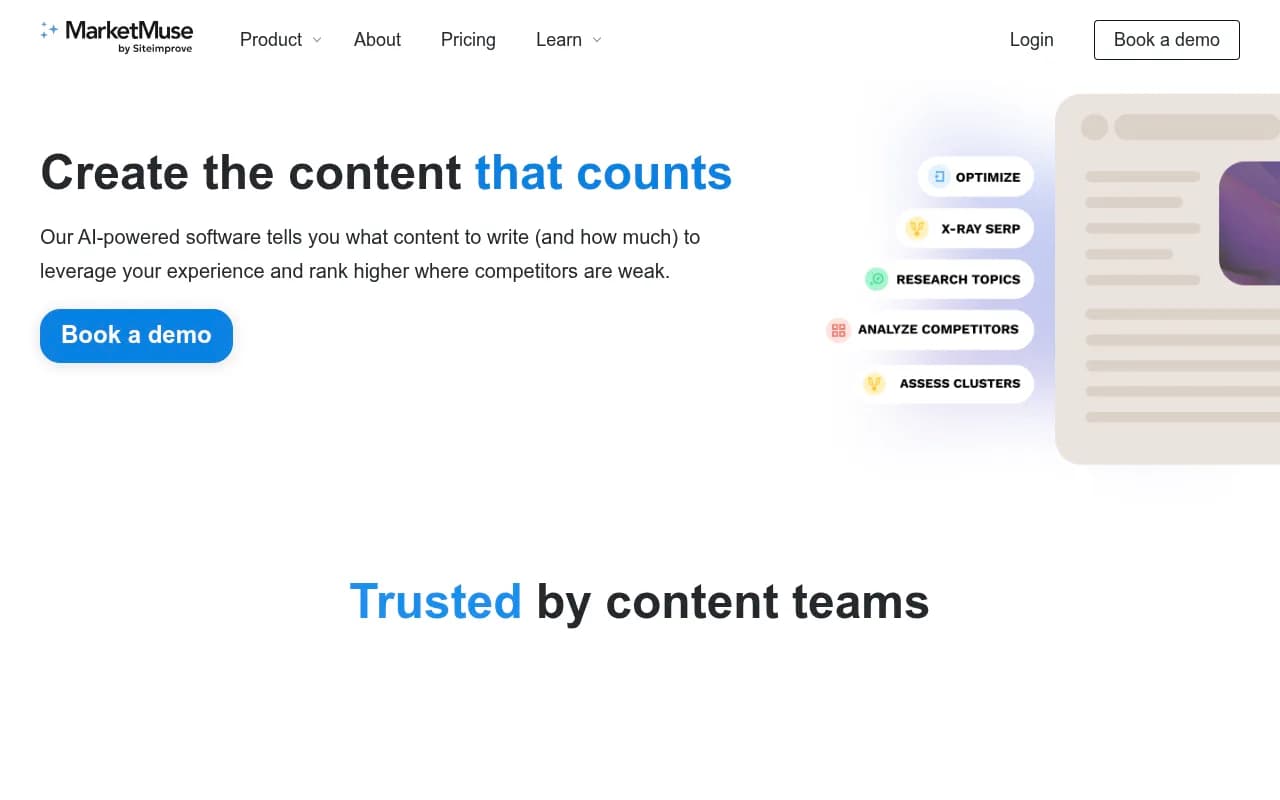
| Content optimization tools | Surfer SEO, Clearscope, Frase, MarketMuse | Strong on-page and topic coverage scoring | Built around search data, not AI answer gaps |
| General AI writers | Jasper, Copy.ai | Fast drafting | No visibility data to guide topics |
Promptwatch's Content Agent is built for this gap-to-draft handoff: it plans, writes and publishes against your visibility gaps, pushes drafts to WordPress, Webflow or Framer, and keeps a review inbox so a human approves before anything goes live. It is on the Business plan and above; confirm current plans at promptwatch.com/pricing.

If you want to compare more trackers and GEO platforms before picking a stack, the directory at bestgeosoftware.com lists them side by side.
Step 5: Measure, then feed results back in
Publishing is the middle of the workflow. The plan only improves if you check what happened.
What to check, and when
- Within a week or two: did AI crawlers fetch the new page? If not, fix access before judging content.
- After 2 to 4 weeks: is the page cited for the prompts it targeted, and where in the source list?
- After a month: did visibility, position and sentiment move on the target prompts versus a control group?
- Ongoing: does the page send visitors, and do they convert?
On that last point, AI traffic is getting harder to attribute. ChatGPT stopped sending a referrer on October 8, 2026, so you may need UTM-tagged visits counted as ChatGPT traffic. The attribution guide covers the options.
The monetary signal matters most. Dfirst's advice for AI content programs is to feed pipeline data back into ideation, so the content types with the highest pipeline per asset dominate the calendar. Same principle here: if comparison pages convert at twice the rate of how-tos, shift the next month's capacity.
Crisp is a concrete example. Using Promptwatch, it reported 2x higher conversion rates from AI traffic than from traditional channels and scaled to 5 to 10 articles per day. Read the Crisp case study for the details. Treat it as one company's result, not a promise.
The monthly review ritual
Run the same 30-minute review each month:
- List pages published last month and their citation status
- List pages that lost citations or position
- Re-score the top 10 gaps (they shift as competitors publish)
- Check for engine behavior changes in Promptwatch Data, such as ChatGPT's August 8, 2026 move to the site: operator at scale, which shifted which sub-queries mattered
- Rewrite next month's calendar
A tool with a prioritized to-do list helps here. Promptwatch's Action Board generates one from your data, and a weekly Discovery agent suggests evidence-backed actions. Other trackers like Peec AI, Otterly.AI and Profound cover monitoring with varying depth on the action side.



Common mistakes
- Tracking too many prompts and acting on none of them
- Writing a blog post for every gap, regardless of intent
- Treating one low score as a content problem when it is a crawl problem
- Ignoring refreshes because new pages feel more productive
- Judging a page after a week. Citation data needs a few weeks to settle
- Using generic prompt lists (the "40 prompts for marketers" kind) as your tracking set. Those help with drafting. They do not tell you what buyers ask models about your category
A one-page template
For each gap, record these fields. If you can fill them in, you have a plan; if not, you have a wish.
- Prompt and topic
- Intent and prompt type
- Current visibility, position and sentiment
- Top cited URLs and their formats
- Fan-out sub-questions to cover
- Chosen format and target URL
- Priority score
- Owner and publish date
- Refresh date (60 to 70 days out for product pages and how-tos)
- Check dates for crawl, citation and traffic
If you would rather have a team run this loop for you, 1001 SEO Media offers GEO and content services built around this kind of tracking-to-publishing workflow, and uses Promptwatch for AI visibility work.
Where to start this week
Pick one topic cluster, not the whole site. Build or audit 20 to 30 prompts, tag them, pull the cited sources, and identify the three biggest gaps. Choose formats using the intent split above, publish within two weeks, and set a calendar reminder to check citations at day 14 and day 30. You can run a first scan for free with the AI visibility report, or start a 7-day trial through Promptwatch if you want tracking and drafting in one place. Then repeat on the next cluster. The plan gets better each pass because the data you collect from your own published pages is the most relevant data you will ever have.