Key takeaways
- A query fan-out is the set of background searches an AI engine runs before it writes an answer. Your brief should cover those sub-queries, not only the head keyword.
- The sub-query count is variable. Promptwatch Data measured about 2.15 fan-outs per ChatGPT response in early December 2025, falling to roughly 1.0 by April 2026, then rising to about 1.8 after August 8, 2026. Vendor claims of 8-12 are not typical for ChatGPT.
- Sort sub-queries into three buckets (H2 sections, passage briefs, separate pages) rather than turning every one into a heading.
- Write each section as a standalone chunk that leads with the answer. Refresh briefs after major platform changes, because fan-out behavior shifts overnight.
What a fan-out actually is
When you ask ChatGPT, Google AI Mode or Perplexity something, the engine rarely searches your literal prompt. It rewrites it into one or more searches, retrieves passages for each, and synthesizes the result. The more of those retrieval paths your content shows up in, the better your odds of being cited.
So the brief changes. A classic SEO brief targets one keyword plus related terms. A fan-out brief targets the whole cluster of questions the engine asks on the user's behalf.
I'll be blunt about one thing before we start: a lot of fan-out content online overstates the numbers. Some guides say AI Mode fires 8-12 sub-queries and ChatGPT 4-20. Others say "3+". Promptwatch's own measurements for ChatGPT are much lower, so treat any single figure as a snapshot, not a rule.
What the data says about ChatGPT
Promptwatch Data's ChatGPT query fanout report tracked average fan-outs per response from early December through April:
- About 2.15 in early December
- About 1.84 by early March
- Exactly 1.0 when fan-outs returned in April after a gap in the data
Average query length also shrank, from about 117 characters in December to about 53 from April. That is roughly six to eight words. The practical takeaway: the searches ChatGPT runs look more like terse keyword queries than conversational questions.
Then on August 8, 2026, things moved again. Promptwatch Data found that the share of fan-outs using the site: operator jumped from 0.37% to 16.8% in a day, and average fan-outs per response rose from about 1.08 to about 1.83. Those site: searches were added on top of generic searches, not instead of them.
The lesson is that any fan-out list you pulled before August 8 is stale, and any list you pull now will drift.
Step 1: Pick the page and the prompts
Start from a page that matters, either one you already rank for or one you plan to build. Then write down the real prompts a buyer would type. Fan-outs hang off prompts, not keywords, so "best CRM for small agencies" and "CRM" produce very different clusters.
A few ways to get the prompt list:
- Search Console queries for the page
- People Also Ask boxes
- Sales call transcripts and support tickets
- Prompt research inside a visibility tool, which often shows volumes and difficulty
Keep it to five to ten prompts per page. More than that and the brief turns into a pile.
Step 2: Extract the fan-outs
There are three practical routes.
Route A: Read them directly from the engine
The free-ish option. Run your prompt in ChatGPT and inspect the searches it ran. A browser extension such as the GEO Inspector for ChatGPT from Promptwatch shows fan-outs and which sources were fetched versus cited. Gemini's grounding metadata and the OpenAI Responses API with web search expose the same data if you are comfortable with code. Fifty-Five and Five describes using exactly these APIs for their own content planning.
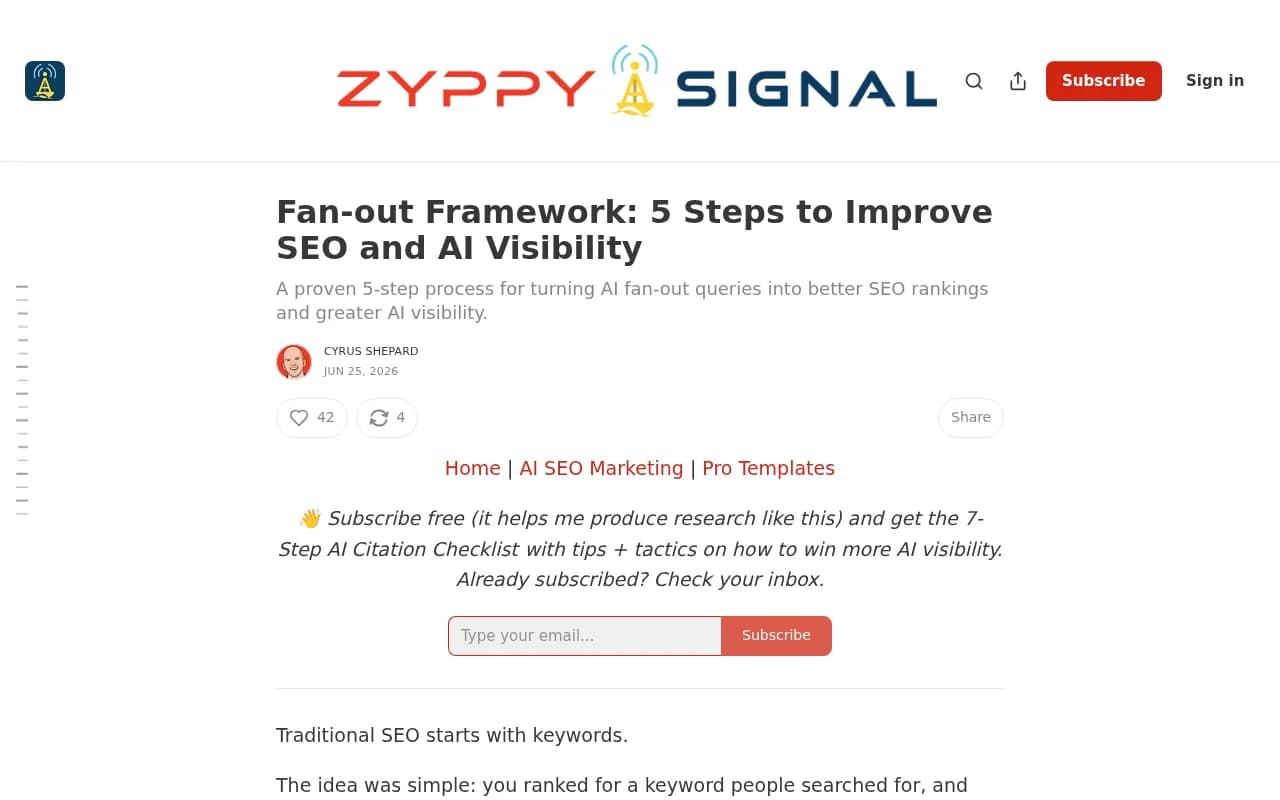
Cyrus Shepard's fan-out framework at Zyppy Signal points to QueryFan, which works best with an OpenAI or Gemini API key, and adds AlsoAsked data if you have a Pro plan there.
Route B: Use a dedicated fan-out tool
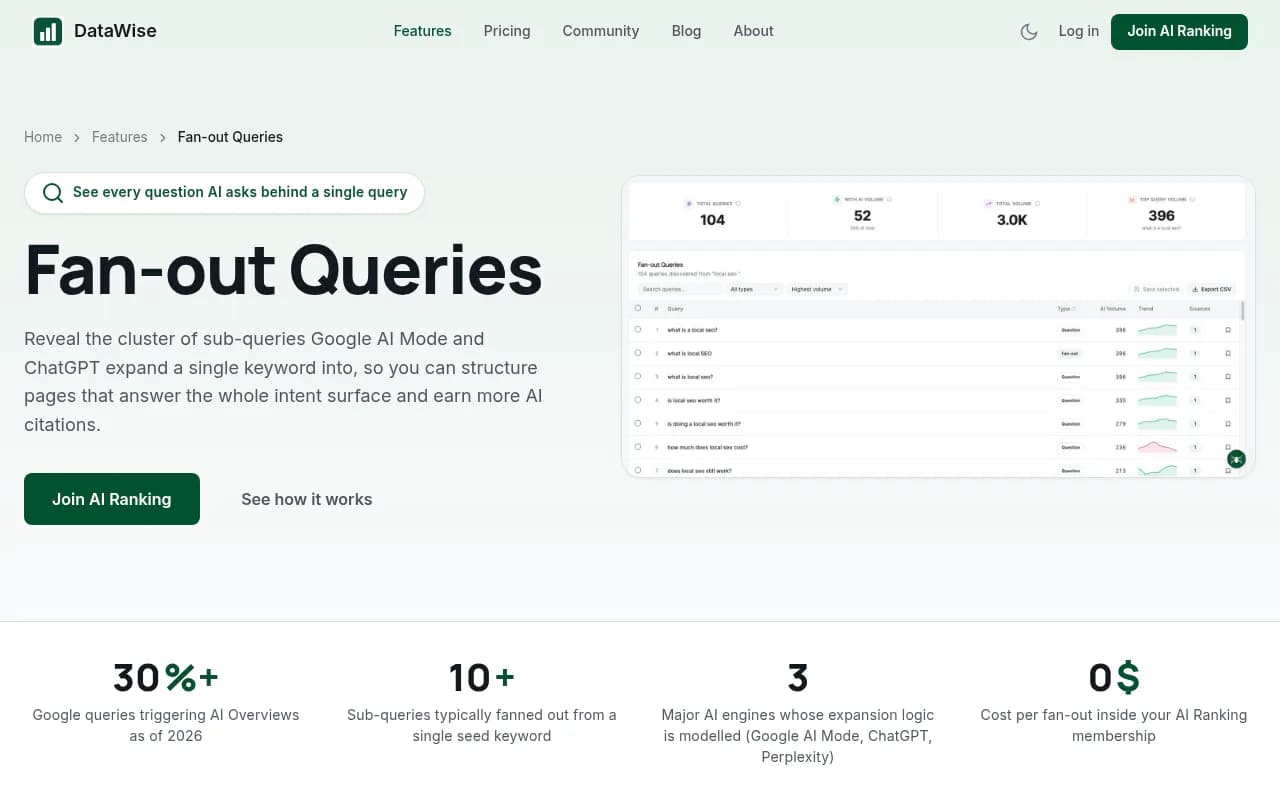
DataWise SEO has a Fan-out Queries feature that groups sub-queries by intent (informational, comparison, transactional, follow-up) and exports them as a heading outline. It is a modeled cluster, not a log of what an engine did on a given day, and its claim that one cluster works equally for Google AI Mode, ChatGPT and Perplexity is a vendor claim I could not verify. Use it as a starting point.
Route C: Pull them from a visibility platform
If you already track prompts, the fan-outs behind each tracked prompt are the most reliable input, because they come from real runs rather than a model of one.
Promptwatch shows the exact web searches AI runs per response alongside monthly prompt volumes and difficulty, and it can turn a citation's prompts into a content brief.

Profound ties its brief creation to the fan-out behind each tracked prompt too.

Aiso also advertises prompt and fan-out tracking.

Step 3: Sort the sub-queries
Do not turn every sub-query into an H2. You'll end up with a 6,000-word page that answers everything shallowly, and the retrieval step will skip it.
Fifty-Five and Five uses a useful classification: cross-platform (shows up in more than one engine), stable (shows up repeatedly over time) and weak (one-offs). Combine that with search volume and you get three outcomes.
| Sub-query type | Signal | What it becomes |
|---|---|---|
| Has search volume and recurs | Ranks in classic search and AI | H2 section on the page |
| Recurs in AI runs but no volume | Only AI cares | Passage brief: a 130-170 word self-contained answer inside a related section |
| Deserves a full treatment | Different intent from the main page | Separate page linked from the pillar |
| One-off or noisy | Appears once | Ignore, recheck next run |
Promptwatch's own recommendation from the fan-out data is to favor a cluster of focused pages over one mega-page. A page aimed at one intent beats a page that half-covers two. That fits the table above: the third row exists for a reason.
Check intent type
Across your sub-queries, look for these recurring shapes and make sure the page covers the ones that apply:
- X vs Y comparisons
- Pricing and cost
- Alternatives
- How-to steps
- Definitions and "what is"
Promptwatch's data suggests ChatGPT's searches skew terse, so also note the exact phrasing. A sub-query like "best CRM for small agencies 2026" suggests a heading that reads like that search, not a chatty question.
Step 4: Write the brief
A fan-out brief has a few more fields than a standard SEO brief. Here is a template you can paste.
Page: [URL or working title]
Target prompts: [5-10 real prompts]
Head answer (40-60 words): [direct answer to the main prompt]

H2 sections (from sub-queries with volume):
  H2: [sub-query phrasing]
    Answer-first paragraph: [what it must state]
    Evidence to include: [data, quotes, first-party numbers]
    Format: [list / table / steps]

Passage briefs (AI-only sub-queries):
  Q: [sub-query]
  Place under: [section]
  Answer length: 130-170 words, standalone

Separate pages to create: [list]
FAQ rows: [remaining sub-queries]
Schema: [FAQ / Product / HowTo as relevant]
Internal links: [pillar <-> cluster pages]
Own-domain check: [category pages, internal search, indexation]
Refresh trigger: [monthly, or after major model update]
Lead with the answer
Conductor's advice is blunt and right: don't bury the answer under a long intro. The longer a retrieval system takes to find the relevant text, the more likely it uses someone else's page. Put a 40-60 word direct answer first, then elaborate.
Write extractable chunks
Similarweb recommends each section function as a standalone chunk. In practice that means every H2 section should make sense if lifted out of the page. Avoid "as mentioned above" and pronouns that depend on earlier paragraphs. Hedge-heavy passages ("on the one hand, on the other, depending on...") are hard to extract because they do not answer anything directly.
Add something nobody else has
Generic coverage is cheap, and AI engines have plenty of it. Cyrus Shepard's advice applies here: add first-party information or a personal perspective when you can. Original data, screenshots of your own product, and named experts give a passage a reason to be the one cited.
Promptwatch Data supports leaning toward specific formats. In the week of Sep 28 to Oct 4, 2026, product pages were the most cited content type in ChatGPT at 22.4%, ahead of landing pages and listicles. If a sub-query is commercial, a page type that matches belongs in the plan.
Step 5: Structure for retrieval
A few mechanics that make the passages easier to pull:
- Headings that mirror sub-queries, with the entity and category up front
- Tables for comparisons and lists for steps
- FAQ schema on the FAQ block, product schema on product pages
- Short paragraphs with one claim each
- Descriptive alt text on images and transcripts for video
Schema does not rank a passage by itself, but it labels a paragraph as the answer to a question, which is exactly what the retrieval step is looking for.
Treat your own domain as a retrieval surface
Since ChatGPT started using site: at scale, your domain is searched directly in a meaningful share of fan-outs. According to Promptwatch Data, thin category pages, broken internal search and unindexed content now cost you answers. Before publishing, confirm the page is crawlable and indexed, and check that your category and hub pages say something real.
Step 6: Publish, measure, and refresh
A brief is a hypothesis. To test it, track whether the new page gets crawled, cited, and clicked.
- AI crawler logs show whether bots reached the page and hit errors
- Citation tracking shows which prompts cite it and where it lands in the source list
- Analytics shows whether AI referrals convert
- Search Console shows classic rankings for the same page
Then rerun the fan-out. Promptwatch's data says to re-audit keyword-to-heading mapping after major ChatGPT updates, because phrasing that matched last quarter may be stale. Monthly is reasonable for fast-moving topics. DataWise keeps prior runs so you can diff clusters, which is a good habit whatever tool you use.
Content also decays. In Promptwatch's half-life study, landing pages and docs stayed cited longest, while news lost half its pages within 36 days. Plan refreshes by content type, not by one calendar.
Tools compared
| Tool | What it gives you for fan-out briefs | Best for |
|---|---|---|
| Promptwatch | Real fan-outs per tracked prompt, volumes, difficulty, content gap analysis, Content Agent, crawler logs | Teams that want to go from brief to published page to measured result |
| Profound | Brief creation built from tracked prompts and their fan-outs | Enterprise teams already in Profound |
| DataWise SEO Fan-out Queries | Modeled sub-query clusters grouped by intent, exports to outline | Quick briefs from a seed keyword |
| QueryFan plus an API key | Raw sub-queries from OpenAI or Gemini | Technical SEOs on a budget |
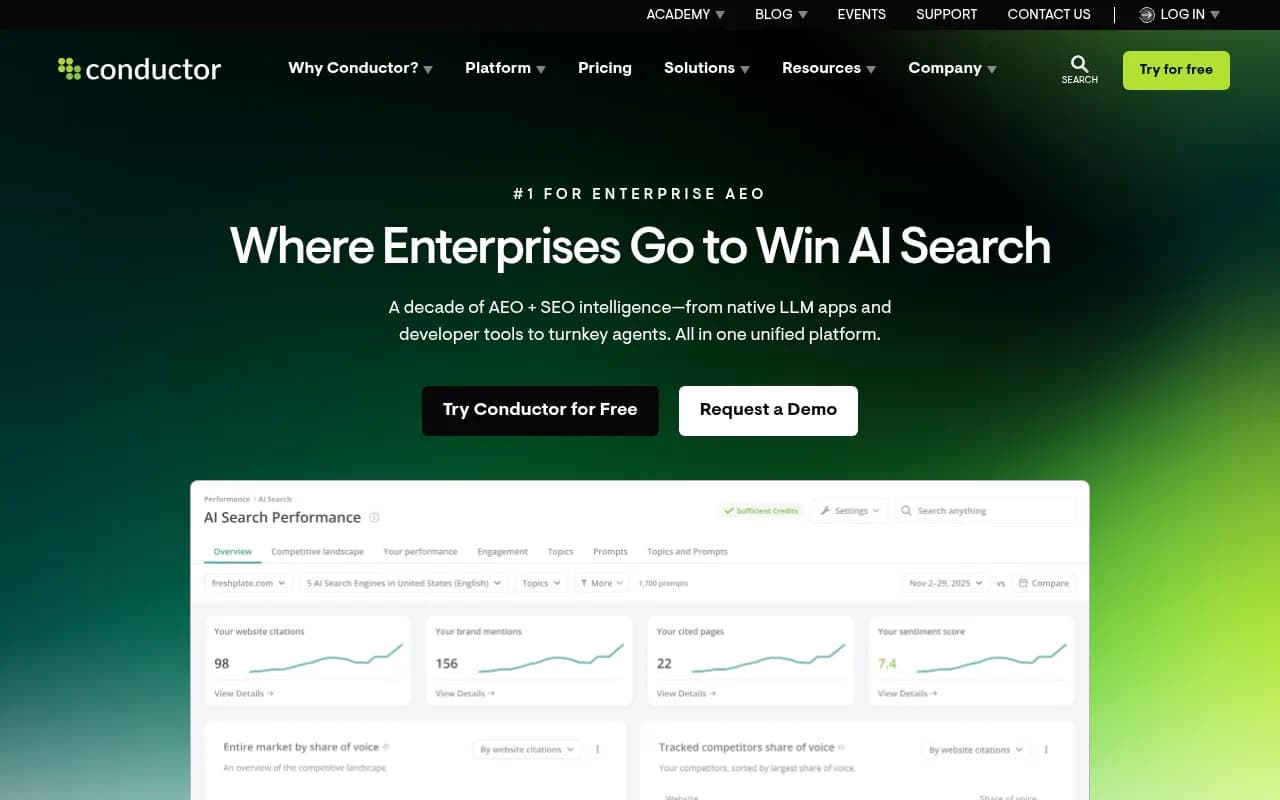
| Conductor | Topic cluster and AEO visibility guidance | Enterprise content teams |
| Surfer SEO | Content optimization against search data | Drafting and scoring pages |
For a wider survey of options, the GEO software directory lists many more trackers and optimizers.
Common mistakes
Treating the sub-query count as fixed
It is not. It changed from about 2 down to 1 and back to about 1.8 across 2026 in ChatGPT, and Google AI Mode behaves differently. Build briefs from fresh data.
Writing one giant guide
A 4,000-word ultimate guide often has one or two clean passages for a dozen sub-queries. The fix is not more words. It is more passages, and sometimes more pages.
Copying vendor clusters without checking
Modeled clusters are useful, but verify a few against a real ChatGPT or Gemini run. If the engine searches something your brief never mentions, add it.
Skipping the off-page side
AI engines cite third-party pages heavily. Social platforms are a good example: in one week from Sep 28 to Oct 4, 2026, ChatGPT got 0.46% of its citations from social platforms while Google AI Overviews got 12.2%. A brief that ignores where each engine actually looks will miss half the picture.
A worked example
Say your target prompt is "best project management software for agencies". A run might return searches like "project management software agencies 2026", "agency project management pricing", "[Tool A] vs [Tool B] agencies", and "project management software for client reporting".
Sorting them:
- The first has volume and recurs, so it is the page's main H2 and its head answer
- The pricing query has volume, so it gets an H2 with a table
- The comparison query suggests a separate comparison page, linked from the pillar
- The client reporting query has no volume but recurs, so it becomes a 150-word passage inside the features section
The brief lists each of those, the evidence to include, and the pages to link. A writer can work from it without guessing.
Final checklist
- Real prompts written down for the page
- Fan-outs pulled from a live run or a tracker, dated
- Sub-queries sorted into H2s, passage briefs, separate pages and ignored
- Head answer of 40-60 words at the top
- Every section standalone, with the answer first
- Something original on the page that competitors lack
- Page crawlable, indexed, linked from related pages
- A refresh date in the calendar
If you want a second opinion on the plan, an agency such as 1001 SEO Media runs this kind of GEO planning for clients and uses Promptwatch for the measurement side. Otherwise, pick one prompt, run the fan-out today, and write one brief. You will learn more from the first page than from any guide.