Key takeaways
- Most SEO fundamentals still carry over: crawlable sites, useful content, real authority. AI search did not replace them.
- What changed in practice is the unit of success (a citation inside an answer, not a ranked URL), the shape of content that gets picked, and how you measure it.
- Promptwatch Data (Sep 28 to Oct 4, 2026) shows ChatGPT sends 39% of its citations to product and landing pages, so commercial pages matter more than many SEO teams assumed.
- Each AI engine behaves differently. Social citations are 0.46% of ChatGPT's citations but 12.2% of Google AI Overviews'.
- You need new measurement: prompt tracking, crawler logs, and AI referral traffic, because analytics often files this activity under "Direct".
The short answer
Yes and no. If you ask whether AI SEO is a separate discipline with its own secret rules, the answer is mostly no. If you ask whether you can keep running a 2019 SEO playbook and expect the same results, also no.
I think the honest framing is this: AI SEO is SEO with a different finish line and a few new inputs. Indexable pages, clear writing, topical depth, and a reputation worth citing still do the heavy lifting. But the place where a buyer meets your brand has moved. Increasingly it is a synthesized answer, not a list of ten links.
The Adobe team put it neatly in their 2026 piece on SEO fundamentals: the question shifts from "does this page rank?" to "is this brand cited in the answer?"
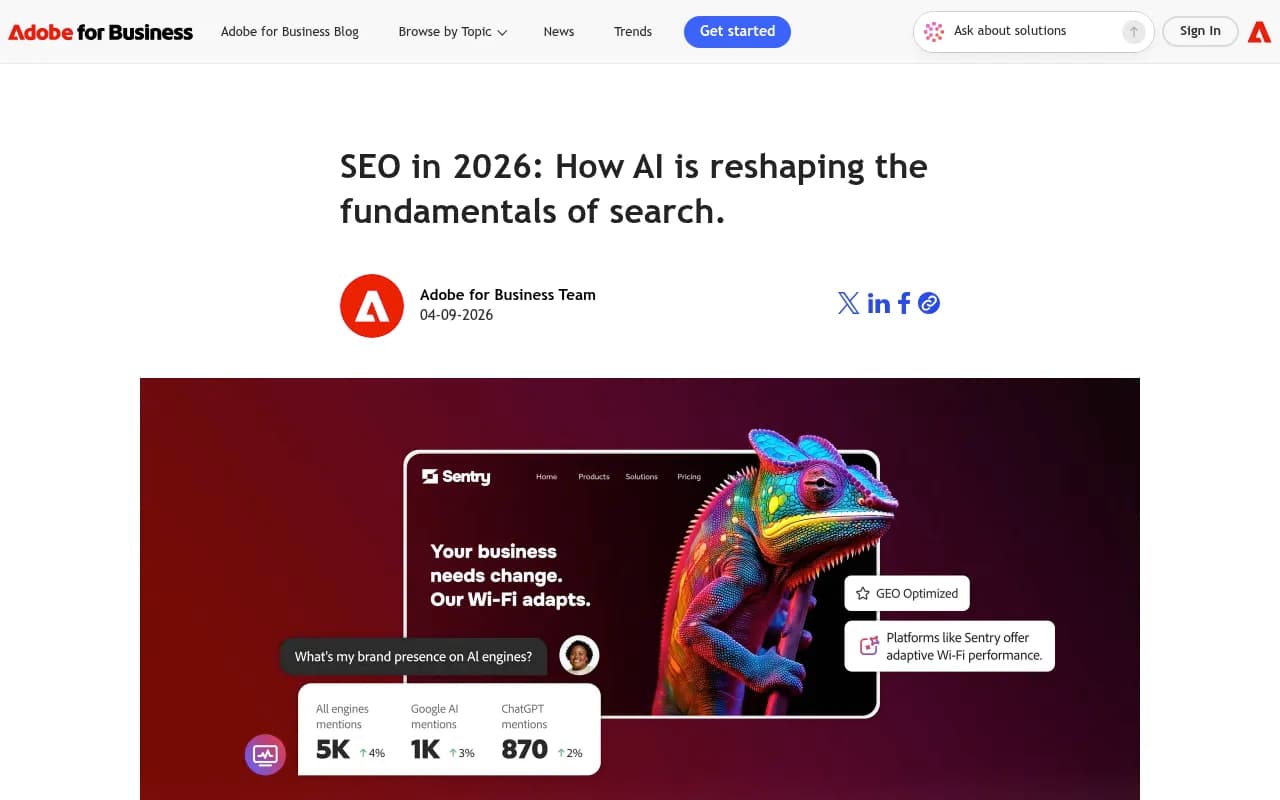
That framing is useful, even if some of the surrounding vendor language is inflated. Let's separate what stayed from what moved.
What stayed the same
Crawlability and technical health
An AI system cannot cite a page it cannot fetch. Broken rendering, blocked bots, slow servers, and orphaned pages hurt you in Google and in ChatGPT alike. If anything, technical hygiene matters more now, because there are more crawlers hitting your site, and each has its own user agent and its own rules.
A good example is the growth of Meta-WebIndexer. Promptwatch Data shows it going from about 2% to nearly 38% of tracked AI crawler requests between mid-July and August 9, 2026. A robots.txt written for Googlebot alone is no longer a complete policy.
Content that answers the question
Thin pages and keyword stuffing were already weak. They are weaker now. AI systems extract facts and compare claims across sources, so contradictory or outdated statements on your own site work against you. That is old advice (be accurate, be complete) with a sharper penalty.
Authority, but not the way you might expect
Backlinks and brand reputation still matter. Yet the data suggests the authority game is less top-heavy than classic SEO. In August 2026, sites with domain rank 46 to 75 earned almost half of ChatGPT citations, while DR 91 to 100 sites fell to about 3%. A mid-sized site with a focused, relevant page can beat a giant.
What actually changed
The goal is a citation, not just a click
Classic SEO measured rankings, sessions, and conversions. AI search adds a layer before the click: did the model mention you, where in the answer, and did it link to you? Those are different problems.
A few practical consequences:
- You can be mentioned without being linked, and still influence a purchase.
- You can rank on page one of Google and never get cited by ChatGPT.
- A citation can drive traffic that your analytics misclassifies. Adobe flags exactly this: AI-driven visits often land in "Direct" or go uncaptured.
Which pages get cited has shifted toward commercial content
This is the part that surprised me most. Many SEO teams treat product and landing pages as conversion assets, not ranking assets, and put their effort into blog posts. The data says the opposite for ChatGPT.
In Promptwatch's ChatGPT citation data by content type (Sep 28 to Oct 4, 2026), the breakdown looked like this:
| Content type | Share of ChatGPT citations |
|---|---|
| Product pages | 22.4% |
| Landing pages | 16.8% |
| Listicles | 13.6% |
| How-to guides | 8.7% |
| Documentation | 7.5% |
| General articles | 6.1% |
| Comparisons | 5.9% |
| News | 5.7% |
| FAQ pages | 3.3% |
| Reviews | 1.7% |
Product and landing pages together take 39%. For commercial prompts like "best CRM for small businesses", product pages alone hit 26.0% and landing pages 20.6%. Branded prompts lean on reviews at 5.6%, more than three times their overall share.
So the practical shift is not "write more blog posts." It is: make sure your product pages state specs, prices, and positioning plainly, because the model quotes them directly.
Content has a half-life that varies by type
Classic SEO content could sit and earn for years. In ChatGPT, formats age differently. Promptwatch's half-life study tracked pages ChatGPT cited on July 6, 2026 for 90 days. Landing pages and docs stayed cited longest, while news lost half its pages within 36 days. If your strategy leans on news-style posts, expect to refresh them or accept the churn.
One prompt becomes many searches
When someone asks ChatGPT a question, it often runs its own web searches, called query fan-outs. Promptwatch's fan-out data shows averages around 2.15 searches per response in December 2025, about 1.84 by early March 2026, and 1.0 in April. Fan-out query length also shrank, from about 117 characters in December to about 53 in April.
The implication is subtle but real. You are not optimizing for the user's prompt. You are optimizing for the shorter, more literal queries the model generates from it. That favors headings that read like search queries, with the entity and category up front, and clusters of focused pages over one sprawling mega-page.
Things shift quickly here. On August 8, 2026, ChatGPT started using the site: operator at scale, jumping from about 0.4% to about 17% of fan-out queries overnight. Behavior you rely on today can change in a day.
Every engine has its own habits
In classic SEO, Google was the whole game. Now you are optimizing for several systems that disagree with each other. Social citations show it clearly. In Promptwatch's October 2026 social citations report (Sep 28 to Oct 4):
| Engine | Share of citations from social platforms | Top social source |
|---|---|---|
| ChatGPT | 0.46% | LinkedIn (0.3%) |
| Google AI Overviews | 12.2% | YouTube (4.28%) |
| Perplexity | 2.7% | LinkedIn and Reddit (0.86% each) |
Reddit is the sharp example. Reddit's share of ChatGPT citations collapsed from roughly 4% to 0.5% on August 14, 2026, while AI Overviews declined more gradually. If your plan was "seed Reddit threads to get into ChatGPT," that plan aged badly in one afternoon.
The takeaway: invest in YouTube, Facebook, and Instagram if Google AI Overviews matters to you, and do not lean on Reddit for ChatGPT.
Not everything people say about AI SEO is true
Some claims worth treating with suspicion:
- "You need markdown files for AI." Markdown files are just 0.05% of AI search citations. They serve AI agents, not AI search.
- "Special schema is required." PBJ Marketing notes that Google says AI search needs no special schema. Structured data helps machines understand a page, but it is not a magic switch.
- "Zero-click is above 65% on mobile." One vendor blog claims this. I could not trace it to a primary source, so I would not repeat it in a deck.
Side by side: classic SEO vs AI SEO in practice
| Area | Classic SEO | AI SEO in 2026 |
|---|---|---|
| Goal | Rank and earn the click | Be cited and recommended in the answer |
| Main metrics | Rankings, sessions, conversions | Visibility, share of voice, citations, AI referral traffic |
| Content bias | Informational blog content | Product pages, landing pages, listicles, docs |
| Query matching | Target the keyword | Match the fan-out queries the model generates |
| Authority | Domain strength | Relevance, with mid-authority sites doing well |
| Bots to manage | Googlebot, Bingbot | GPTBot, ChatGPT-User, ClaudeBot, PerplexityBot, Meta-WebIndexer and more |
| Volatility | Core updates a few times a year | Behavior can shift in a day |
What to do about it
1. Audit your commercial pages first
Before you commission another ten blog posts, read your product and landing pages as if you were a model. Are prices, specs, and positioning stated in plain text? Is anything contradicted elsewhere on your site? Fix those first.
2. Check that AI crawlers can actually reach you
Look at your robots.txt, your CDN rules, and your server logs. Many sites accidentally block AI bots or serve them errors. Crawler logs that are IP-verified are better than user-agent strings alone, since spoofing is common.
3. Map content to prompt intent
Commercial prompts want product pages, comparisons, and "best of" lists. Informational prompts lean more on how-tos and docs. Branded prompts reward reviews and FAQs. Build the format the prompt type tends to cite.
4. Get into the third-party pages AI already trusts
Listicles earn 13.6% of ChatGPT citations. If a roundup in your category never mentions you, that is a gap no amount of on-site work will close. Reviews on trusted sites and digital PR fill it. This is one place where an agency such as 1001 SEO Media is relevant, since it blends technical SEO, digital PR, and generative engine optimization, but plenty of in-house teams do this too.
5. Measure the new things
You need three views: what AI engines say about you (prompt tracking), what bots read on your site (crawler logs), and what visitors they send (referral analytics). The tooling splits into a few groups.
Tools worth knowing
There are well over a hundred AI visibility tools now, so I will keep this to what each type is for.
For end-to-end work, Promptwatch tracks real AI interfaces, shows crawler logs and AI traffic, and has agents that draft and publish content against visibility gaps. That covers the loop from "where am I missing" to "did the fix work", which most pure trackers do not.

If you are already deep in a classic SEO suite, the AI add-ons are the easy starting point, though they tend to be shallower on AI-specific data.

For enterprise-grade monitoring, Profound and Scrunch AI are the usual names.


For lightweight, lower-cost prompt monitoring, Otterly.AI and Peec AI cover the basics.


If you want to browse more options, the GEO software directory at bestgeosoftware.com lists many of them side by side.
| Need | Tool type | Examples |
|---|---|---|
| Track mentions and citations | AI visibility tracker | Promptwatch, Otterly.AI, Peec AI |
| Fix content and publish | Optimization platform | Promptwatch, Surfer SEO |
| Add AI to existing SEO workflow | SEO suite add-on | Semrush, Ahrefs Brand Radar |
| Enterprise reporting | Enterprise platform | Profound, BrightEdge, Conductor |
For content optimization grounded in search data, Surfer SEO remains a common pick.
So, is AI SEO just SEO?
Mostly it is SEO with a wider surface area. The craft is the same: make something useful, make it easy to fetch, make it clear who you are. The differences are in where the result shows up, which pages get picked, how fast the rules change, and how you prove it worked.
If I had to pick one habit to start with, it would be this: pull up the last 20 prompts a customer might type into ChatGPT about your category, run them, and see who gets cited. If it is not you, the cause is usually something specific you can fix, like a vague product page, a blocked crawler, or a missing spot on a roundup. That is a more productive afternoon than debating whether the name of the discipline should change.