Key takeaways
- Searchable is a well-funded AI search monitoring platform ($14M Series A, May 2026) with real traction -- 12,000+ brands tracked, 45M+ citations analyzed -- but it's primarily a monitoring tool, not an optimization platform.
- For mid-market teams ($5M-$50M ARR), the ROI question isn't "can it track AI citations?" -- it can. The question is whether monitoring data alone translates into pipeline impact without a content action layer.
- Searchable has a notable gap: Claude tracking is limited or absent depending on your plan, which matters because Claude is increasingly used in enterprise buying contexts.
- The platforms that generate measurable ROI in 2026 tend to close the loop between visibility data and content creation. Monitoring-only tools leave that work to your team.
- If you're evaluating Searchable, compare it directly against platforms that include content gap analysis and generation -- the difference in time-to-impact is significant.
The context: why mid-market teams are asking this question now
AI search isn't a future trend anymore. Buyers at B2B SaaS companies are using ChatGPT, Perplexity, and Google's AI Mode to shortlist vendors before they ever visit a website. According to research from Marketri, AI-generated answers now influence a meaningful share of early-stage B2B research, and that share is growing fast in 2026.
For mid-market marketing teams -- roughly $5M to $50M ARR, with a lean but dedicated marketing function -- this creates a specific problem. You don't have the headcount of an enterprise team to manually audit every AI response. You need tooling. But the tooling market is crowded, confusing, and full of platforms that look similar on a features page but behave very differently in practice.
Searchable is one of the most-discussed options right now, partly because of its funding story and partly because it launched publicly in January 2026 and grew fast. So let's look at whether the hype holds up for your specific situation.
What Searchable actually is
Searchable was founded by Chris Donnelly, a British serial entrepreneur, and launched publicly in January 2026. By May 2026, it had raised a $14 million Series A led by Headline at an $85 million valuation. Headline's portfolio includes Semrush (later acquired by Adobe for $1.9 billion), which gives the investment some pattern-recognition credibility -- they've backed search software before and know what category leadership looks like.
The platform's core pitch is that it replaces guesswork about AI search visibility with structured data. You can track how often your brand appears in AI-generated responses, which competitors are getting cited instead of you, and which topics you're visible for across models like ChatGPT, Perplexity, and Google AI Overviews.
By mid-2026, Searchable had:
- 12,000+ brands tracked
- 45 million+ citations analyzed
- £1.4 million ARR reached in under 4.5 months from launch
That's a real growth story. The question is whether the product behind those numbers is mature enough to justify the cost for a mid-market team with limited resources.
What Searchable does well
Visibility tracking across major AI models
Searchable tracks brand mentions and citations across ChatGPT, Perplexity, and Google AI Overviews. For teams that have been flying blind -- no idea whether they're appearing in AI responses at all -- this is genuinely useful. You get a structured view of your AI presence instead of manually prompting models and hoping for consistent results.
Competitor comparison
The platform shows you how your AI visibility compares to named competitors. This is one of the more actionable outputs a monitoring tool can produce: knowing that a competitor is getting cited 3x more often than you for a specific category of prompts gives you a clear direction for content investment.
Citation source analysis
Searchable surfaces which pages and sources AI models are pulling from when they generate responses in your category. This matters because it tells you where to focus -- whether that's your own site, third-party publications, or community content like Reddit threads.
Speed of setup
Multiple reviewers note that Searchable is relatively fast to configure. For a mid-market team that doesn't have weeks to spend on onboarding, that's a real advantage.
Where Searchable falls short for mid-market teams
It's a monitoring tool, not an optimization platform
This is the central limitation. Searchable shows you data. It doesn't help you act on it. If your brand isn't appearing in AI responses for a key buying-stage prompt, Searchable will tell you that. It won't tell you exactly what content to create, generate a brief, or produce a draft article targeting that gap.
For a mid-market team where the SEO manager is also doing content strategy, paid search oversight, and reporting, "here's the gap" without "here's how to close it" means the data sits in a dashboard and the gap stays open.
The Claude tracking gap
This is a specific, documented limitation. Searchable's Claude coverage is either absent or limited depending on your plan tier. Claude matters more than it did 12 months ago -- it's increasingly the model of choice in enterprise environments, and Anthropic has been expanding Claude's web access and citation behavior. If your buyers work at companies that use Claude via Anthropic's API or the Claude.ai interface, you have a blind spot.
Prompt intelligence is shallow
Searchable tracks whether you appear in responses to prompts, but it doesn't give you volume estimates or difficulty scores for individual prompts. For a mid-market team trying to prioritize where to invest content effort, this is a meaningful gap. You want to know not just "we're missing from this prompt" but "this prompt is searched 4,000 times a month and our competitors are weak here." Without that, prioritization is still guesswork.
No crawler log visibility
You can't see whether AI crawlers are actually hitting your pages, how often, or what errors they're encountering. This matters because a page that isn't being crawled by AI agents won't be cited regardless of how good the content is. Diagnosing indexing issues requires a different tool entirely.
No content generation
No briefs, no drafts, no AI-assisted content creation tied to the visibility gaps the platform surfaces. You get the diagnosis without the treatment.
The ROI math for mid-market teams
Let's be direct about how ROI works here, because "AI search visibility" can feel abstract until you connect it to revenue.
The chain looks like this:
- A buyer prompts ChatGPT or Perplexity with a category question ("best [your category] software for [use case]")
- Your brand appears in the response with a citation
- The buyer clicks through or searches your brand name directly
- They enter your funnel
If you're not in step 2, you're invisible to a growing share of early-stage buyers. According to a Forbes analysis from January 2026, 56% of CEOs report seeing no ROI from AI investments -- and the pattern among the 12% who do see returns is that they measure specific outcomes, not just usage metrics.
The same principle applies to AI visibility tooling. Paying for a monitoring platform that shows you gaps but doesn't help you close them is paying for awareness of a problem, not a solution to it. The ROI comes from closing gaps, not from knowing they exist.
For a mid-market team spending $300-600/month on an AI visibility tool, the break-even is roughly one additional qualified opportunity per quarter that you can trace back to improved AI citation. That's achievable -- but only if the tool helps you actually improve your citations, not just measure them.
How Searchable compares to the alternatives
Here's a direct comparison of Searchable against other platforms mid-market teams commonly evaluate:
| Platform | Monitoring | Content gap analysis | Content generation | Crawler logs | Prompt volume data | Claude tracking |
|---|---|---|---|---|---|---|
| Searchable | Yes | Limited | No | No | No | Limited |
| Otterly.AI | Yes | No | No | No | No | Partial |
| Peec AI | Yes | Basic | No | No | No | Partial |
| AthenaHQ | Yes | Yes | No | No | Limited | Yes |
| Profound | Yes | Yes | No | No | Yes | Yes |
| Promptwatch | Yes | Yes | Yes | Yes | Yes | Yes |
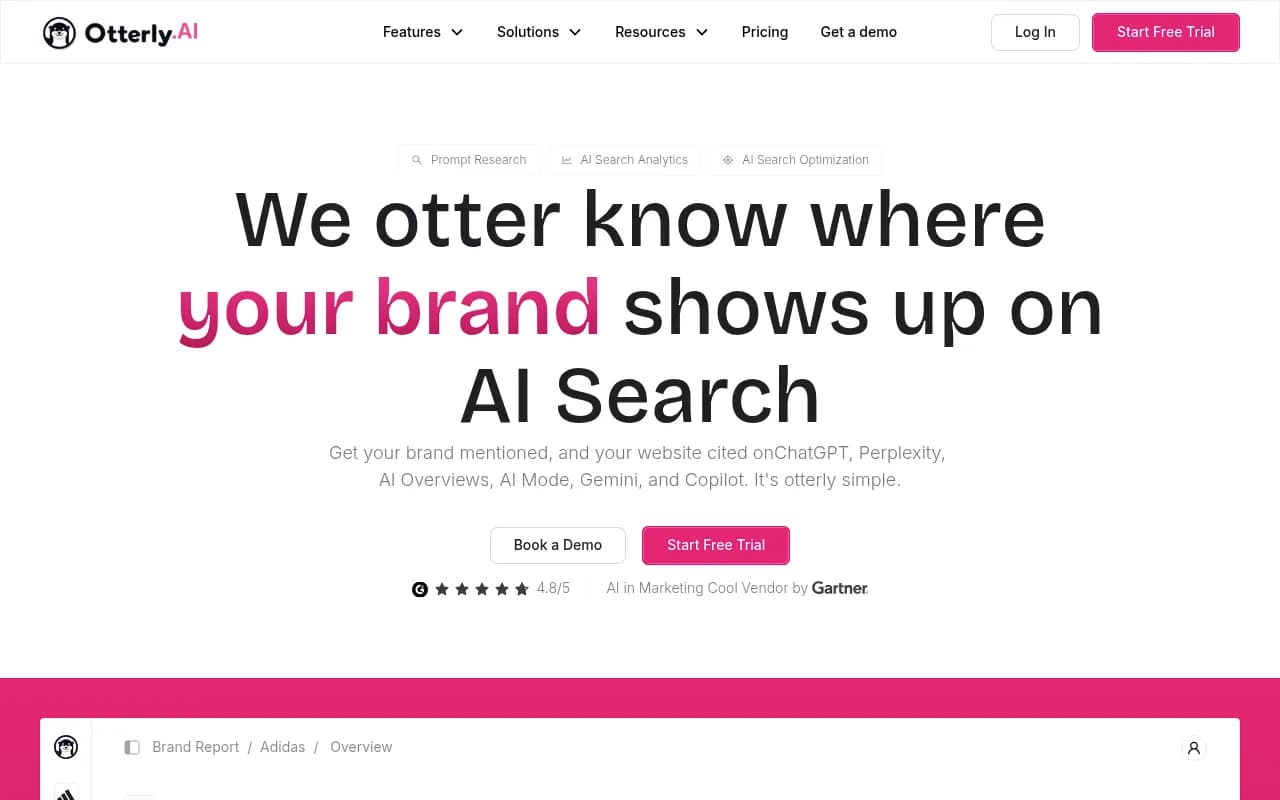
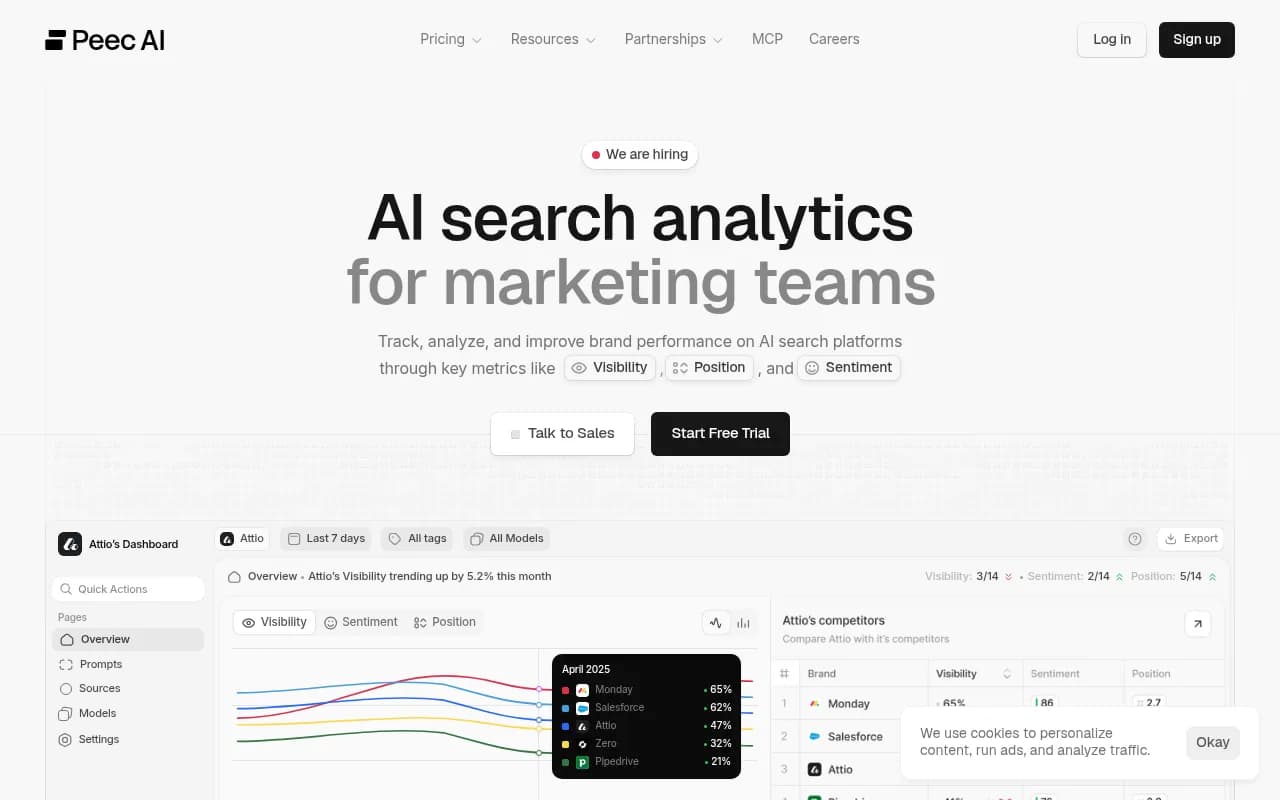
The pattern is clear: Searchable is competitive on the monitoring side but trails on the action side. If your team's primary need is "we need to know where we stand," Searchable does that. If your need is "we need to improve where we stand and show the results to our CMO," you need a platform that closes the loop.
Who Searchable is actually a good fit for
Despite the limitations, there are real use cases where Searchable makes sense:
Brand and comms teams doing reputation monitoring. If your primary goal is knowing when and how your brand appears in AI responses -- not necessarily improving it -- Searchable's monitoring capabilities are solid and the setup is fast.
Teams with existing content production capacity. If you have a content team that can act on gap data independently, the lack of built-in content generation matters less. Searchable surfaces the gaps; your team closes them.
Companies early in their AI visibility journey. If you've never tracked AI citations before and want to establish a baseline before investing in optimization, Searchable is a reasonable starting point. Just be aware you'll likely outgrow it.
Agencies doing competitive audits. The competitor comparison features are useful for one-time or periodic audits, even if the platform isn't ideal for ongoing optimization work.
Who should probably look elsewhere
Mid-market teams with limited headcount. If your marketing team is 3-5 people and everyone is stretched, you need tooling that reduces work, not tooling that surfaces work for you to do manually. The gap between "here's your visibility data" and "here's the content that will fix it" is real labor.
Teams that need to show ROI to leadership. Monitoring dashboards are hard to connect to pipeline. Platforms with traffic attribution and page-level citation tracking give you a cleaner story for your CMO or CFO.
Companies where Claude is the dominant AI model in their buyer's workflow. The Claude tracking gap is a real problem if your buyers are in enterprise environments where Claude is standard.
Teams targeting high-competition categories. If you're in a crowded SaaS category where competitors are actively investing in AI visibility, monitoring alone won't move your position. You need to be creating content that AI models want to cite, and you need tooling that helps you do that efficiently.
The action loop problem
The broader issue with monitoring-only platforms isn't specific to Searchable -- it's a category-wide pattern. Most AI visibility tools built in 2024 and early 2025 were designed around a single question: "Are we appearing in AI responses?" That was the right question then.
In 2026, the question has shifted to: "How do we improve our AI citations, and can we measure the revenue impact?" Answering that requires more than a dashboard.
The platforms generating real ROI for mid-market teams in 2026 are the ones that complete what you might call the action loop: find the gaps in your AI visibility, create content specifically engineered to close those gaps, and track whether that content actually gets cited. Promptwatch is built around this cycle -- Answer Gap Analysis identifies which prompts competitors rank for that you don't, Content Agents generate articles and briefs grounded in real prompt data, and page-level tracking shows whether the new content moves your citation numbers.
That's a different product category than monitoring. It's worth being clear-eyed about which one you're buying.
Practical recommendations
If you're evaluating Searchable right now, here's how to think through the decision:
Run a free trial with specific prompts. Don't just look at the dashboard -- enter the 10-15 prompts your buyers actually use when researching your category. See whether Searchable's data matches what you get when you manually test those prompts in ChatGPT and Perplexity. If the data is accurate, that's a good sign.
Map the gap between data and action. Before you buy, ask yourself: if Searchable shows me I'm missing from 40 prompts, what happens next? Who on your team acts on that, how long will it take, and what's the cost? If the answer is "we'd need to hire a content writer or spend 20 hours a month on this," factor that into the total cost.
Check Claude coverage explicitly. Ask the sales team which Claude models are tracked, at what frequency, and whether the data comes from the API or the user-facing interface. The answer matters for your specific buyer context.
Compare against one platform that includes content generation. Even if you ultimately choose Searchable, you'll make a better decision if you've tested a platform that includes the full action loop. The difference in workflow is significant.
Set a 90-day ROI benchmark. Whatever platform you choose, define upfront what success looks like: a specific improvement in citation rate for your top 10 prompts, a measurable increase in AI-referred traffic, or a specific number of new content pieces published and tracked. Without a benchmark, you'll be renewing on inertia rather than results.
The bottom line
Searchable is a real product with real traction and credible backing. The growth numbers are genuine, the monitoring capabilities work, and the team is moving fast. For a brand-monitoring use case or a team with strong existing content capacity, it's a reasonable choice.
For a mid-market marketing team that needs to show pipeline impact from AI visibility investment, the monitoring-only model has a ceiling. You'll hit it around the time your CMO asks why the dashboard numbers aren't showing up in your lead attribution report.
The AI visibility category is maturing fast. The platforms that will win in 2026 and beyond are the ones that don't just tell you where you're invisible -- they help you fix it.