Key takeaways
- ChatGPT and other AI models pull heavily from off-site sources -- Reddit, YouTube, review sites, and third-party listicles -- not just your own website
- An Ahrefs analysis of 75,000 brands found off-site mentions are the single strongest predictor of AI visibility
- The channels that matter most: Reddit discussions, YouTube videos, G2/Trustpilot/Capterra reviews, industry listicles, and niche community forums
- You can't fully control these signals, but you can actively cultivate them with the right strategy
- Tracking which off-site sources AI models are actually citing is now possible -- and worth doing
There's a question a lot of marketing teams are sitting with right now: why does ChatGPT recommend competitors instead of us, even though our website is better?
The answer is almost always off-site signals.
ChatGPT doesn't form opinions about brands by reading your homepage. It reads Reddit threads where someone complained about your competitor's pricing. It watches (well, reads transcripts of) YouTube videos where a creator compared five tools in your category. It scans G2 reviews, Trustpilot pages, industry blogs, and listicles from sites you've never heard of. Then it synthesizes all of that into a recommendation.
If your brand is absent from those conversations, you're invisible -- no matter how good your on-site SEO is.
This guide covers the specific off-site channels that drive AI recommendations in 2026, what actually works on each one, and how to start building a presence that AI models will notice.
Why off-site signals matter more than your own content
Your website is one input. The broader web is thousands of inputs.
When someone asks ChatGPT "what's the best project management tool for remote teams," the model doesn't just crawl your features page. It draws on everything it was trained on -- and everything it retrieves in real time through browsing -- including community discussions, review aggregators, comparison articles, and video content.
An Ahrefs study of 75,000 brands confirmed what most GEO practitioners already suspected: off-site mentions are the strongest predictor of whether a brand gets recommended by AI models. More than domain authority. More than content quality on your own site.
The implication is uncomfortable for teams that have spent years optimizing their own content. You need to shift some of that effort outward.
One SEO practitioner with eight years of experience put it plainly in a Reddit thread: "In the AI era, reputation signals matter as much as rankings. If AI tools summarize your brand using Reddit threads and review pages, you want those to say the right things."
That's the frame. Now let's get specific.
Reddit: the channel AI models trust most
Reddit has become one of the most-cited sources in AI responses, and it's not hard to see why. The platform has millions of authentic, experience-based discussions. AI models treat it as a proxy for real user opinion.
The problem is that Reddit is also notoriously hostile to obvious marketing. You can't just post "our tool is great" and expect it to stick. But there are legitimate ways to build a presence.
What actually works on Reddit
Participate in relevant subreddits as a genuine contributor. If you're in the project management space, you should be active in r/projectmanagement, r/productivity, r/remotework, and similar communities -- answering questions, sharing honest takes, and occasionally mentioning your tool when it's genuinely relevant.
The key word is "occasionally." Redditors can smell a pitch from a mile away. If every comment you make is about your product, you'll get downvoted into irrelevance. But if you're a known, helpful voice in a community, and you mention your tool in context, that comment can end up being the thing ChatGPT cites when someone asks for a recommendation.
Encourage your actual users to share their experiences on Reddit. When someone posts "looking for alternatives to [competitor]," a genuine user saying "I switched to [your brand] and here's why" is worth more than any ad you could run.
Watch for threads where your category is being discussed and make sure your brand is represented -- either by you or by happy customers. Tools like Promptwatch track which Reddit discussions are influencing AI recommendations, so you can see exactly where your brand is (or isn't) showing up.
YouTube: the underrated AI signal
Most brands think of YouTube as a video platform. AI models think of it as a massive corpus of expert opinion and product reviews.
When someone asks Perplexity or ChatGPT about a software tool, the AI often surfaces information from YouTube video transcripts -- particularly from comparison videos, tutorials, and review content. If a popular creator in your niche has made a "best [category] tools" video that doesn't include you, that's a gap in your AI visibility.
Building YouTube presence without making your own channel
You don't necessarily need to build a YouTube channel from scratch (though it helps). The more immediate opportunity is getting into existing creators' content.
Reach out to YouTubers who cover your category and offer free access, a demo, or a story angle. Creators who make "top 5 tools for X" videos are actively looking for interesting products to feature. If your tool has a genuinely interesting use case or differentiator, pitch it.
When you do appear in a video, the transcript becomes a citable source for AI models. Make sure the creator mentions your brand name clearly, explains what you do, and ideally links to you in the description.
If you do have your own YouTube presence, optimize video titles and descriptions for the exact questions your customers ask. "How to do X with [your brand]" and "[Your brand] vs [competitor]: honest comparison" are formats that AI models pull from regularly.
Review sites: G2, Trustpilot, Capterra, and the rest
Review aggregators are among the most trusted sources AI models use when forming brand opinions. G2, Capterra, Trustpilot, and similar platforms carry significant weight because they aggregate large numbers of verified user opinions.
The math here is simple: more reviews, more recent reviews, and higher average ratings all improve how AI models characterize your brand. But the content of reviews matters too.
Getting the most from review platforms
Ask customers to be specific in their reviews. A review that says "great tool, highly recommend" is less useful than one that says "we use it for managing client onboarding workflows and it's cut our setup time by 40%." The specific use case language is what AI models pick up and repeat.
Respond to reviews -- especially negative ones -- professionally and helpfully. AI models sometimes cite how companies respond to criticism as a signal of brand quality.
Make sure you're listed on every relevant platform for your category. If you're a B2B SaaS tool and you're not on G2 or Capterra, you're missing a significant source of AI-visible social proof.
Don't neglect niche review sites. Depending on your industry, there may be vertical-specific review platforms that carry more weight than the generalist ones. A cybersecurity tool might get more AI visibility from a mention on a security-focused review site than from a generic Trustpilot page.
Third-party listicles and comparison articles
"Best [category] tools in 2026" articles are AI recommendation gold. When someone asks ChatGPT for tool recommendations, it frequently synthesizes answers from exactly these types of articles.
If your brand isn't in the top listicles for your category, you're not in the conversation.
How to get into the right listicles
Start by finding which articles are already ranking and being cited. Search for "[your category] tools" and note which publications appear consistently. These are your targets.
Reach out to the authors or editors. Many of these articles are updated periodically, and a well-timed pitch -- especially if you can offer a demo, a data point, or a unique angle -- can get you added to the next update.
Build relationships with journalists and bloggers who cover your space. A single mention in a well-trafficked comparison article can drive AI citations for months.
Also consider creating your own comparison content. "Your brand vs competitor" pages and "[your brand] alternatives" pages are formats that AI models pull from heavily, according to SEO practitioners who've studied AI response patterns. These pages work because they're exactly what people ask about -- and AI models recognize the format.
Industry forums, newsletters, and niche communities
Beyond Reddit and YouTube, there's a long tail of community spaces that AI models draw from: Hacker News, Product Hunt, Indie Hackers, niche Slack communities, industry newsletters, and specialized forums.
The pattern is the same across all of them: authentic participation beats promotional posting. Be present, be helpful, and let your product speak for itself when the context is right.
Product Hunt launches, in particular, can generate a burst of mentions across multiple platforms simultaneously -- reviews, comments, blog posts, and social shares -- that collectively improve AI visibility.
Hacker News is worth watching for threads in your category. A thoughtful comment from a founder or team member in a relevant "Ask HN" thread can end up being cited by AI models for a long time.
Podcast mentions and transcripts
Podcasts are increasingly indexed and cited by AI models, particularly as more platforms publish full transcripts. A mention on a well-known industry podcast -- especially one where the host recommends your tool or a guest discusses using it -- can become a persistent AI citation.
Guest appearances on relevant podcasts are worth pursuing for this reason alone, separate from any direct traffic they might drive. When you appear on a podcast, ask the host to include your brand name and what you do in the show notes and transcript. That text is what AI models actually read.
PR and earned media
Traditional PR still matters, but the reason has shifted. It's less about driving direct traffic from a TechCrunch mention and more about creating citable, authoritative sources that AI models trust.
Coverage in recognized publications -- even a brief mention in a relevant industry roundup -- signals to AI models that your brand is legitimate and worth recommending. The Wall Street Journal, industry trade publications, and respected blogs in your niche all carry weight.
A practical approach: focus PR efforts on publications that AI models are known to cite. You can identify these by running prompts about your category in ChatGPT or Perplexity and noting which sources appear in the citations.
How to track which off-site signals are actually working
Here's the thing most brands miss: you can now track exactly which off-site sources AI models are citing when they mention your brand or your competitors. This isn't guesswork anymore.
Platforms like Promptwatch track citation sources across ChatGPT, Perplexity, Claude, Gemini, and other AI models -- showing you which Reddit threads, YouTube videos, review pages, and third-party articles are driving AI recommendations. You can see where competitors are getting cited that you're not, which tells you exactly where to focus your off-site efforts.
Other tools worth knowing about for monitoring your AI visibility:
Comparison: off-site channels by AI impact and effort
| Channel | AI citation frequency | Effort to build presence | Time to see results |
|---|---|---|---|
| Very high | Medium (requires authenticity) | 1-3 months | |
| G2 / Capterra reviews | High | Low-medium (ask customers) | 1-2 months |
| YouTube mentions | High | Medium-high (creator outreach) | 2-4 months |
| Third-party listicles | High | Medium (outreach + pitching) | 1-3 months |
| Trustpilot | Medium-high | Low (ask customers) | 1-2 months |
| Podcast transcripts | Medium | Medium (guest appearances) | 3-6 months |
| Hacker News / Product Hunt | Medium | Low-medium | Variable |
| Earned media / PR | Medium | High | 3-6 months |
| Niche forums | Low-medium | Low | 2-4 months |
Putting it together: a practical off-site strategy
The brands getting recommended by ChatGPT in 2026 aren't doing one thing -- they're building presence across multiple channels simultaneously. Here's a reasonable starting point:
Start with reviews. It's the lowest-effort, highest-impact move. Email your best customers and ask them to leave a detailed review on G2, Capterra, or Trustpilot. Give them a template that encourages specificity about use cases.
Identify the top five Reddit threads in your category from the past six months. See where your brand is missing. Either participate directly or find customers who might be willing to share their experience.
Find the three or four YouTube creators who cover your category and pitch them. You don't need to pay for a sponsored video -- a free account and a good story is often enough.
Run a search for "[your category] tools 2026" and note which listicles appear. Reach out to the top three and ask about being included in the next update.
Set up tracking so you know when these efforts start showing up in AI citations. Without measurement, you're flying blind.
The underlying logic is simple: AI models recommend brands that the internet talks about positively, specifically, and repeatedly. Your job is to make sure those conversations are happening -- and that they're saying the right things.
Tools for tracking and improving AI visibility
Beyond Promptwatch, there are several tools worth knowing about depending on your budget and focus:
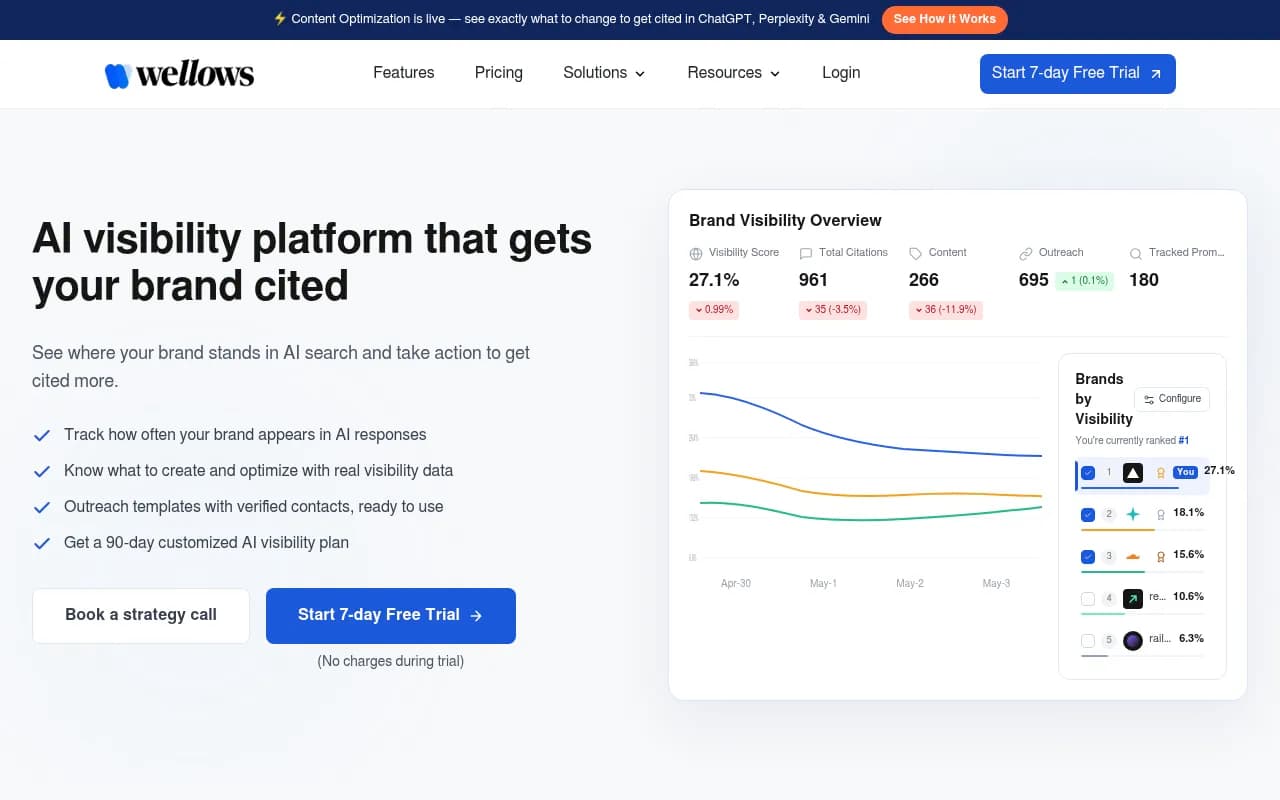
Each takes a different approach -- Wellows focuses on citation tracking with outreach tools, Scrunch AI is built for agencies monitoring multiple brands, and Rankscale tracks ranking positions across AI models. The right choice depends on whether you need monitoring only or a full optimization workflow.
If you want the full picture -- off-site citations, on-site gaps, content generation, and crawler logs all in one place -- Promptwatch covers all of it. Most other tools handle one or two pieces of the puzzle.
The off-site signals that drive AI recommendations aren't a mystery. They're Reddit, YouTube, review sites, listicles, and earned media. The brands winning in AI search right now are the ones who figured that out early and started showing up in those places consistently.