Key takeaways
- Google rankings and ChatGPT visibility are almost entirely separate. Only about 12% of AI citations overlap with the top 10 Google results.
- The fastest way to diagnose the problem is to run the exact prompts your customers use -- not branded queries -- across multiple AI models and record what comes back.
- 85% of AI brand mentions come from third-party sources like G2, Reddit, YouTube, and industry publications. Fixing your website alone won't be enough.
- AI responses are non-deterministic: run the same prompt twice and you may get different brands cited. You need to test repeatedly, not once.
- A dedicated AI visibility platform can automate this audit and turn the findings into content that actually fixes the gaps.
There are two types of businesses right now. The ones ChatGPT recommends when someone asks "what's the best [your category] tool?" -- and the ones it doesn't mention at all.
If you're reading this, you're probably in the second group. And the frustrating part is that you might be ranking well on Google, have a fast site, and publish content regularly. None of that automatically translates to AI visibility.
This guide walks you through a structured 30-minute audit to figure out exactly where the gap is. You don't need expensive tools to start. You need a browser, a notepad, and about half an hour.
Why your Google rankings don't explain your ChatGPT visibility
This is the thing most SEOs and marketers miss when they first look at this problem. They assume that if they rank #1 for a keyword, ChatGPT will cite them. That's not how it works.
Research from VisibleIQ found that only 12% of AI citations match the top 10 Google results. AI models like ChatGPT, Claude, and Perplexity don't crawl the web in real time the way Google does (though some have browsing capabilities). They were trained on large datasets, and they form opinions about brands based on what they saw across the whole web -- not just your website.
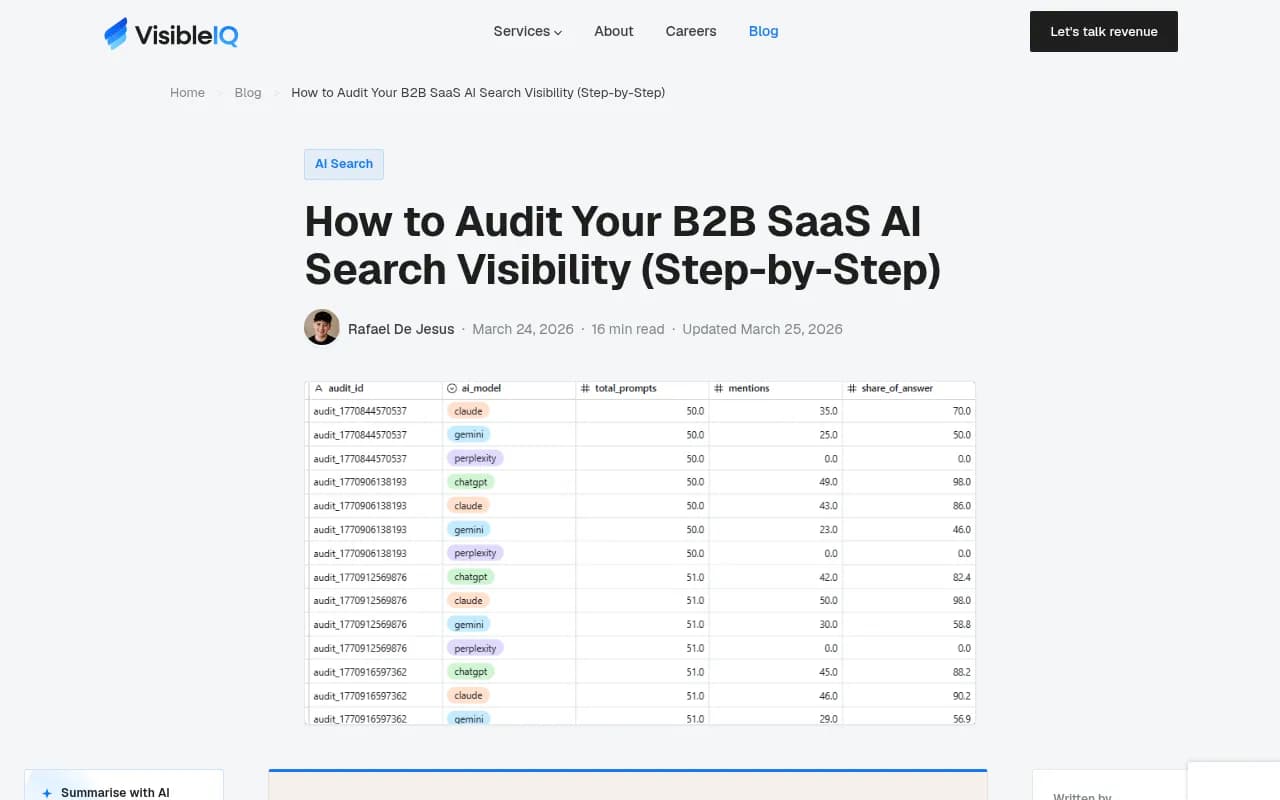
What this means practically: ChatGPT's recommendation of your brand is shaped by what it's read about you on Reddit, G2, YouTube, LinkedIn, industry publications, and comparison sites -- not primarily by your homepage or blog posts. Your website is one input. Third-party mentions are the bigger signal.
So the audit isn't just about your website. It's about your entire digital footprint.
The 30-minute audit: a step-by-step walkthrough
Minutes 0-5: Set up your testing environment
Before you start running prompts, get organized. Open a spreadsheet with these columns:
- Prompt
- AI model tested
- Brands mentioned
- Was your brand cited? (Y/N)
- Source URLs cited (if any)
- Notes
You'll be running the same prompts across multiple AI models, so having a consistent tracking format matters. Otherwise you'll end up with a mess of browser tabs and no clear picture.
Pick at least three AI models to test: ChatGPT, Perplexity, and either Claude or Gemini. Perplexity is worth including because it cites sources by default, which tells you exactly what content is influencing its answers.
One important note before you start: AI responses are non-deterministic. Run the same prompt twice and you may get different results. This isn't a bug -- it's how these systems work. So for any prompt where you're borderline visible, run it two or three times and note the variance.
Minutes 5-15: Build and run your prompt list
This is the most important part of the audit. The prompts you test need to match how your actual customers talk, not how you describe yourself.
Think about the questions someone asks before they've decided on a vendor:
- "What's the best [tool category] for [use case]?"
- "How do I solve [specific problem]?"
- "What are the top [your category] tools in 2026?"
- "Which [your category] tool is best for [company size or industry]?"
- "What do people recommend for [pain point]?"
Aim for 10-15 prompts. Mix broad category queries ("best project management software for remote teams") with more specific ones ("what project management tool works best with Slack and has good time tracking?").
Also run a few branded prompts:
- "[Your brand name] review"
- "What is [your brand name]?"
- "Is [your brand name] good for [use case]?"
The branded prompts tell you whether ChatGPT has accurate information about you at all. Sometimes brands are invisible not because they're unknown but because the AI has outdated or wrong information about what they do.
Run each prompt, record the results, and move on. Don't get distracted analyzing yet -- just capture the data.
Minutes 15-20: Check your technical accessibility
While you're waiting for AI responses to load, open a new tab and check a few technical things that directly affect whether AI crawlers can read your site.
Check your robots.txt file. Go to yourdomain.com/robots.txt. Look for any rules that block AI crawlers. The main ones to check for are:
User-agent: GPTBot
Disallow: /

User-agent: ClaudeBot
Disallow: /

User-agent: PerplexityBot
Disallow: /
If you see these, AI crawlers are being blocked from reading your site entirely. This is a surprisingly common issue -- some developers add these rules to reduce server load without realizing the visibility cost.
Check your llms.txt file. This is a newer standard (analogous to robots.txt but specifically for AI models) that tells AI systems what your site is about and what content is most important. Go to yourdomain.com/llms.txt. If you get a 404, you don't have one. It's not mandatory, but having one is a signal that you're making it easy for AI to understand your site.
Check your structured data. Use Google's Rich Results Test (search.google.com/test/rich-results) on your homepage and a few key pages. Structured data like Schema.org markup helps AI models understand what your business does, what products you offer, and how you're categorized. Missing or broken schema is a common gap.
Minutes 20-25: Analyze your third-party presence
Go back to your prompt results. For the prompts where competitors are cited but you're not, look at which sources are being linked. Perplexity is great for this because it shows citations inline.
You're looking for patterns. Are competitors being cited from:
- G2 or Capterra reviews?
- Reddit threads?
- YouTube comparison videos?
- Industry blogs or publications?
- Their own content?
Make a list of the specific sources that are driving competitor visibility. Then ask yourself: do I have a presence there?
If ChatGPT is recommending a competitor partly because they have 400 G2 reviews and you have 12, that's a fixable problem. If a competitor keeps showing up because there's a popular YouTube video comparing tools in your category and they're featured prominently, that's a content gap you can address.
This is the insight most people miss. They look at the audit results and think "I need to write more blog posts." But the real answer is often "I need more third-party coverage in the places AI models actually read."
Minutes 25-30: Prioritize your findings
By now you should have a clear picture of:
- Which prompts you're visible for vs. invisible for
- Whether technical issues are blocking AI crawlers
- Which third-party sources are driving competitor visibility
- Whether ChatGPT has accurate information about your brand
Now rank the issues by impact and effort. A blocked robots.txt is a 10-minute fix with potentially huge impact -- do that first. Missing G2 reviews take months to accumulate but are high-value -- start that process now. A missing llms.txt file takes an hour to create.
What the audit usually reveals
After running this process, most businesses find one of four root causes:
You're technically blocked. AI crawlers can't read your site because of robots.txt rules, JavaScript-heavy pages that don't render properly, or aggressive bot-blocking at the CDN level. This is the easiest fix.
You have no third-party footprint. Your website is fine, but there's almost nothing written about you anywhere else. No reviews, no Reddit mentions, no YouTube coverage, no press. AI models have nothing to cite.
You're in the wrong category. ChatGPT has categorized your product incorrectly, or it associates you with a use case that isn't how your best customers actually use you. This shows up when branded prompts return accurate-ish but slightly wrong descriptions.
Your content doesn't answer the right questions. Your site talks about your features, not the problems you solve. AI models are trying to answer user questions, and if your content isn't structured around those questions, it won't get cited even if it's technically accessible.
Going deeper: tools that automate this
The manual audit above is a solid starting point, but it has real limits. You're testing a handful of prompts once, and AI responses change over time. What ChatGPT says about your brand today may be different in six weeks.
For ongoing monitoring, a few tools are worth knowing about:
Promptwatch goes beyond just tracking visibility -- it runs Answer Gap Analysis to show you exactly which prompts competitors appear for that you don't, then uses Content Agents to generate content specifically designed to close those gaps. It also logs AI crawler activity on your site in real time, so you can see when GPTBot or ClaudeBot visits, which pages they read, and whether those visits lead to citations.
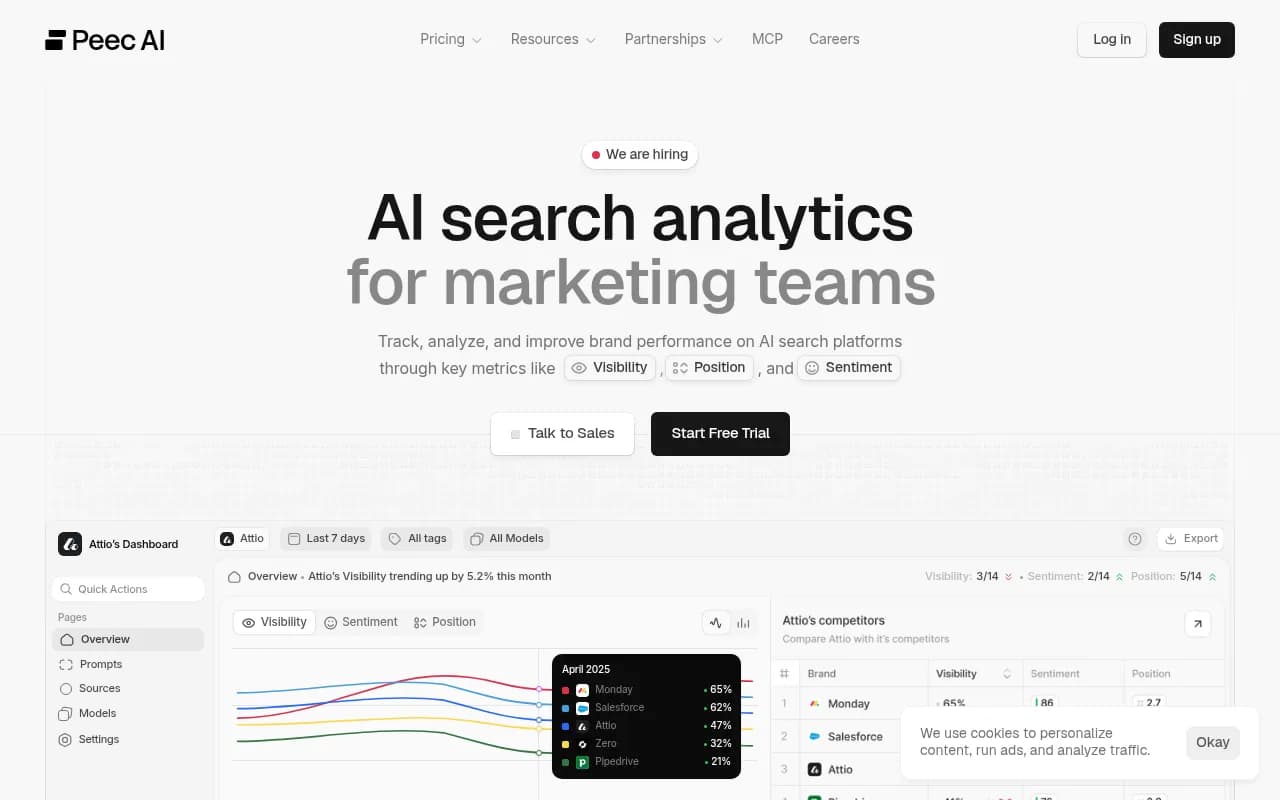
For simpler monitoring without the content generation layer, tools like Otterly.AI and Peec AI track brand mentions across AI models at a lower price point.
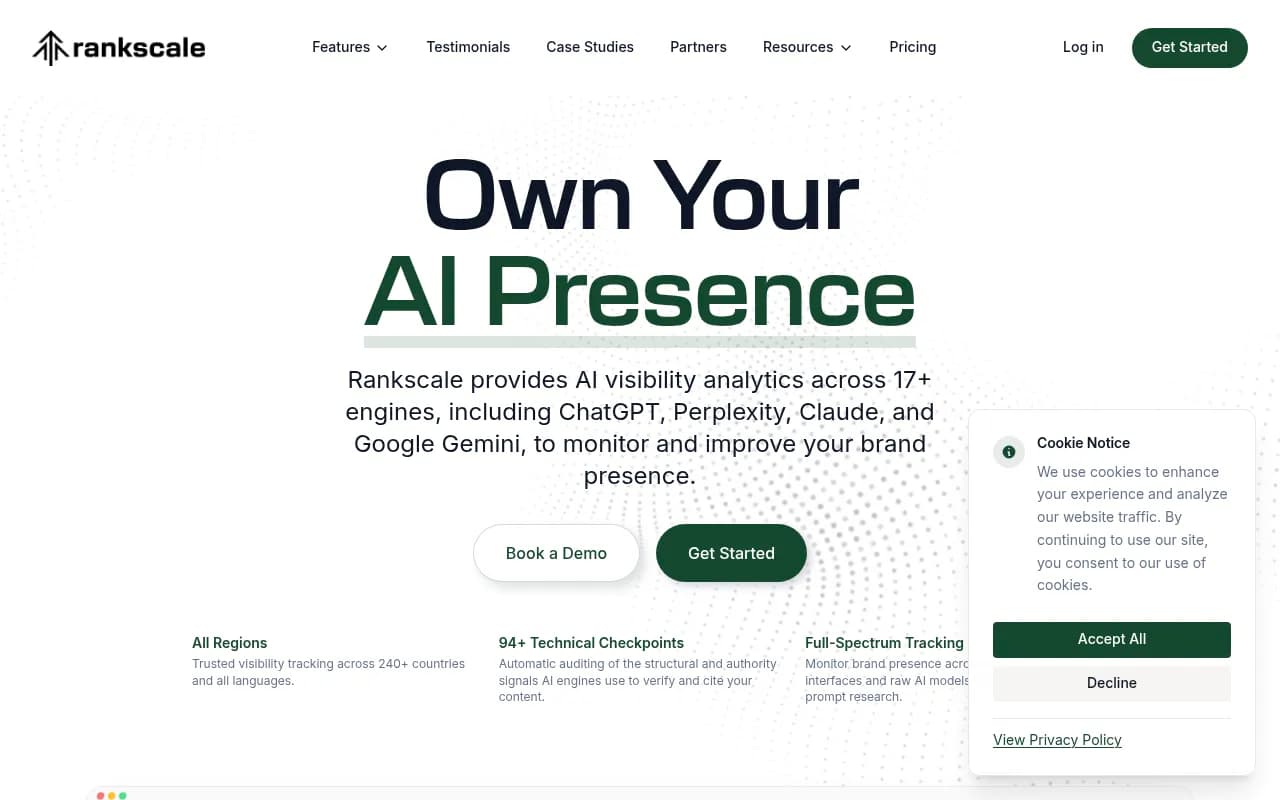
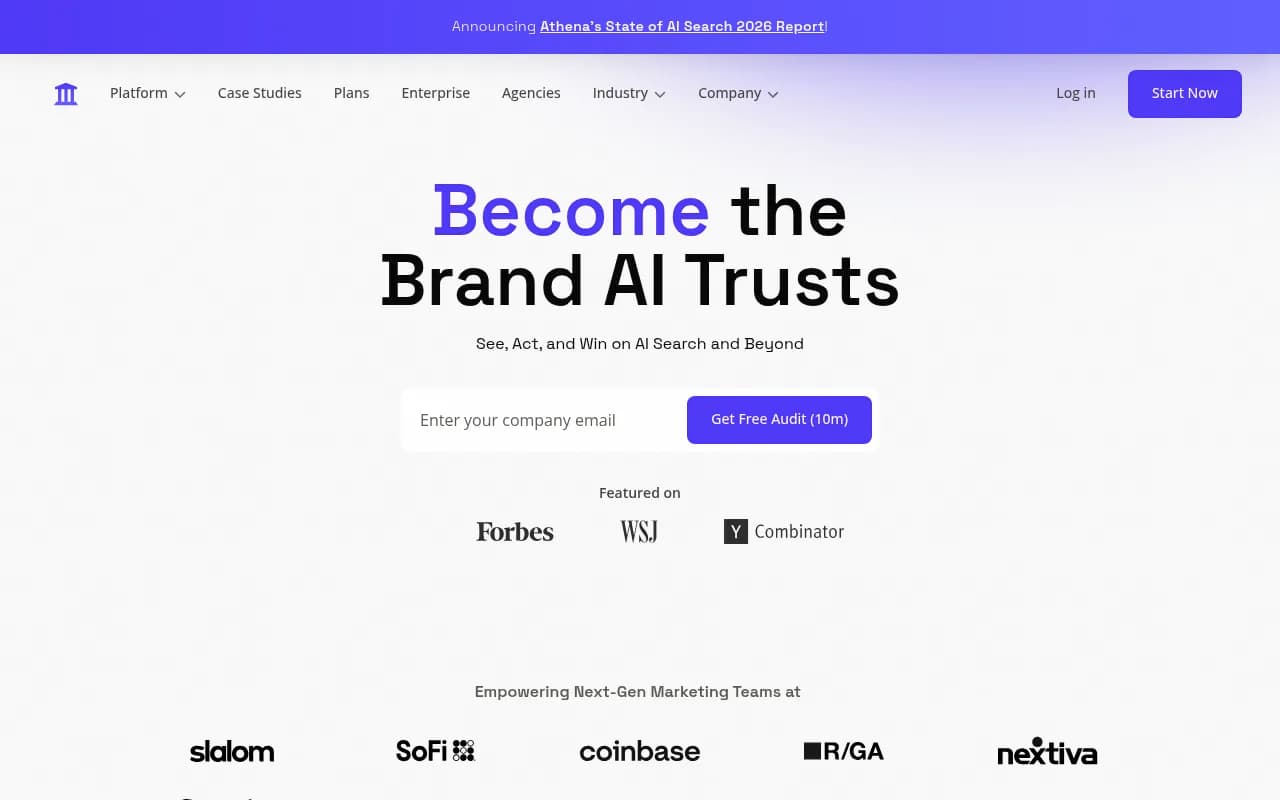
If you want to dig into which prompts are worth targeting -- based on volume and difficulty -- tools like Rankscale and AthenaHQ offer prompt intelligence features.
Comparison: manual audit vs. tool-assisted audit
| Approach | Time investment | Prompt coverage | Ongoing tracking | Gap analysis | Content fixes |
|---|---|---|---|---|---|
| Manual (this guide) | 30 min setup | 10-15 prompts | Manual, ad hoc | You interpret | You write |
| Otterly.AI / Peec AI | 1-2 hrs setup | 50-200 prompts | Automated | Basic | None |
| Promptwatch | 1-2 hrs setup | 50-350 prompts | Automated | Answer Gap Analysis | Content Agents |
| Profound / AthenaHQ | 2-3 hrs setup | 100+ prompts | Automated | Moderate | None |
The manual approach is the right starting point. It costs nothing and gives you a real feel for how AI models talk about your category. But if you find significant gaps -- which most businesses do -- you'll want automated tracking to measure whether your fixes are working.
The fixes that actually move the needle
Based on what the audit typically surfaces, here's where to focus your energy:
Fix technical access first. Unblock AI crawlers in robots.txt. Add an llms.txt file. Make sure your key pages render properly for bots (check with a tool like Screaming Frog or Google's URL Inspection tool).
Build third-party presence systematically. Ask customers for G2 or Capterra reviews. Reach out to YouTubers who cover your category. Get mentioned in comparison articles on industry blogs. These are the sources AI models actually cite.
Rewrite content around questions, not features. Instead of "Our platform has 47 integrations," write "How [Your Brand] connects with your existing stack" and answer the specific questions buyers ask. AI models are trying to answer questions -- your content needs to be structured as answers.
Create comparison and category content. Pages like "[Your Brand] vs [Competitor]" or "Best [Category] tools for [Use Case]" directly match the prompts buyers use. These pages get cited disproportionately often.
Monitor and iterate. This isn't a one-time fix. AI models update their training data, new competitors enter the picture, and buyer prompts evolve. Run this audit monthly, or use a tool to do it automatically.
A note on expectations
One thing worth being honest about: even if you do everything right, AI visibility takes time. You're not optimizing for an algorithm that re-crawls your site daily. You're building a reputation across the web that AI models will eventually incorporate.
The businesses that are winning in AI search right now mostly started building their third-party presence 12-18 months ago. That's not a reason to wait -- it's a reason to start today.
The 30-minute audit tells you where you stand. What you do with that information determines where you'll be six months from now.