Key takeaways
- Local prompt tracking means running the questions patients actually ask ("urgent care near me", "pediatric dentist open Saturday") through AI assistants from your clinic's location, then recording who gets named and cited.
- Health is a YMYL category. For informational prompts, ChatGPT leans on government and research sources, so a local clinic's realistic goal is accuracy and local recommendation share, not outranking NIH.
- Tracking needs no patient data. Any tool you pick should send only generic, PHI-free prompts, and you should ask the vendor to confirm that in writing.
- City-level or exact-coordinate targeting, wrong-detail detection (old address, wrong insurance) and a link from AI visits to bookings are the features that separate useful tools from generic brand trackers.
- Verify pricing and compliance claims on vendor sites. Several of the sources behind this guide are vendor-published, and I found no public HIPAA or BAA details for most tools.
Why local prompt tracking is different for clinics
A patient asks an assistant for "urgent care near me", the assistant names two or three clinics, and the patient calls the first one. There is no page of ten blue links to scroll. That is the whole reason clinics have started tracking prompts.
Two things make healthcare harder than, say, a pizza shop:
- Location matters a lot. The answer to "dermatologist accepting new patients" changes block by block. A national average tells you nothing.
- The content is YMYL. Your Money or Your Life topics get extra scrutiny. AI engines lean on authoritative sources for anything medical, and a wrong answer about your hours, services or insurance has real consequences for a patient.
So the job splits in two. For local intent prompts (find a clinic), you want to be named. For informational prompts (what causes this symptom), you mostly want your content to be accurate, consistent with official guidance, and cited where it makes sense.
What the data says about YMYL health citations
Promptwatch Data analyzed healthcare prompts in ChatGPT from Sep 9 to Oct 8, 2026. These were organic informational and treatment prompts, not "near me" searches, so read them as a picture of who owns the medical-information layer.
- NIH was the top source at 5.46% of healthcare citations, across six nih.gov subdomains. PubMed Central added 2.38% and PubMed 2.33%.
- The FDA earned 1.76% and the NHS 1.1%.
- The top non-government site was the American Society of Plastic Surgeons at 0.64%, followed by the American Academy of Dermatology (0.54%), Mayo Clinic (0.49%) and Cleveland Clinic (0.40%).
- By source type, government and public health sites took 7.06%, medical associations 1.39%, hospitals and clinics 0.89%, and reviews and directories 0.46%.
- The top 20 domains together held only 15.54% of citations, so the long tail is large.
What I take from this: you will not displace NIH, and trying to is a waste of a clinician's afternoon. But the long tail is big, medical associations punch above hospitals, and directory profiles such as Doctify and WebMD doctor pages (0.23% each) show up. For a local clinic, that points to three practical moves: cite peer-reviewed studies on PubMed, keep your claims consistent with FDA, CDC, NHS or NICE guidance, and keep third-party profiles complete.
For a broader view of how citation sources shift, the Promptwatch Data hub publishes free, regularly updated reports. One more relevant finding: almost half of ChatGPT responses cite 10 or more unique domains (Sep 28 to Oct 4, 2026), so there are usually many slots, not one.
What to monitor
Local intent prompts
These are the revenue prompts. Build a monitor around the patient's phrasing, not your service menu:
- "urgent care near me open now"
- "best pediatrician in [city]"
- "dentist near me that takes [insurance]"
- "walk-in clinic [neighborhood] weekend"
- "how much does an MRI cost in [city]"
Track each prompt per location. If you have three clinics, you have three monitors, because the answers differ.
Informational and treatment prompts
"What is the recovery time for knee arthroscopy?" is where YMYL sources dominate. You are not trying to win these outright. You are checking whether your content is cited at all, and whether AI repeats anything inaccurate about your approach.
Brand and comparison prompts
"Is [clinic name] good?", "[clinic A] vs [clinic B]", and "does [clinic] accept [insurer]?" These are late-funnel. A wrong answer here costs a booking directly.
The metrics worth reading
| Metric | What it tells you | Typical clinic problem it reveals |
|---|---|---|
| Share of voice | How often you appear versus nearby competitors | Low coverage on "near me" prompts |
| Position | Where you land in the list of named clinics | Named, but fourth |
| Citations and cited sources | Which pages and directories AI trusts | You are mentioned but never linked |
| Sentiment | Tone of the answers about you | Review-driven reputation issues |
| Accuracy of details | Hours, address, services, insurance | Outdated listings feeding wrong answers |
| AI referral visits and bookings | Whether visibility turns into patients | Visibility with no conversion path |
Read them together. Low share of voice is a coverage problem. Mentions without citations usually mean a content or crawlability problem. Wrong details usually trace back to stale third-party listings.
YMYL and privacy: the checklist before you buy
Curve Compliance, which sells its own competing product and so is not neutral, publishes a useful list of questions for healthcare buyers. The points hold up regardless of who wrote them:
- What leaves your systems? Tracking AI answers requires no patient data. Ask exactly what is sent to the assistants and whether prompts are screened for PHI.
- Does it show competitors and cited sources? Patients compare clinics before booking.
- Can it connect AI visits to bookings?
- Does it catch wrong details? An old address or wrong insurance listing is the classic failure.
- Is the plan sized to what your clinicians can review and publish? Medical pages need clinical sign-off, so a tool that promises fifty articles a month is solving the wrong bottleneck.
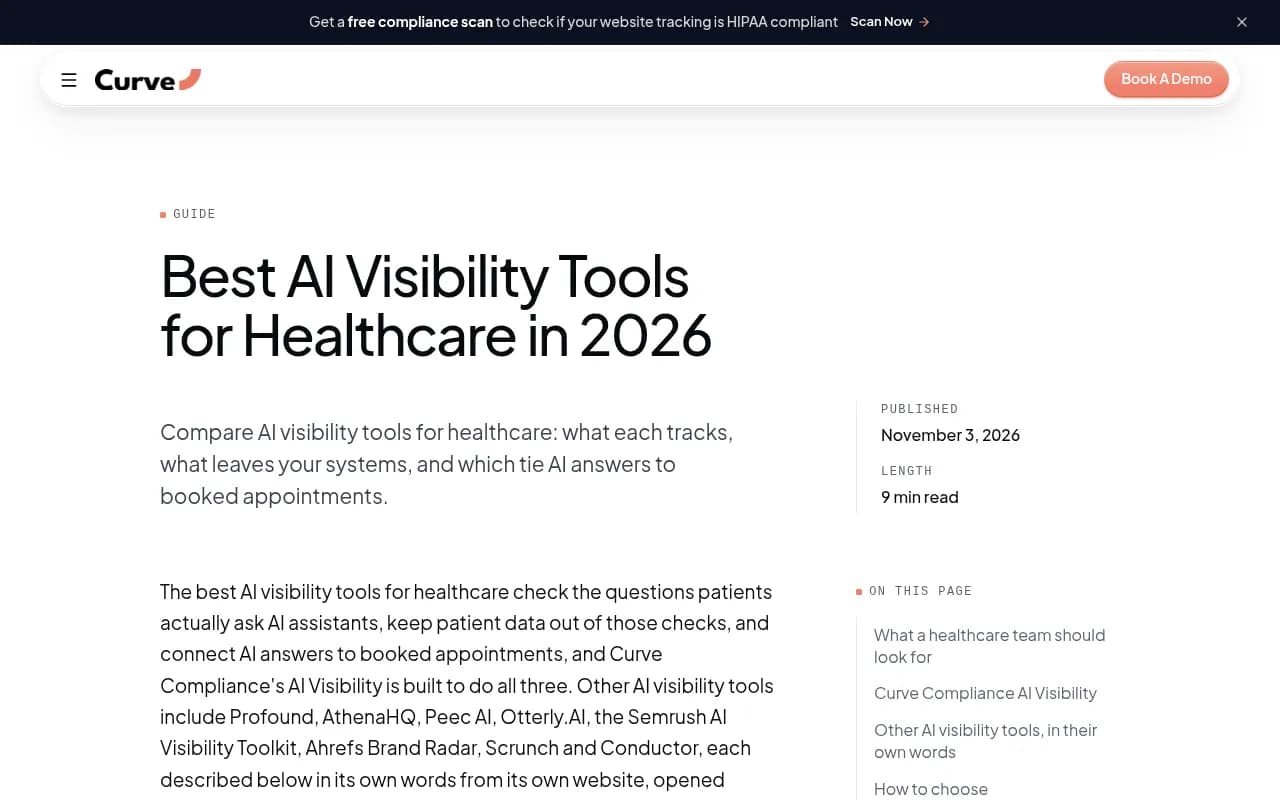
One more filter, from Google Search Central's AI optimization guidance as quoted by Curve: no third-party tool has access to Google's internal ranking or AI systems. A good tracker asks assistants the same questions patients ask and records the output. If a vendor claims inside access, walk away.
A caveat I want to be upfront about: I did not find public HIPAA or BAA documentation for most of these tools. Since prompt tracking should not touch PHI at all, a BAA is often not the right question. The better question is whether the tool ever ingests patient data, for instance through analytics or form integrations. If it does, get compliance details in writing.
Which tools handle local and YMYL queries
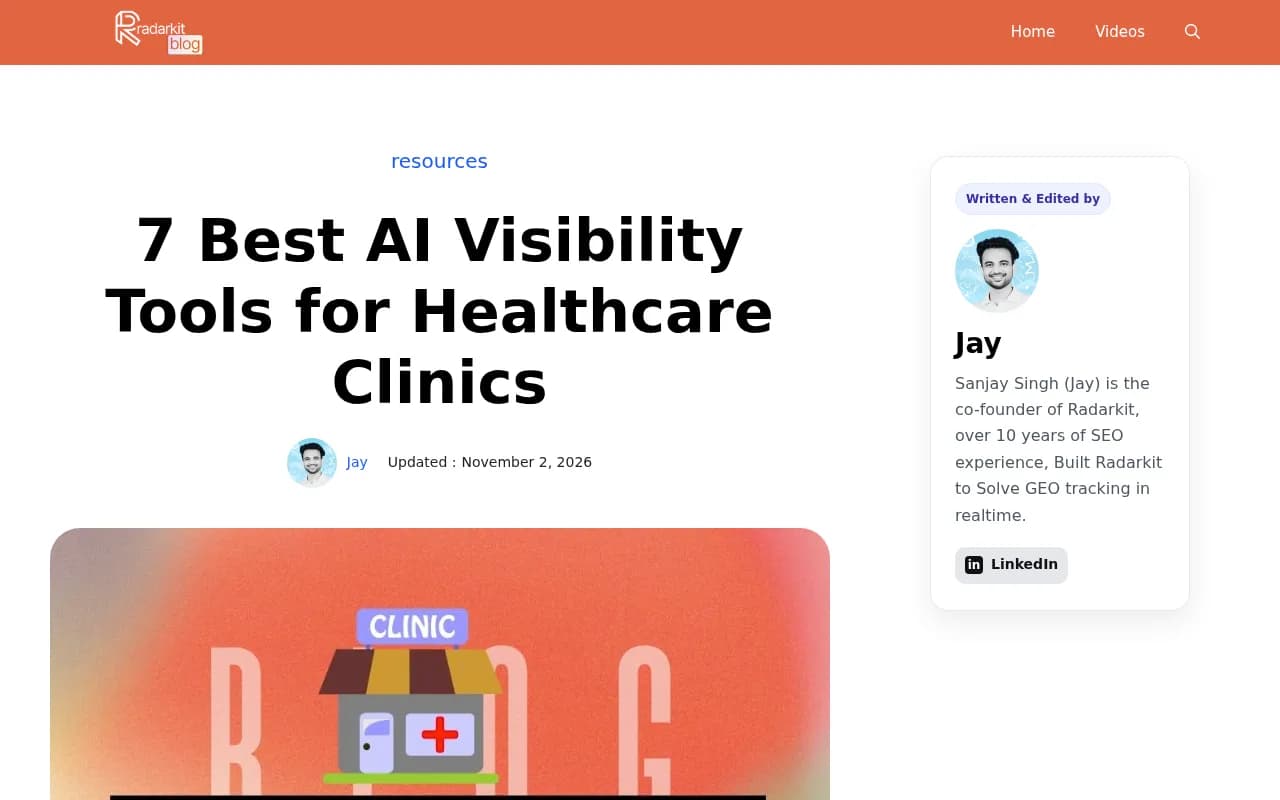
Pricing below comes from RadarKit's comparison table updated Nov 2, 2026. RadarKit publishes that list and ranks itself first, so treat the ordering with suspicion and confirm prices on each vendor's site.
| Tool | Local angle | Starting price (vendor-reported) | Notes for clinics |
|---|---|---|---|
| RadarKit | Tracks local AI recommendations across six assistants | $29/mo | Built around patient-style prompts; outreach agent |
| BrightLocal | Listings, citations, reviews plus AI tracking | $31/mo (yearly) | Good if listing hygiene is your main gap |
| Local Falcon | Map grid scans plus AI appearance tracking | $24.99/mo | Strong for geographic spread |
| Otterly.AI | Daily prompt monitoring | $29/mo | Low-cost for a single clinic |
| Peec AI | Dashboards and source analysis | $95/mo | Clean reporting |
| Promptwatch | City/state monitors, exact coordinates | $95/mo (Essential) | Crawler logs, content and fact checking |
| Profound | Enterprise monitoring | Custom | Suited to large health groups |
Promptwatch
Promptwatch is an end-to-end AI visibility platform, and it is the one 1001 SEO Media uses, so factor that in. For clinics the relevant pieces are location control and accuracy. Monitors can target a country, state or city, and Business plans add local targeting pinned to exact coordinates (20 m to 5 km radius), so ChatGPT, Google AI Overviews and AI Mode answer as if asked from that spot. Tracking runs against the real interfaces of ChatGPT, Gemini, Perplexity, Copilot and others, not just APIs.
For YMYL, Brand Narrative pulls the individual claims AI makes about you ("accepts Medicaid", "long wait times"), and Fact Check lets you mark a claim inaccurate and find which of your pages states it. Fact Check sits on Business and above. IP-verified AI crawler logs show whether bots can actually read your site, and visitor analytics show AI-referred traffic and conversions. Pricing starts at $95/month on Essential, with a 7-day free trial on monthly billing. Confirm current plans at promptwatch.com/pricing, and a free AI visibility report is available without signing up.

RadarKit
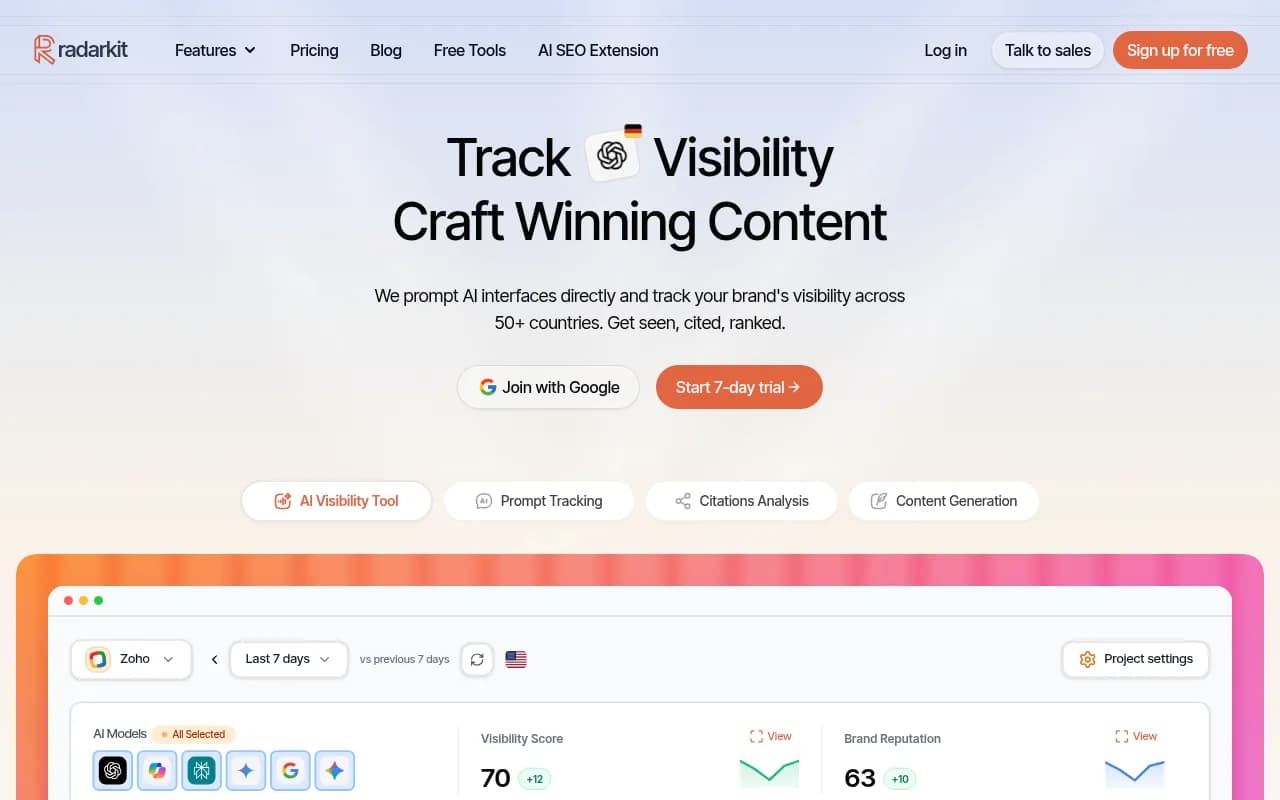
RadarKit is positioned squarely at clinics: it runs patient-style prompts through six assistants and records competitor ratings. It is the cheapest serious option on the list at $29/month, but it is also a vendor describing itself, so test it on your own prompts before committing.
BrightLocal
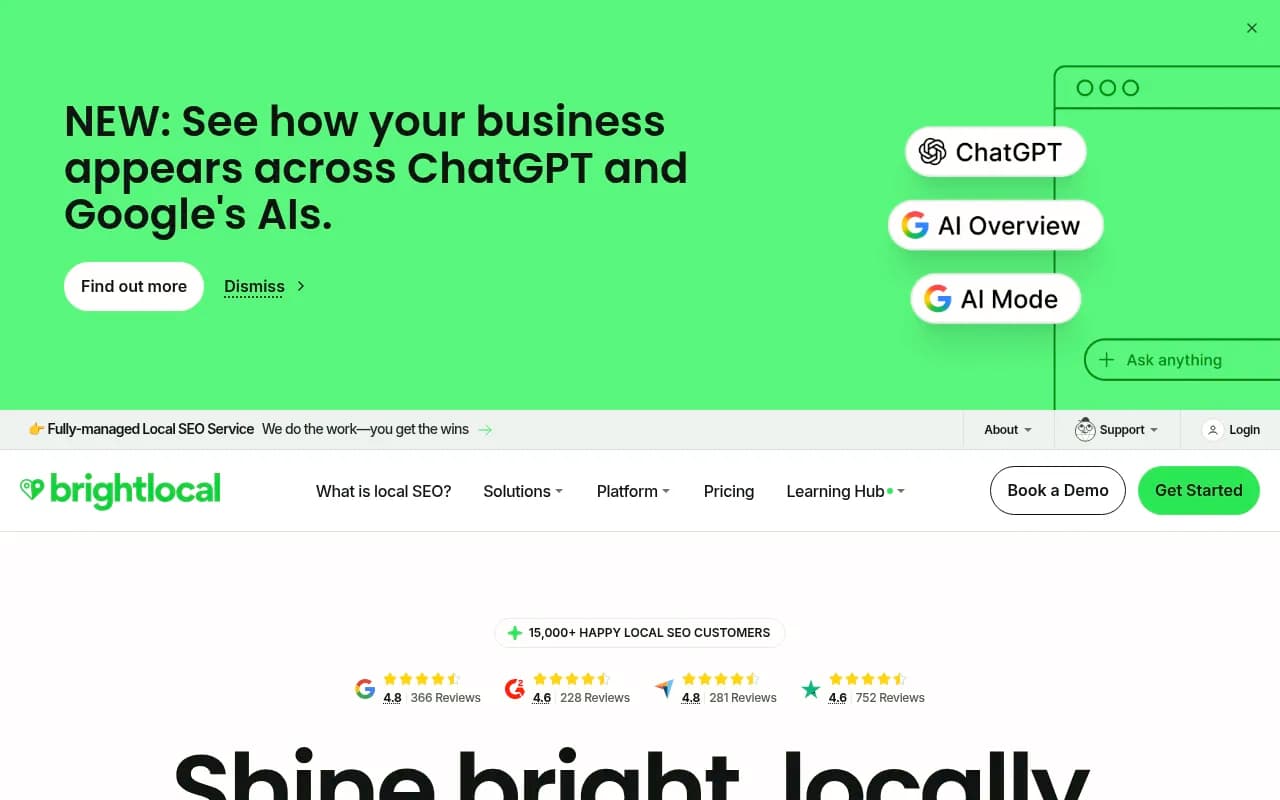
BrightLocal is a local SEO tool that added AI tracking. If your problem is inconsistent listings and thin reviews, which is common in healthcare, it covers the fundamentals that feed AI answers.
Otterly.AI and Peec AI
Both are monitoring-focused. Otterly.AI suits a single clinic that wants a cheap daily record. Peec AI has clean dashboards and source analysis. Neither is built around local targeting or crawler data the way clinic work needs, so expect to pair them with something else.


Profound and Birdeye Search AI
Profound is aimed at large health groups with security needs and custom pricing. Birdeye Search AI is worth a look for multi-location providers that want location-level tracking tied to reviews.

If you want to browse beyond this shortlist, the GEO software directory at bestgeosoftware.com lists many more.
A practical setup for a clinic
- List 20 to 30 prompts per location. Mix local intent, brand and a handful of informational prompts. Use real patient language from call logs and intake forms, stripped of anything identifying.
- Pin location. Use city monitors at minimum. For "near me" prompts in dense areas, coordinates matter.
- Baseline competitors. Note which three or four clinics are named most often and what sources AI cites for them.
- Audit your facts. Compare what AI says about hours, address, services and insurance with reality. Fix the source (usually a directory listing or an old page), not just your site.
- Check crawl access. If AI crawlers are blocked or erroring on your site, no amount of content helps. Free tools like the Agentic Readiness Check test this quickly.
- Publish clinician-reviewed content. Back claims with PubMed links and match FDA, CDC, NHS or NICE guidance. Fewer, accurate pages beat volume.
- Tie to bookings. Track AI referrals through to appointment requests. Note that ChatGPT stopped sending a referrer on October 8, 2026, so tagged links matter for attribution.
- Review monthly. Citation patterns move. ChatGPT's Reddit share fell from about 4% to 0.5% on August 14, 2026, which is a reminder that sources can vanish overnight.
Mistakes I see clinics make
- Tracking only brand prompts. Patients rarely know your name yet.
- Treating a visibility score as the goal. A clinic named first for a service it does not offer has a problem, not a win.
- Chasing national authority sources. Fix listings and local relevance first.
- Ignoring accuracy. For YMYL, a wrong detail is worse than an absence.
- Buying on a vendor's own "best of" list without testing it against your prompts.
Which should you choose?
A single clinic on a tight budget can start with Otterly.AI or RadarKit and a manual accuracy check. A clinic with weak listings should look at BrightLocal first. Multi-location groups, or anyone who needs crawler data, fact-checking and a path from AI answers to booked appointments, will want a fuller platform such as Promptwatch or Profound. Whatever you pick, run it on your own twenty prompts for a week before paying for a year.
If you want an agency to run this for you, 1001 SEO Media handles GEO and local SEO programs. Otherwise, the free report from Promptwatch is a no-cost way to see where you stand today.