Key takeaways
- Most marketing teams use AI somewhere. Far fewer have it wired into how they work. Salesforce puts adoption at 75% of marketers, while Duke's CMO Survey says AI touches about 24% of marketing activities.
- Gartner's 2026 CMO Spend Survey says CMOs put 15.3% of marketing budgets into AI, and 21.3% for AI-ready organizations. Other sources quote 19%. Use the Gartner figure when you need one number.
- AI search (visibility in ChatGPT, AI Overviews, Perplexity and similar) is still a small budget line, usually carved out of SEO, content and PR rather than added on top.
- The org chart question is unsettled. Most teams assign AI search to an SEO lead plus one content person and a slice of PR, then grow it after the evidence arrives.
- Tool choice depends on team size. Trackers answer "are we mentioned?" Platforms that add crawler data, traffic and content workflows answer "what do we do next?"
Which adoption numbers to believe
Adoption statistics on this topic are a mess, and it helps to say so up front. The headline numbers come from different surveys, different respondents and different definitions of "use."
Here is what the primary sources actually say:
- Salesforce's State of Marketing release (February 19, 2026) reports 75% AI adoption. It surveyed 4,450 marketing decision-makers across four regions between October 8 and November 17, 2025.
- HubSpot's 2026 report says 86.4% of teams use AI in at least a few marketing areas, and only 1.7% neither use nor plan to. HubSpot sells marketing software, like Salesforce.
- The Content Marketing Institute's B2B report found 95% organizational use of AI applications, but also put 68% of respondents in exploratory or developing stages.
- The CMO Survey from Duke Fuqua (308 U.S. marketing leaders) shows AI's share of marketing activities rising from 13.1% to 24.2%, with leaders expecting 55.9% within three years.
One aggregator article circulating this year claims 87% of marketers use GenAI in a recurring workflow and attributes it to the same Salesforce report. That conflicts with the 75% in the Salesforce release itself, and I would not repeat it. Where a figure can't be traced to a primary source, leave it out of your board deck.
The honest read: nearly every team has touched AI, about a quarter of the work involves it, and a minority has made it operational. Adobe's 2026 report makes the same point from the vendor side. It says more than 8 in 10 teams missed an opportunity last quarter because they couldn't respond in time, and only 7% have embedded AI in ways that deliver measurable business results.
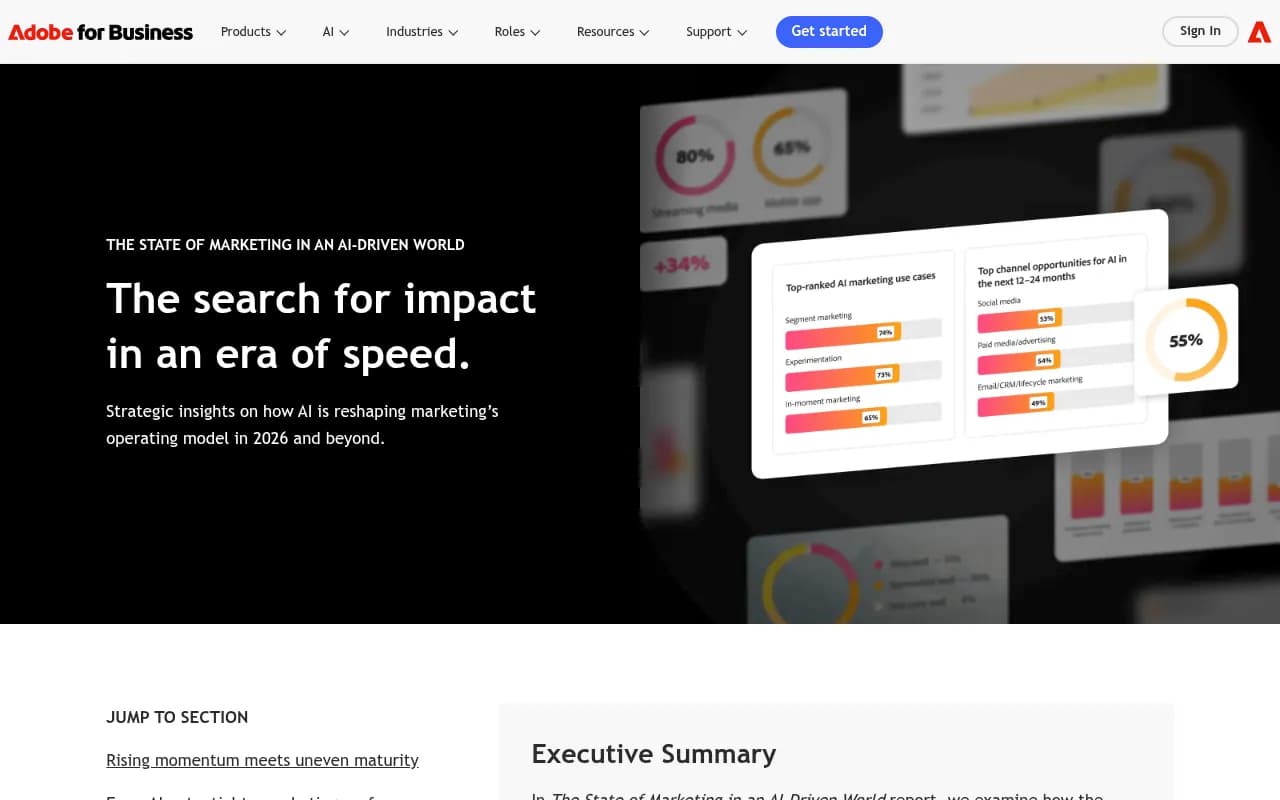
Adobe's data also shows where AI lives: 69% of teams use it through existing martech tools, 53% through individual subscriptions, and 47% through enterprise platforms. Those overlap, which tells you a lot of AI use is people paying for their own ChatGPT seat. That is adoption, but it isn't a program.
Digital Applied's evidence guide is worth reading for its correction notice. In October 2026 it withdrew benchmark series and forecasts it couldn't support. Treat that as a warning about every tidy statistic in this space, including the ones below.
What the budget data says
Gartner's 2026 CMO Spend Survey is the cleanest budget source. It reports CMOs allocate an average of 15.3% of marketing budgets to AI initiatives, with total marketing budgets at 7.8% of company revenue. Organizations Gartner classifies as AI-ready allocate 21.3%. The same release says only 30% of CMOs are ready to scale AI capabilities.
You will also see 19% budget share and 28% annual growth quoted from Searchlab, plus a median mid-market tool spend of $1,200 a month in Q1 2025 rising to $3,400 in Q1 2026 from Digital Applied. Those are secondary syntheses. Useful for direction, weaker for planning.
Two things stand out when you put these together.
- Spend is rising faster than integration. Money is going into tools while most organizations haven't changed how work moves between people.
- AI search is not yet its own budget category in most surveys. None of the sources above break it out. That's a gap, and it means your internal numbers matter more than any benchmark.
A realistic AI search reallocation
Search Engine Journal published a worked example this August that is concrete enough to borrow from. For a client spending $60,000 a month, the author moved budget like this after one quarter:
| Line | Before | After |
|---|---|---|
| Paid search | $30,000 | $24,000 |
| Content production | $12,000 | $10,000 |
| SEO retainer | $8,000 | folded into AI search program ($10,000) |
| Brand and PR | $5,000 | $10,000 (digital PR with citation targets) |
| Tools | $5,000 | $6,000 (adds an AI visibility tracker) |
The rule behind it is sensible: move 15% to 20% of budget in the first quarter, then let evidence move the rest. Paid search is cut by only 20% because it is still your cleanest read on which queries carry buying intent. I like that restraint. Defunding a working program on faith is as bad as freezing the 2022 allocation.
Note the PR line doubling. That fits what the citation data shows about where AI answers pull from, which brings us to the thing teams are actually spending on.
What AI search work is worth funding
Budget should follow how AI engines build answers. Promptwatch Data gives a few anchors, all from late September to early October 2026.
- In Promptwatch's ChatGPT content type data (Sep 28 to Oct 4, 2026), product pages are the most cited type at 22.4% of classified citations and landing pages follow at 16.8%. About 39% of citations go to pages describing what a company sells. Listicles get 13.6%, how-tos 8.7%, comparisons 5.9%, and news 5.7%.
- Almost half of ChatGPT responses with citations (47.6%) cite 10 or more domains, per Promptwatch's unique domains report. You will share every answer, so position and description matter as much as presence.
- Content shelf life varies. Promptwatch's content half-life report found news lost half its cited pages within about 36 days, while landing pages and docs held for months.
- Social is not a ChatGPT channel anymore. In the October 2026 social citations report, social platforms made up 0.46% of ChatGPT citations but 12.2% of Google AI Overviews citations. See also the Reddit citation drop, where reddit.com fell from about 4% to 0.5% of ChatGPT citations on August 14, 2026.
Translate that into budget lines: fix and expand product and landing pages first, keep docs crawlable, publish comparison pages, earn third-party mentions through PR, and don't pour money into news-style content that decays in five weeks. If your audience searches through Google, social still deserves a place, because AI Overviews cites it far more than ChatGPT does.
Org charts: who owns AI search
The research here is thin, and I'd rather say that than invent a benchmark. No survey I found measures who owns AI search inside marketing teams. What I can say from the budget examples and how the work divides:
Small team (under 10 people)
No new hires. The SEO lead owns AI search as an extension of their job. One content person rewrites key pages and builds comparison content. A tracker tool plus a PR slice. The SEJ example above describes this: an AI search lead, one content person, and part of the PR budget pointed at a single product line.
Mid-size team
A named AI search lead, often an SEO manager with a new title, sitting between SEO, content and PR. This person owns measurement, the prompt set, and a weekly list of fixes. Engineering gets pulled in for crawler access, structured data and site health. Brand and PR owns citation targets.
Enterprise and agencies
A small cross-functional pod: AI search lead, content strategist, technical SEO, digital PR, and an analyst who owns reporting. Governance matters here. Gartner found 45% of marketing leaders say GenAI is causing confusion within teams, and only 13% of marketers fully trust AI insights without human checks (per TechnologyChecker's compilation). Someone has to own review rules.
The common failure is making AI search everyone's job in a slide and nobody's job on the calendar. Whoever owns it needs a prompt set, a baseline and a weekly cadence.
Tools by team type
The catalog of AI visibility tools is crowded. Most split into three groups: trackers that tell you whether you're mentioned, suites that add AI tracking to existing SEO products, and platforms that connect visibility to content and traffic.
For teams that want tracking plus action, Promptwatch is the one I'd shortlist first. It monitors real AI interfaces rather than only API outputs, shows IP-verified AI crawler logs and AI-referred traffic, and has a Content Agent that writes and publishes to your CMS and an Action Board that turns gaps into a to-do list. Plans start at $95 a month (check promptwatch.com/pricing).

If you already live in a classic SEO suite, adding its AI module is the lowest-friction path.

Peec AI is a straightforward citation and prompt tracker, and the SEJ example above uses it for tracking.

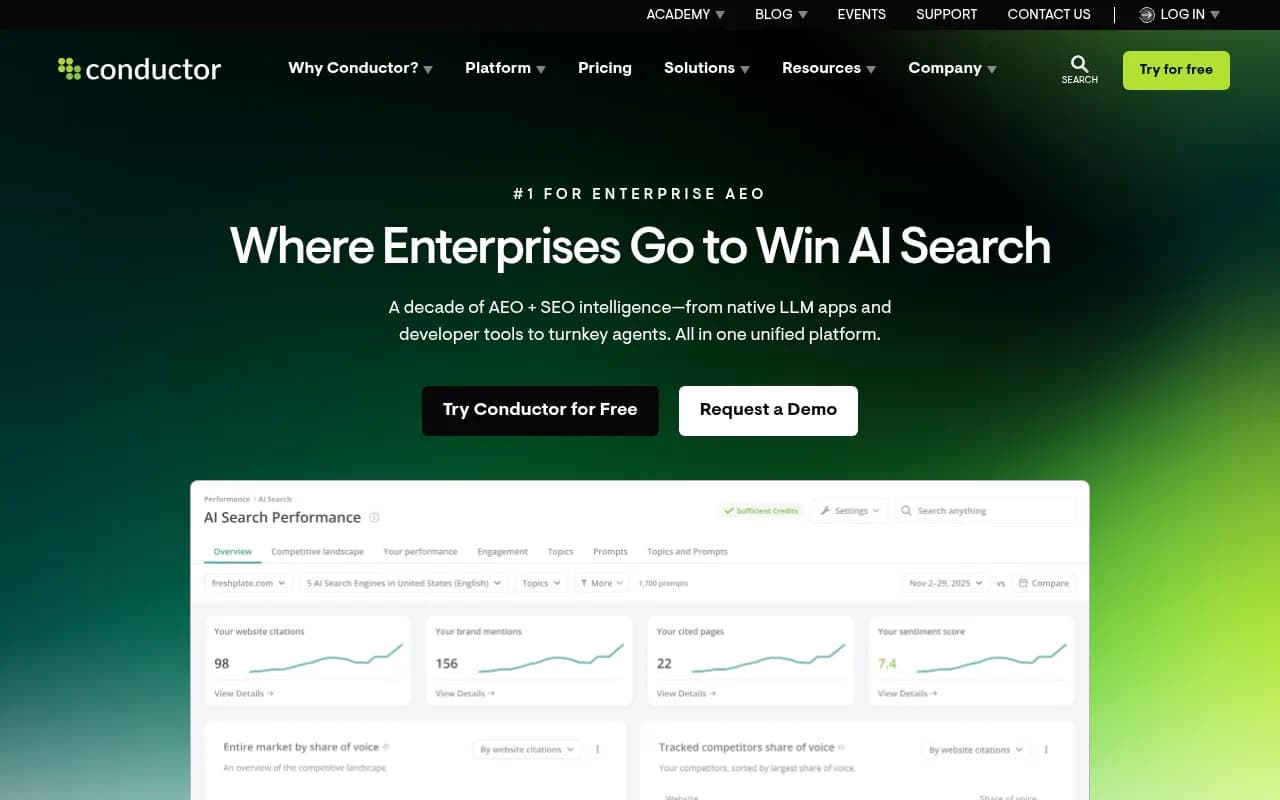
Enterprise teams with existing platforms often evaluate these:

For budget-sensitive monitoring:

| Team type | What you need | Candidates | Rough budget logic |
|---|---|---|---|
| Solo or small team | Tracking and a fix list | Promptwatch Essential, Otterly.AI, Peec AI | Single-digit share of tool spend |
| In-house mid-size | Tracking, crawler data, traffic, content | Promptwatch Professional or Business | Replaces part of the SEO retainer |
| Already on an SEO suite | Basic AI coverage in one login | Semrush AI toolkit, Ahrefs Brand Radar | Add-on to existing contract |
| Enterprise | Governance, scale, security | Promptwatch Enterprise, Profound, BrightEdge, Conductor | Procurement and security review |
| Agency | Multi-client, white-label | Promptwatch Agencies plans, Scrunch | Priced per client load |
Plan limits and pricing change, so verify on each vendor's site. For a wider scan, the GEO software directory lists far more options than I can cover here.
A 90-day adoption plan
- Weeks 1 to 2: pick one product line and 50 to 100 prompts your buyers actually use. Run a baseline for visibility, position and sentiment.
- Weeks 3 to 6: check AI crawler access and site health. If bots can't read your pages, nothing else matters. Fix product and landing pages first.
- Weeks 7 to 10: publish comparison and how-to content tied to prompt gaps. Start digital PR aimed at the third-party pages AI already cites.
- Weeks 11 to 13: review what moved. Look at citations and AI-referred traffic, not just mentions. Shift another slice of budget only if the evidence supports it.
Track outcomes in the language the finance team uses. Crisp, a Promptwatch customer, reported AI traffic converting at 2x the rate of traditional channels, and that is the sort of metric that gets budget approved. Mentions alone don't.
Three mistakes to avoid
- Treating adoption stats as a benchmark for your team. A 75% survey figure says little about whether your workflow works.
- Funding content volume instead of proof. AI answers favor pages describing what you sell and third-party validation, not more generic blog posts.
- Measuring only mentions. With nearly half of answers citing 10 or more domains, being named is table stakes. Position, description and click-through are where you win or lose.
The practical bottom line
Adoption is broad and shallow. Budgets are moving, with Gartner's 15.3% average a safe planning number, but AI search itself rarely has a clean line item. The teams getting ahead are not the ones with the most tools. They are the ones with a named owner, a fixed prompt set and a weekly habit of fixing what the data shows. Start with a 15% to 20% reallocation, one product line and one owner, and let the next quarter's numbers decide the rest. If you want outside help setting that up, an agency like 1001 SEO Media works across technical SEO, content and GEO.