Key takeaways
- Peec AI tracks brand mentions across a handful of AI engines, but has no SKU-level tracking, no ChatGPT Shopping visibility, and no content generation tools.
- E-commerce brands in 2026 need platforms that go beyond brand monitoring to track which specific products AI recommends, at what price, and where buyers are sent.
- The 7 tools below cover a range of use cases: from deep product-level analytics to full-cycle content optimization that helps you actually show up in AI recommendations.
- Platforms like Promptwatch go further than monitoring by helping you find content gaps and generate content engineered to rank in AI search -- a meaningful difference from tools that only show you a dashboard.
- ChatGPT Shopping is now a real commercial channel. If your stack doesn't track it, you're flying blind on a growing revenue stream.
Why Peec AI isn't enough for e-commerce in 2026
Peec AI does what it says on the tin. You set up your brand, define some prompts, and it tells you how often you show up in ChatGPT, Perplexity, Google AI Overviews, and DeepSeek. The interface is clean. The setup is fast. For a general brand monitoring use case, it's fine.
But e-commerce has a different problem.
When a shopper asks ChatGPT "what's the best noise-cancelling headphone under $300," they don't get a list of brands. They get a handful of specific products, with prices, reasons, and often a direct link to buy. That's ChatGPT Shopping -- and it's now a real commercial channel pulling revenue away from brands that aren't in those answers.
Peec AI's Pro plan (€199/mo) caps you at 100 prompts and 9,000 AI answers per month. Claude, Gemini, and Google AI Mode are Enterprise add-ons with custom pricing. There's no SKU-level tracking, no product feed analysis, no ChatGPT Shopping visibility, and no content tooling to help you fix what's missing. For a DTC brand or retailer trying to understand why a competitor's product keeps showing up instead of yours, that's a real gap.
Generative AI traffic to retail sites was up roughly 4,700% year-over-year in recent data, and AI-driven shoppers convert at about 4x the rate of traditional search visitors (12.3% vs 3.1%). The brands winning in AI search aren't just monitoring -- they're optimizing.
Here are 7 tools worth considering instead.
The 7 best Peec AI alternatives for e-commerce brands
1. Promptwatch -- best for closing the gap between monitoring and results
Promptwatch is the tool that most directly addresses the problem with monitoring-only platforms: it shows you what's missing, then helps you fix it.
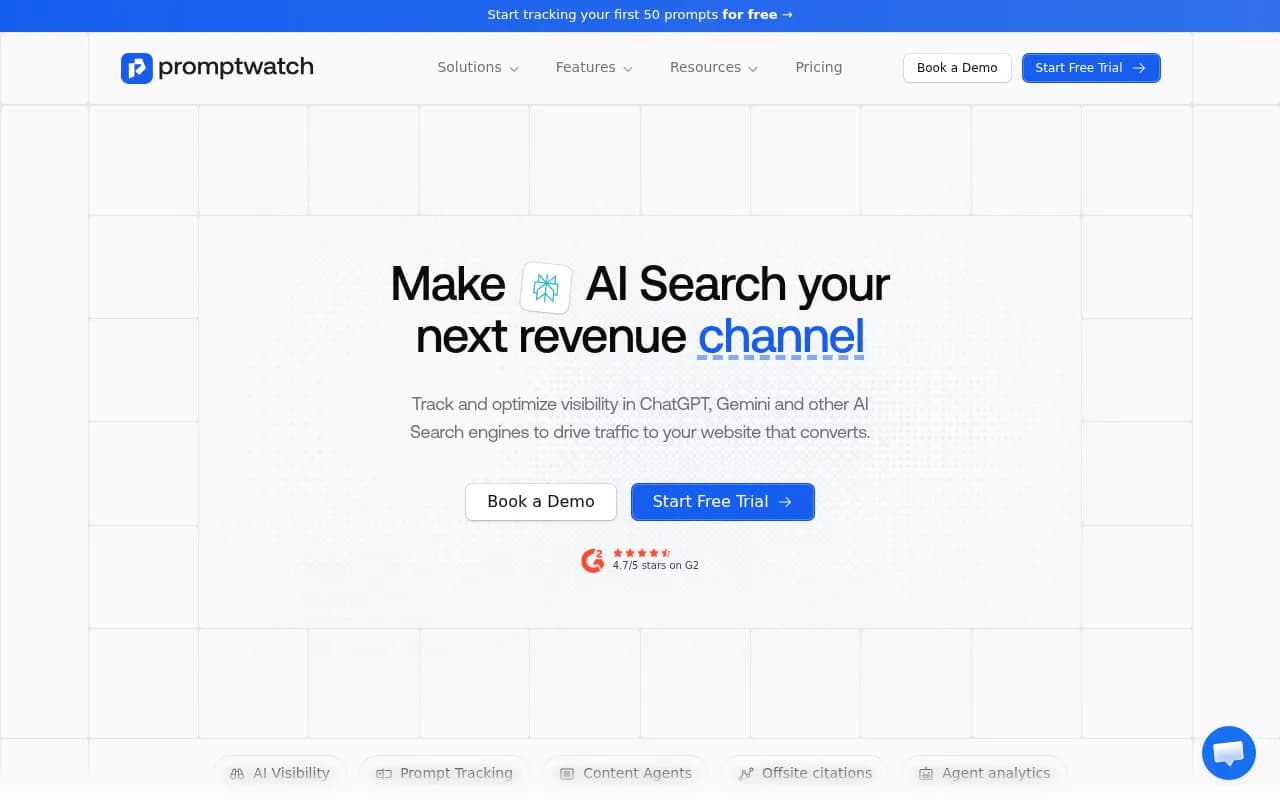
For e-commerce brands, the relevant workflow looks like this. Answer Gap Analysis surfaces the exact prompts where competitors are being cited but you're not -- including product-level queries like "best running shoes for wide feet" or "affordable standing desks under $500." You see the specific content your site is missing. Then Content Agents generate articles, listicles, and comparison pages grounded in real prompt data, citation data, and competitor analysis. These aren't generic SEO articles -- they're built around the exact questions AI models are already answering without you.
On the tracking side, Promptwatch monitors 10 AI models including ChatGPT, Perplexity, Google AI Overviews, Google AI Mode, Claude, Gemini, DeepSeek, Grok, Copilot, and Meta AI. It also tracks ChatGPT Shopping specifically -- so you can see when your brand or products appear in product recommendation carousels, not just text answers. Page-level tracking shows which URLs are being cited, how often, and by which model. AI Crawler Logs show when ChatGPT, Claude, or Perplexity actually crawl your pages, what errors they hit, and when a crawled page moves to a citation.
Pricing starts at $99/mo (Essential: 1 site, 50 prompts), $249/mo (Professional: 2 sites, 150 prompts, crawler logs), and $579/mo (Business: 5 sites, 350 prompts). Free trial available.
The core difference from Peec AI: Peec shows you a score. Promptwatch shows you a score, tells you why it's low, and gives you the tools to improve it.
2. Profound -- best for enterprise e-commerce teams
Profound is one of the more serious platforms in this space, built for teams that need depth rather than simplicity.
It tracks AI visibility across major models and goes into meaningful detail on source analysis -- which pages, domains, and external content AI models are citing when they discuss your category. For e-commerce brands, that's useful: if a Reddit thread or a review site keeps appearing in AI answers about your product category, you want to know about it.
Profound has added AI shopping analytics features that show which products are being recommended and in what context. The platform is generally positioned at mid-market and enterprise teams, and pricing reflects that. It doesn't have the content generation loop that Promptwatch does, but the data depth is real.
3. AthenaHQ -- best for category-level visibility analysis
AthenaHQ takes a research-heavy approach to AI visibility. Its "State of AI Search 2026" report coined the term "answer-share" as a metric, and the platform is built around that concept -- understanding how much of the AI conversation in your category you're actually capturing.
For e-commerce brands, the category-level framing is genuinely useful. Instead of just asking "is my brand mentioned?", AthenaHQ helps you understand the structure of AI answers in your space: which brands dominate, which product types get recommended, and how that shifts across different AI models.
The limitation is that it's primarily a monitoring and analysis tool. There's no content generation, no crawler logs, and no direct path from "here's the gap" to "here's the content that fills it." You'll need to pair it with something else if you want to act on the data.
4. Ahrefs Brand Radar -- best for data quality and real-prompt grounding
Most AI visibility tools construct their own prompts -- they guess what users might ask, run those against AI engines, and report back. Ahrefs Brand Radar does something different: its 243M+ prompts come from real search data, specifically "People Also Ask" questions with measurable search volume behind them.
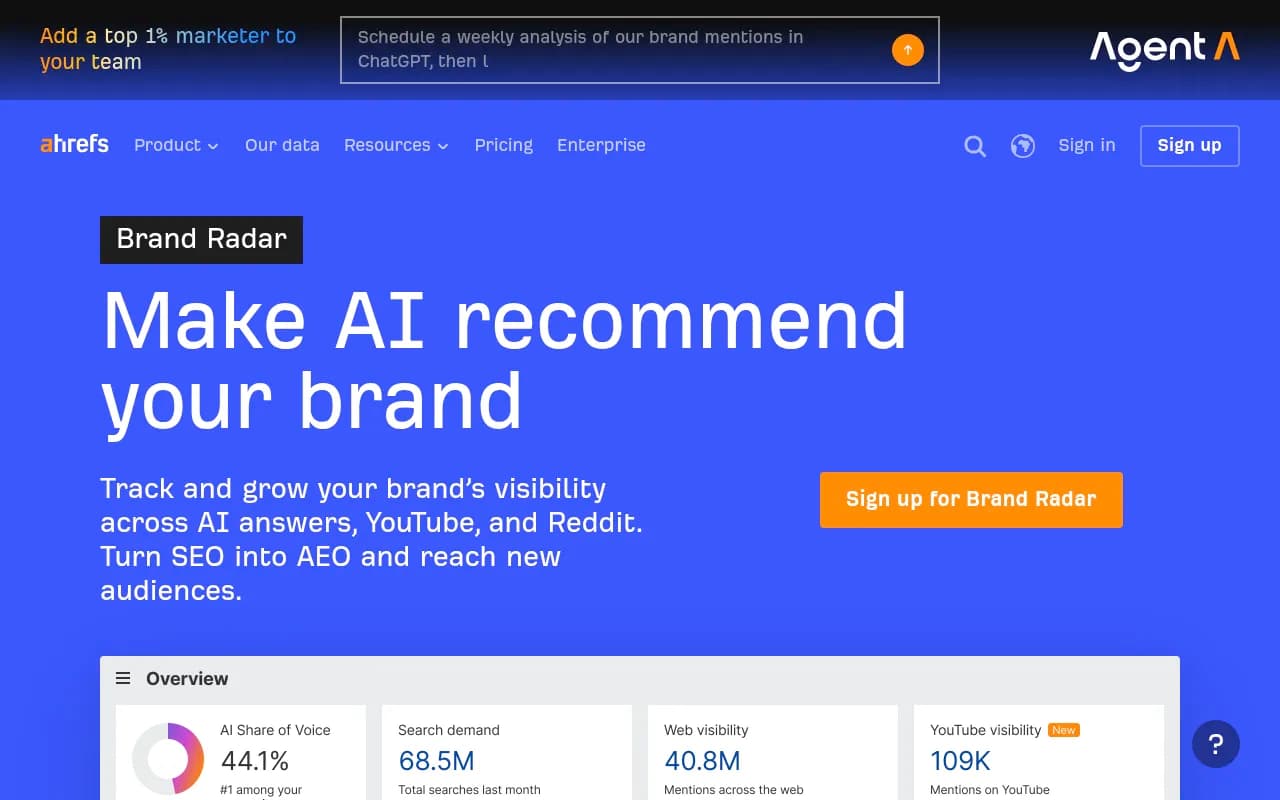
For e-commerce, this matters. A prompt like "best budget espresso machine" that has real search volume behind it is worth tracking. A fabricated prompt that nobody actually types is noise. Brand Radar also covers six AI engines (ChatGPT, Perplexity, Gemini, Copilot, Google AI Overviews, Google AI Mode) plus YouTube, TikTok, and Reddit -- broader than Peec's base plan without needing Enterprise pricing.
Pricing is flexible: $50/mo for 2,500 checks, $100/mo for 7,000 checks, up to $699/mo for all 6 AI indexes with custom prompt checks included. It's a monitoring tool, not an optimization platform, but the data quality is a genuine differentiator.
5. Semrush AI Visibility Toolkit -- best for teams already in the Semrush ecosystem
If your team already uses Semrush for traditional SEO, the AI Visibility Toolkit is the path of least resistance into AI search monitoring.
It layers AI visibility tracking on top of Semrush's existing keyword, backlink, and competitive intelligence data. For e-commerce brands, that means you can look at AI visibility alongside organic rankings, paid search data, and competitor traffic in one place -- which is genuinely useful for understanding the full picture of how shoppers find products.
The limitation is that Semrush uses fixed prompts rather than letting you fully customize your tracking setup, and there's no AI traffic attribution connecting AI visibility to actual revenue. It's a solid addition to an existing workflow, but not a purpose-built AI search platform.
6. Otterly.AI -- best for smaller e-commerce brands on a budget
Otterly.AI is the most accessible entry point in this list. It tracks brand citations across ChatGPT, Perplexity, Google AI Overviews, AI Mode, Gemini, and Microsoft Copilot at a price point that makes sense for smaller teams.
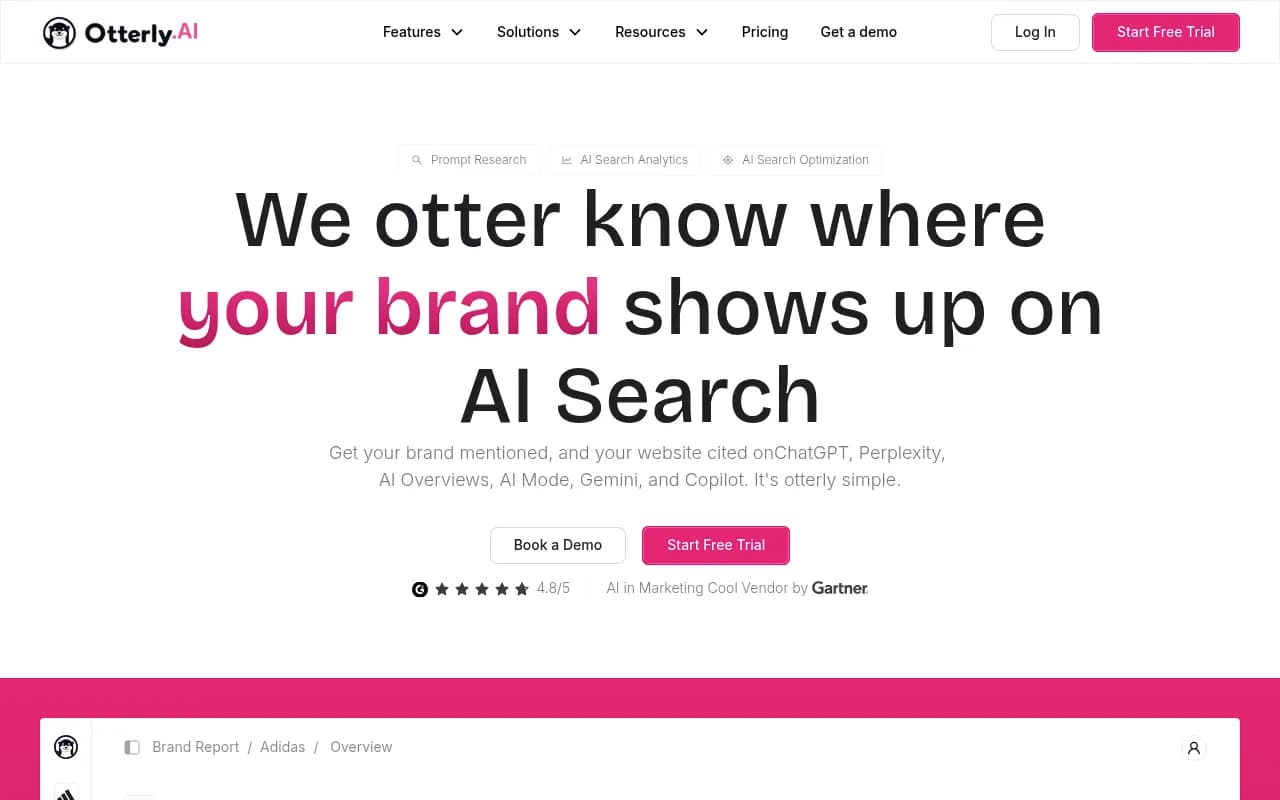
It's a monitoring tool -- there's no content generation, no crawler logs, no product-level tracking. But if you're a smaller DTC brand that just wants to know whether you're showing up in AI answers about your category, Otterly gives you that visibility without the enterprise price tag.
The honest trade-off: you'll see the data, but you won't get much help acting on it. For brands just getting started with AI visibility, that's often fine. For brands that need to move fast, it's a starting point rather than a destination.
7. Scrunch AI -- best for agencies managing multiple e-commerce clients
Scrunch AI is built with agencies in mind -- multi-client management, white-label reporting, and the kind of workflow that makes sense when you're managing AI visibility for several brands at once.
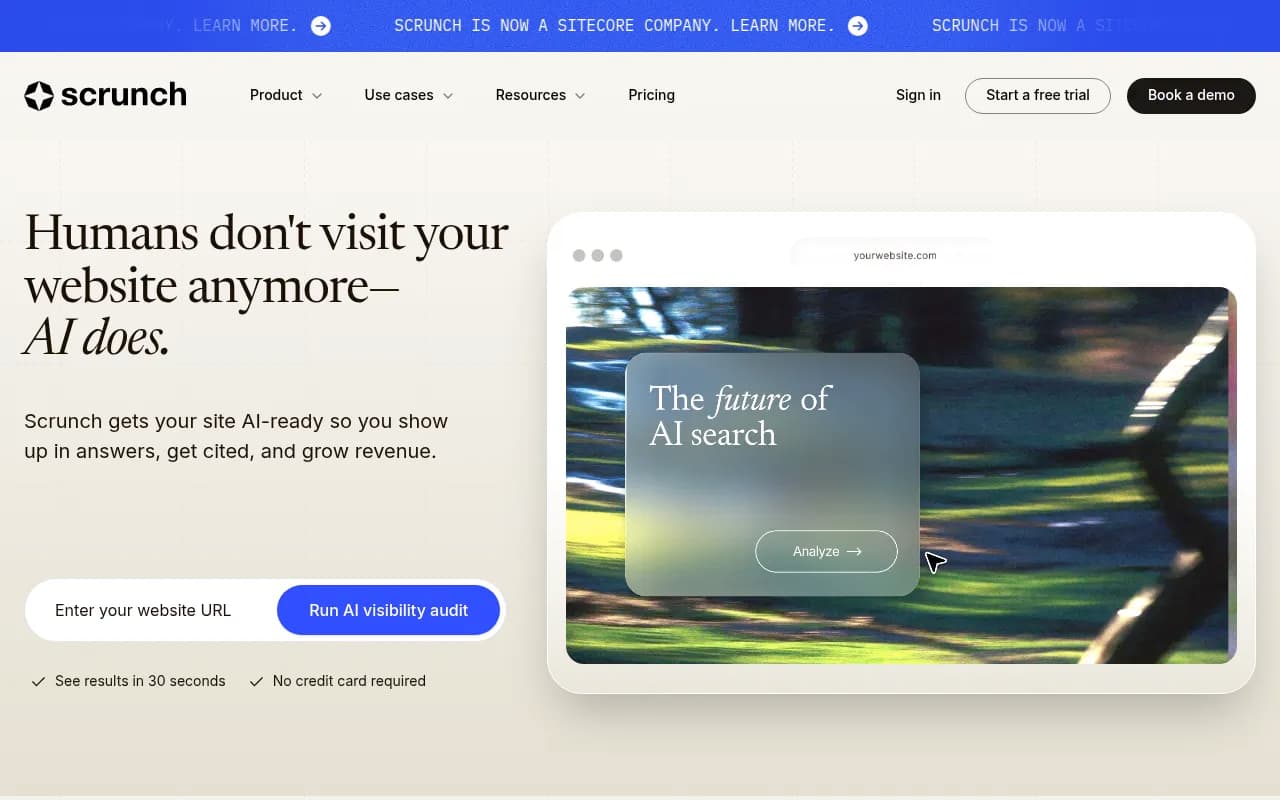
For e-commerce agencies, the appeal is practical: you can track AI visibility across a portfolio of clients, benchmark them against category competitors, and produce client-ready reports without a lot of manual work. Scrunch covers major AI models and includes source analysis showing which external pages are driving AI citations.
Like most tools in this list, it's primarily a monitoring platform. Content optimization and generation aren't core features. But for agencies that need to show clients where they stand and how they're trending, Scrunch does that job well.
How these tools compare
Here's a direct comparison across the dimensions that matter most for e-commerce brands:
| Tool | ChatGPT Shopping tracking | Product-level tracking | Content generation | AI crawler logs | Starting price |
|---|---|---|---|---|---|
| Promptwatch | Yes | Yes (page-level) | Yes (Content Agents) | Yes | $99/mo |
| Profound | Partial | Partial | No | No | Custom |
| AthenaHQ | No | Category-level | No | No | Custom |
| Ahrefs Brand Radar | No | No | No | No | $50/mo |
| Semrush AI Toolkit | No | No | No | No | Included in Semrush |
| Otterly.AI | No | No | No | No | ~$19/mo |
| Scrunch AI | No | No | No | No | Custom |
| Peec AI (baseline) | No | No | No | No | €199/mo |
A few things stand out from this table. First, ChatGPT Shopping tracking is genuinely rare -- most platforms don't have it yet. Second, content generation is almost entirely absent from this category, which is why the gap between "monitoring" and "optimization" is so wide. Third, Peec AI's pricing is actually on the higher end for what it delivers relative to some alternatives.
What to look for when evaluating these tools
Product-level vs brand-level tracking
Most AI visibility tools track brand mentions. That's useful, but it's not the same as knowing which specific products AI recommends. If you sell 50 SKUs and ChatGPT consistently recommends three of them while ignoring the rest, brand-level tracking won't tell you that. Look for tools that can get to the product or page level.
Real prompts vs constructed prompts
There's a meaningful difference between tools that track real user queries (with actual search volume) and tools that construct their own hypothetical prompts. For e-commerce, you want to be visible for the questions real shoppers are actually asking -- not questions a platform invented.
The monitoring-to-action gap
This is the biggest issue in the category right now. Most tools will show you that you're invisible in AI search. Very few will tell you why, and fewer still will help you fix it. Before committing to a platform, ask: "If this tool shows me I'm missing from AI answers about my category, what does it give me to act on that?" If the answer is "a dashboard," that's a monitoring tool. If the answer involves content gap analysis, content briefs, or content generation, that's an optimization platform.
ChatGPT Shopping specifically
ChatGPT Shopping is a distinct channel from text-based AI answers. Products appear in carousels with prices, images, and buy links. The signals that determine which products appear are different from the signals that determine which brands get mentioned in a text response. If you sell physical products, you want a tool that tracks both.
Multi-model coverage
Different AI engines surface different products and brands. A product that dominates in Perplexity answers might be invisible in Google AI Overviews. Tracking across multiple models gives you a more accurate picture of your actual AI search footprint.
The bottom line
Peec AI is a reasonable starting point for brand monitoring, but e-commerce brands have specific needs that it doesn't address: product-level visibility, ChatGPT Shopping tracking, and some path from data to action.
The tools above cover different parts of that gap. Ahrefs Brand Radar and Otterly.AI are solid monitoring options at accessible price points. Profound and AthenaHQ go deeper on analysis. Scrunch AI works well for agencies managing multiple clients.
But if you want a platform that closes the full loop -- finding the gaps in your AI visibility, generating content to fill them, and tracking the results as AI models start citing your pages -- Promptwatch is the only tool in this list that does all three. For e-commerce brands where AI search is becoming a real revenue channel, that distinction matters more than it did a year ago.