Key takeaways
- Peec AI uses UI scraping technology to simulate real user queries across ChatGPT, Perplexity, and Google AI Overviews -- this is meaningfully different from pure API-based polling, but it still has limitations.
- Because AI models return non-deterministic responses, any platform's data is a statistical sample, not a ground truth. The question is how representative that sample is.
- Platforms that crawl actual user-facing interfaces tend to capture more of what real users see -- including shopping carousels, follow-up suggestions, and response formatting that APIs don't expose.
- Peec AI is strong for clean, structured monitoring data and works well for analyst teams comfortable building their own interpretation layer. It stops at diagnosis, though -- it doesn't help you act on what you find.
- If you need to move from tracking to actually improving your AI visibility, you'll want a platform that closes the loop between data and content optimization.
Why data accuracy matters more than it used to
A year ago, most marketing teams weren't tracking AI search visibility at all. According to Nobori.ai's 2025 AI Search Visibility Statistics report, B2B companies actively monitoring AI search jumped from 8% to 47% in a single year. That's a fast shift, and it means a lot of teams are now making decisions based on whatever data their chosen platform gives them.
The problem: not all AI visibility data is created equal. When you're deciding whether to invest in content, restructure your site architecture, or pitch your CMO on a GEO budget, the accuracy of your tracking data is the foundation everything else rests on. Bad data leads to bad prioritization.
So when evaluating Peec AI specifically, the right question isn't just "does it track AI visibility?" -- it's "how does it collect that data, and what does that mean for reliability?"
How Peec AI actually collects its data
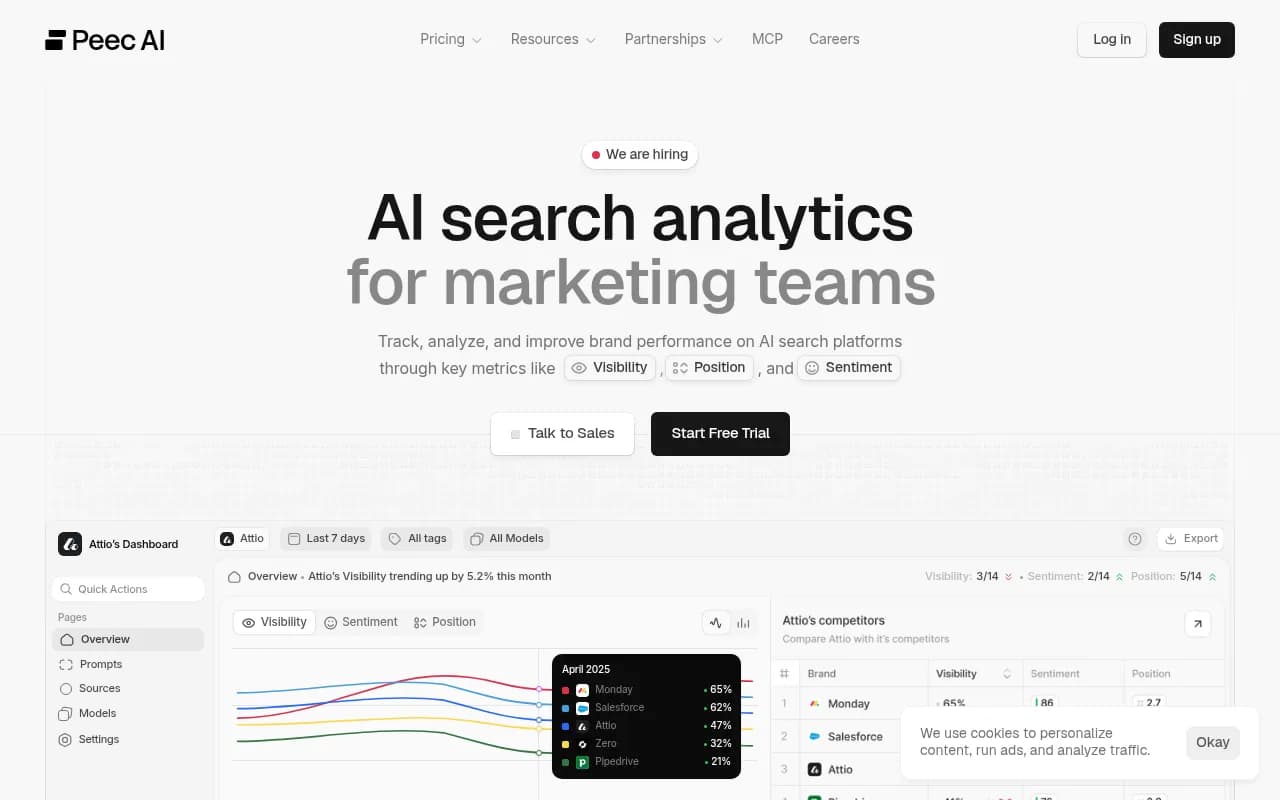
Peec AI's documentation describes its approach as "UI scraping technology" -- meaning it simulates real user interactions with AI platforms rather than hitting their APIs directly. In practice, this means Peec AI sends queries to ChatGPT, Perplexity, Google AI Overviews, and other models through their actual user interfaces, then captures and parses the responses.
This matters because there's a real difference between what you get from an API call and what a user actually sees. AI platforms frequently customize their user-facing responses with features that don't appear in API outputs: shopping carousels, source cards, follow-up question suggestions, image results, and formatting that changes how prominently a brand appears. An API-only approach can miss all of that.
Peec AI's UI scraping approach means it's at least trying to capture what users actually encounter. That's a meaningful design choice, and it's one reason the platform tends to produce data that feels closer to real-world conditions than some competitors.
The fundamental accuracy challenge every platform faces
Here's something worth being honest about: no AI visibility platform has perfectly accurate data. That's not a knock on Peec AI specifically -- it's a structural reality of how large language models work.
LLMs are non-deterministic. Ask ChatGPT the same question twice and you'll often get different answers, different sources cited, and different brands mentioned. This means any tracking platform is working with a statistical sample of possible responses, not a definitive record of what users see. The accuracy question then becomes: how representative is the sample, and how consistently is it collected?
For Peec AI, a few factors affect this:
Query frequency and volume. If a platform only checks each prompt once a day (or less), it's capturing a single data point from a distribution of possible responses. Peec AI runs scheduled query batches, but the frequency varies by plan. Lower-tier plans may check prompts less often, which increases variance in the data.
Response parsing. Extracting structured data from free-form AI responses requires parsing logic that can break when models change their output format. Any platform that relies on text parsing will occasionally misclassify a mention or miss a citation when the response structure shifts.
Model updates. AI models update constantly. A response pattern that was stable in February may behave differently in May. Platforms need to continuously update their parsing and query logic to keep up -- and there's always some lag.
Peec AI handles these challenges reasonably well for a monitoring-focused platform. Users on r/Agentic_SEO describe it as "really intuitive and easy to use" with "very clean UX," which suggests the data presentation is reliable even if the underlying sample has the same limitations as any other tool.
UI scraping vs real user-facing crawls: what's the actual difference?
The phrase "real user-facing crawls" gets used in a few different ways, so it's worth being precise.
Peec AI's UI scraping does simulate user-facing interactions -- it's not a pure API approach. But there are platforms that go further by tracking actual crawler behavior on your own website, not just simulating queries to AI platforms. This is a different capability entirely.
Platforms with AI crawler log analysis (sometimes called agent analytics) can tell you when ChatGPT's crawler, Perplexity's crawler, or Claude's crawler actually visited your site, which pages they read, how often they return, and whether those crawls eventually resulted in citations. This is real user-facing data in the truest sense: you're watching the AI engines interact with your content directly.
Peec AI doesn't offer this. It tracks what AI models say about your brand in response to prompts, but it doesn't have visibility into whether those models are actively crawling your site or what they're doing when they do. That's a meaningful gap if you're trying to understand why your citation rate is what it is -- or why it's not improving despite publishing new content.
Where Peec AI's data holds up well
To be fair to the platform, Peec AI does several things reliably:
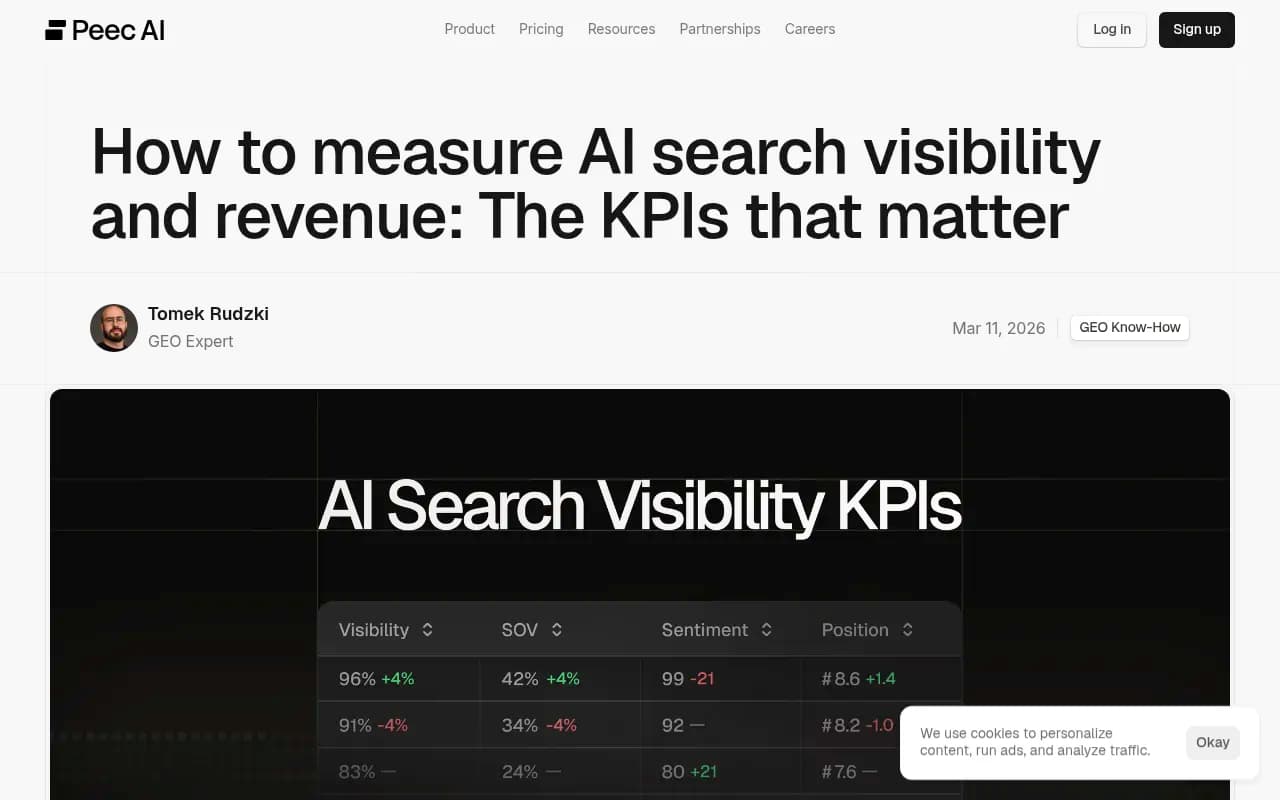
Share of voice tracking. Peec AI's core metric -- how often your brand appears relative to competitors across a set of tracked prompts -- is a clean, consistent measurement. Even with the non-determinism issue, running the same prompts repeatedly and averaging the results gives you a statistically reasonable picture of relative visibility.
Citation source tracking. The platform shows which URLs are being cited in AI responses, which is useful for understanding what content is working and what external sources are driving mentions.
Competitive benchmarking. Seeing how your visibility compares to named competitors across specific prompt categories is one of the more actionable outputs Peec AI produces. The data is good enough to spot meaningful gaps.
Sentiment analysis. Peec AI tracks not just whether your brand appears, but how AI models describe it -- positive, neutral, or negative framing. This is harder to get right than raw citation tracking, but the platform handles it adequately for most use cases.
Where it falls short is in the depth of diagnosis. As graph.digital's independent review puts it: "Peec is a strong platform for analyst teams who have the capability to work with structured raw data and build their own interpretation layer." That's a polite way of saying the platform gives you numbers but not much guidance on what to do with them.
The monitoring-only problem
This is the bigger issue with Peec AI, and it's worth spending time on.
Knowing your AI visibility score is useful. Knowing it's lower than your competitors' is more useful. But neither of those facts tells you what to do next. What content should you create? Which prompts are worth targeting? What's missing from your site that AI models are looking for?
Peec AI, like most monitoring-focused platforms, stops at the diagnosis stage. It shows you the gap. It doesn't help you close it.
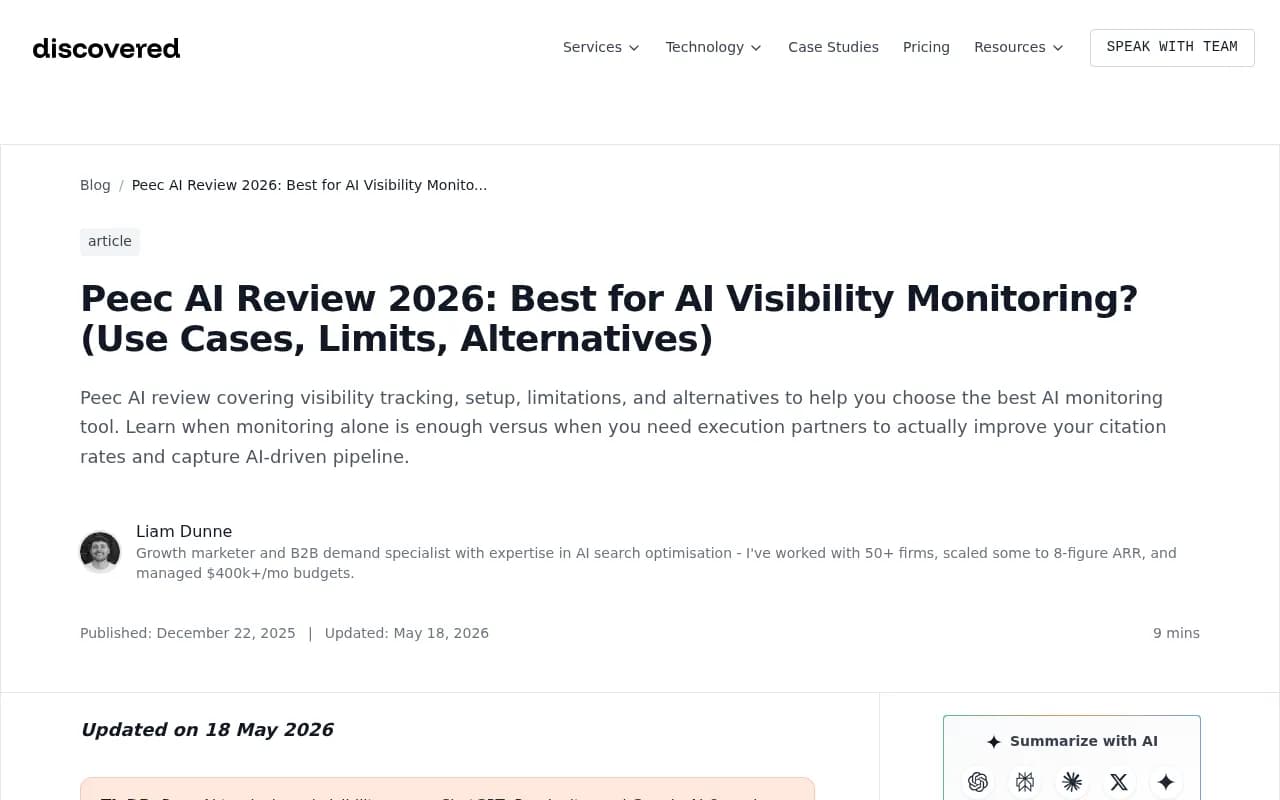
The Discovered Labs review of Peec AI puts this plainly: "Peec AI stops at diagnosis. It tracks mentions but doesn't write content, build authority signals, or implement technical optimizations needed to improve your numbers."
For teams with dedicated content strategists and SEO resources who can translate monitoring data into action, this is fine. You take the data, build your own content briefs, and execute. But for teams that need the platform to help them act -- not just observe -- Peec AI's value proposition gets thinner.
How Peec AI compares to other platforms
Here's a direct comparison of Peec AI against other tools in the space across the dimensions that matter most for data accuracy and actionability:
| Platform | Data collection method | Crawler log access | Content generation | Prompt volume data | Pricing (starting) |
|---|---|---|---|---|---|
| Peec AI | UI scraping | No | No | Limited | ~$100/mo |
| Promptwatch | Real user-facing + API | Yes | Yes (Content Agents) | Yes | $99/mo |
| Profound | API + UI simulation | No | No | Yes | Higher |
| Otterly.AI | API-based | No | No | No | ~$49/mo |
| AthenaHQ | API-based | No | No | Limited | Custom |
| Search Party | UI simulation | No | No | Limited | Custom |

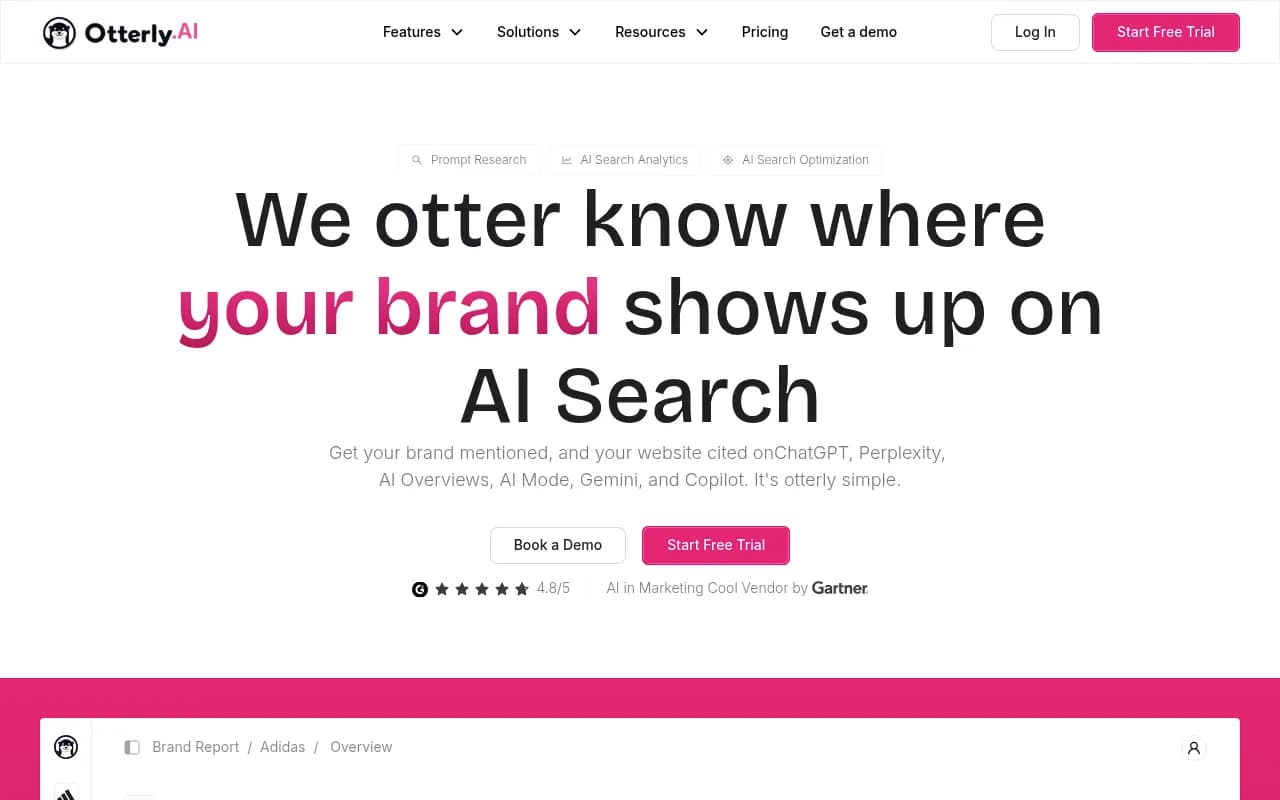

The table makes the tradeoff visible: Peec AI sits in a middle tier. It's more sophisticated than pure API tools like Otterly.AI in terms of data collection, but it doesn't close the loop the way platforms with crawler logs and content generation do.
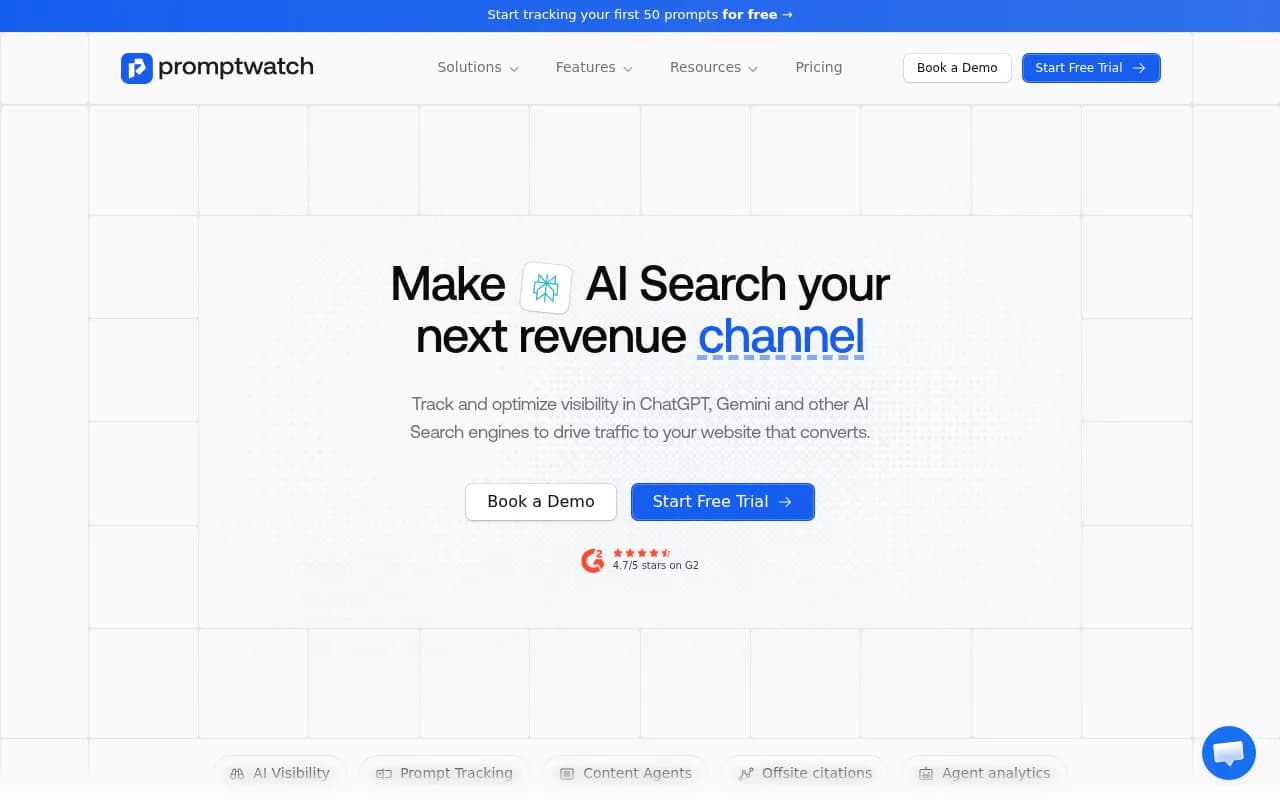
Promptwatch is worth calling out here specifically because it takes a different architectural approach. Rather than just polling AI platforms with queries, it tracks how AI crawlers actually behave on your website -- which pages they visit, how often, and whether those visits lead to citations. That's a fundamentally different data source from what Peec AI provides, and it answers questions that query-based monitoring can't.
What the Reddit community says
The r/Agentic_SEO thread from April 2026 reviewing AI search platforms gives Peec AI a generally positive reception, with users highlighting the clean UX and easy onboarding. The consensus seems to be that it's a solid entry point for teams new to AI visibility monitoring who want something they can set up quickly and understand without a steep learning curve.
The criticism that surfaces is consistent with what independent reviewers say: it's good at showing you where you stand, less useful for figuring out what to do about it. One user noted that most AI visibility tools "show you where you are not ranking and leave you to figure out the rest" -- and Peec AI fits that description.
For teams that are just starting to track AI visibility, this is probably fine. Getting baseline data is the first step, and Peec AI makes that step easy. The question is what happens six months in, when you have the baseline and need to improve it.
Specific accuracy limitations to know about
A few concrete limitations worth flagging before you commit to Peec AI:
Google AI Overviews coverage is inconsistent. Google's AI Overviews don't appear for every query, and their appearance rate varies significantly by query type, user location, and device. Platforms that track AI Overviews through simulated queries can struggle to capture this variability accurately. Peec AI's coverage here is functional but not as robust as its ChatGPT and Perplexity tracking.
No multi-region or multi-language depth. Peec AI's regional tracking is limited compared to platforms built for international brands. If your AI visibility strategy spans multiple countries or languages, the data gets thinner.
No traffic attribution. Peec AI can tell you that your brand appeared in an AI response, but it can't connect that appearance to actual website traffic or revenue. This is a significant gap for teams trying to justify GEO investment to finance or leadership. The platform acknowledges this -- their own blog notes that "traffic from large language models is underreported because when someone discovers your brand through ChatGPT, there's no click to track."
Fixed prompt sets. Like several competitors, Peec AI works with a defined set of prompts you configure. It doesn't automatically surface new prompts that are gaining traction in AI search, which means you can miss emerging opportunities unless you're actively updating your tracked queries.
Who should use Peec AI
Despite the limitations, Peec AI is a legitimate tool for specific use cases:
- Teams that are just starting to measure AI visibility and need clean, accessible data without a steep learning curve
- Analyst teams comfortable working with structured data and building their own interpretation layer on top
- Smaller brands or agencies that need a cost-effective monitoring baseline ($100/month is a reasonable entry point)
- Companies primarily focused on ChatGPT and Perplexity visibility, where Peec AI's tracking is strongest
It's less well-suited for:
- Teams that need to understand why their visibility is what it is (crawler behavior, content gaps, indexing issues)
- Brands that need to generate and optimize content based on AI visibility data
- International brands needing robust multi-language and multi-region tracking
- Teams that need to connect AI visibility to revenue attribution
The bottom line on data accuracy
Peec AI's UI scraping approach is a genuine step above pure API-based monitoring. It captures more of what users actually see, and the platform's data is consistent enough for meaningful competitive benchmarking.
But "more accurate than API-only tools" isn't the same as "accurate enough to make high-stakes decisions without caveats." The non-determinism of LLMs means all visibility data is probabilistic. Peec AI's sample sizes and query frequency are adequate for trend analysis but not for precise, real-time measurement.
The more important limitation isn't accuracy -- it's scope. Peec AI shows you a slice of your AI visibility picture. It doesn't show you how AI crawlers interact with your site, which content gaps are driving your low citation rate, or what you should publish next to improve your numbers. For that, you need a platform that treats AI visibility as an optimization problem, not just a measurement problem.
If you're evaluating tools right now, start by asking what you actually need to do with the data. If the answer is "understand where we stand," Peec AI is a reasonable choice. If the answer is "improve where we stand," you'll need something that goes further.