Key takeaways
- Peec AI is a dedicated AI visibility platform built around prompt-level tracking, with unlimited seats and structured pricing tiers from $95/month.
- Hall is a lighter, more accessible tool suited to teams that want straightforward citation monitoring without a steep learning curve.
- Neither tool closes the full loop from monitoring to content creation -- they're both primarily monitoring dashboards.
- For teams that need to act on visibility gaps (not just see them), a platform with built-in content generation and gap analysis will go further.
- The right choice depends heavily on team size, budget, and whether you need depth or simplicity.
If you've spent any time evaluating AI visibility tools in 2026, you've probably noticed that most of them look similar at a glance. Track prompts, see citations, watch your brand score go up or down. Peec AI and Hall both fit that description, but they're aimed at different buyers and make different tradeoffs.
This guide breaks down how they actually compare -- features, pricing, what each does well, and where each one leaves you wanting more.
What these tools are trying to solve
Before getting into the comparison, it's worth being clear on the problem. AI search engines like ChatGPT, Perplexity, Claude, and Google AI Overviews don't work like traditional search. There's no rank 1 through 10. Instead, an AI model synthesizes a response and either mentions your brand or it doesn't. If it does mention you, it might cite a specific page, or it might not cite anything at all.
Traditional SEO tools can't track this. Google Search Console doesn't know whether ChatGPT recommended your product. That's the gap these tools are trying to fill.
Both Peec AI and Hall sit in the "AI brand monitoring" category -- they watch what AI models say about your brand and report back. Where they differ is in how deep they go, how much they cost, and what they expect from the person using them.
Peec AI: prompt-level tracking with team-friendly pricing

Peec AI is built specifically around the idea that prompts are the unit of measurement. Instead of tracking brand mentions loosely, you define specific prompts -- the questions your potential customers are actually asking -- and Peec AI runs those prompts across multiple AI models on a regular cadence, then reports on whether your brand appears, how often, and in what context.
A few things stand out about Peec AI:
- Unlimited seats across all plans. This matters for marketing teams where multiple people need access -- you're not paying per user.
- Prompt suggestions built in. If you're not sure which prompts to track, the platform helps you identify relevant ones based on your category.
- Multi-model coverage. Even the entry-level plan covers 3 AI models, with broader coverage at higher tiers.
- Integrations at the Advanced tier ($495/month) include Google Search Console, Google Analytics, and Looker Studio.
The pricing structure is relatively transparent:
| Plan | Price | Prompts | Projects | Models |
|---|---|---|---|---|
| Starter | $95/mo | 50 | 1 | 3 |
| Pro | $245/mo | 150 | 2 | More |
| Advanced | $495/mo | 350 | 5 | Multi-country |
| Enterprise | Custom | Unlimited | Unlimited | All |
The Starter plan is genuinely usable for a small brand or a team just getting started. The jump to Advanced is steep, but the integrations and multi-country support justify it for larger teams.
Where Peec AI falls short: it's primarily a monitoring tool. It shows you where you're visible and where you're not, but it doesn't help you create content to close those gaps. You get the data, then you're on your own to figure out what to do with it.
Hall: simplicity-first brand monitoring
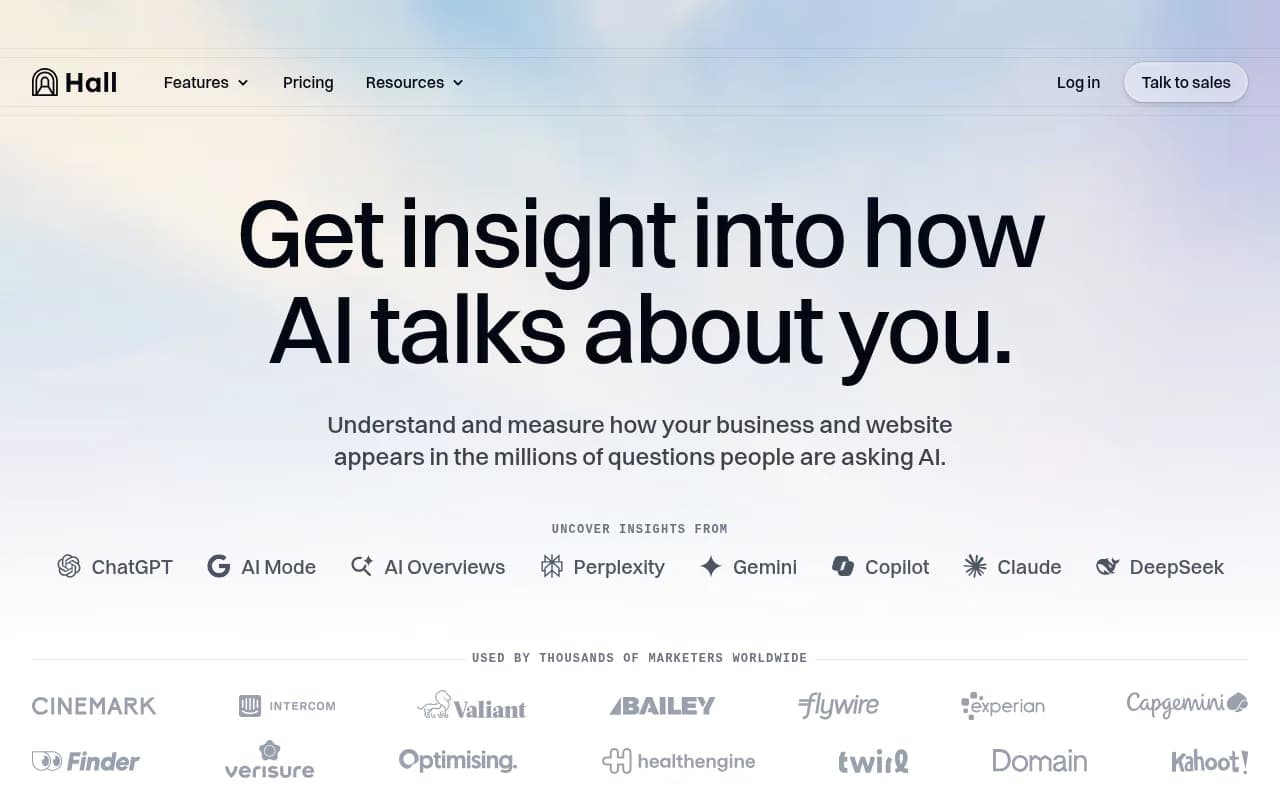
Hall takes a different approach. It's designed to be accessible -- the kind of tool a marketing manager can set up in an afternoon without needing a dedicated SEO specialist to interpret the results.
Hall focuses on citation tracking: which AI models are citing your brand, which pages are being referenced, and how that changes over time. The interface is cleaner and less data-dense than Peec AI, which is either a feature or a limitation depending on what you need.
From what's publicly available, Hall works well for:
- Brands that want a quick read on AI visibility without building out a full prompt tracking program
- Smaller teams or solo marketers who don't need multi-seat access or complex integrations
- Companies early in their AI visibility journey who want to understand the basics before investing in a more sophisticated platform
Hall doesn't publish pricing as openly as Peec AI, which makes direct comparison harder. It's positioned as a lighter-weight option, which typically means lower entry cost but also fewer advanced features.
What Hall doesn't do well: depth. If you need prompt-level granularity, competitor heatmaps, or the ability to track visibility across many models and geographies, Hall isn't built for that. It's a starting point, not a full program.
Head-to-head comparison
Here's how the two tools stack up across the dimensions that matter most to marketing teams:
| Feature | Peec AI | Hall |
|---|---|---|
| Prompt-level tracking | Yes | Limited |
| Citation tracking | Yes | Yes |
| Multi-model coverage | Yes (3+ models) | Yes (core models) |
| Unlimited seats | Yes | Not confirmed |
| Competitor tracking | Yes | Basic |
| Content gap analysis | No | No |
| Content generation | No | No |
| AI crawler logs | No | No |
| GSC/GA integration | Advanced plan only | Not confirmed |
| Multi-country | Advanced plan only | Not confirmed |
| Pricing transparency | Clear tiers published | Limited public info |
| Best for | Growing teams, structured programs | Small teams, quick setup |
The honest summary: Peec AI has more depth and is better suited to teams running a real AI visibility program. Hall is easier to start with but hits a ceiling faster.
What both tools are missing
This is worth saying plainly: neither Peec AI nor Hall helps you do anything about what you find.
Monitoring is step one. You learn that your brand appears in 12% of relevant AI responses while your main competitor appears in 34%. Now what? Both tools leave you there. You have to figure out which content to create, which topics to cover, which gaps to close -- and then do all of that work elsewhere.
This is the core limitation of monitoring-only platforms. They're useful, but they're not complete.
The tools that go further are the ones that connect the monitoring data to actual content strategy and creation. Promptwatch, for example, runs an Answer Gap Analysis that shows you exactly which prompts competitors rank for that you don't, then uses that data to generate content briefs and articles designed to close those gaps. The cycle is: find gaps, create content, track whether it works.

That's a different category of tool -- and a more expensive one -- but worth knowing about if you're evaluating where to invest.
Which tool should you choose?
The answer depends on what you actually need right now.
Choose Peec AI if:
- You want structured, prompt-level tracking across multiple AI models
- Your team has multiple people who need access (the unlimited seats matter here)
- You're running a real AI visibility program and need data you can report on
- You eventually want to connect visibility data to analytics tools like GA or Looker Studio
Choose Hall if:
- You're just starting to explore AI brand monitoring and want something simple
- You have a small team or solo setup and don't need deep configuration
- You want to understand citation patterns without committing to a full platform
- Budget is a constraint and you need a lower entry point
Neither tool is the right choice if you need to act on what you find. If closing visibility gaps is the goal -- not just measuring them -- you'll need something that includes content gap analysis and generation capabilities.
A note on the broader landscape
Peec AI and Hall are two of many tools in this space. The market has grown quickly and the feature sets are converging. Most platforms now offer some version of prompt tracking, citation monitoring, and competitor comparison.
The real differentiator in 2026 isn't whether a tool tracks AI mentions -- most do. It's whether the tool helps you improve your visibility, not just measure it. That's the question worth asking before you commit to any platform.
A few other tools worth knowing about in this space:
- Otterly.AI is a budget-friendly monitoring option for small teams
- AthenaHQ goes deeper on monitoring but still stops short of content generation
- Scrunch AI is strong for agencies managing multiple brands
- Profound is built for enterprise teams with more complex reporting needs




Final take
Peec AI is the stronger tool between the two for most marketing teams. The unlimited seats, prompt-level tracking, and integration options at higher tiers make it a more complete monitoring solution than Hall. If you're serious about understanding your AI search visibility, Peec AI gives you more to work with.
Hall has a place -- specifically for teams that want to dip a toe in without a big commitment. But it's a starting point, not a long-term solution for a brand that takes AI visibility seriously.
The bigger picture: both tools are monitoring dashboards. If you want to move from "we know we're invisible" to "we're doing something about it," you'll need to either supplement these tools with a content strategy workflow or move to a platform that handles both sides of the equation.